

Contact


Manufacturing companies operate in a uniquely complex environment. Long sales cycles, multi-stakeholder buying committees, distributor networks, and ongoing service relationships all demand strong coordination across teams. Traditional CRMs often fall short by being too rigid, overly technical, or disconnected from marketing and service.
This is where a modern CRM becomes critical. Many manufacturing companies use platforms like HubSpot not just as sales tools, but as unified CRM systems that align marketing, sales, and service teams, helping them generate pipeline, manage complex deals, and build long-term customer relationships.
This blog explains how manufacturing companies use CRM platforms like HubSpot to manage complex sales cycles, align teams, and build long-term customer relationships.
Manufacturing businesses operate with long sales cycles, multiple stakeholders, and ongoing customer relationships that extend well beyond the initial sale. Managing this complexity without a centralized system often leads to missed opportunities and fragmented execution.
A CRM helps manufacturing companies bring structure, visibility, and coordination across teams by enabling them to:
By acting as a single source of truth, a CRM allows manufacturing teams to operate more efficiently, close deals with greater confidence, and build stronger customer relationships over time.
Not all CRM features are equally valuable for manufacturers. The most effective systems support complex sales motions, partner-driven revenue, and long-term customer management rather than simple transactional selling.
Key CRM capabilities manufacturing businesses rely on include:
When these capabilities work together, a CRM becomes more than a sales tool. It acts as the operational backbone that supports growth, consistency, and customer retention across the manufacturing organization.
Manufacturers in the manufacturing sector choose HubSpot because it brings structure to complex revenue operations while supporting long B2B buying cycles. Rather than relying on disconnected tools, HubSpot helps teams manage customer relationship management in a single system built for scale and coordination.
Key reasons manufacturers adopt HubSpot include:
Overall, HubSpot provides manufacturers with a practical CRM foundation that balances usability, scalability, and cross-team alignment when implemented with the right technical approach.
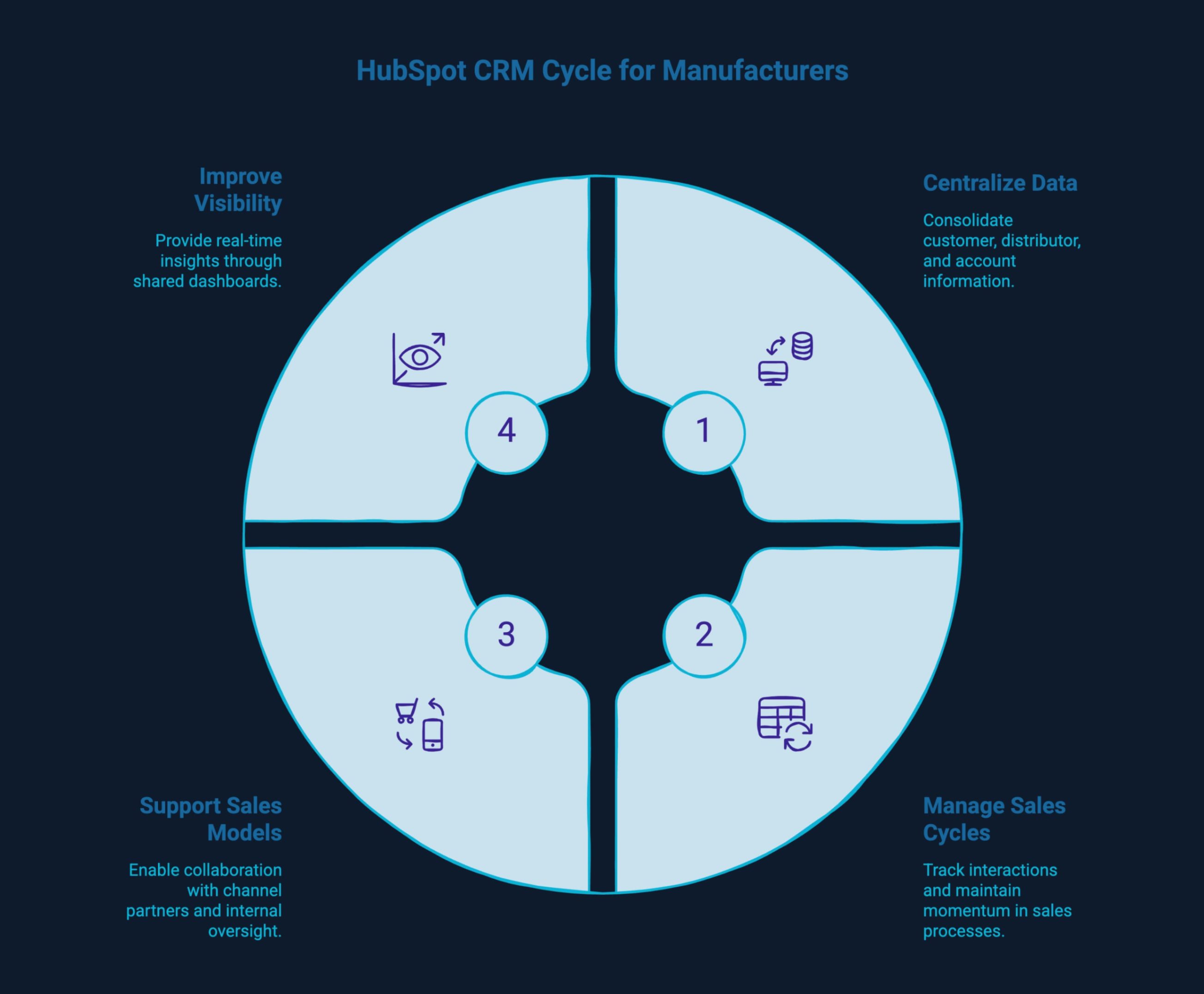
Manufacturers often use platforms like HubSpot as a centralized CRM to connect customer data, sales activity, and performance insights across teams. By unifying information in one system, manufacturing organizations gain clarity, consistency, and better control over complex B2B relationships and multi-channel revenue operations.
Here are the main ways manufacturing companies use HubSpot as their CRM:
HubSpot enables manufacturers to manage customers, distributors, OEM partners, and resellers within a single CRM. Teams gain full visibility into account histories, contacts, communications, and deal activity across both direct and indirect sales relationships.
Manufacturing sales cycles often extend for months. HubSpot tracks every interaction from initial inquiry through purchase, helping sales teams stay organized, follow up consistently, and maintain momentum throughout prolonged evaluation and approval processes.
HubSpot allows flexible deal ownership, permissions, and pipelines for manufacturers working with distributors. This setup enables collaboration with channel partners while preserving accurate forecasting, reporting, and internal oversight of customer relationships.
Custom dashboards provide leadership with real-time views of pipeline health, deal progress, and account activity. Shared visibility reduces information silos, aligns teams, and supports faster, data-driven decision-making across the organization.
Overall, HubSpot functions as a scalable CRM foundation that supports manufacturing growth, collaboration, and long-term customer management.
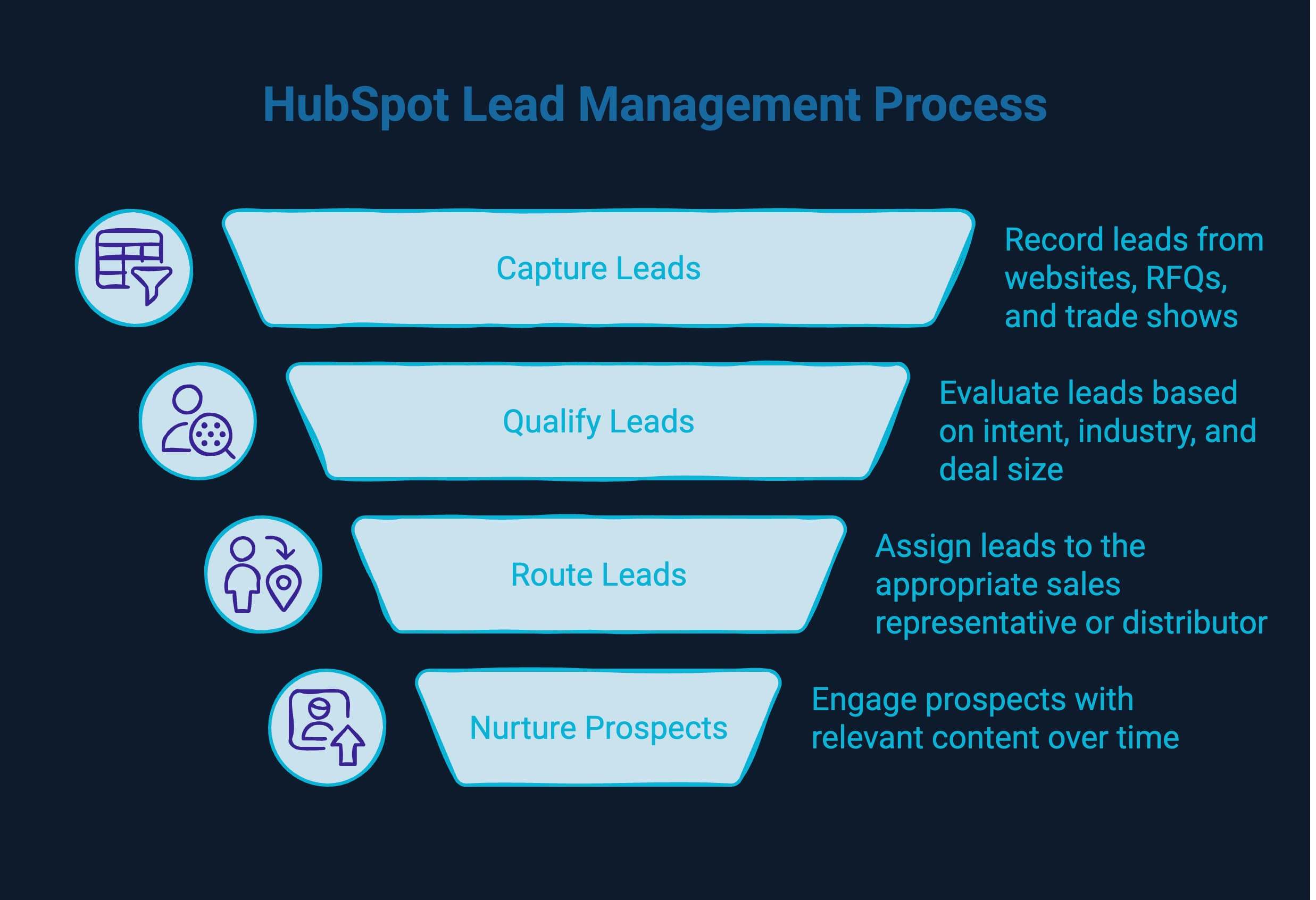
Manufacturing lead generation rarely follows a single path. Prospects may come from websites, events, referrals, or direct inquiries. HubSpot helps manufacturers centralize, organize, and act on these leads efficiently, ensuring visibility across teams while supporting long, research-heavy buying journeys.
Here’s how HubSpot supports lead generation and management in manufacturing:
HubSpot does not generate RFQs, but it allows manufacturers to track RFQ requests submitted through website forms or imported from external systems and trade shows. This ensures every quote request is recorded, routed, and followed up on within the CRM.
Manufacturers can define custom properties and scoring criteria to evaluate leads. By assessing factors like industry, company size, product interest, and buying intent, sales teams can focus on high-potential opportunities rather than low-fit inquiries.
Automated workflows assign leads to the correct sales representative or distributor based on region, territory, or product line. This structured routing reduces response delays and ensures prospects connect with the most relevant contact immediately.
HubSpot supports ongoing engagement through automated email workflows. Prospects receive relevant product updates, technical information, and case studies over time, helping manufacturers stay top-of-mind throughout extended evaluation and approval cycles.
By combining capture, qualification, routing, and nurturing in one system, HubSpot helps manufacturers turn complex lead flows into consistent pipeline growth.
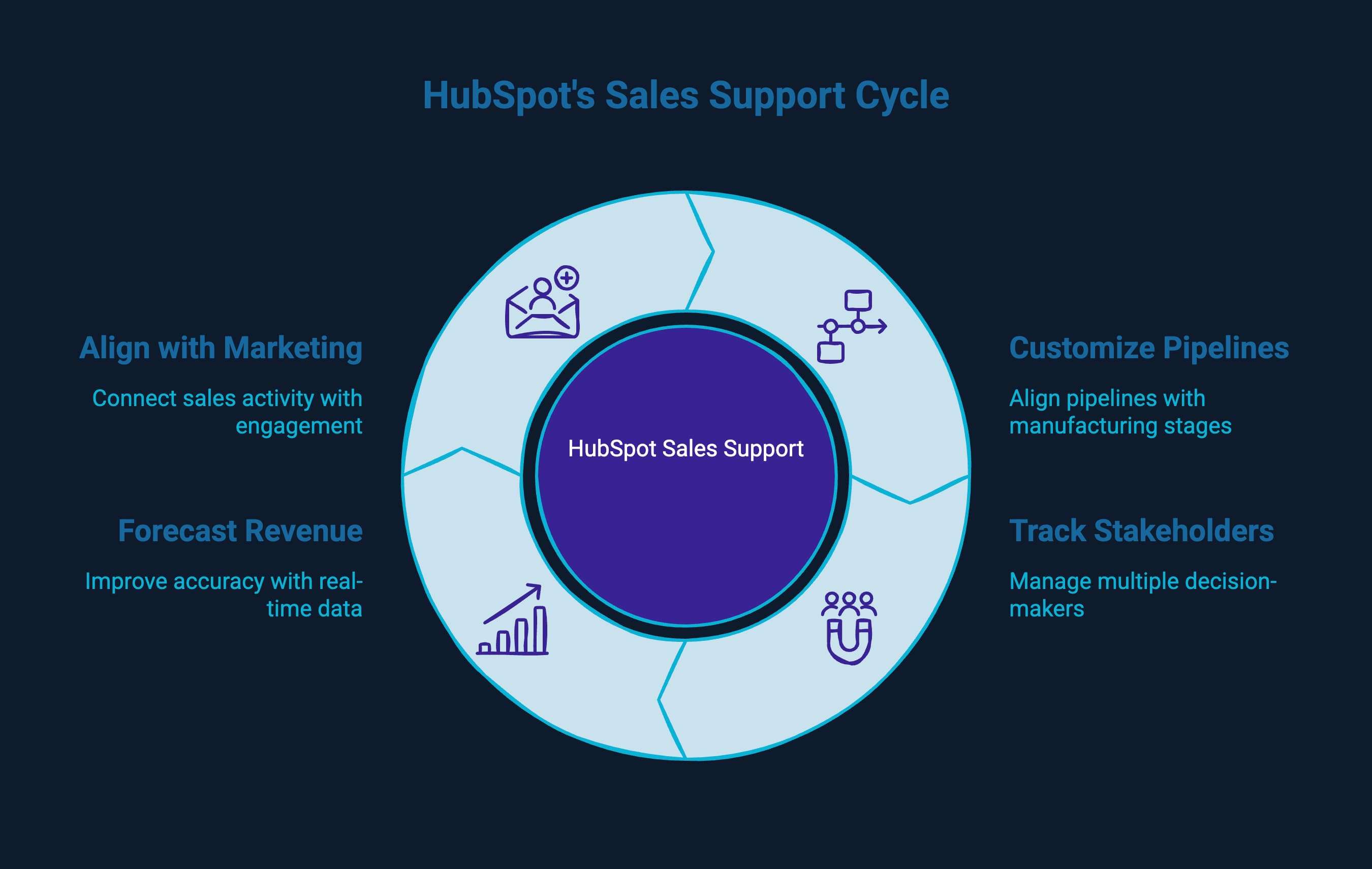
Manufacturing sales teams manage long cycles, complex approvals, and multiple stakeholders. HubSpot supports this environment by providing structured yet flexible tools that reflect real-world processes. It helps teams stay organized, visible, and aligned without forcing rigid workflows or disrupting established selling motions.
Here’s how HubSpot supports manufacturing sales teams effectively:
HubSpot allows sales teams to customize deal pipelines that mirror actual manufacturing stages. From qualification and engineering review to quoting, pilot orders, and production approval, this alignment improves accuracy, visibility, and internal coordination across technical and commercial stakeholders.
Manufacturing deals often involve multiple decision-makers. HubSpot enables sales teams to associate several contacts with a single deal, clearly tracking engineers, procurement, executives, and influencers together, ensuring communication stays coordinated and no stakeholder is overlooked during negotiations.
With continuously updated deal stages and activity tracking, HubSpot improves forecast reliability. Sales leaders gain clearer visibility into pipeline health, expected close timelines, and revenue projections, supporting better planning across production, inventory, and resource allocation decisions.
HubSpot connects sales activity with prospect engagement history. Sales reps can see which emails, pages, and resources prospects interacted with, enabling more informed conversations, timely follow-ups, and outreach that reflects real buyer interests and readiness.
Overall, HubSpot gives manufacturing sales teams clarity, adaptability, and insight, helping them manage complex deals with greater confidence and consistency.
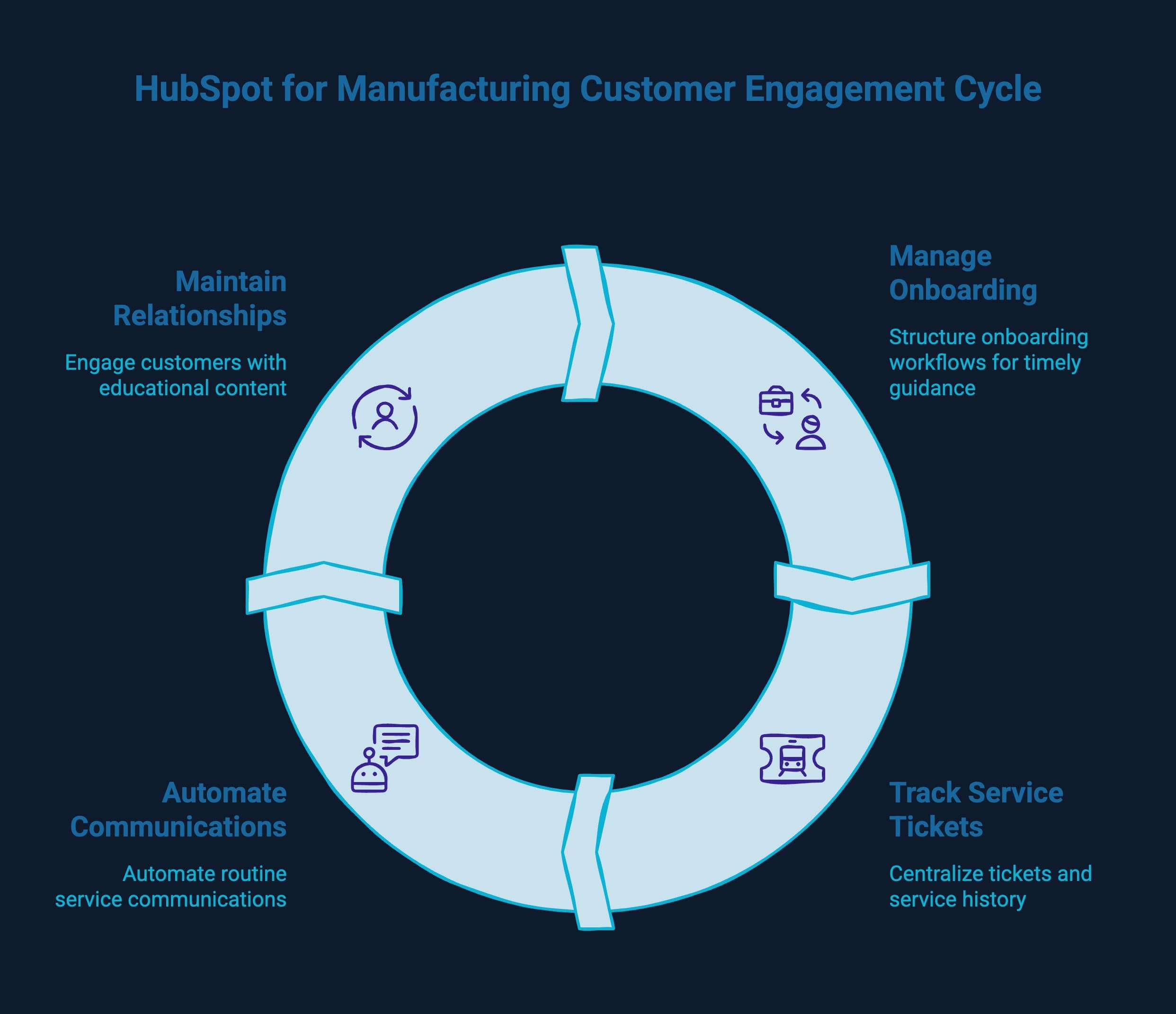
Customer relationships in manufacturing extend well beyond the initial sale. To support onboarding, service, and retention, manufacturers often rely on HubSpot Marketing Hub and Service Hub, as these capabilities are not included in every HubSpot CRM edition.
Below are key ways manufacturers use these hubs to strengthen communication and service across the customer lifecycle:
With Marketing Hub or Service Hub, manufacturers can build structured onboarding workflows that trigger emails, tasks, and reminders at each stage. This helps ensure customers receive timely guidance while internal teams stay aligned on follow-ups.
Service Hub enables manufacturers to centralize tickets, conversations, and service history within the CRM timeline. This shared view connects past orders, inquiries, and resolutions, allowing teams to respond faster with full context.
Automation features available in Marketing Hub and Service Hub support confirmations, status updates, and service notifications. Tools like live chat and inbox routing improve responsiveness while reducing manual effort across support teams.
Marketing Hub supports ongoing engagement through educational content, lifecycle-based nurturing, and retention campaigns. This allows manufacturers to move beyond transactional interactions and focus on long-term account value.
By using the right combination of HubSpot hubs and licenses, manufacturers can create a connected communication and service experience that scales with customer growth and operational complexity.
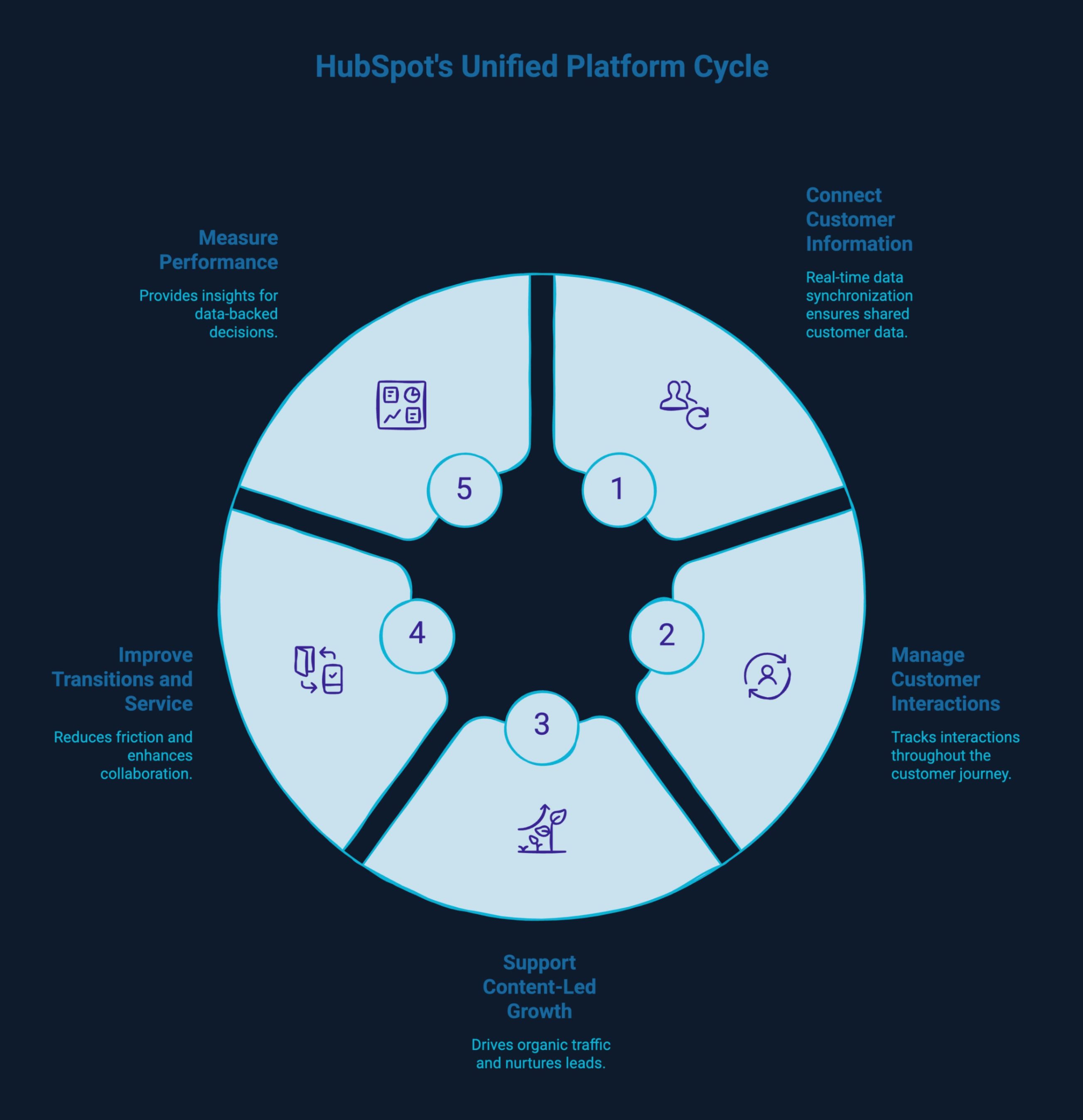
Manufacturing teams face unique challenges such as long sales cycles, complex buying groups, and ongoing service relationships. HubSpot is widely adopted in manufacturing marketing because its unified platform helps teams align around shared customer information, consistent processes, and connected performance insights.
Here’s how HubSpot’s unified architecture supports alignment across teams:
Through real-time data synchronization, HubSpot ensures marketing, sales, and service teams have access to the same customer information and data points. This shared foundation improves visibility into accounts, reduces duplication, and keeps all teams aligned around accurate customer records.
HubSpot tracks customer interactions from first touch through post-sale engagement. Its built-in content management system supports consistent messaging across emails, landing pages, and sales outreach, helping the right people stay informed at every stage.
Manufacturers use HubSpot for content marketing and content creation to drive organic traffic and nurture long buying cycles. Marketing teams can measure engagement, route qualified leads efficiently, and support sales without disconnected tools.
Lifecycle stages and workflows reduce friction between teams while Service Hub features support ticket tracking, a shared knowledge base, and structured follow-ups. Integrated customer feedback adds context that helps teams refine outreach and service quality.
With HubSpot’s reporting, leadership can connect pipeline movement, engagement, and service outcomes in one view. These insights highlight bottlenecks, surface trends, and support data-backed decisions across marketing, sales, and service.
Together, these capabilities allow manufacturers to operate with better coordination, clearer accountability, and a more connected customer experience as they scale.
Getting real value from HubSpot in manufacturing takes more than turning on features. It requires aligning CRM structure, sales processes, marketing automation, and reporting with long, complex B2B buying cycles. That’s where LeadGem comes in.
LeadGem brings deep experience in B2B growth, RevOps, and CRM implementation, helping manufacturing companies design HubSpot setups that actually reflect how deals move from inquiry to production approval. The focus is on building systems teams use daily, not overengineered setups that stall adoption.
With LeadGem, manufacturing teams can:
Looking to turn HubSpot into a true revenue engine for manufacturing? Contact our team today!
Manufacturing companies face complex sales processes, distributed teams, and long-term customer relationships that demand more than a basic CRM. HubSpot provides a unified platform that helps manufacturers centralize data, generate and manage leads, support complex sales cycles, and deliver better customer experiences.
By aligning marketing, sales, and service in one system, HubSpot enables manufacturers to operate more efficiently, forecast more accurately, and drive sustainable growth in an increasingly competitive market.
Manufacturers report success using HubSpot to unify data, automate follow-ups, and personalize outreach. One automotive supplier increased retention and upsells by centralizing communications, improving response times, and delivering consistent customer service across sales, support, and marketing touchpoints globally.
HubSpot is widely adopted by technology, professional services, education, and e-commerce companies. These industries value integrated analytics, automation, and scalability, making the platform’s marketing hub especially useful for managing demand generation, content distribution, and multi-channel growth initiatives today.
For small agencies, HubSpot can be worth the investment when used fully. Agencies often see improved efficiency, clearer reporting, and higher conversion rates by consolidating CRM, automation, and analytics instead of paying for multiple disconnected tools for long-term value.
HubSpot is most commonly used to manage inbound marketing campaigns, track leads, automate communications, and measure performance. Businesses rely on it to align content, email, ads, and analytics within one centralized growth platform for modern scaling teams globally.
Yes, HubSpot can be used without a traditional sales team. Solopreneurs and service businesses leverage automation, forms, and the sales hub to manage inquiries, schedule follow-ups, and close deals with minimal manual selling effort required or overhead costs.
HubSpot’s main downsides include higher costs at scale, feature complexity, and onboarding time. Some users find customization limiting, and advanced reporting may require upgrades, particularly when managing extensive social media and multi-brand workflows across large, distributed organizations globally.
HubSpot is often worth it as a combined CRM and website management solution. Centralized data, personalization tools, and analytics help businesses optimize journeys, maintain consistency, and improve customer satisfaction across marketing, sales, and web experiences for growing organizations.
HubSpot offers manufacturing-focused features like custom properties, deal pipelines, automation, and integrations. While not an ERP, it supports the manufacturing industry with reporting, lead tracking, and workflows tailored to complex, long-cycle B2B sales environments and partner ecosystems globally.
Setting up HubSpot for manufacturing starts with mapping sales stages, distributors, and long buying cycles. Then customize pipelines, properties, automation, and dashboards to reflect real processes, ensuring marketing, sales, and service teams share accurate data and aligned workflows for companywide adoption.
It is not strictly necessary, but a HubSpot implementation partner helps manufacturers avoid misconfiguration. Partners bring industry context, faster setup, cleaner data models, and scalable architecture, reducing risk, saving time, and ensuring HubSpot supports complex sales cycles from day one.