

Contact


Many SaaS teams struggle to scale because their marketing, sales, and customer data live in disconnected systems. According to Salesforce’s State of Sales report, only 35% of sales professionals fully trust the accuracy of their data, which directly affects forecasting and revenue planning in B2B environments.
As SaaS companies grow, these data silos become harder to manage. Teams rely on manual updates, inconsistent reports, and partial customer views, slowing decision-making and weakening alignment across marketing, sales, and customer success. Without a single source of truth, growth becomes unpredictable.
This guide explains how HubSpot for SaaS helps address these challenges. You will learn how SaaS companies use HubSpot to centralize data, align go-to-market teams, track key SaaS metrics, and build a scalable foundation for predictable growth.
HubSpot for SaaS is the use of the HubSpot platform to manage marketing, sales, and customer data in one unified system. It helps SaaS companies replace fragmented tools with a single source of truth across the customer lifecycle.
Unlike traditional CRMs focused mainly on contact storage, HubSpot supports lead generation, B2B sales pipelines, automation, and ongoing customer engagement. This makes it well-suited for SaaS businesses built on recurring revenue and long-term relationships.
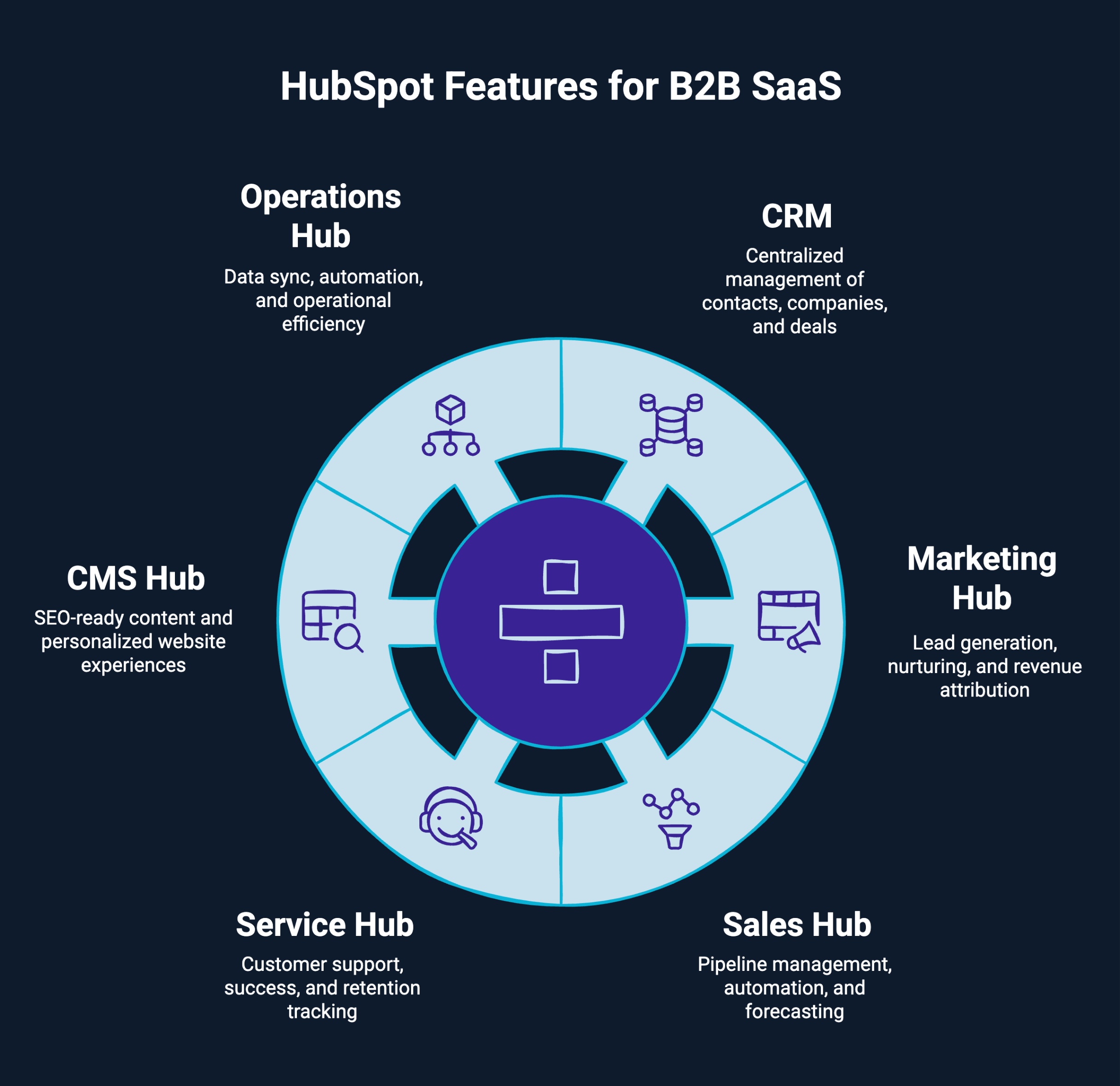
B2B SaaS teams operate across long sales cycles, multiple decision makers, and recurring customer relationships. To manage this complexity, teams need features that provide visibility, reduce manual effort, and keep every function aligned around shared data.
HubSpot brings together the core capabilities SaaS companies need to manage growth in one platform. Instead of switching between tools, teams can track performance, automate workflows, and maintain consistency across the entire customer lifecycle.
Key HubSpot features that matter most for B2B SaaS include:
HubSpot CRM acts as the central system of record for SaaS companies. It brings all contact, company, and deal data into one place, giving every team the same view of prospects and customers throughout the lifecycle.
For B2B SaaS, the CRM is especially valuable because it supports long sales cycles, multiple stakeholders, and ongoing account relationships.
Key HubSpot CRM features for SaaS include:
Marketing Hub helps SaaS teams attract, nurture, and qualify leads at scale. It allows marketing teams to run inbound campaigns while maintaining clear attribution to the pipeline and revenue.
For SaaS companies, this hub supports consistent demand generation and improves lead quality before handoff to sales.
Core Marketing Hub capabilities include:
Sales Hub is built to support structured, repeatable sales processes. It helps SaaS sales teams manage pipelines, automate follow-ups, and track deal progress without relying on manual updates.
This is especially important in B2B SaaS, where sales cycles are longer and involve multiple touchpoints.
Sales Hub features include:
Service Hub enables SaaS companies to manage post-sale relationships and customer support in the same system used by sales and marketing. This creates continuity across the entire customer journey.
For SaaS businesses, customer success and retention are critical to long-term growth, making this hub essential.
Service Hub capabilities include:
CMS Hub allows SaaS companies to manage websites and content directly within HubSpot. This ensures content, CRM data, and personalization work together seamlessly.
It helps SaaS teams create content that supports both acquisition and conversion.
CMS Hub features include:
Operations Hub focuses on data quality, automation, and system alignment. It helps SaaS teams maintain clean data and automate operational workflows across tools.
For growing SaaS companies, this hub reduces friction as systems and processes scale.
Operations Hub features include:
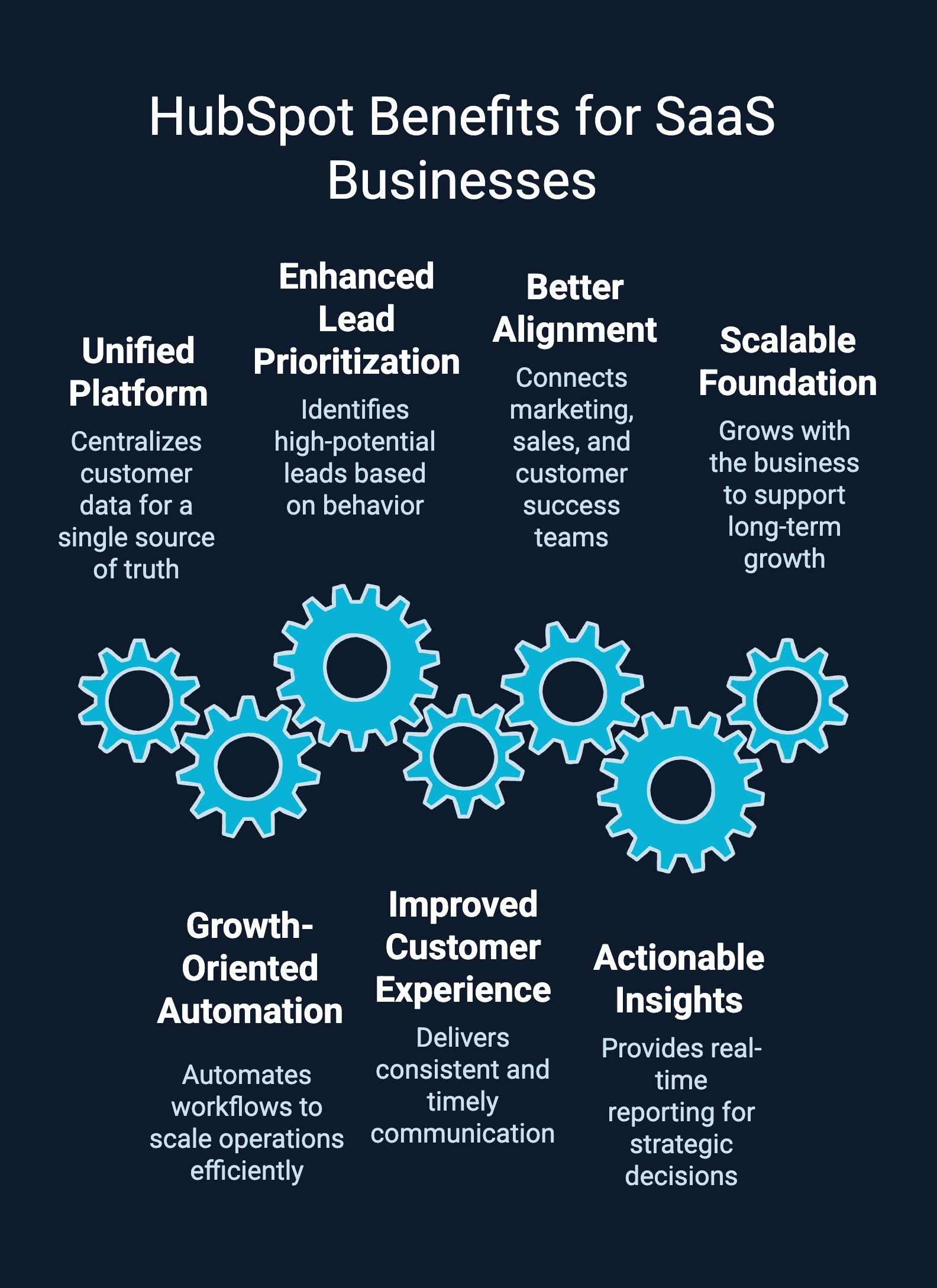
For SaaS companies, growth depends on alignment, speed, and data-driven execution. HubSpot supports these priorities by bringing marketing, sales, and customer success together on a single, scalable platform. Below are the key benefits SaaS businesses gain from using HubSpot across the customer lifecycle.
HubSpot centralizes all customer and prospect data in one system, giving SaaS teams a shared source of truth. Every interaction, including marketing engagement, sales activity, product interest, and support history, is visible in one place.
This unified data model eliminates silos, improves handoffs between teams, and allows leaders to track the entire revenue journey from first touch to renewal and expansion.
Automation is essential for scaling a SaaS business without increasing operational overhead. HubSpot enables teams to automate lead nurturing, trial onboarding, follow-ups, renewals, and upsell workflows while maintaining personalization.
As your user base grows, these workflows adapt easily, helping teams execute consistently at scale without relying on manual processes.
SaaS sales teams need to focus on leads that show real buying intent. HubSpot’s lead scoring and behavioral tracking help identify high-potential prospects based on actions like demo requests, trial engagement, pricing page visits, and email interactions.
This ensures sales teams spend time on the right opportunities, improving conversion rates and reducing wasted effort.
Customer experience directly impacts retention and lifetime value in SaaS. HubSpot supports consistent and timely communication across onboarding, adoption, support, and renewal stages.
With complete visibility into each customer’s history, teams can deliver more relevant messaging, faster support, and proactive engagement. This results in stronger relationships and lower churn.
HubSpot creates alignment by connecting all revenue teams through shared data, dashboards, and workflows. Marketing understands which campaigns drive qualified signups, sales sees full lead context, and customer success tracks engagement and health.
This alignment reduces friction, improves internal collaboration, and creates a more predictable and scalable revenue engine.
SaaS leaders need clarity into what is working and where growth is leaking. HubSpot provides real-time reporting on funnel performance, conversion rates, pipeline velocity, churn trends, and campaign ROI.
These insights enable smarter forecasting, better resource allocation, and continuous optimization of go-to-market strategies.
HubSpot grows with your business. SaaS companies can start with core CRM and marketing features, then expand into sales automation, customer success, and advanced reporting as complexity increases.
This flexibility makes HubSpot a long-term platform for managing growth, customer relationships, and revenue operations as your SaaS business scales.
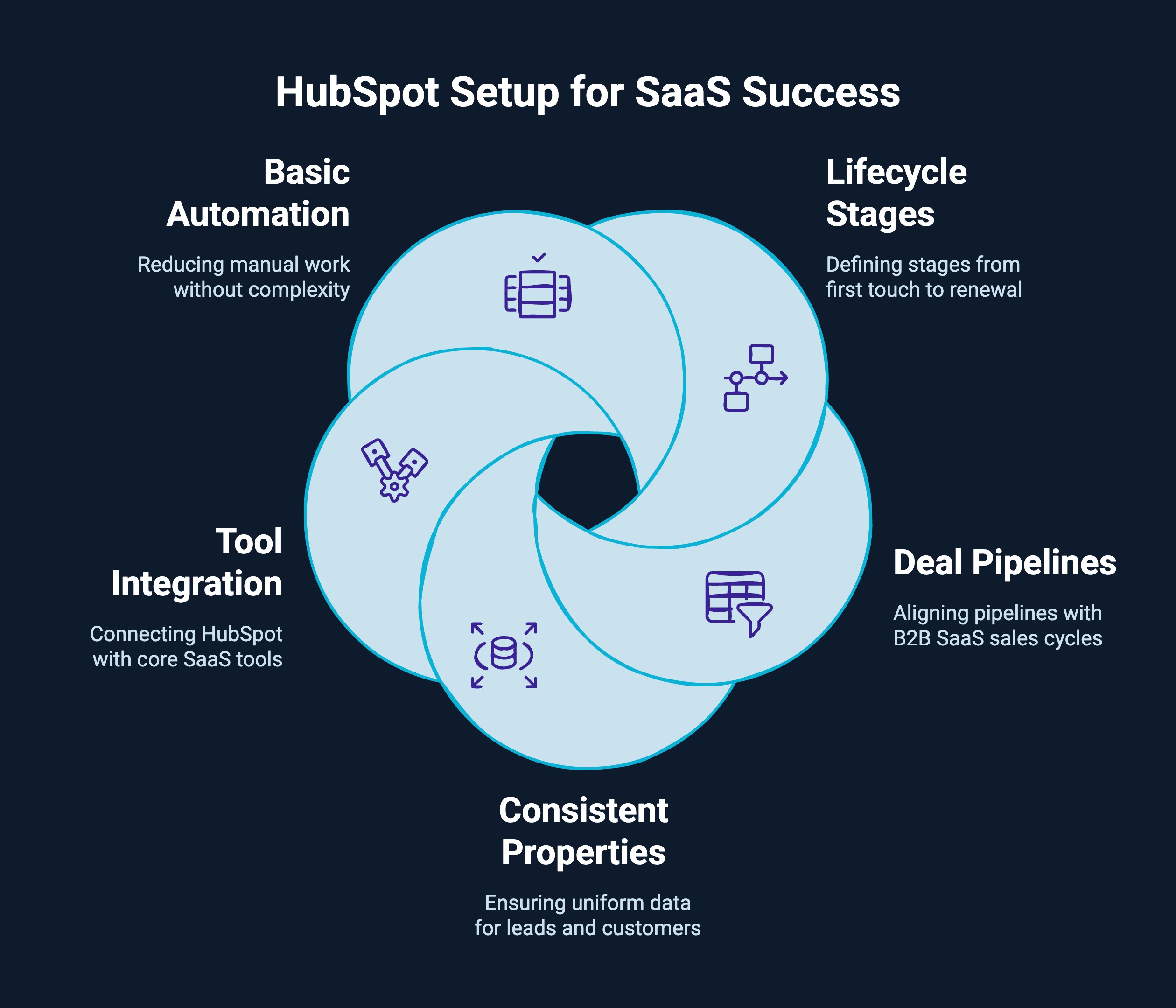
A successful HubSpot implementation for SaaS starts with structure, not features. Before automation or reporting, teams need clarity on how leads move through the funnel and how each team contributes to revenue.
For SaaS companies, the setup should reflect the full customer lifecycle, from first touch to renewal and expansion. This ensures HubSpot supports both growth and retention from day one, instead of becoming just another disconnected tool.
Here are the key steps to setting up HubSpot for SaaS success:
Lifecycle stages should mirror how prospects become users and how users become long-term customers. This means clearly distinguishing between subscribers, trial users, product-qualified leads, customers, and retained or expanded accounts. When lifecycle stages reflect reality, reporting and automation become far more accurate.
Your deal pipeline should match how revenue is actually won in your SaaS business. This includes stages such as demo booked, evaluation, security or procurement review, and closed won. For product-led or hybrid models, pipelines should also support sales-assisted conversions from trials or freemium plans.
SaaS teams rely on more than basic contact data. Creating standardized properties for leads, accounts, and customers ensures every team captures information consistently. Common examples include plan type, trial start date, product usage tier, lead source, and account size. A clean data model prevents reporting gaps later.
HubSpot becomes significantly more powerful when connected to the rest of your SaaS stack. Integrating product analytics, billing systems, support tools, and data warehouses allows teams to see product usage, revenue data, and customer health signals directly inside the CRM. This connection is especially important for PLG and retention-focused teams.
Early automation should focus on reducing manual work, not over-engineering processes. Simple workflows such as lead assignment, trial follow-ups, lifecycle updates, and internal notifications create efficiency without adding complexity. As teams mature, these workflows can evolve into more advanced automation.
By building HubSpot around structure, lifecycle clarity, and real SaaS workflows, teams create a scalable foundation that supports acquisition, activation, retention, and revenue growth over time.
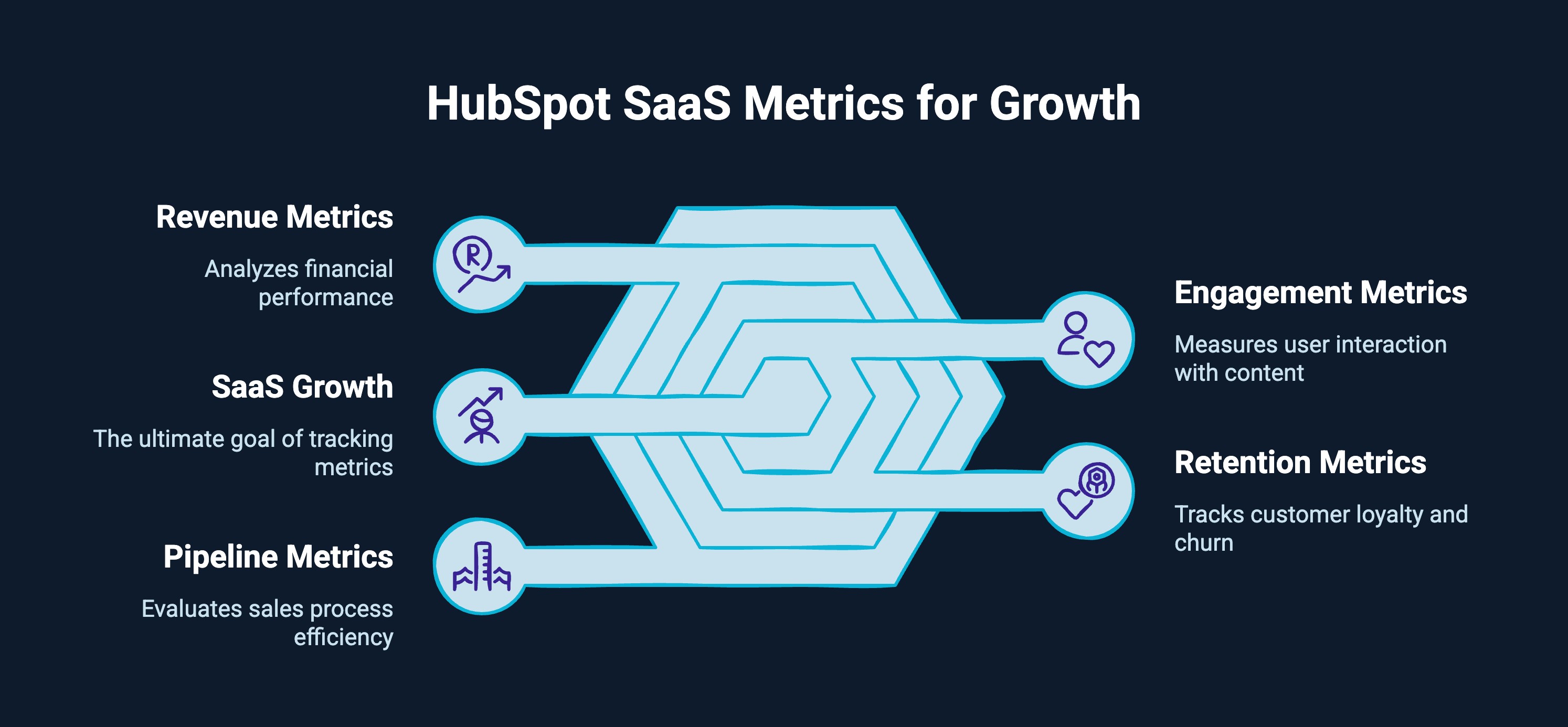
Tracking the right metrics is essential for SaaS growth. Without clear visibility into performance, teams struggle to understand what is working, where deals stall, and how revenue is trending.
HubSpot allows SaaS teams to track key metrics across marketing, sales, and customer success in one place. This makes it easier to align teams around shared goals and make informed decisions.
Important HubSpot B2B SaaS metrics to track include:
By centralizing these metrics, SaaS teams gain a clearer understanding of performance and can plan growth with greater confidence.
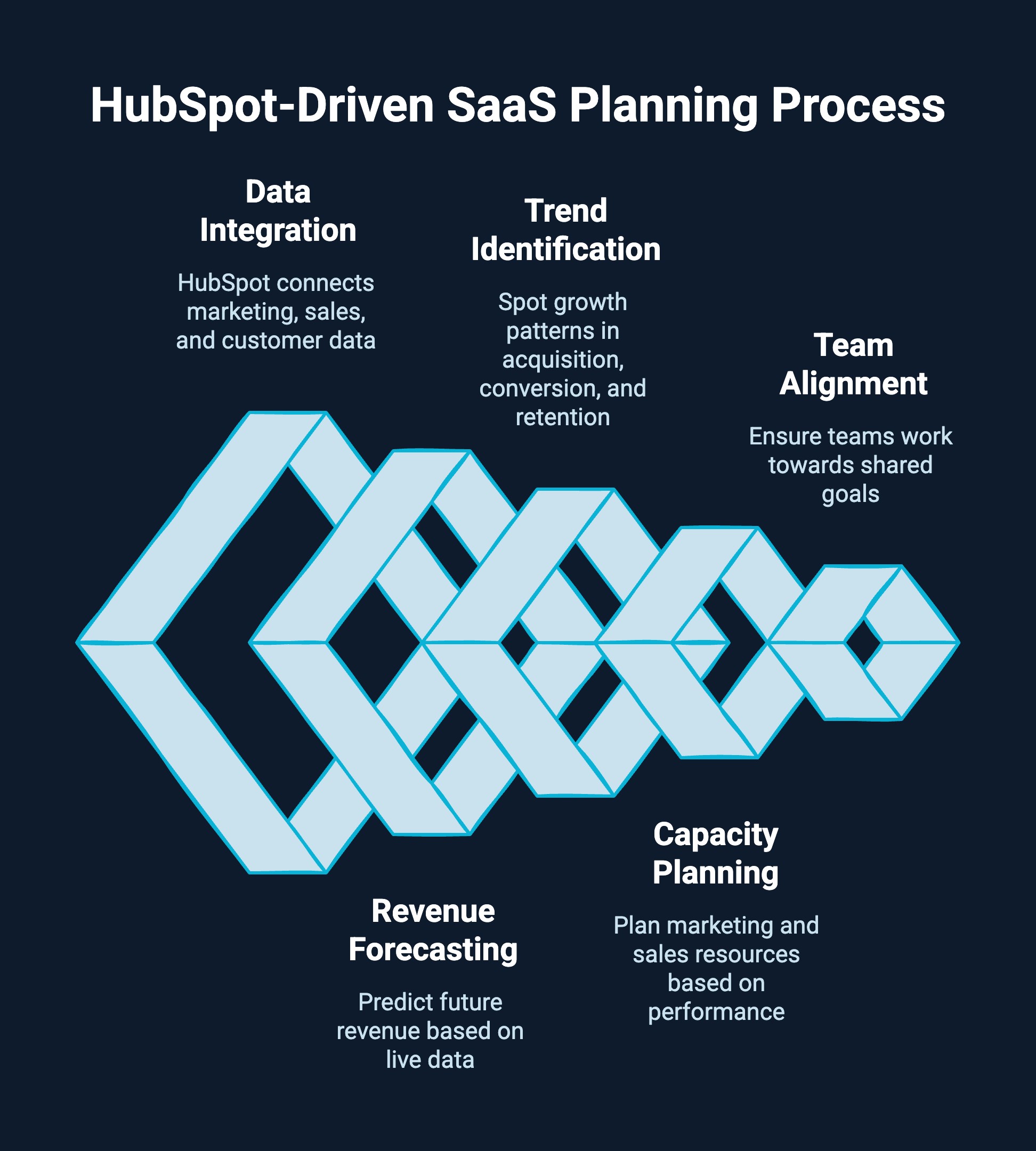
Effective SaaS business planning depends on accurate data and clear visibility into future revenue. When teams rely on disconnected reports or manual spreadsheets, planning becomes reactive and unreliable.
HubSpot brings planning data into one system by connecting marketing performance, sales pipelines, and customer activity. This allows SaaS leaders to base decisions on real-time insights rather than assumptions.
HubSpot supports SaaS business planning by enabling teams to:
With centralized data and consistent reporting, HubSpot helps SaaS companies plan growth with greater accuracy and confidence.
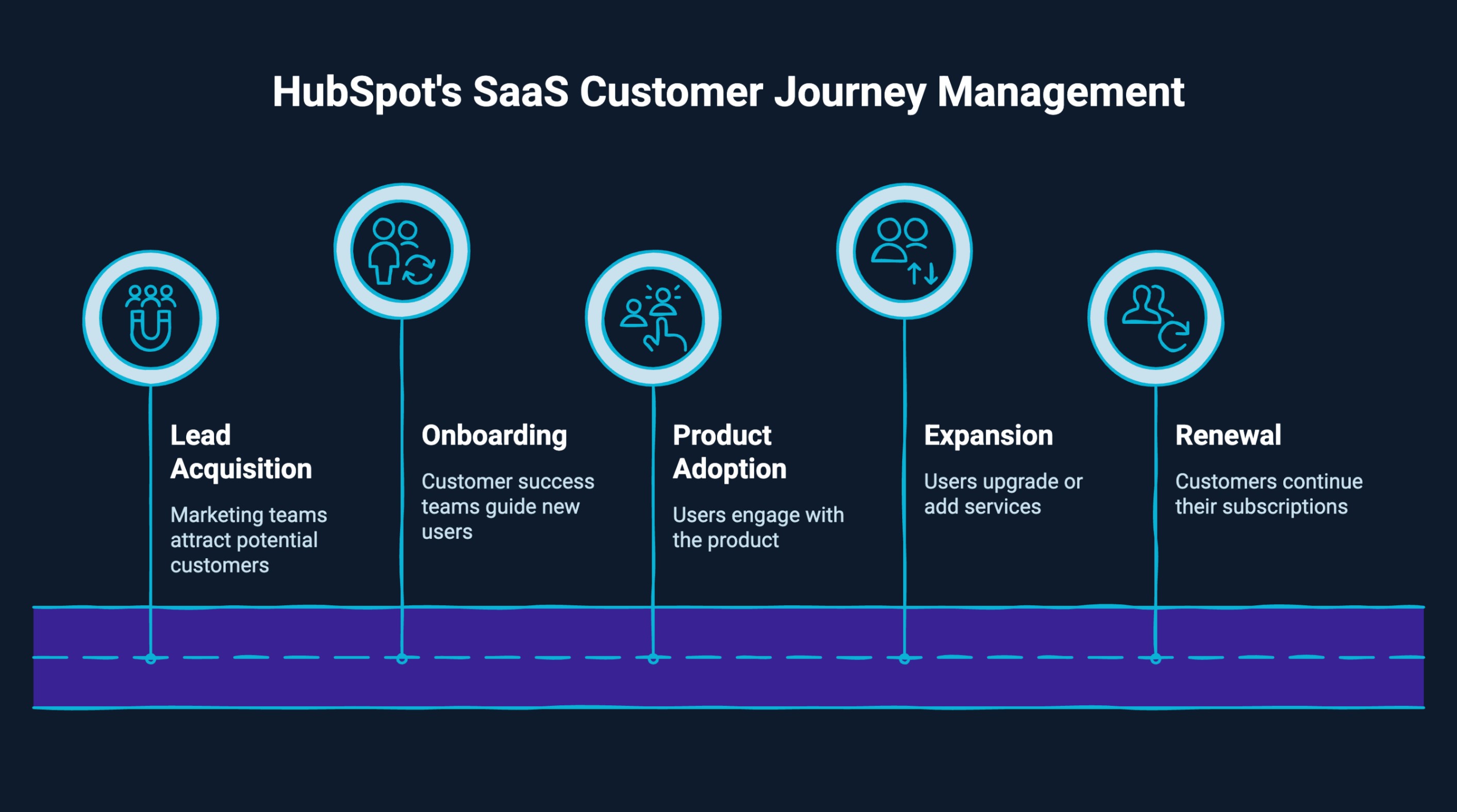
The SaaS customer journey does not end at conversion. It spans lead acquisition, onboarding, product adoption, expansion, and renewal. Managing this journey requires consistent data and clear ownership across teams.
HubSpot connects every stage of the customer journey in one platform. Marketing, sales, and customer success teams all work from the same customer record, ensuring continuity and context at every interaction.
HubSpot manages the SaaS customer journey by enabling teams to:
By centralizing journey data, HubSpot helps SaaS companies deliver more consistent experiences and build long-term customer relationships.
SaaS companies have different needs depending on their growth stage. HubSpot’s flexibility allows teams to start simple and add complexity as the business scales, without changing platforms.
By adapting workflows, pipelines, and reporting, HubSpot supports SaaS companies from early traction to advanced growth.
Early-stage SaaS teams need speed and clarity. HubSpot helps them capture leads, track conversations, and build basic pipelines without heavy setup.
Key benefits for early-stage teams include:
As SaaS companies grow, processes become more complex and harder to manage across teams. HubSpot supports scale by introducing structure through automation, reporting, and cross-team alignment, without slowing down momentum.
Growth-stage SaaS teams use HubSpot to:
For product-led growth models, HubSpot also plays a key role in connecting product usage with go-to-market execution. Teams can track trial activation milestones, monitor in-app engagement signals, and surface product-qualified leads (PQLs) based on real product behavior.
Larger SaaS companies require deeper segmentation and reporting. HubSpot supports advanced use cases while maintaining data consistency.
Enterprise SaaS teams rely on HubSpot to:
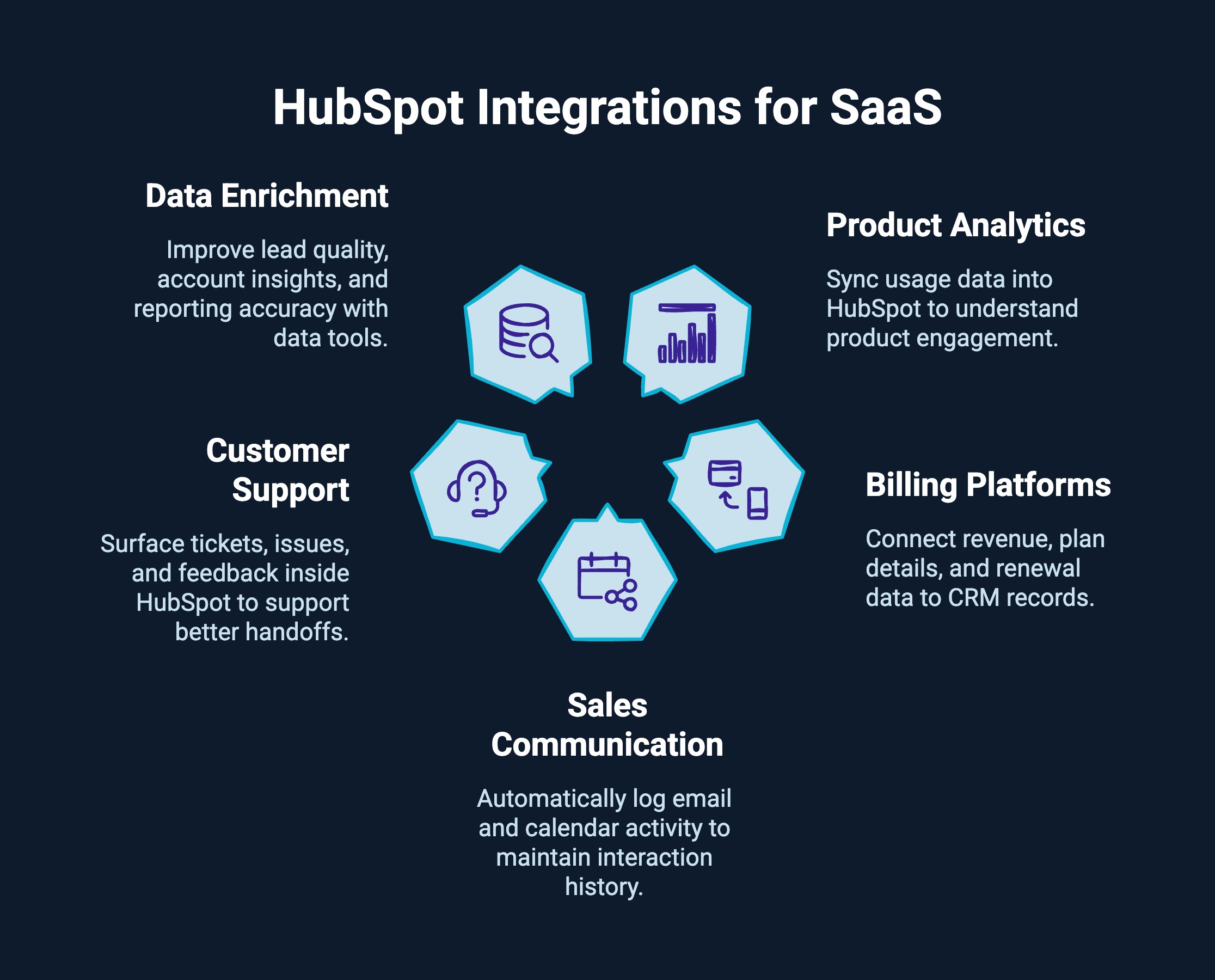
Most SaaS companies operate on a multi-tool stack that includes product analytics, billing systems, and customer support platforms. Without proper integration, critical data stays isolated, and teams lose visibility into how leads convert, customers adopt the product, and revenue is generated.
HubSpot integrations allow SaaS teams to connect these systems and keep all customer data aligned in one CRM. This creates a complete view of each account and supports better coordination across marketing, sales, and customer success.
Common integration categories for HubSpot in SaaS include:
By integrating these systems, HubSpot becomes the central hub for SaaS operations rather than just a standalone CRM. This enables teams to reduce manual updates, improve data accuracy, and make decisions based on a complete customer picture.
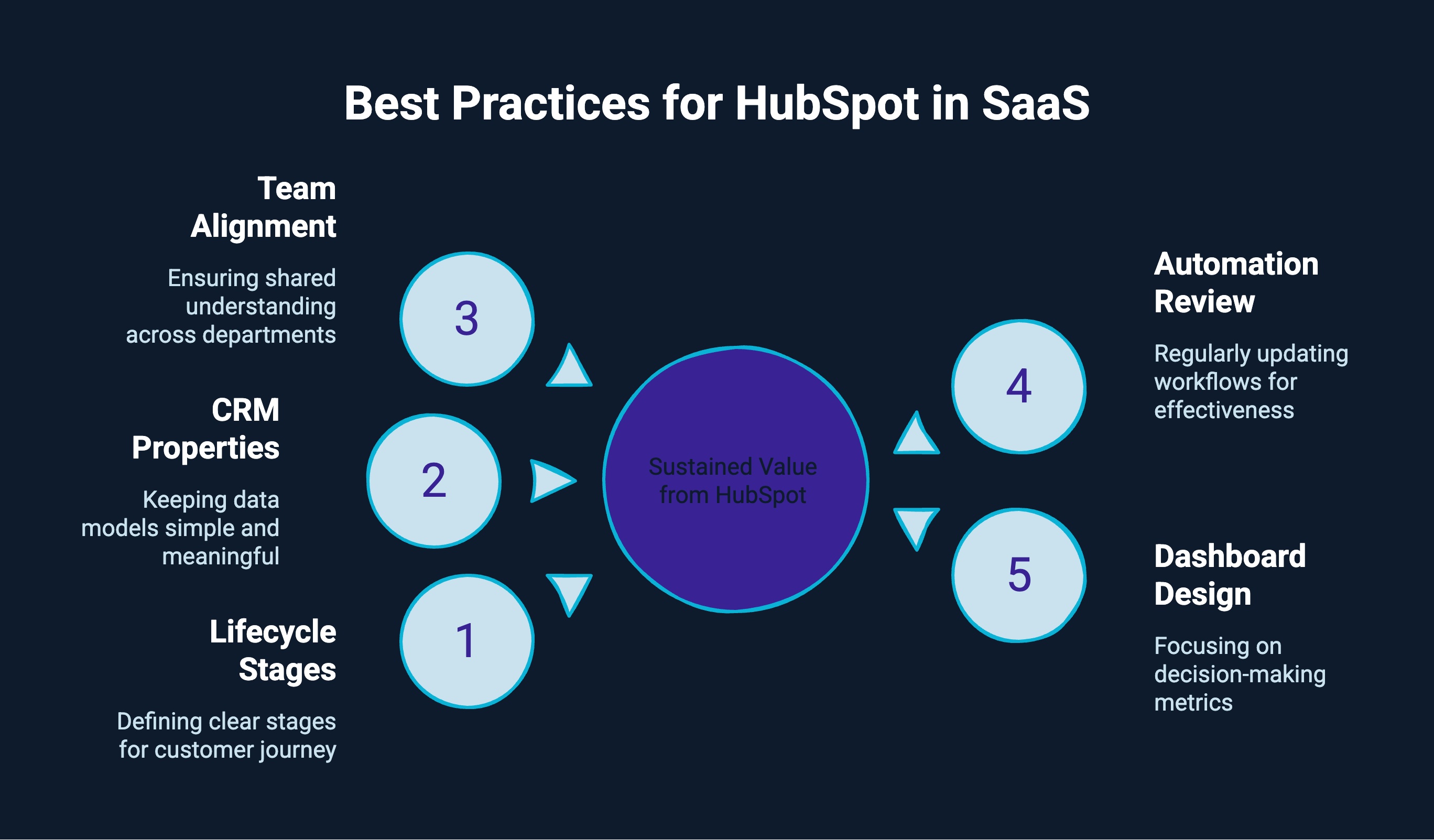
HubSpot works best for SaaS companies when it is treated as a long-term growth system rather than a short-term implementation. Strong fundamentals and ongoing discipline are what separate high-performing SaaS teams from those that struggle with CRM sprawl.
The following best practices help SaaS teams get sustained value from HubSpot as they scale.
Before building workflows, SaaS teams should clearly define lifecycle stages and sales pipelines. This ensures automation supports real business processes rather than forcing teams to adapt to the tool. Clear structure at this stage prevents confusion, broken reporting, and rework later.
Overengineering the CRM early creates friction and poor adoption. SaaS teams should focus on a small set of meaningful properties that support reporting and decision-making. Simple data models are easier to maintain and scale as more users join the platform.
HubSpot works best when all teams share the same understanding of leads, opportunities, and customers. Alignment on definitions such as MQL, SQL, and customer stages prevents handoff issues and reporting conflicts. This alignment is especially important in B2B SaaS with long sales cycles.
As SaaS companies grow, processes change. HubSpot workflows should be reviewed periodically to ensure they still reflect how teams operate. Regular reviews help remove outdated logic, reduce errors, and keep automation effective.
Dashboards should answer real business questions, not just display activity volume. SaaS leaders should focus reporting on pipeline health, revenue trends, and retention signals. Well-designed dashboards improve accountability and support better planning across teams.
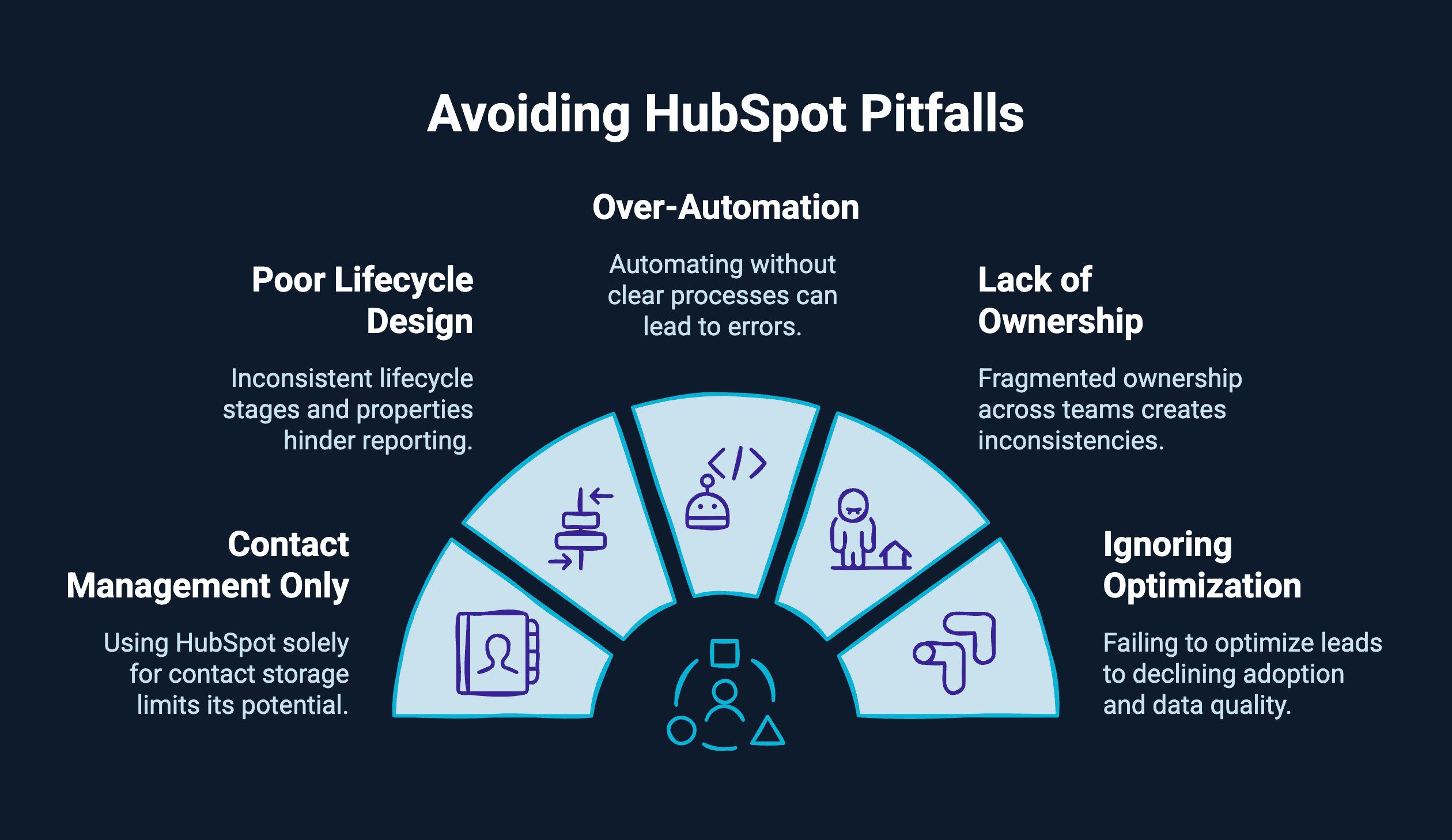
Many SaaS teams adopt HubSpot with good intentions but run into issues as they scale. These problems often come from a rushed setup, unclear ownership, or treating HubSpot as a basic contact database.
Avoiding common mistakes early helps SaaS teams protect data quality and get long-term value from the platform.
When HubSpot is used only to store contacts, teams miss out on lifecycle tracking, automation, and reporting. This limits visibility into pipeline performance and customer relationships. HubSpot is most effective when it supports the entire go-to-market motion.
Inconsistent lifecycle stages and poorly defined properties lead to unreliable reporting. SaaS teams often add fields without a clear purpose, which creates confusion and data gaps. Clear structure and naming conventions are essential for accurate insights.
Automation built without defined processes can create errors and break workflows. SaaS teams should establish how work is done before relying on automation to scale it. Well-planned automation improves efficiency rather than introducing risk.
Without shared ownership, HubSpot becomes fragmented across teams. Marketing, sales, and customer success must collaborate on structure, reporting, and governance. Clear ownership ensures HubSpot evolves with the business.
HubSpot is not a one-time setup. SaaS teams that fail to review and improve their setup over time often experience declining adoption and data quality. Regular optimization keeps the platform aligned with business goals.
Scaling HubSpot for SaaS requires more than CRM setup. It requires strong RevOps design, clean data, and outbound systems that drive the pipeline.
LeadGem is a B2B growth and revenue operations agency with 5+ years of experience in B2B growth marketing and growth hacking. Headquartered in Amsterdam, the Netherlands, LeadGem builds scalable HubSpot and outbound systems for SaaS companies.
LeadGem helps SaaS teams:
As a Clay certified partner, LeadGem works with SaaS companies across Benelux, the Nordics, America, and Australia, supporting growth across multiple markets.
SaaS growth suffers when teams work in silos and data stays fragmented. Without a unified system, visibility and execution break down.
HubSpot for SaaS brings every team onto one platform, creating clarity across the entire customer lifecycle. When used with the right structure, it supports predictable growth and scalable operations.
The real advantage comes from how HubSpot is implemented. Done right, it becomes a foundation for long-term SaaS growth.
SaaS companies use HubSpot’s CRM and marketing automation to run targeted marketing campaigns, improve conversion rates, track user behavior in real time, and turn website visitors into qualified leads, driving scalable growth across the SaaS industry.
Yes. HubSpot supports your SaaS business with a unified suite of tools for customer acquisition, customer service, and customer relationship management, helping teams reduce manual tasks, manage the sales funnel, and improve customer experience as customer needs evolve.
HubSpot and Salesforce serve different needs. For many teams, hubspot crm features for b2b saas offer faster setup, simpler workflows, and easier adoption compared to Salesforce’s heavier enterprise focus.
Modern SaaS platforms invest heavily in encryption, access controls, and compliance. A well-managed hubspot saas platform provides strong security standards suitable for handling sensitive business data.
According to Cloud Daily, a strong SaaS retention rate typically falls between 90 and 95% annually, depending on pricing model, customer segment, and product maturity.
HubSpot features for b2b saas startups include ticketing, feedback tools, and shared customer context, helping teams resolve issues faster and deliver consistent post-sale experiences that support retention.
SaaS is delivered through the cloud, but it is not identical. HubSpot features for saas business planning rely on cloud infrastructure, while SaaS specifically refers to ready-to-use software accessed online.