

Contact


Revenue teams lose more money from internal misalignment than most leaders realize. According to Demand Gen Report, poor sales and marketing alignment can cost companies 10% or more of annual revenue due to missed opportunities, weak handoffs, and inaccurate forecasting.
As companies grow, disconnected systems and inconsistent lifecycle stages make revenue unpredictable. Marketing focuses on leads, sales focuses on closed deals, and customer success focuses on retention.
That is where HubSpot RevOps becomes critical. In this guide, you will learn what RevOps HubSpot means, how to build a scalable RevOps framework inside HubSpot, and how to use integrations, automation, and expert support to drive measurable revenue growth.
Revenue Operations in HubSpot refers to the structured use of HubSpot’s CRM, automation, reporting, and integration capabilities to align marketing, sales, and customer success under a single revenue strategy.
It centralizes data, standardizes processes, and creates shared accountability across the entire customer lifecycle.
Rather than treating marketing ops, sales ops, and customer success ops as separate functions, HubSpot RevOps connects them through unified lifecycle stages, consistent data governance, and closed-loop reporting.
The result is clearer attribution, more accurate forecasting, and a scalable revenue operating model built directly inside the HubSpot ecosystem.
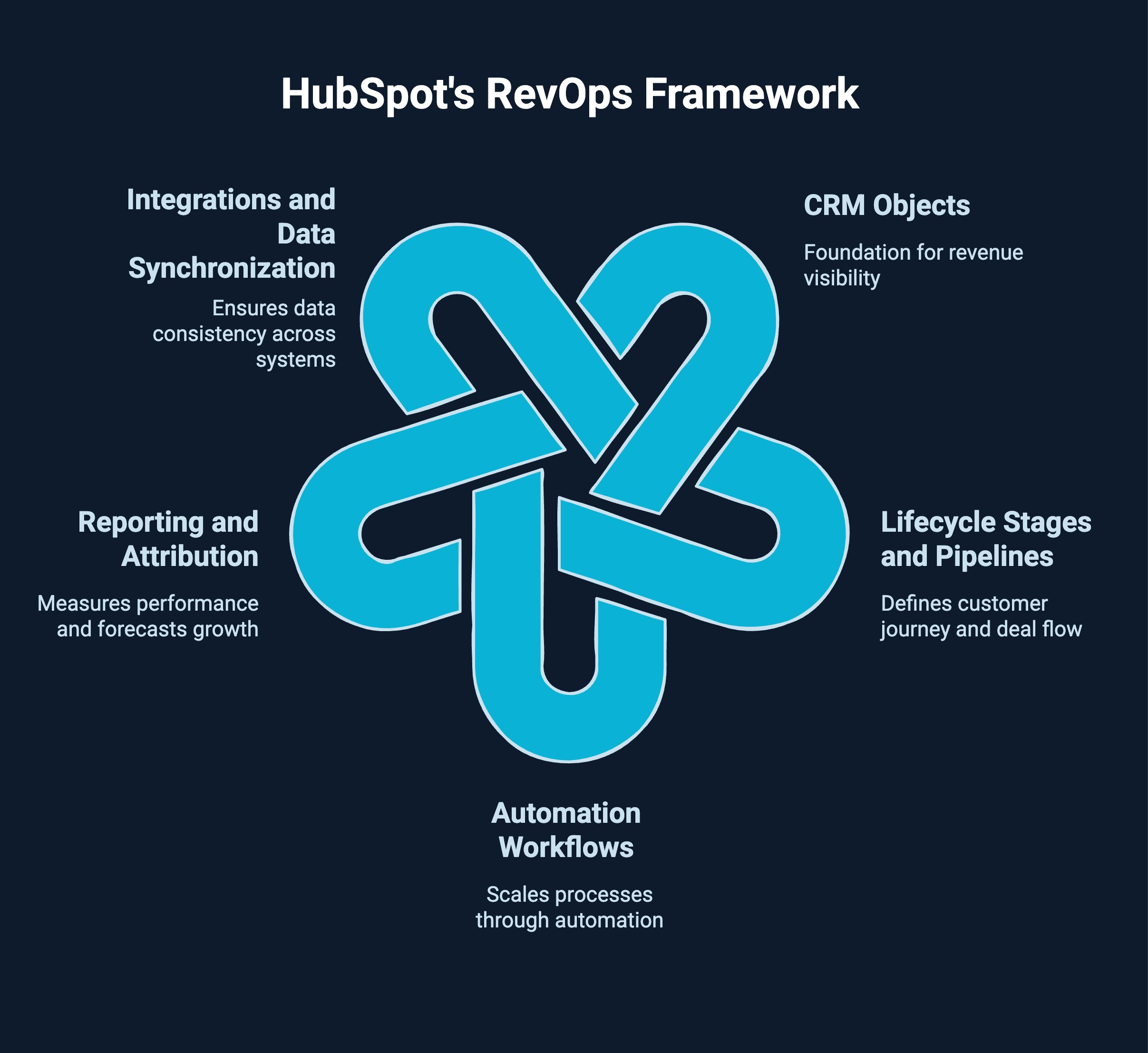
HubSpot enables RevOps by structuring revenue operations across five core system layers. When configured correctly, these layers connect marketing, sales, and customer success into one unified revenue engine.
HubSpot’s core objects, including Contacts, Companies, Deals, and Tickets, form the foundation of revenue visibility.
Together, these objects ensure every revenue interaction is recorded and measurable.
Lifecycle stages define where a prospect or customer sits within the revenue journey, from subscriber to evangelist. Pipelines structure how deals move from qualification to close.
When standardized, these layers:
RevOps depends on consistent lifecycle governance to maintain reporting accuracy.
Automation is what turns process into scale. HubSpot workflows enable:
HubSpot provides revenue dashboards, funnel reports, cohort tracking, and attribution modeling.
Operationally, this allows teams to:
HubSpot integrates with billing tools, ERP systems, analytics platforms, outbound tools, and enrichment providers. Proper data synchronization ensures:
When these five system layers work together, HubSpot evolves from a CRM into a structured Revenue Operating System that supports alignment, visibility, and scalable growth.
Revenue growth does not slow down because of a lack of effort. It slows down because of operational inefficiencies. As companies scale, complexity increases across systems, teams, and customer touchpoints.
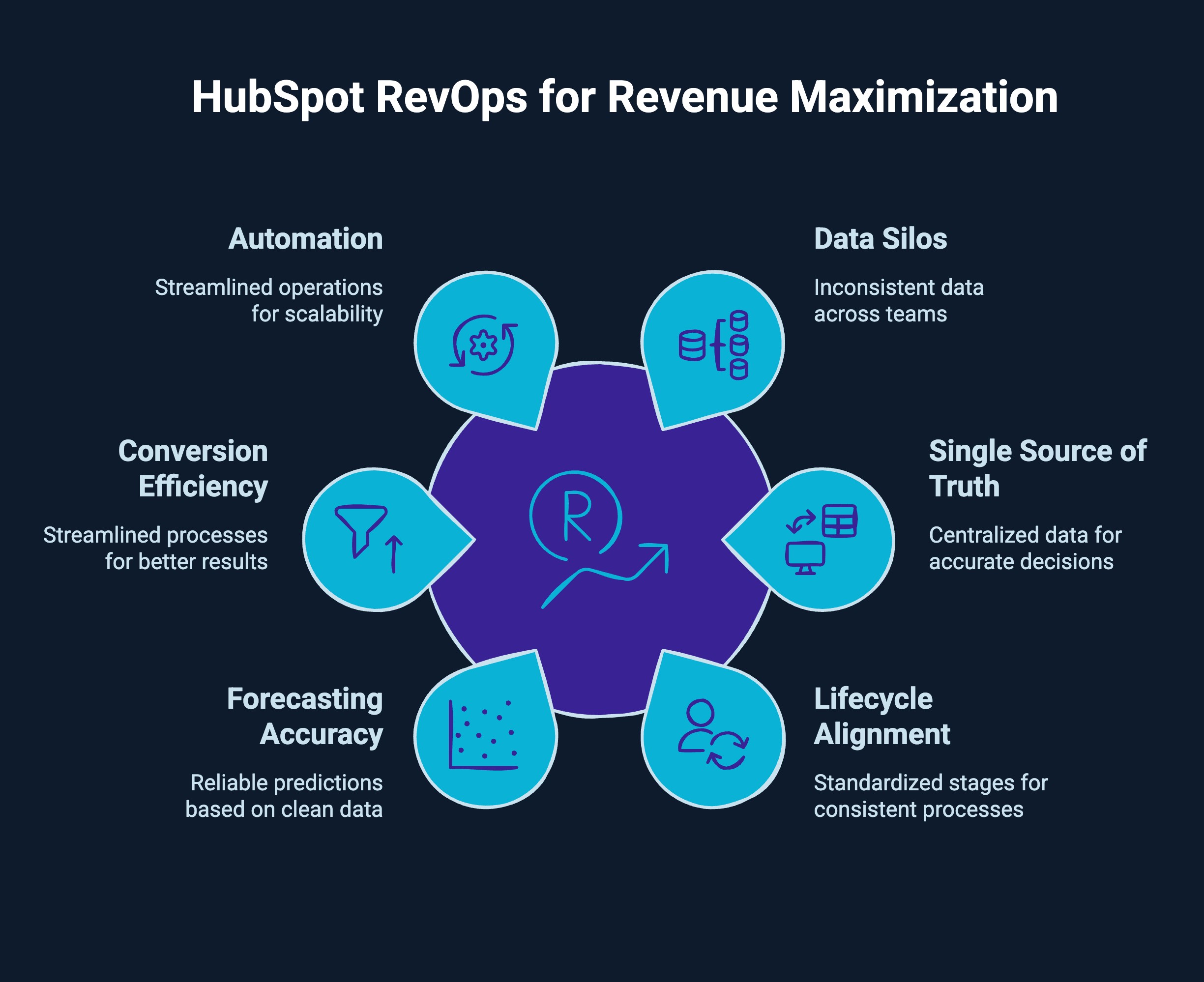
Here is how HubSpot RevOps directly impacts revenue maximization:
As companies grow, data often lives in multiple tools across marketing, sales, and customer success. This fragmentation leads to inconsistent reporting, duplicate records, and unclear ownership. HubSpot RevOps centralizes CRM data and integrates key systems, ensuring every team works from a single, reliable source of truth.
Revenue decisions are only as strong as the data behind them. HubSpot RevOps unifies reporting dashboards, attribution models, pipeline data, and customer insights into one consolidated ecosystem. This ensures leadership teams make strategic decisions based on accurate, real-time revenue data instead of disconnected spreadsheets.
Without standardized lifecycle stages, teams define leads, opportunities, and customers differently. This creates confusion in handoffs and distorts performance metrics. HubSpot RevOps enforces consistent lifecycle definitions and shared KPIs across departments, aligning all teams around unified revenue targets.
Revenue forecasting depends on clean data and clearly defined pipeline stages. When deal stages are inconsistent or data is incomplete, forecasts become unreliable. HubSpot RevOps introduces structured pipeline management and full funnel visibility, resulting in more predictable projections.
Disconnected systems slow lead routing and delay follow-ups. HubSpot RevOps automates handoffs between marketing and sales, applies lead scoring, and tracks performance at every stage. This removes bottlenecks and improves pipeline velocity.
Manual processes limit scalability. HubSpot RevOps leverages automation workflows, data synchronization, and integrated reporting to streamline operations. This allows teams to focus on strategic growth initiatives that directly increase revenue.

As scaleups grow, revenue complexity increases. More channels, larger sales teams, longer deal cycles, and expansion revenue introduce operational friction. Without a defined framework, HubSpot becomes just a CRM instead of a revenue engine. A structured RevOps model ensures that growth remains predictable and measurable.
Below is a practical RevOps framework for scaleups using HubSpot:
Start with shared revenue metrics across marketing, sales, and customer success. Align on pipeline velocity, customer acquisition cost, revenue per customer, win rate, and expansion revenue. HubSpot dashboards should reflect these unified KPIs rather than department-specific metrics.
Create clear definitions for subscriber, lead, MQL, SQL, opportunity, customer, and evangelist. Enforce these definitions inside HubSpot to ensure consistent reporting and accurate attribution across the funnel.
Before scaling automation, define strict CRM governance. Standardize property naming conventions, required fields, data entry rules, permission levels, and duplication controls. Implement clear ownership for data hygiene and reporting accuracy.
Design automation that routes leads instantly, assigns ownership, triggers follow-ups, and updates lifecycle stages. This reduces manual errors and prevents pipeline delays.
Connect marketing campaigns, sales activities, and revenue outcomes. Use HubSpot reporting to track which channels, campaigns, and actions generate actual revenue, not just leads.
Regularly audit pipeline performance, stage conversion rates, and attribution reports. Use data insights to refine scoring models, automation workflows, and targeting strategies to sustain scalable growth.
After establishing a structured RevOps framework, the next step is execution. Strategy alone does not drive revenue. The real impact comes from configuring the right HubSpot solutions to support alignment, automation, and measurable growth across the entire customer lifecycle.
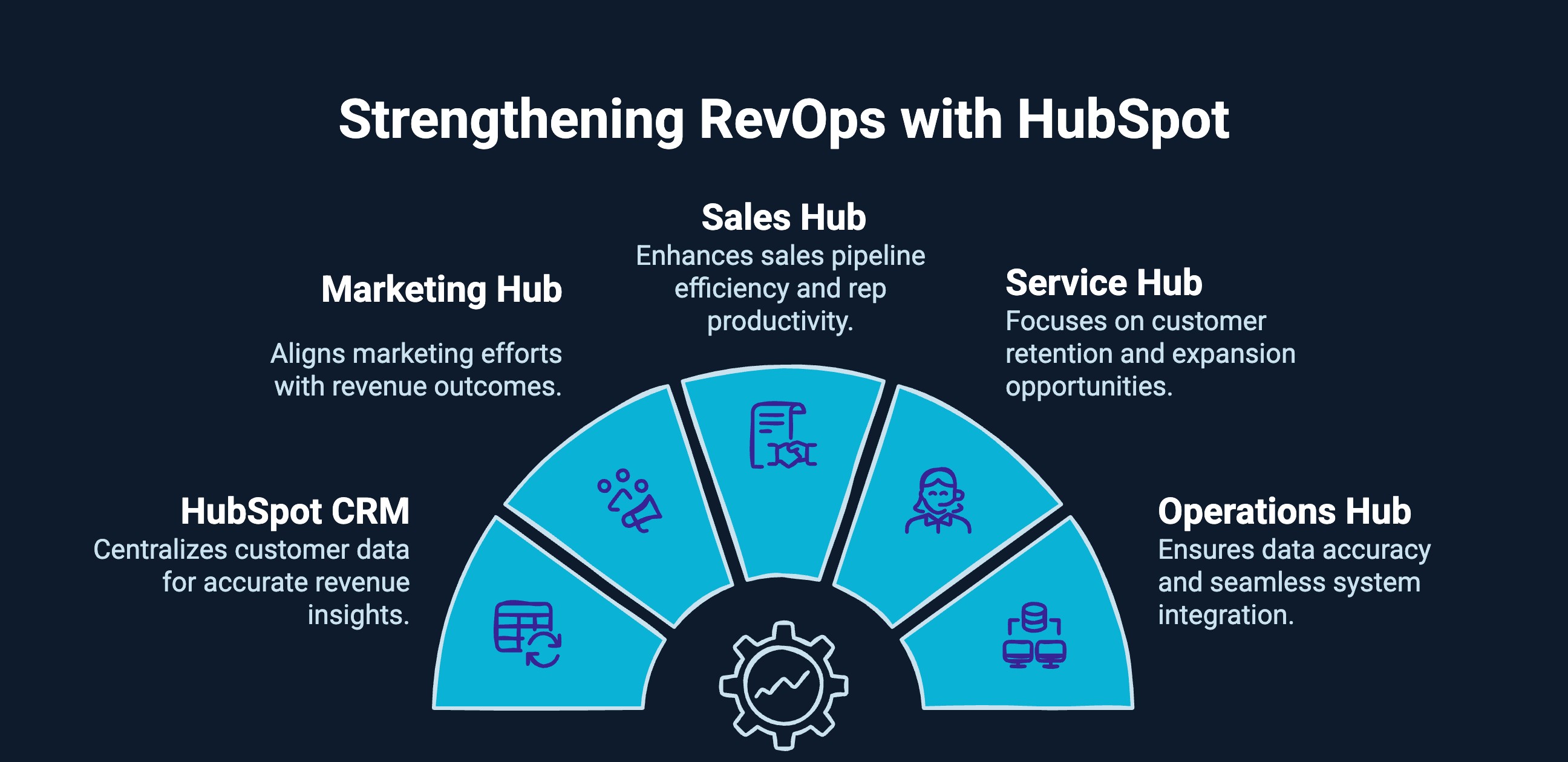
Here are the core HubSpot solutions that directly strengthen revenue alignment and operational efficiency.
The CRM serves as the foundation of your RevOps structure. It centralizes contact records, company data, deal stages, and activity tracking across teams. With standardized properties and clean data governance, leadership gains accurate visibility into pipeline performance and revenue metrics.
Marketing Hub connects campaigns directly to revenue outcomes. Through lead scoring, campaign tracking, and attribution reporting, teams can identify which channels generate qualified pipeline and closed revenue rather than surface-level metrics.
Sales Hub structures deal pipelines, automates follow-ups, and improves rep productivity. Features such as sequences, task automation, and forecasting tools ensure opportunities move consistently and predictably through the funnel.
Revenue growth extends beyond acquisition. Service Hub enables ticket automation, feedback collection, and account management workflows that strengthen retention and uncover expansion opportunities.
Operations Hub ensures data accuracy and seamless synchronization across systems. It supports automation, data cleaning, and RevOps HubSpot integrations that connect external tools into a unified revenue engine.
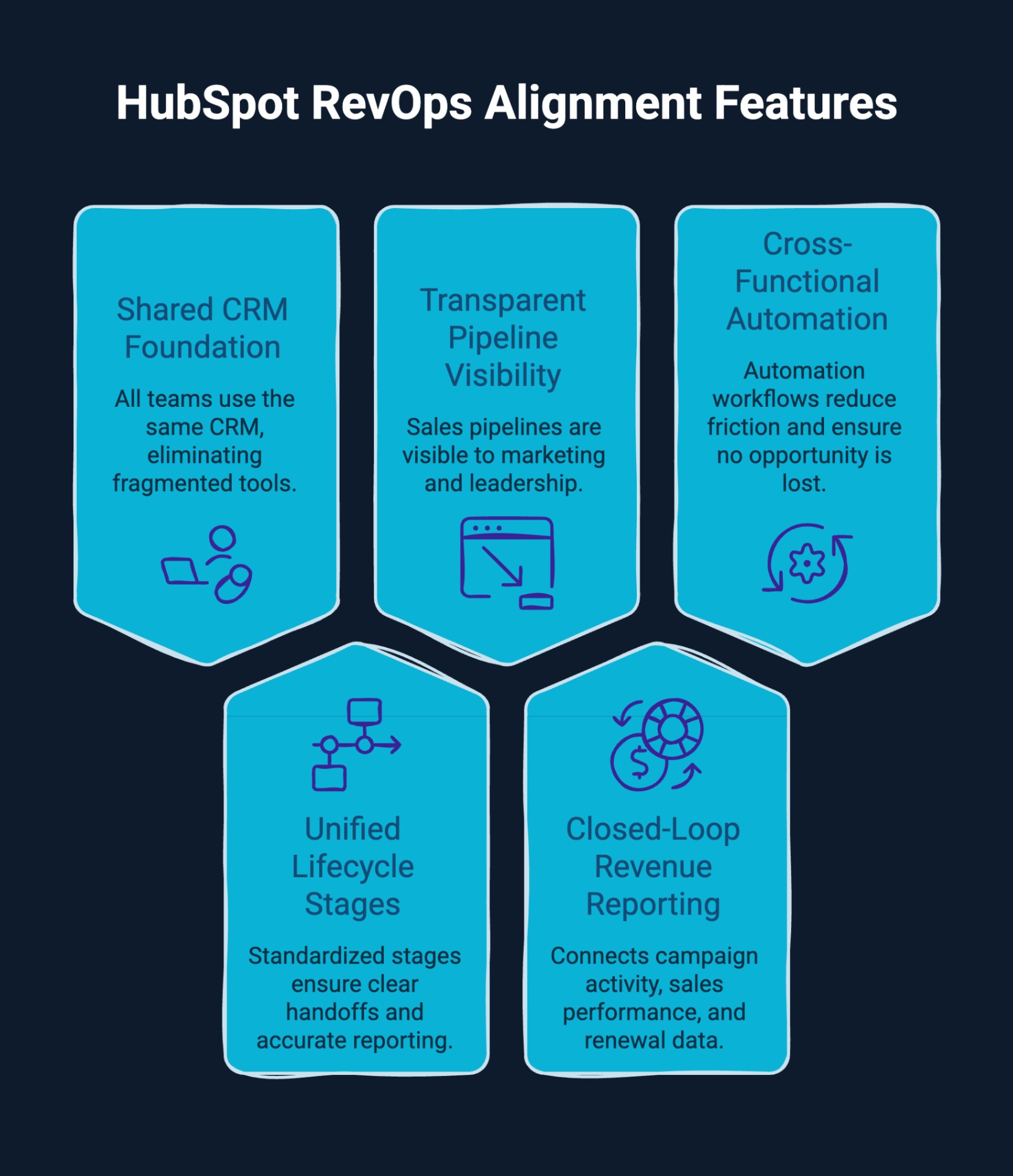
RevOps alignment happens when marketing, sales, and customer success operate on shared data, shared processes, and shared revenue goals. HubSpot enables this alignment by centralizing systems, standardizing lifecycle governance, and creating full-funnel visibility.
All teams operate inside the same CRM environment. Marketing tracks engagement, sales manages pipeline, and customer success monitors retention within a unified system. This eliminates fragmented tools and conflicting reports.
HubSpot enforces standardized lifecycle stages from lead to customer and beyond. This ensures clear handoffs between teams, consistent qualification criteria, and accurate funnel reporting across departments.
Sales pipelines are fully visible to marketing and leadership. Marketing can see how campaigns convert into opportunities, while customer success gains insight into the deal context before onboarding.
HubSpot connects campaign activity, sales performance, and renewal data into one reporting layer. This allows teams to optimize based on revenue impact rather than isolated metrics like leads or activities.
Automation workflows route leads, trigger internal notifications, assign ownership, and update lifecycle stages in real time. This reduces friction between teams and ensures no opportunity is lost due to manual gaps.
When structured properly, HubSpot becomes the operational backbone that aligns marketing, sales, and customer success around predictable and measurable revenue growth.
Ready to align your revenue teams inside HubSpot? Contact Leadgem today.
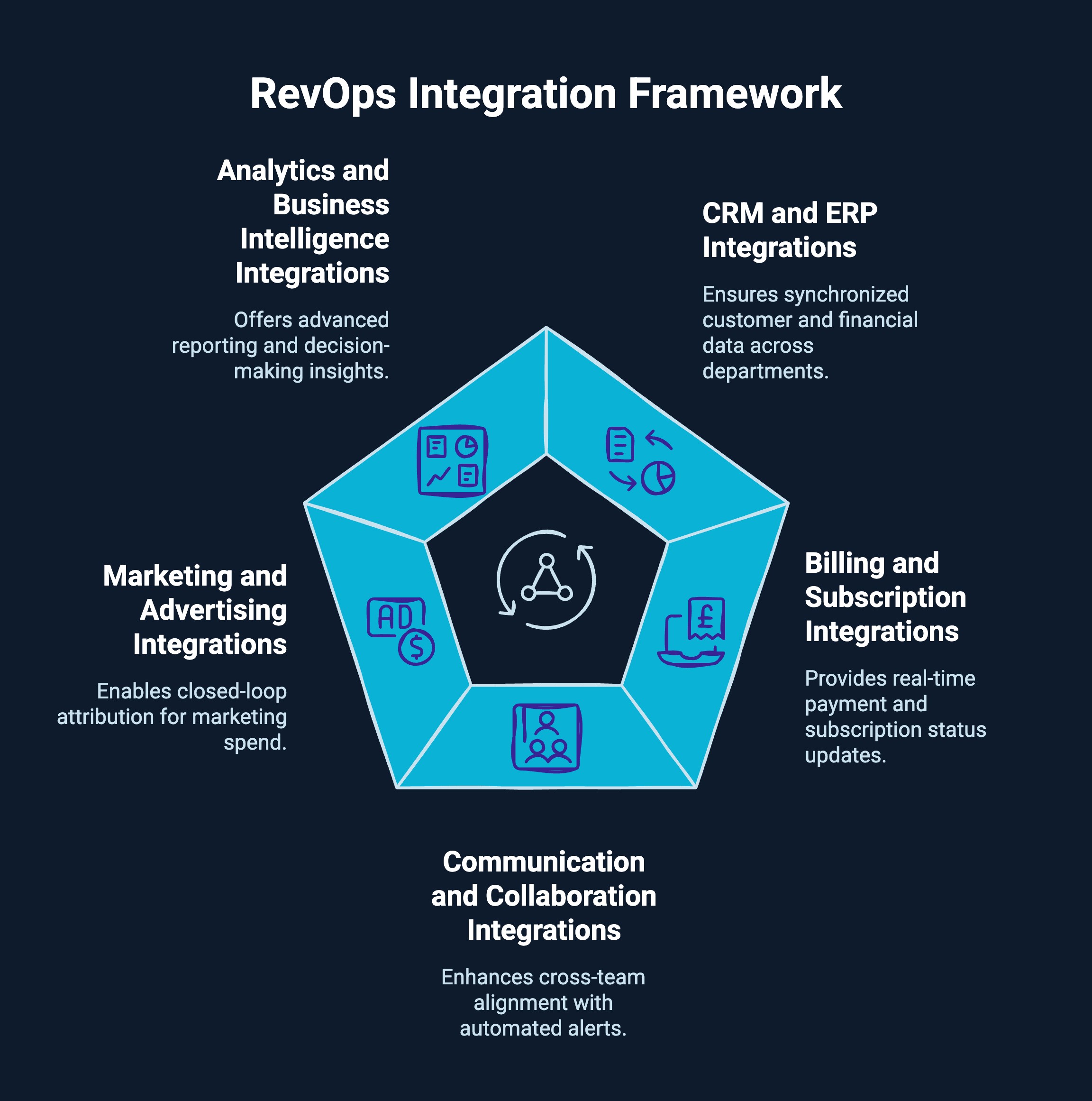
A strong RevOps system does not operate in isolation. To fully unlock the value of the HubSpot RevOps platform, you need integrations that connect marketing, sales, finance, and analytics into one unified revenue ecosystem. Below are the most impactful RevOps HubSpot integrations and why they matter.
Integrating HubSpot with systems like Salesforce or enterprise ERP platforms ensures that customer, deal, and financial data stay synchronized across departments. This is especially critical for larger organizations where finance and operations require accurate revenue recognition, invoicing visibility, and contract tracking alongside sales pipeline data.
Connecting HubSpot with tools such as Stripe enables real-time syncing of payment status, subscription renewals, upgrades, and churn signals. This gives RevOps teams visibility into recurring revenue performance and supports accurate expansion and retention forecasting.
When integrated with platforms like Slack, HubSpot can trigger automated deal alerts, lifecycle updates, and pipeline notifications. This improves cross-team alignment and reduces delays caused by manual follow-ups or missed status changes.
Ad platform integrations allow campaign performance data to flow directly into HubSpot. This enables closed-loop attribution, where marketing spend can be evaluated against actual pipeline and revenue generated rather than just clicks or leads.
Advanced analytics integrations enhance reporting beyond standard dashboards. By connecting HubSpot with BI tools, companies can perform deeper cohort analysis, revenue forecasting, and performance benchmarking to guide executive-level decision-making.
When these integrations are implemented strategically, HubSpot evolves into a fully connected revenue operations system capable of supporting predictable and scalable growth.
Want HubSpot integrations that strengthen, not break, your RevOps foundation? Talk to Leadgem today.
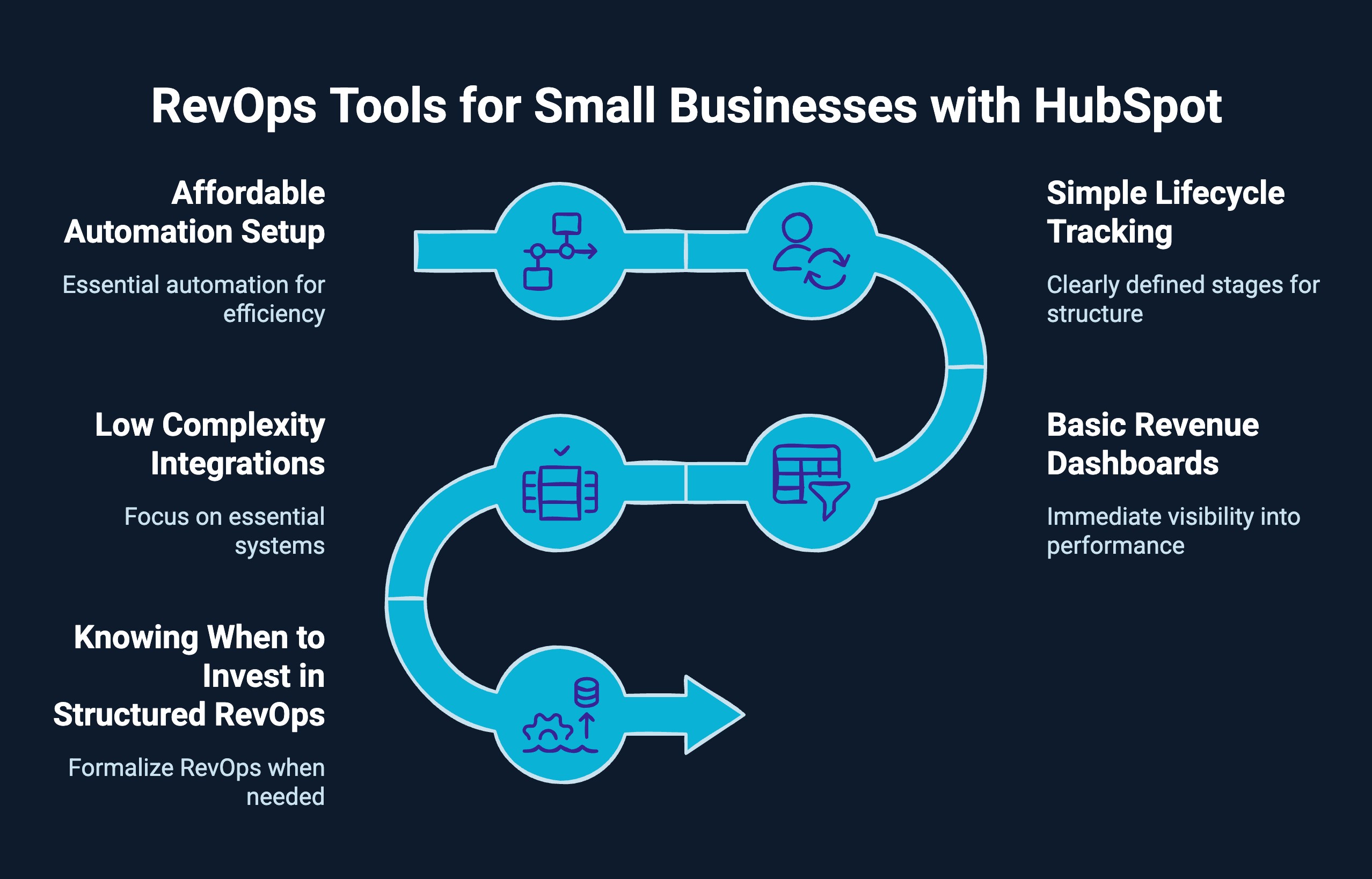
RevOps is not only for large enterprises. Small businesses and early-stage teams can benefit significantly from structured revenue operations, provided the setup matches their scale and complexity. The goal at this stage is not advanced architecture but clarity, efficiency, and visibility.
Here are the core RevOps tools for small businesses with HubSpot:
For small businesses, HubSpot RevOps should start lean, prioritize clarity, and evolve gradually as revenue complexity increases.
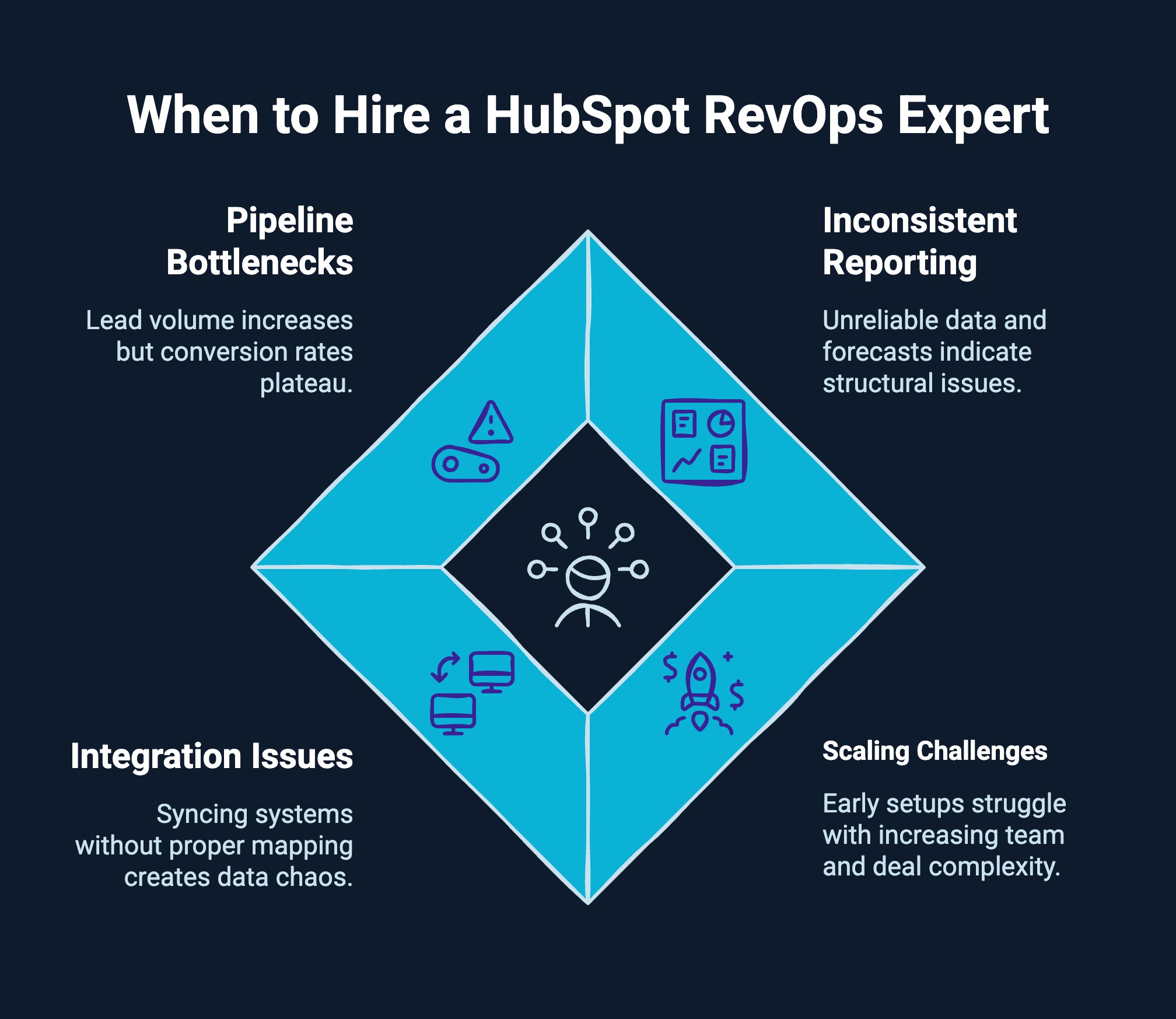
As your revenue engine becomes more complex, HubSpot configuration moves beyond simple setup and into strategic revenue architecture. Many teams start with internal resources, but as growth accelerates, operational gaps, reporting inconsistencies, and automation inefficiencies begin to surface. That is typically the point where a HubSpot RevOps expert adds significant value.
You should consider bringing in a specialist when:
At advanced growth stages, HubSpot is no longer just a CRM. It becomes the foundation of your revenue infrastructure, and expert guidance ensures it supports long-term scalability rather than limiting it.
Need help structuring it properly? Leadgem helps scaleups redesign HubSpot for clean data, strong automation, and predictable revenue growth.
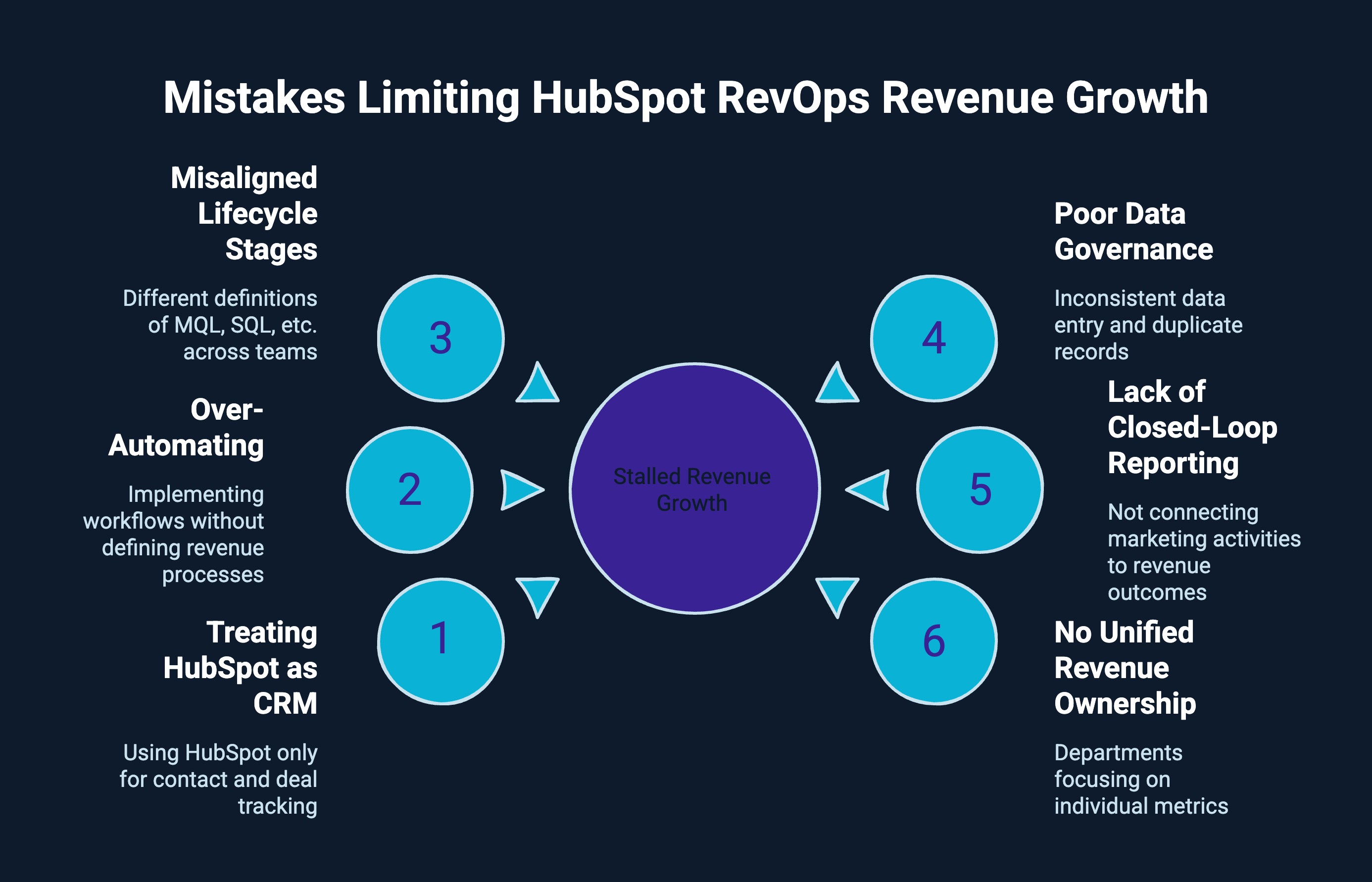
Even well-intentioned RevOps initiatives can underperform when the foundation is weak. HubSpot is powerful, but without clear structure and governance, it can create reporting confusion, automation chaos, and stalled revenue growth.
Below are the most common mistakes that prevent companies from fully benefiting from HubSpot RevOps.
Many companies use HubSpot only to store contacts and track deals. When it is not structured as a full revenue system connecting marketing, sales, and customer success, alignment breaks down. HubSpot should serve as the operational backbone of your entire revenue engine.
Many teams rush to build workflows without first documenting lifecycle stages, qualification criteria, and handoff rules. Automation should reinforce a clearly defined revenue process. When the process is unclear, workflows multiply inconsistencies and make troubleshooting more difficult.
If marketing, sales, and customer success define MQL, SQL, Opportunity, or Customer differently, reporting becomes unreliable. Conversion rates appear distorted, attribution loses accuracy, and forecasting confidence drops. RevOps requires strict lifecycle governance and shared definitions across teams.
Uncontrolled property creation, duplicate records, and inconsistent data entry rules gradually weaken reporting quality. Over time, dashboards become less trustworthy. Strong RevOps requires standardized fields, validation rules, and routine data audits to maintain integrity.
Tracking leads and campaign performance without connecting them to closed revenue creates surface-level optimization. Without closed-loop reporting, marketing may optimize for volume instead of quality. Effective RevOps ties activities directly to pipeline value, win rates, and revenue outcomes.
When each department focuses only on its own metrics, accountability becomes fragmented. Marketing optimizes for leads, sales for deals, and customer success for renewals without shared revenue targets. HubSpot RevOps works best when leadership enforces unified KPIs and cross-functional accountability.
Avoiding these structural mistakes ensures HubSpot supports scalable and predictable revenue growth instead of becoming another disconnected operational tool.
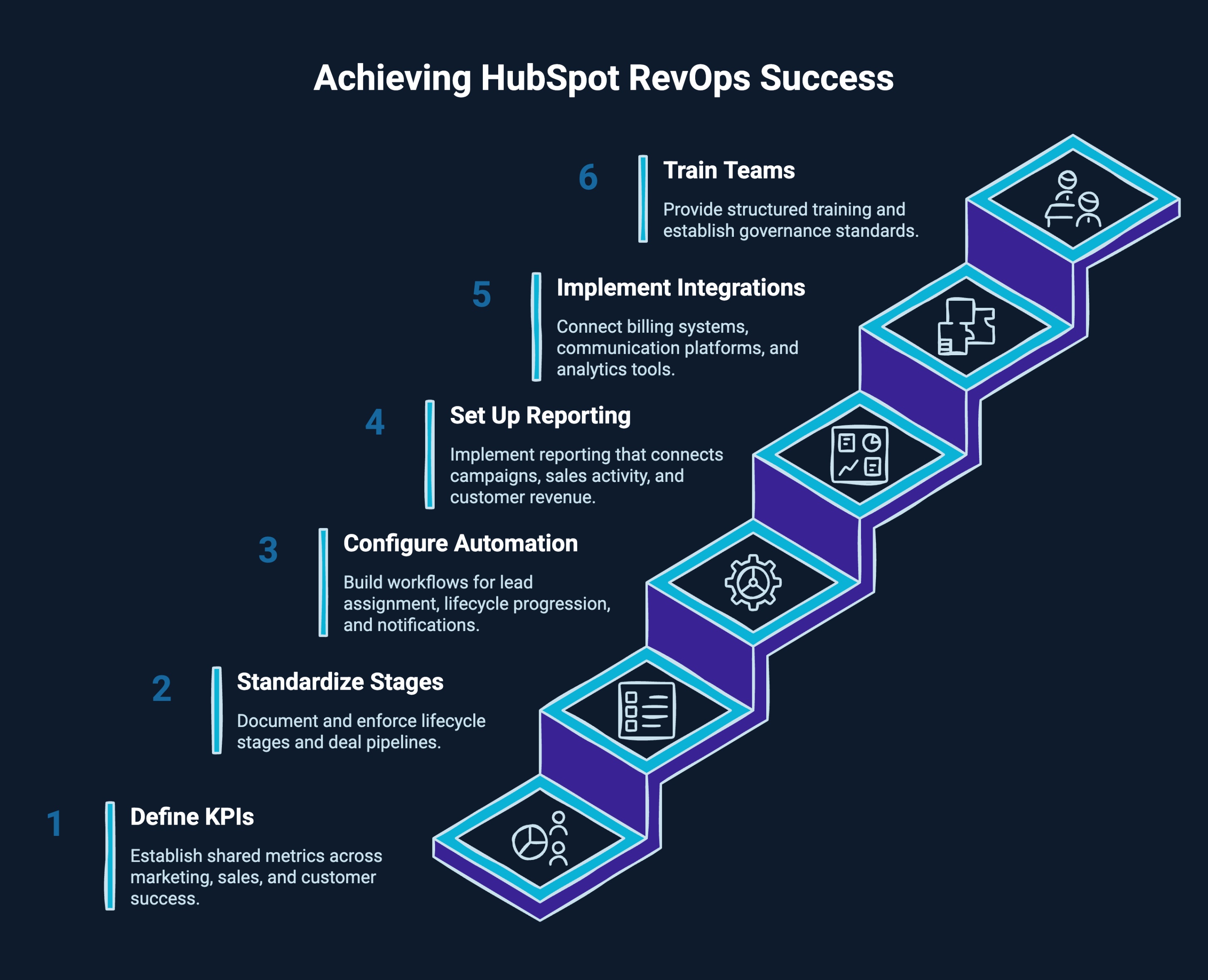
Designing a RevOps strategy is only effective if execution is structured and disciplined. A proper HubSpot RevOps implementation ensures that your CRM, automation, reporting, and integrations work together to drive predictable revenue growth. Below is a practical checklist that helps translate strategy into operational clarity.
A successful implementation should include:
When implemented with discipline, HubSpot becomes a scalable revenue operations infrastructure that supports sustainable growth instead of short-term operational fixes.
Leadgem is a B2B growth and revenue operations agency headquartered in Amsterdam, the Netherlands. With 5+ years of experience in B2B growth marketing and growth systems, we focus on helping companies use HubSpot as a true RevOps engine, not just a CRM.
We approach HubSpot as a structured revenue alignment platform that connects marketing, sales, and customer success under one measurable framework.
What Differentiates Us:
We support growth-focused teams across Benelux, the Nordics, North America, and Australia, helping them turn HubSpot into a scalable and predictable revenue system.
Looking to align sales, marketing, and customer success inside HubSpot? Talk to Leadgem today.
Growth is no longer about isolated campaigns or individual performance. It is about building a revenue system that compounds over time. When marketing, sales, and customer success operate inside a unified HubSpot RevOps framework, revenue becomes predictable instead of reactive.
HubSpot gives you the platform. Your RevOps strategy determines the outcome.
The companies that scale fastest are not the ones adding more tools. They are the ones aligning data, automation, and accountability around one clear goal: revenue.
With the right RevOps architecture, HubSpot becomes a scalable revenue operating system that aligns teams and drives predictable growth.
Through HubSpot Academy, professionals can earn certifications in revenue operations, marketing operations, sales operations, and marketing automation. These programs teach data management, process optimization, revenue strategy, and building a single source of truth to support predictable growth and revenue generation.
Yes. Certified agencies provide automated RevOps services using HubSpot’s capabilities to streamline sales processes, marketing automation, data quality, and customer success operations. They build scalable processes and unified revenue tech stacks to improve lead quality, customer experience, and revenue generation.
HubSpot consultants typically charge between $75 and $250 per hour, depending on experience, technical expertise, and project scope. Rates vary based on CRM complexity, revenue tech stack requirements, data management needs, and the level of strategic planning involved.
Sales operations focus on optimizing sales processes, pipeline management, and sales enablement. RevOps takes a holistic approach by aligning marketing operations, sales operations, and customer success teams under a unified revenue strategy to drive predictable growth and revenue generation.
Yes. HubSpot supports small businesses with scalable processes, marketing automation, lead generation tools, and customer relationship management features. It helps create a single source of truth, improve customer experience, and build predictable growth without requiring a complex revenue tech stack.
A CRM manages customer relationship management data, sales activities, and customer interactions. RevOps is a broader operating system aligning marketing, sales, and customer success operations through shared data and a unified revenue strategy to improve customer lifetime value and revenue generation.
Some leading agencies specializing in HubSpot RevOps solutions include Vonazon, Huble, Penguin Strategies, Set 2 Close, and Leadgem, all known for aligning CRM strategy with revenue operations to drive predictable growth across marketing, sales, and customer success.
The best full-service marketing firms, HubSpot RevOps setup revenue growth, align marketing, sales, and customer success around shared metrics, standardized lifecycle stages, automation workflows, and revenue attribution dashboards to create predictable and scalable growth.
Improving RevOps with HubSpot solutions involves centralizing CRM data, enforcing lifecycle consistency, automating handoffs, integrating key systems, and optimizing reporting to connect campaigns and sales activity directly to revenue outcomes.