

Contact


Sales teams without a clear process often lose track of leads, miss important follow-ups, and struggle to hit revenue targets consistently. Research by the Sales Collective shows that 55% of sales leaders say not having a clearly defined sales process has led to lost revenue in their organizations.
When sales activities are not standardized, communication breaks down, deals get stuck between undefined stages, and managers lack visibility into what is working. This makes it harder to scale efforts, onboard new reps, and close deals predictably.
This blog will show you how to build, automate, and optimize your HubSpot sales process. You’ll learn how to define effective sales stages, integrate HubSpot CRM into your workflow, implement automation, and apply best practices that help your team close more deals and grow revenue.
The HubSpot sales process is the structured framework that moves a prospect from the first interaction to a closed deal within HubSpot. It standardizes how reps qualify leads, run discovery, send proposals, and close opportunities, creating consistency, accountability, and revenue visibility.
Inside HubSpot, this process primarily lives within the CRM and is supported by several connected components:
Together, these elements transform HubSpot from a simple tracking system into an operational sales engine.
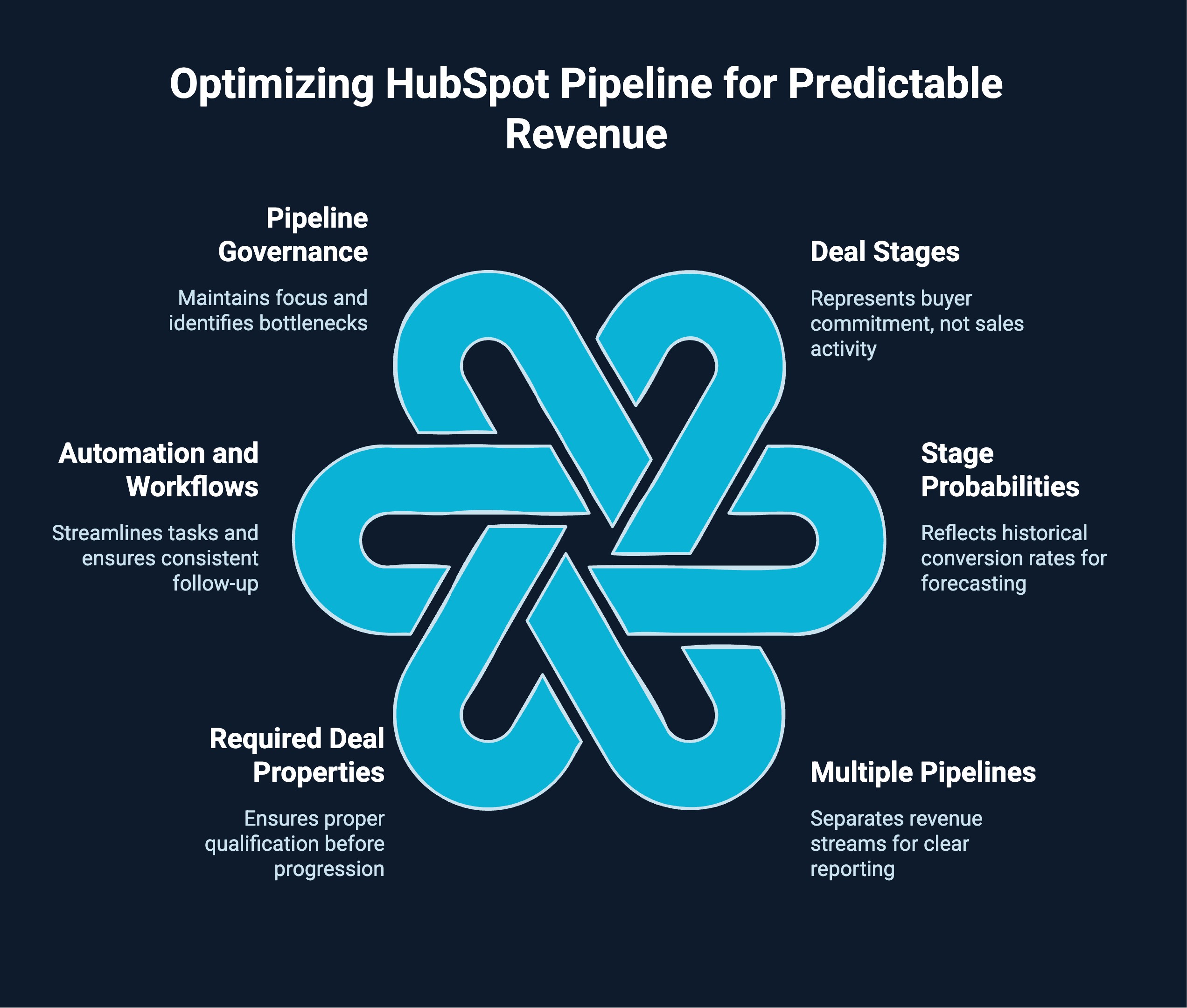
A well-structured pipeline in HubSpot should reflect how your buyers move through the decision process while giving leadership accurate visibility into revenue. When designed intentionally, it becomes a system for managing growth rather than just tracking deals.
When structured thoughtfully, your HubSpot pipeline becomes a practical framework for predictable revenue growth.
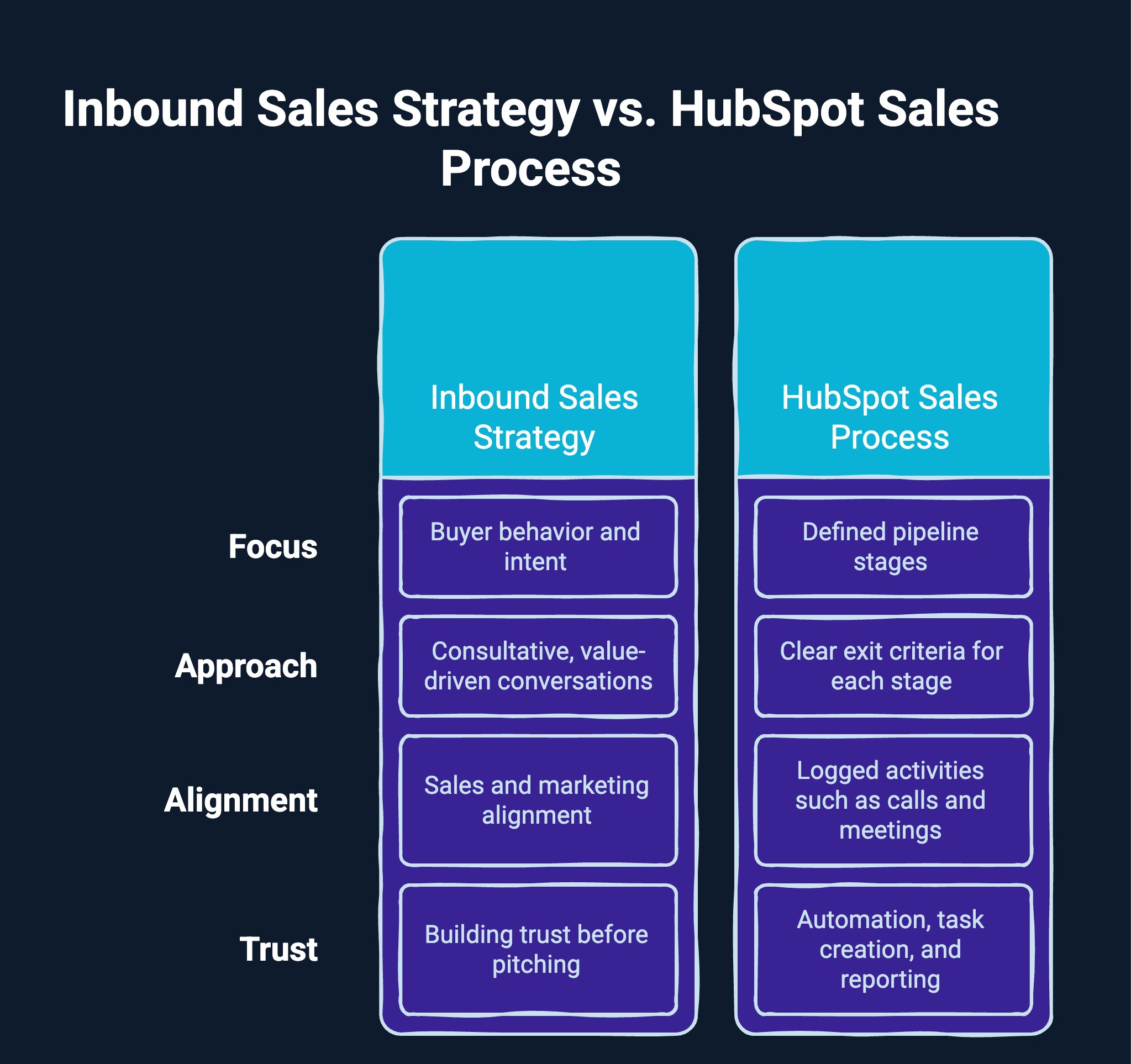
Many teams treat these as the same thing, but understanding the HubSpot difference in inbound sales strategy and the HubSpot sales process is critical for building a scalable revenue system.
An inbound sales strategy defines your philosophy of selling. It focuses on understanding buyer intent, delivering value early, and guiding prospects through their decision journey. It answers the question, “How do we approach selling?”
The HubSpot sales process, on the other hand, turns that philosophy into structured, trackable steps inside your CRM. It answers the question, “What exact stages and actions must happen to move a deal forward?”
Inbound Sales Strategy Focuses On:
HubSpot Sales Process Focuses On:
Simply put, strategy shapes how you sell. The HubSpot sales process ensures you sell that way consistently and at scale. It enables RevOps teams to translate inbound strategy into measurable pipeline stages, automation, and reporting.
Running a SaaS company? Discover how to structure your pipeline, automate revenue workflows, and scale predictable growth with HubSpot in our guide on HubSpot for SaaS.
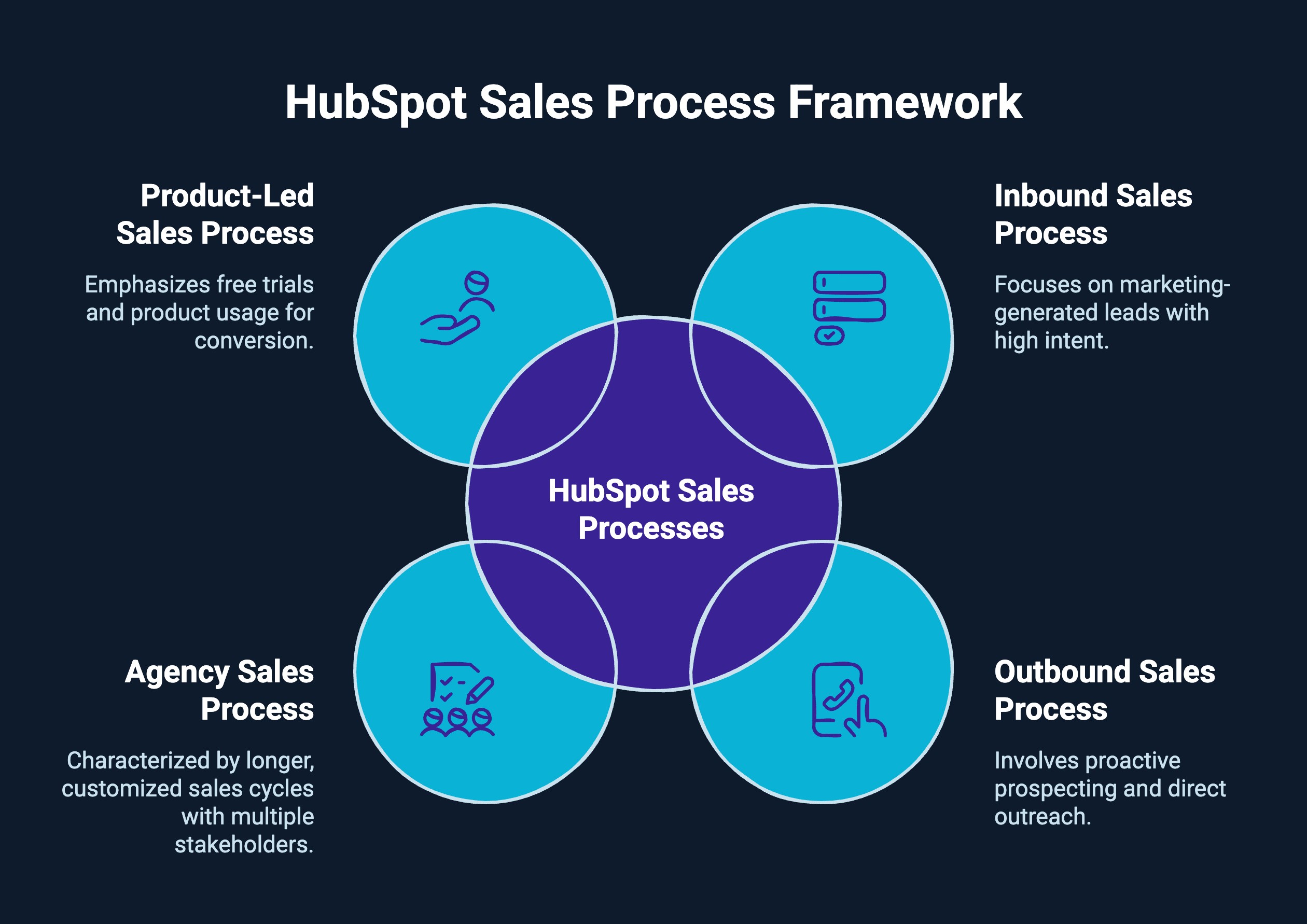
HubSpot allows you to customize pipelines based on how your customers buy. The right HubSpot sales process depends on your lead source, deal complexity, and sales cycle length. Here is how the most common sales processes work in practice.
This process is built for marketing-generated leads who already show intent. Prospects typically enter through forms, downloads, demo requests, or content engagement.
The stages often include:
The focus is consultative. Reps guide prospects based on their needs rather than pushing a pitch. This model works well for content-driven B2B and SaaS companies.
This process is designed for proactive prospecting. Sales teams identify target accounts and initiate conversations through calls, emails, and sequences.
The stages usually include:
Outbound pipelines require stronger activity tracking and automation inside HubSpot, since follow-ups and task management are critical for conversion.
Agencies often have longer and more customized sales cycles. Deals may involve multiple stakeholders, scope discussions, and pricing negotiations.
Typical stages include:
This type of agency sales process in HubSpot often includes custom deal properties such as service type, retainer value, and project duration to improve forecasting.
In product-led growth models, users typically start with a free trial or freemium plan before speaking to sales.
Common stages include:
This process relies heavily on behavioral data synced into HubSpot CRM, helping reps prioritize high-intent users.
Each of these processes can be structured into clear HubSpot sales process stages, ensuring your pipeline reflects real buying behavior instead of a generic template.
Still relying on manual follow-ups and scattered tasks? Explore how to streamline workflows, trigger smarter automations, and accelerate deal progression with our in-depth guide on HubSpot Sales Automation.
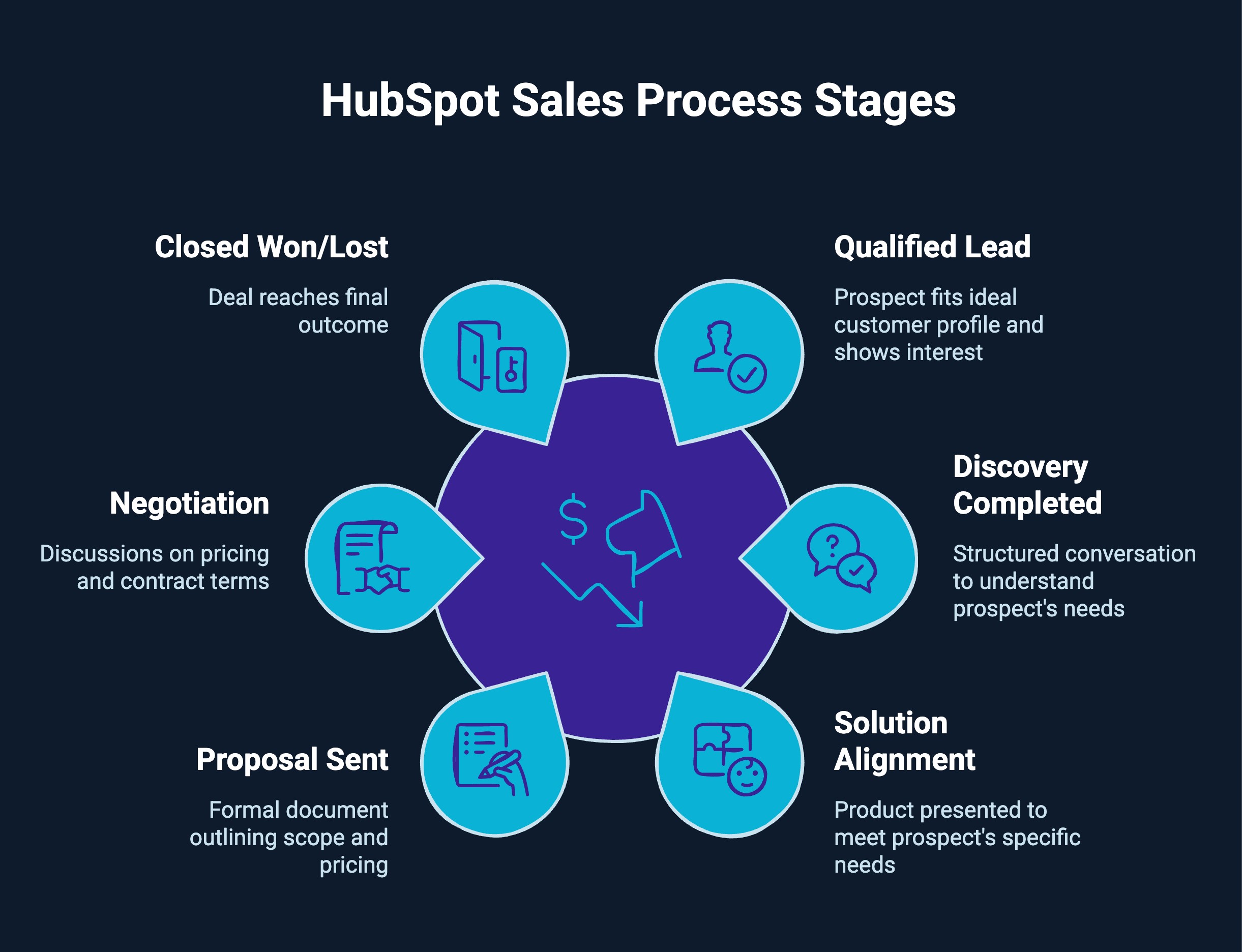
Your HubSpot sales process stages should represent real buying commitment, not just internal activity updates. Inside HubSpot, each stage should have clear entry and exit criteria to maintain forecasting accuracy and pipeline clarity.
Below is a deeper explanation of the most common stages.
At this stage, the prospect fits your ideal customer profile and has shown meaningful interest. This could come from a demo request, inbound inquiry, or successful outbound connection. Qualification confirms basic criteria such as business fit, problem relevance, and potential buying authority.
A structured conversation has taken place to understand the prospect’s challenges, goals, budget range, decision process, and timeline. This stage ensures the opportunity is real and worth pursuing before investing more time.
Your product or service is presented specifically around the prospect’s needs. Instead of a generic pitch, the conversation connects features to measurable outcomes and addresses objections early.
A formal document outlining scope, pricing, timelines, and deliverables is shared with decision-makers. This stage confirms that the opportunity has moved from exploration to serious evaluation.
Final discussions take place around pricing adjustments, contract terms, procurement requirements, or internal approvals. This stage often involves multiple stakeholders and requires strong follow-up management.
The deal reaches a final outcome. If won, onboarding begins. If lost, the reason should be documented to improve future forecasting and process optimization.
These stages should be configured directly in your HubSpot Deal Pipeline with clear entry criteria, exit criteria, and required deal properties to maintain forecasting accuracy.
HubSpot allows you to create multiple deal pipelines within the same CRM. This can improve clarity, but RevOps teams should use it intentionally. More pipelines do not automatically mean better structure. They should simplify reporting and execution, not fragment it.
When to Use Multiple Pipelines:
When to Avoid Multiple Pipelines:
If structured correctly, multiple pipelines improve clarity. If overused, they create silos.
Ready to optimize your HubSpot pipeline structure? Book a RevOps strategy call with LeadGem today.
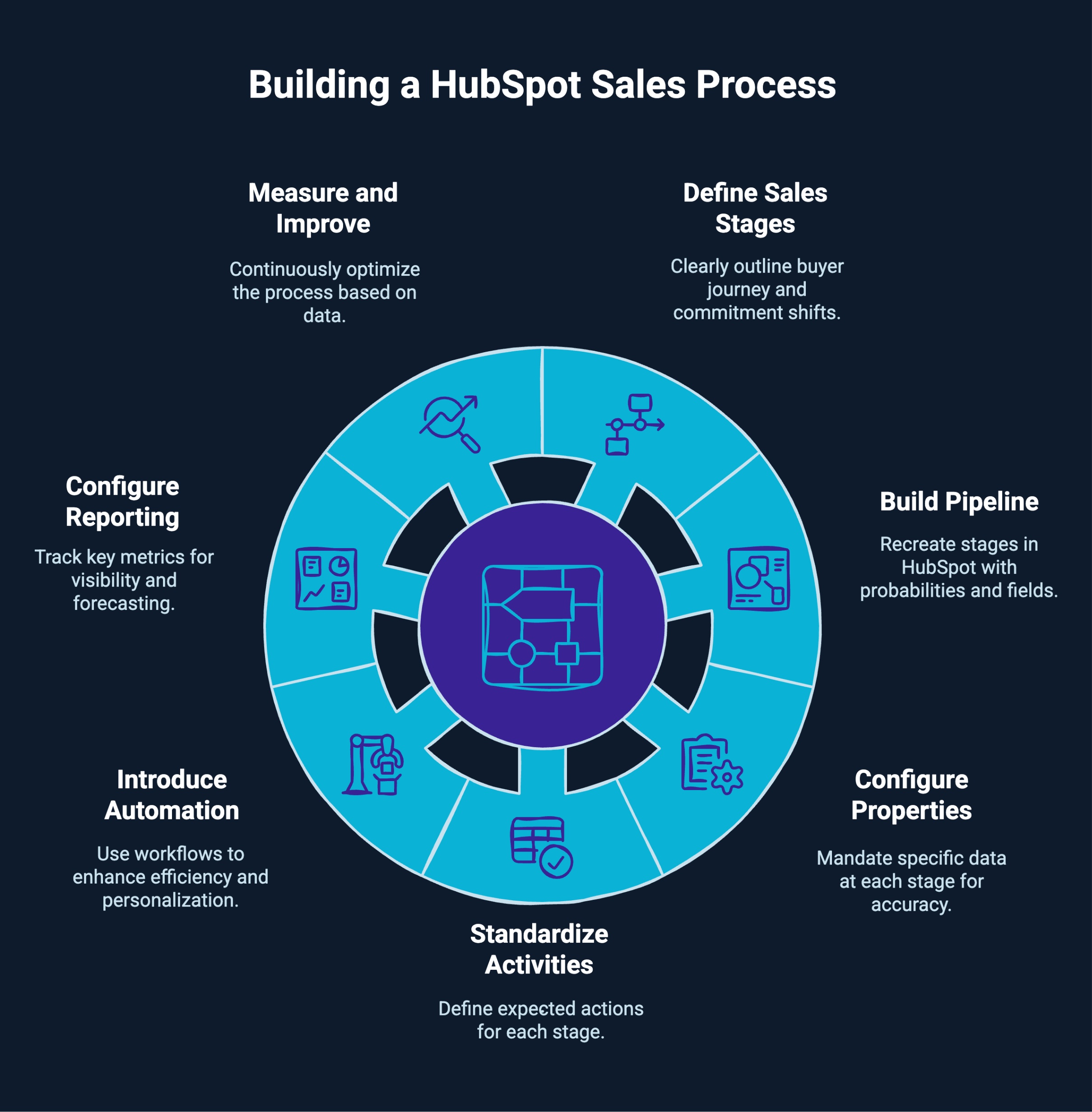
Building a structured HubSpot sales process inside HubSpot takes more than just creating pipeline stages. It requires aligning your buyer journey, sales activities, and CRM configuration into one consistent system. Below is a clearer, more practical breakdown of how to do it properly.
Start by mapping your real buying journey. Outline how a prospect moves from the first conversation to a signed agreement.
Each stage should represent a meaningful shift in buyer commitment. For example, moving from “Qualified” to “Discovery Completed” should confirm that a real conversation occurred and needs were identified.
Avoid vague names like “In Progress.” Every stage must have defined exit criteria so reps know exactly when a deal qualifies to move forward.
Once your stages are finalized, recreate them inside your HubSpot deal pipeline.
Assign realistic deal probabilities to improve forecast weighting. Add required fields such as deal amount, expected close date, and decision-maker status to support data accuracy.
This step converts your documented process into a working CRM system.
A strong process depends on clean, structured data. Define which deal properties are mandatory at specific stages.
For example, budget confirmation may be required before moving to proposal, while close date accuracy may be required before entering negotiation.
Standardizing required properties improves reporting reliability and prevents pipeline inflation.
Each stage should have clear expected actions.
Discovery may require a logged call and detailed notes. The proposal may require a shared document and a scheduled follow-up task.
This ensures consistency across reps and prevents deals from progressing without proper qualification.
Automation should enhance efficiency without replacing strategic selling.
Use workflows to assign leads, trigger follow-up tasks, notify managers, or update stages based on completed activities.
Well-designed automation reduces manual work while keeping the sales experience personalized.
Your process is incomplete without visibility. Build dashboards that track stage conversion rates, sales cycle length, win rate, pipeline coverage, and forecast accuracy.
Align forecast categories with your stage definitions to ensure revenue projections reflect real deal health.
Clear reporting transforms your sales process into a predictable revenue engine.
A sales process should evolve based on performance data.
Regularly review conversion rates, deal velocity, and stage duration. If deals consistently stall at one point, refine stage criteria or supporting activities.
Continuous optimization keeps your HubSpot sales process aligned with buyer behavior and growth targets.
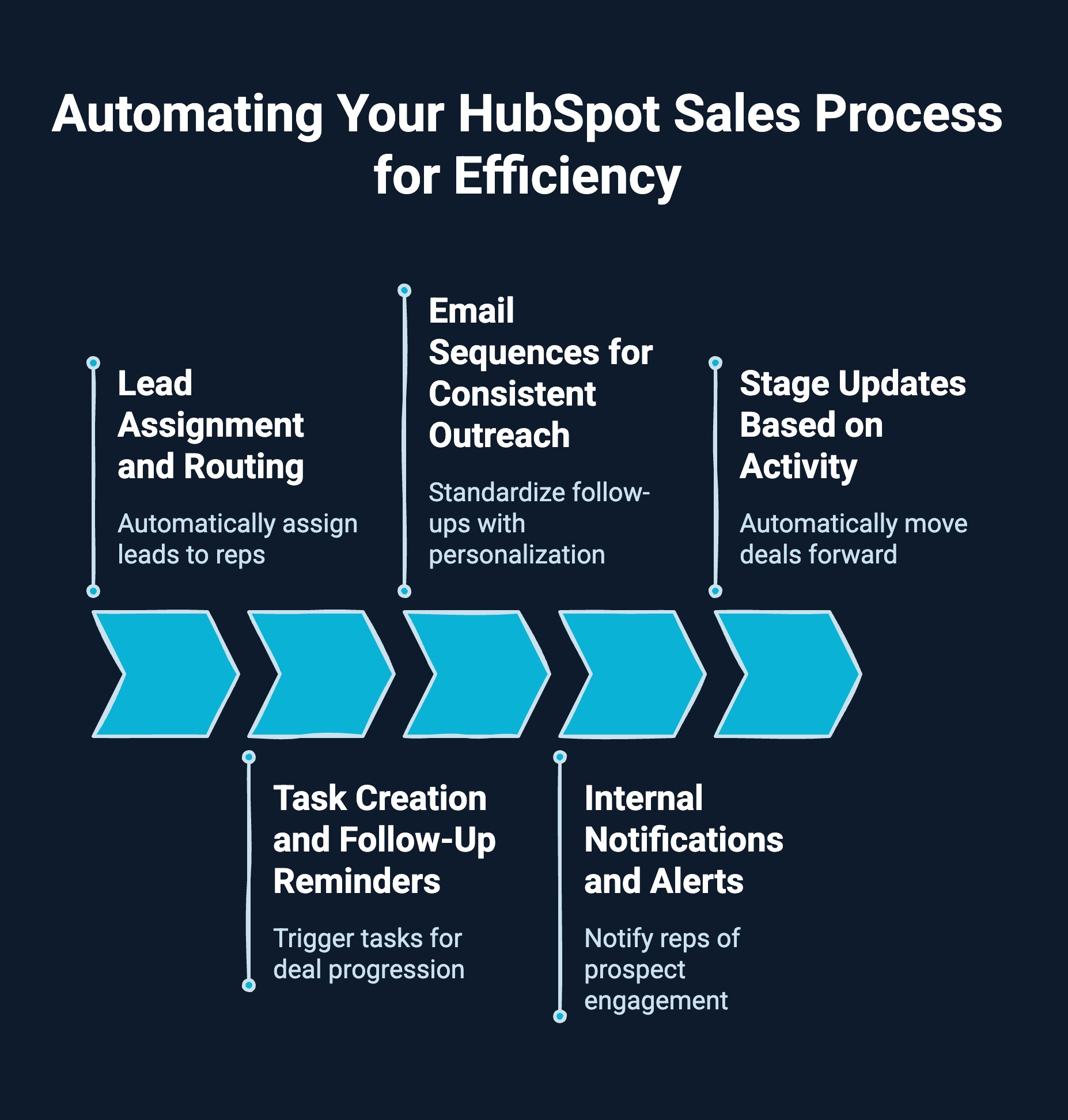
Once your stages are clearly defined, the next step is to scale efficiency. HubSpot allows you to automate repetitive tasks so your team spends more time selling and less time managing admin work. When done correctly, automation strengthens your HubSpot sales process without removing the human touch.
Here are the key areas where automation makes the biggest impact:
The goal is not to automate everything. It is to remove friction from repetitive workflows while keeping strategic conversations human. When balanced properly, automation increases efficiency, improves response time, and strengthens forecasting accuracy.
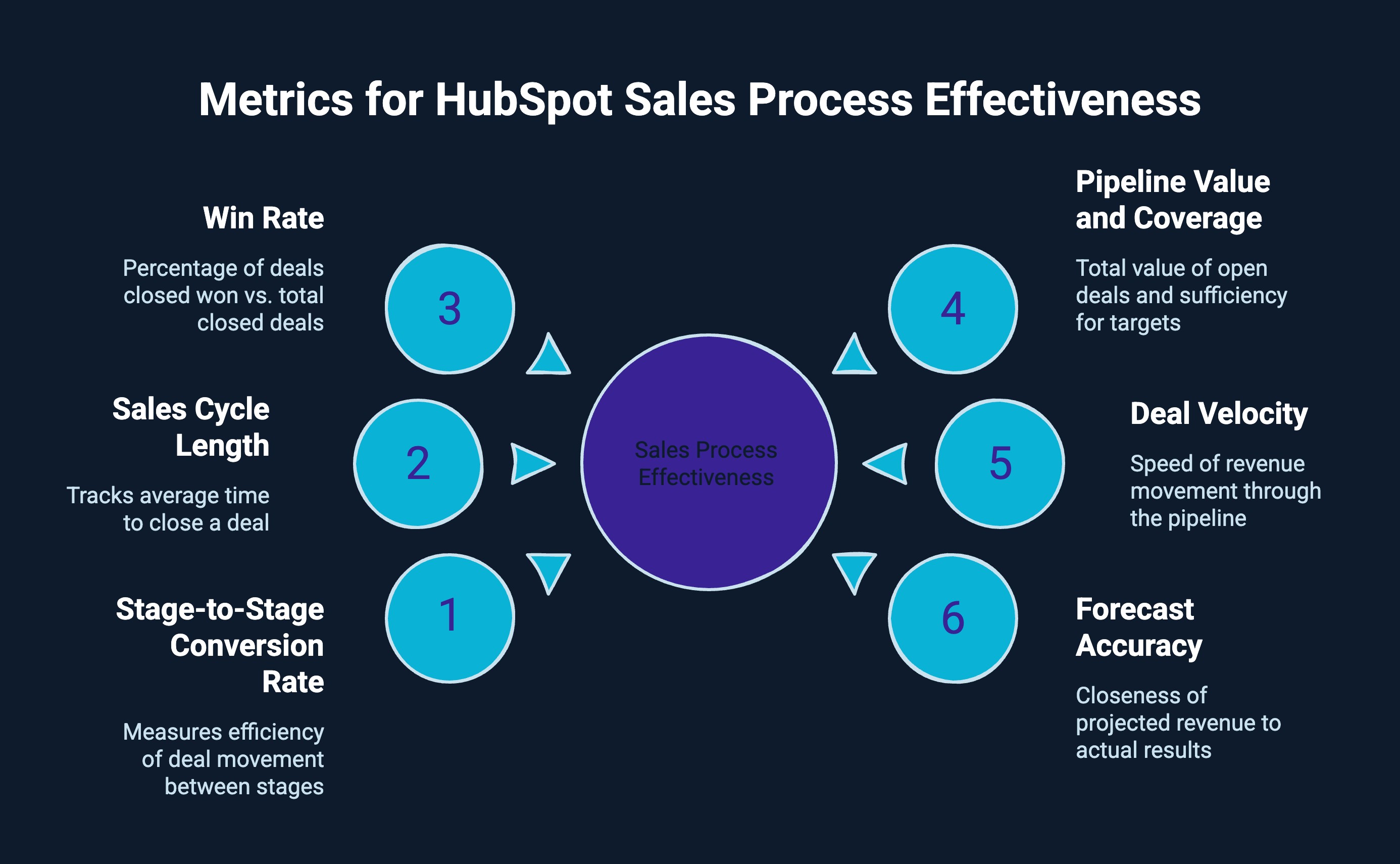
A well-structured HubSpot sales process is only effective if it is measurable. Inside HubSpot, reporting and dashboards allow you to evaluate performance at every stage of the pipeline. Tracking the right metrics helps you identify bottlenecks, improve forecasting, and increase revenue predictability.
Here are the most important metrics to monitor:
By consistently monitoring these metrics, you can refine your HubSpot sales process stages, improve forecasting accuracy, and build a predictable revenue engine instead of relying on guesswork.
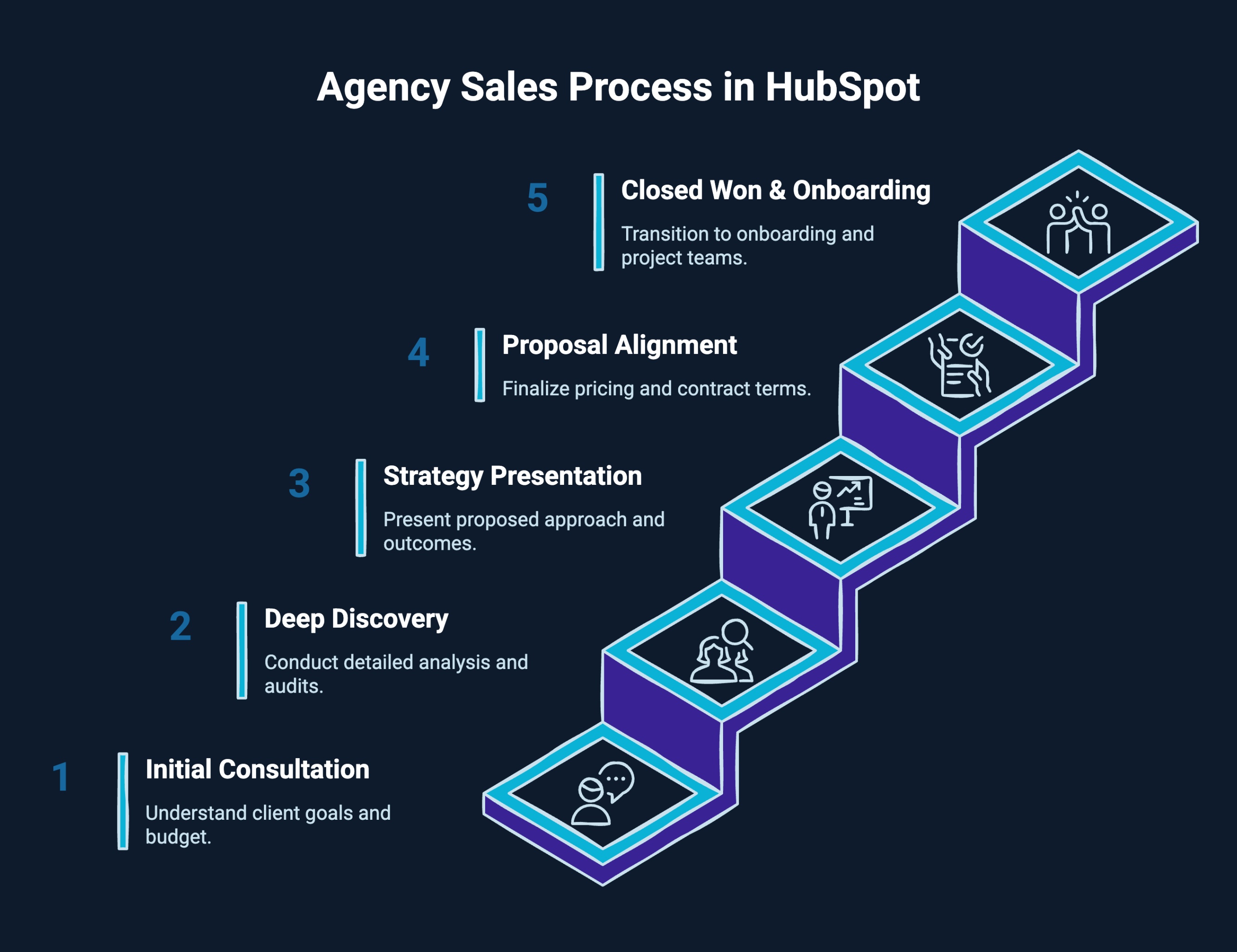
For agencies, the HubSpot sales process looks different from a typical product-based company. Service deals are often longer, involve multiple stakeholders, and require customized proposals. That is why many agencies build a tailored agency sales process in HubSpot to reflect how consulting and retainers are actually sold.
Here is how agencies typically structure it:
Agencies also rely heavily on custom deal properties such as service type, contract duration, and retainer value. Structuring these correctly inside HubSpot improves forecasting, resource planning, and revenue visibility.
Selling complex solutions? See how manufacturers streamline intricate sales cycles, improve lead qualification, and drive predictable revenue with tailored tactics in our HubSpot for Manufacturing guide.
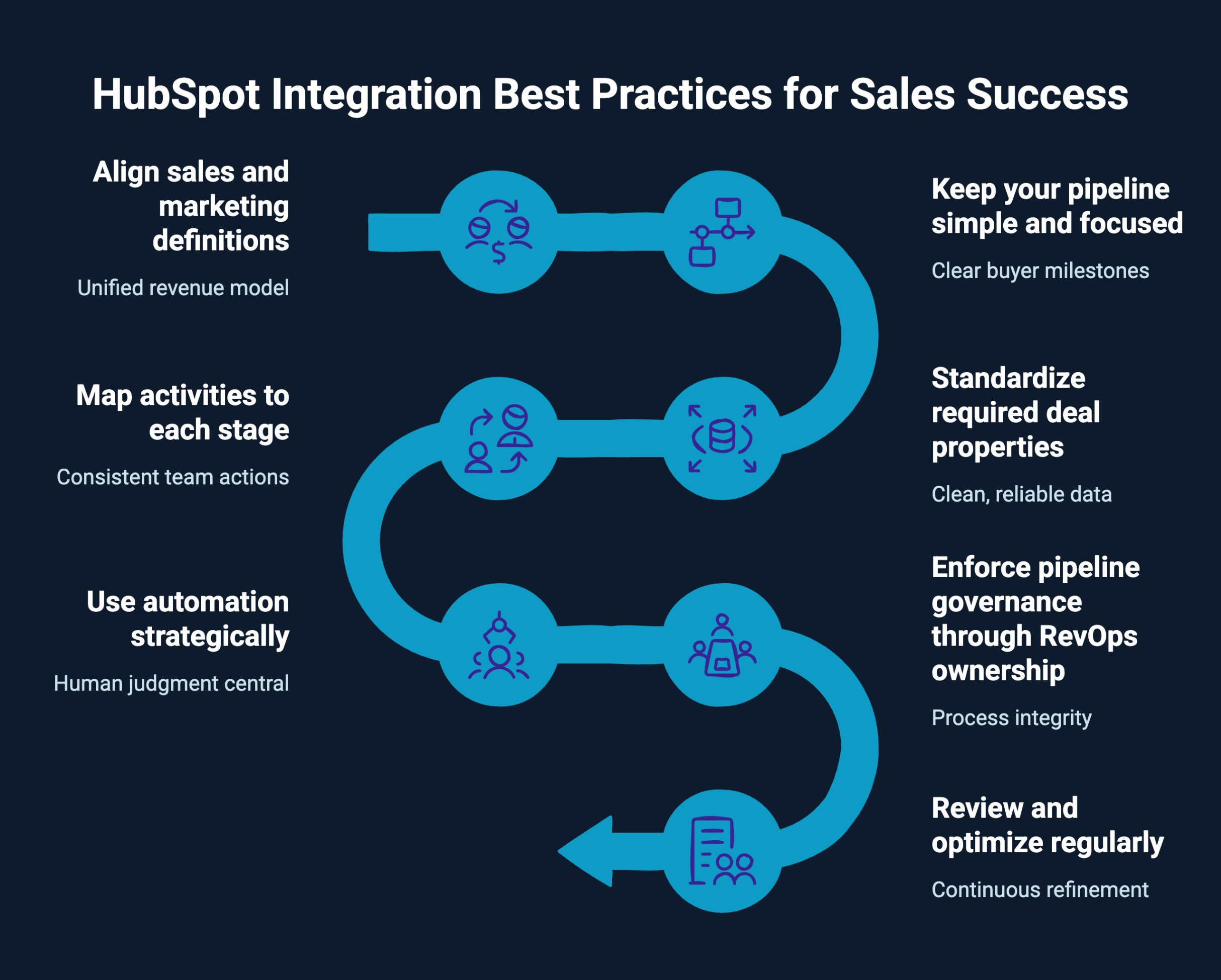
Successfully implementing HubSpot requires more than setting up deal stages. The key is embedding HubSpot into daily workflows so it becomes the single source of truth for your revenue team.
Here are the best practices for integrating HubSpot into sales processes:
Following these best practices ensures HubSpot supports your process instead of becoming just another tool your team partially uses.
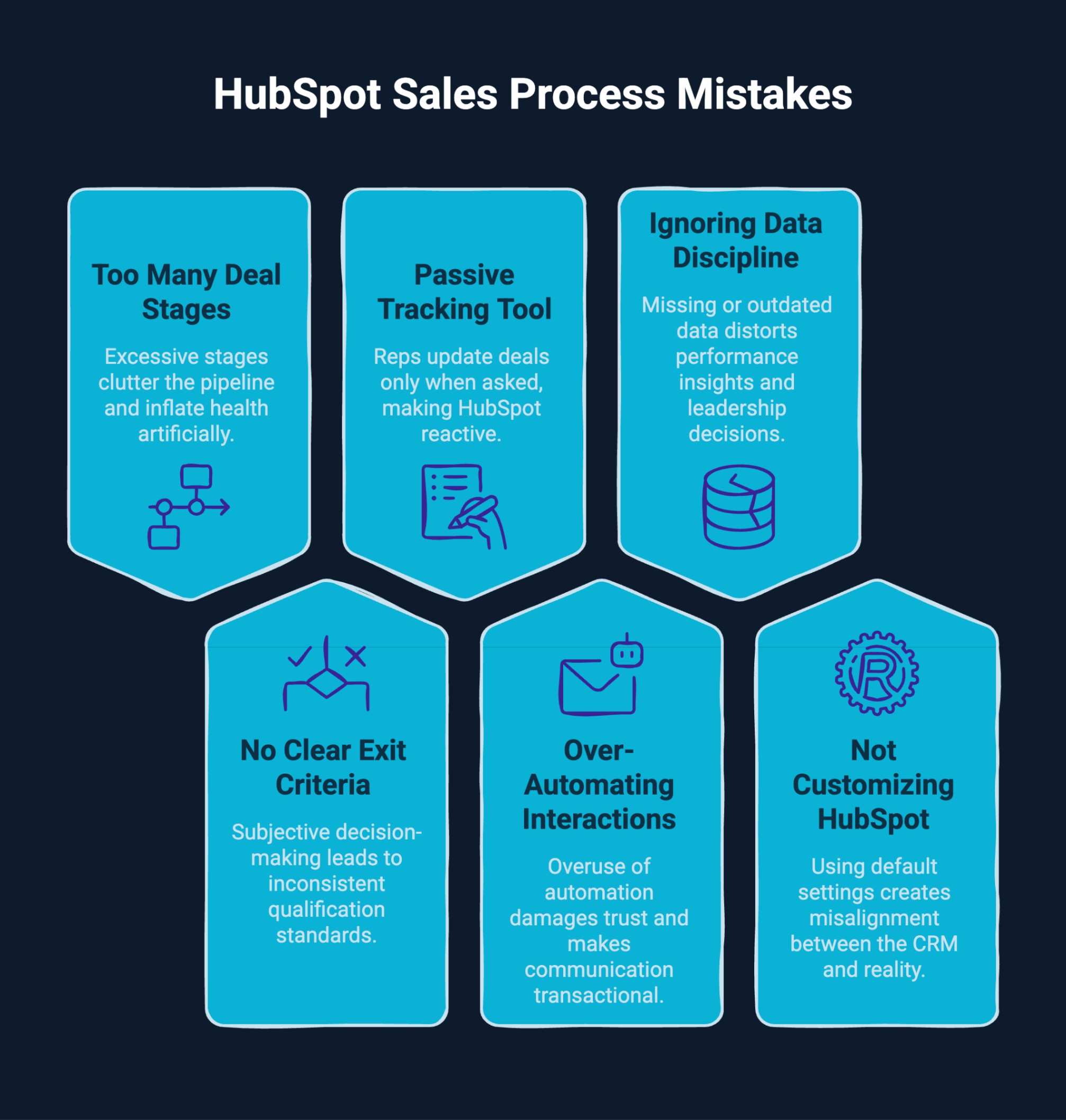
Even when teams use HubSpot daily, their HubSpot sales process often underperforms because of structural flaws. These are not small configuration errors. They directly impact forecast accuracy, rep productivity, and revenue consistency.
Adding excessive stages usually happens when teams try to track every minor activity as progress. The result is a cluttered pipeline where movement between stages does not represent real buyer commitment.
When stages are too granular, reps move deals forward just to show activity, not advancement. This inflates pipeline health artificially and makes forecasting unreliable. A strong sales process limits stages to true buying milestones such as qualification completed, proposal sent, or contract under review.
A stage without defined exit criteria creates subjective decision-making. One rep may move a deal forward after a positive call, while another waits for budget confirmation.
This inconsistency leads to uneven qualification standards across the team. Clear exit criteria, such as confirmed decision-maker involvement or agreed budget range, ensure that movement in your HubSpot CRM sales process reflects real opportunity quality.
If reps update deals only when managers ask for reports, HubSpot becomes reactive rather than operational. The system should actively guide daily selling behavior.
When properly integrated, tasks, follow-ups, reminders, and activity logging happen in real time. This makes the CRM part of the workflow, not an administrative afterthought.
Automation improves efficiency, but overuse can damage trust. Automatically advancing deals or sending rigid email sequences without personalization can make communication feel transactional.
Automation should support follow-ups and internal workflows while keeping strategic conversations human. The strongest HubSpot sales process balances system efficiency with relationship depth.
Even a well-designed pipeline fails without clean data. Missing deal values, outdated close dates, or incomplete qualification fields distort performance insights.
Leadership decisions such as hiring, budgeting, and forecasting rely on CRM accuracy. Data discipline must be enforced through required properties, regular audits, and accountability at the rep level.
Every sales organization operates differently. A complex B2B sales cycle, high-velocity transactional model, or account-based motion each requires different pipeline logic and reporting structures. Using default settings without adapting them to your actual buying journey creates misalignment between the CRM and reality.
Avoiding these bigger structural mistakes ensures your HubSpot sales process stages represent genuine buying progress, support reliable forecasting, and drive consistent revenue growth instead of just creating the illusion of activity.
At LeadGem, we help B2B companies turn their HubSpot sales process into a predictable revenue engine. Headquartered in Amsterdam, the Netherlands, we are a B2B growth and Revenue Operations agency with 5+ years of experience in growth marketing and growth hacking.
We build advanced RevOps and outbound systems that transform CRM setups into scalable pipeline engines.
What We Offer at LeadGem:
If you’re ready to make your HubSpot CRM work as a true revenue driver, connect with LeadGem and let’s build a system designed for predictable, scalable growth.
A high-performing HubSpot sales process is built on clarity and discipline. Clear stages. Clear qualification. Clear forecasting.
When your pipeline reflects real buying commitment, revenue becomes predictable and scalable. Your team executes with confidence instead of reacting to chaos.
Design it intentionally. Automate it intelligently. Optimize it continuously. That is how your HubSpot CRM becomes a true growth engine, not just a tracking tool.
When implemented correctly, HubSpot becomes the operational backbone of your revenue team, enabling scalable and predictable growth.
HubSpot lifecycle stages define where a contact sits in the buyer’s journey, from initial contact to customer. They align lead scoring, sales enablement, and the structured sales process inside the HubSpot sales pipeline to improve sales performance and customer experience.
The CRM process in sales manages interactions from initial contact to deal progression within a CRM platform. It supports deal management, pipeline management, sales data tracking, and aligns team members around a structured sales process and measurable key metrics.
You automate the sales process using HubSpot sales automation within Sales Hub. This includes predictive lead scoring, email templates, live chat routing, task creation, and automated deal pipeline updates, reducing manual tasks while improving pipeline management and team performance.
Building a workflow starts with creating a sales process that HubSpot can automate. Define enrollment triggers, set conditions, and map actions like task creation or deal updates. Workflows support HubSpot different types of sales processes with structured automation.
Create a deal when a qualified opportunity shows clear buying intent and meets defined exit criteria. Whether following inbound models or an agency sales process HubSpot setup, deals should reflect real revenue potential and confirmed deal progression.