

Contact


Outbound prospecting often feels unpredictable; teams invest in tools, hire SDRs, and run campaigns, yet pipeline quality remains inconsistent or hard to scale.
The goal of outbound today isn’t volume. It’s building a repeatable system that reliably reaches the right buyers and converts effort into revenue.
This guide breaks down what modern outbound prospecting agencies actually do, why they still matter in 2026, and which 15 agencies stand out for driving real, measurable growth.
An outbound prospecting agency helps businesses proactively identify, engage, and qualify potential customers instead of waiting for inbound leads. These agencies act as an extension of your sales development function, building systems that turn cold or warm accounts into qualified sales conversations.
A modern outbound prospecting agency typically executes against an existing ICP by handling account research, data enrichment, messaging, multi-channel outreach, meeting booking, and performance reporting. Strong partners integrate tightly with your CRM and sales process, ensuring prospecting activity feeds directly into pipeline visibility and forecasting.
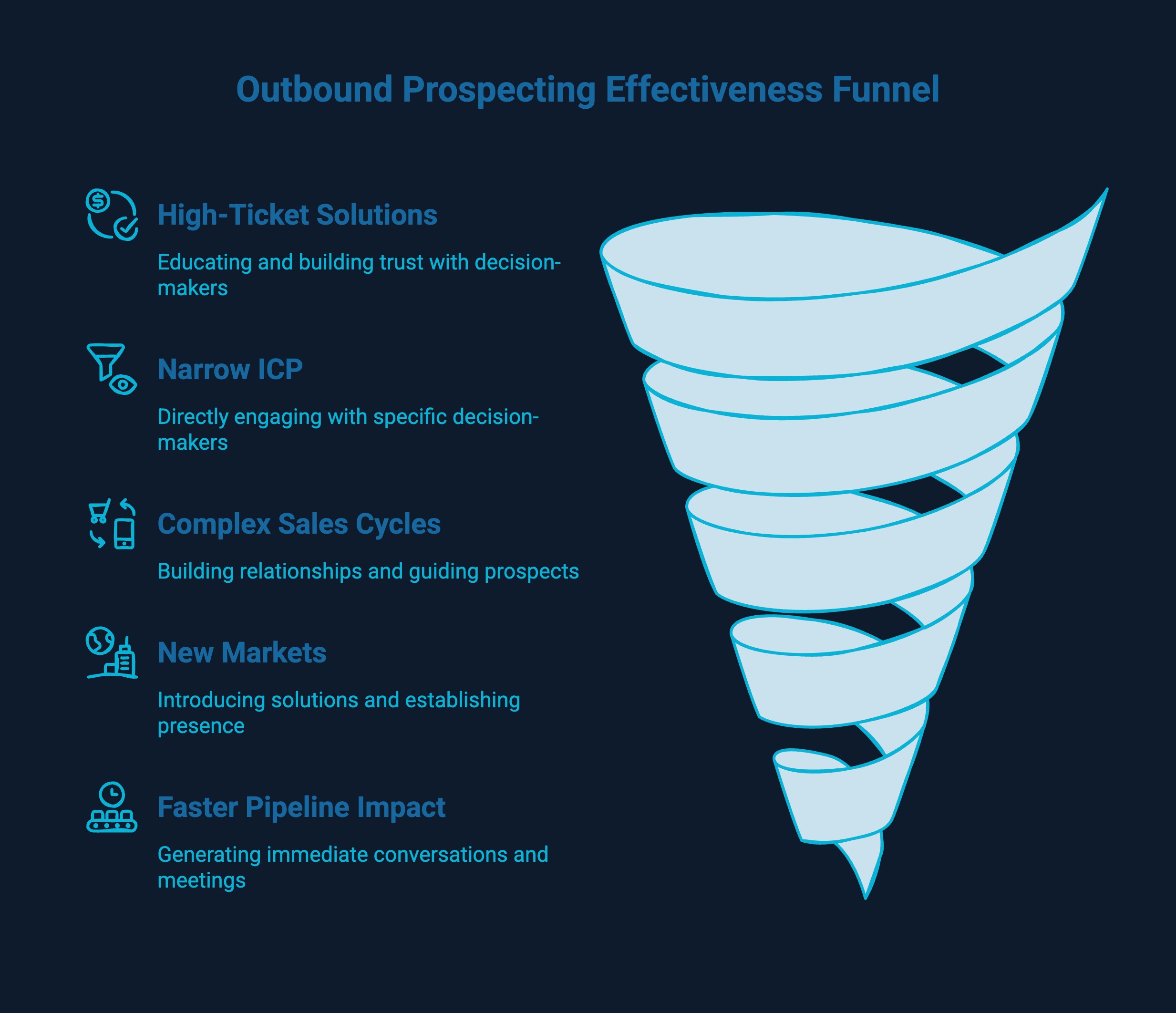
Outbound prospecting becomes more effective when growth requires precision, speed, and direct engagement with specific decision-makers rather than waiting for interest to emerge organically.
Outbound is the better approach in the following situations.
High-value offerings often require education, trust-building, and multiple stakeholder conversations. Outbound allows sales teams to proactively start these discussions rather than relying on prospects to discover complex solutions independently.
When targeting a specific set of accounts or roles, inbound can be inefficient. Outbound prospecting enables direct access to defined decision-makers, ensuring effort and messaging are focused only on high-fit prospects.
Long or consultative sales cycles benefit from early, proactive engagement. Outbound creates opportunities to build relationships, understand buying committees, and guide prospects through extended decision-making processes.
In new markets, awareness is limited, and inbound demand may be low. Outbound helps introduce your solution, test messaging, and establish presence faster without waiting for search demand to develop.
Inbound takes time to compound results. Outbound prospecting delivers immediate reach, allowing teams to generate conversations, meetings, and pipeline predictably within weeks rather than months.
In these scenarios, outbound prospecting provides control over who you reach, when you engage, and how your message lands.
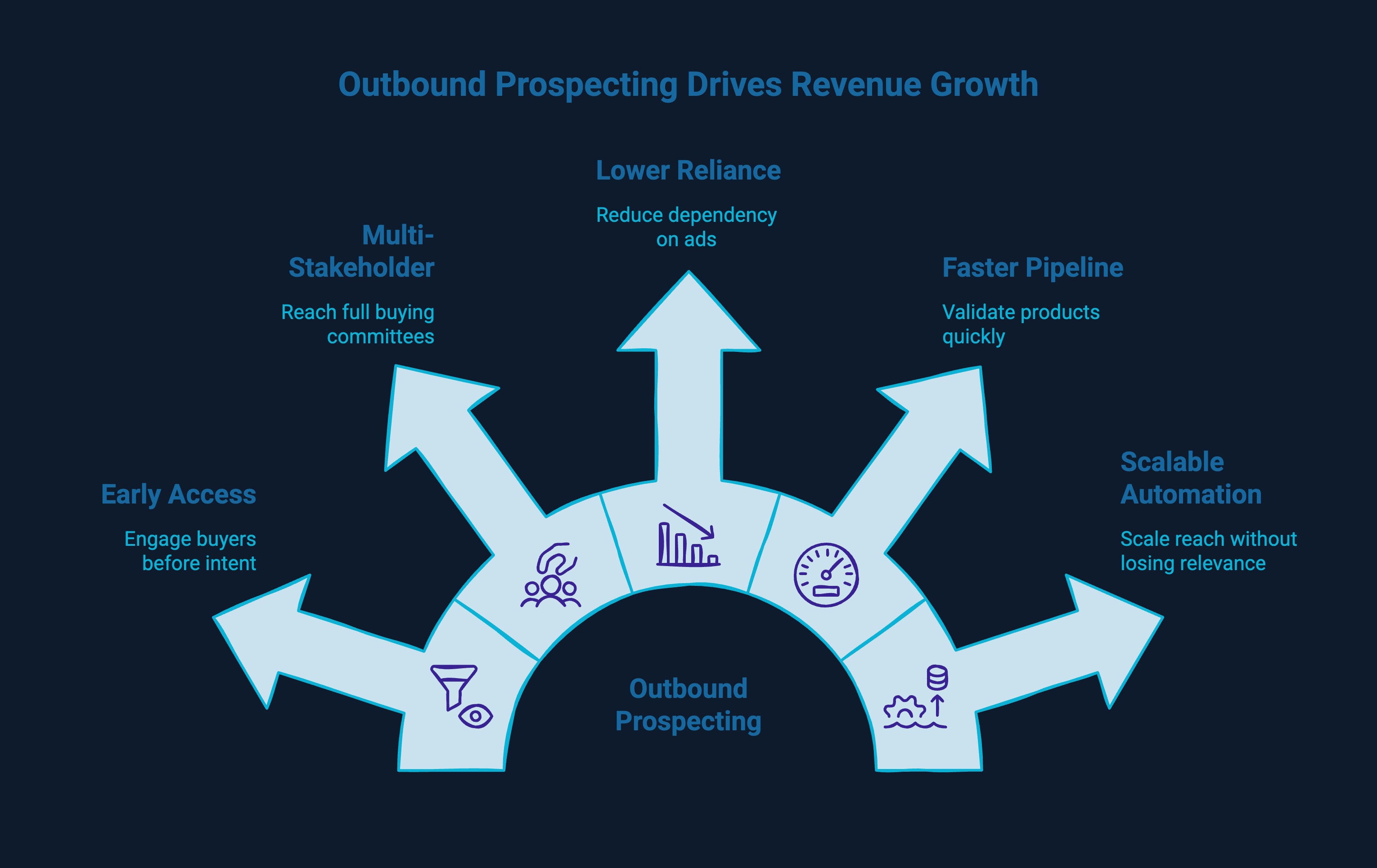
By 2026, inbox saturation and higher competition make inbound slower and more expensive. Outbound prospecting remains essential because it creates proactive demand, accelerates pipeline creation, and gives revenue teams direct control over growth.
Why outbound prospecting still matters in 2026:
Executed with strong data and thoughtful personalization, outbound remains one of the most reliable channels for sustained B2B pipeline growth.
A practical outbound tech stack should balance deliverability, scale, and simplicity. This setup focuses on proven tools for cold email, LinkedIn outreach, enrichment, and CRM syncing, while keeping referral links intact and recommendations grounded in real-world outbound performance.
Here’s how the recommended stack comes together in practice:
Use HeyReach + Smartlead/Instantly for advanced, high-volume outbound, and LaGrowthMachine for a lighter setup, keeping in mind it scales in cost as teams grow beyond three users.
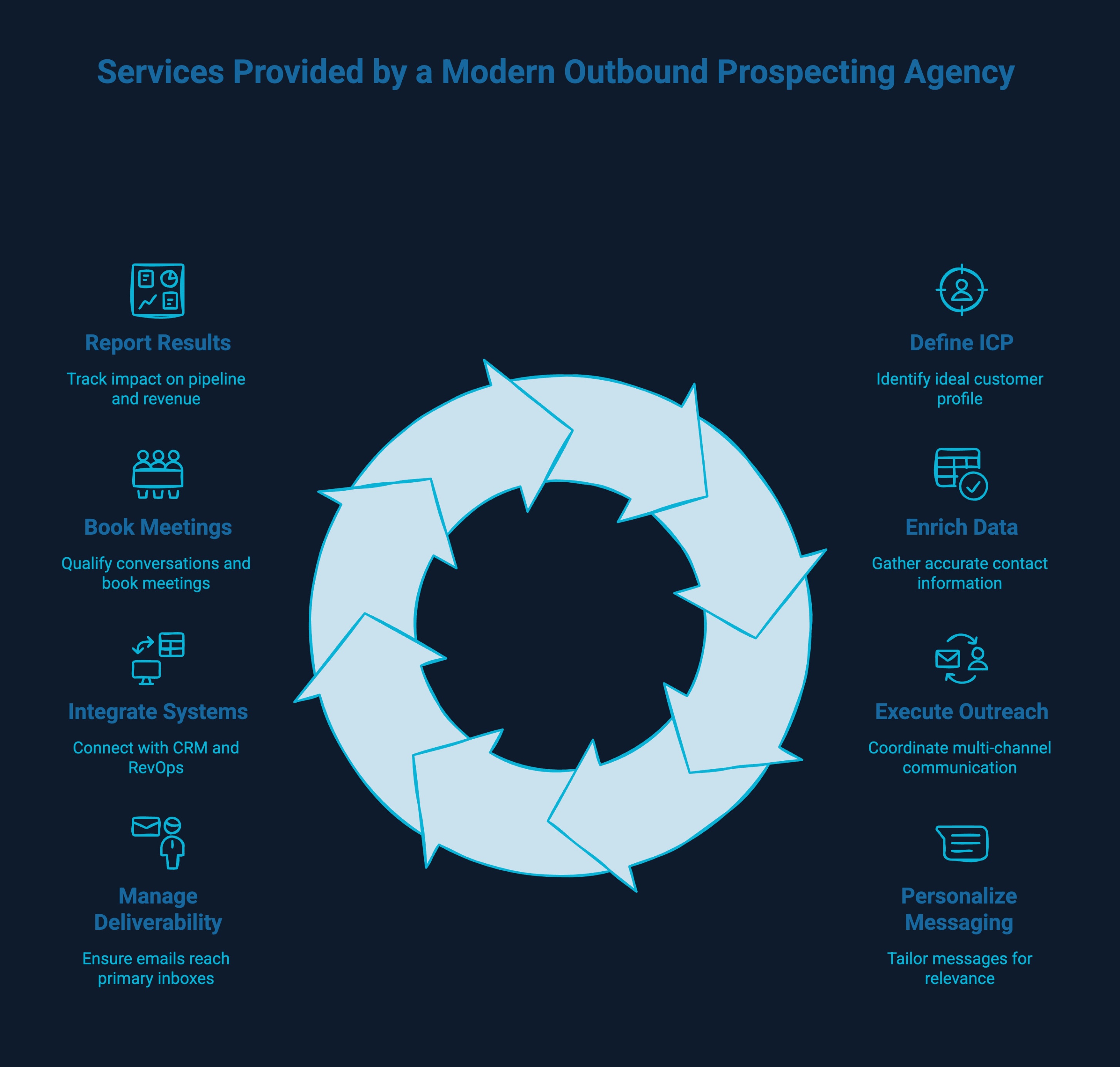
A modern outbound prospecting agency must deliver more than activity; it should build a repeatable, revenue-focused system. Effective agencies combine strategy, data, execution, and measurement to generate a qualified pipeline rather than disconnected outreach volume.
A high-performing outbound agency should include the following services.
A strong outbound program begins with precision targeting. Agencies should help define your ideal customer profile, buying signals, and account criteria, ensuring outreach focuses on high-fit companies and roles that align with deal size, sales motion, and long-term revenue potential.
Accurate data is the foundation of outbound success. Agencies must enrich contact records with verified emails, titles, firmographics, and intent signals while continuously cleaning lists to protect deliverability and ensure messages reach real, relevant decision-makers consistently.
Effective outbound combines email, LinkedIn, and calling into coordinated sequences. Agencies should design and manage multi-channel touchpoints that reinforce messaging, increase response rates, and create multiple opportunities for prospects to engage across preferred communication channels.
Agencies should build scalable messaging frameworks that balance relevance and efficiency. This includes value-based positioning, role-specific pain points, and personalization logic that allows teams to tailor outreach without sacrificing volume, consistency, or brand voice.
Inbox placement directly impacts results. A modern agency must manage domain setup, warming, authentication, sending limits, and monitoring to protect sender reputation and ensure campaigns consistently land in primary inboxes rather than spam or promotions folders.
Outbound should never operate in isolation. Agencies must integrate seamlessly with CRM and RevOps systems to ensure clean data flow, accurate attribution, proper lead handoff, and alignment with sales processes, forecasting, and revenue reporting.
Beyond generating replies, agencies should qualify conversations against agreed criteria before booking meetings. This protects sales teams from low-intent leads and ensures booked meetings have clear context, fit, and potential to progress into the pipeline.
Reporting should go beyond vanity metrics. Agencies must track how outbound activity translates into meetings, pipeline creation, deal progression, and revenue impact, enabling leadership to evaluate performance based on business outcomes, not just outreach volume.
Agencies that stop at “sending emails” rarely build sustainable, scalable outbound engines.
Outbound prospecting continues to evolve in 2026, with agencies combining data, automation, and human expertise to help teams generate a qualified pipeline at scale. The companies below represent leading outbound agencies to consider based on strategy, execution quality, and results across different growth stages.
LeadGem is a B2B outbound and GTM agency that specializes in building scalable, RevOps-aligned prospecting systems for growth-focused companies. Rather than running isolated or short-term campaigns, LeadGem designs end-to-end outbound infrastructure that connects data, automation, and CRM workflows into a predictable revenue channel.
Headquartered in Amsterdam, the Netherlands, LeadGem supports companies across Benelux (Netherlands, Belgium), the Nordics (Sweden, Norway, Denmark), North America, and Australia, making them well-positioned for multi-market outbound execution and global GTM motions.
With a strong focus on execution, LeadGem ensures outbound prospecting is tightly integrated with RevOps foundations, so pipeline quality, reporting accuracy, and sales handoffs improve as volume scales.
LeadGem is best for B2B and SaaS companies that want outbound prospecting tied directly to pipeline performance, data quality, and RevOps execution, turning outbound into a reliable, scalable growth engine rather than a standalone tactic.
Growth Engine X is an outbound growth agency specializing in cold email infrastructure, deliverability, and scalable outbound execution. Their approach centers on building the technical foundation required to run cold email at scale without sacrificing inbox placement, personalization, or performance.
Rather than relying on generic sequences, Growth Engine X focuses on systems, testing, and optimization that make cold email a predictable, repeatable revenue channel.
Growth Engine X is best for teams that want to scale cold email predictably, with strong deliverability controls and outbound systems designed for consistent pipeline generation.
C17 Lab is a revenue engineering agency that specializes in installing outbound-led revenue systems designed to convert buyer intent into a qualified pipeline. Rather than running disconnected campaigns, C17 Lab builds structured outbound infrastructure supported by data, automation, and RevOps workflows.
Their approach ensures intent signals are captured, prioritized, and acted on consistently, turning outbound prospecting into a repeatable GTM motion.
C17 Lab is best for companies prioritizing outbound-led GTM that want intent-driven prospecting tied directly to CRM systems, RevOps workflows, and predictable pipeline growth.

ColdIQ is an outbound automation agency that builds fully automated prospecting engines designed to replace traditional SDR-heavy models. Their systems focus on speed, scale, and consistency, enabling SaaS teams to generate a pipeline without relying on a large outbound headcount.
By combining automation, targeting, and performance tracking, ColdIQ helps teams move from manual outreach to a more efficient, system-driven outbound motion.
ColdIQ is best for SaaS teams that want fast, automated pipeline generation and are looking to scale outbound efficiently without building or expanding a traditional SDR organization.
SalesCaptain is an outbound-focused agency that helps teams build structured, repeatable outbound systems using automation, enriched data, and CRM-driven workflows. Their approach replaces ad-hoc outreach with consistent processes that support predictable pipeline creation.
By grounding outbound execution in clean data and well-defined workflows, SalesCaptain ensures outreach efforts scale efficiently while remaining measurable and aligned with revenue goals.
SalesCaptain is best for teams that need repeatable outbound execution built on automation, clean data, and CRM workflows to turn outreach into a reliable pipeline engine.
The Kiln is a GTM engineering agency focused on building highly automated outbound systems driven by data, intent signals, and RevOps foundations. Rather than treating outbound as a campaign function, The Kiln engineers repeatable GTM infrastructure that connects targeting, enrichment, automation, and CRM workflows into one scalable system.
Their work sits at the intersection of RevOps and GTM engineering, making outbound execution more technical, measurable, and resilient as volume increases.
The Kiln is best for RevOps-led teams that need to scale highly technical outbound systems and want GTM infrastructure built with long-term scalability, automation, and data integrity at the core.
Belkins is a B2B outbound agency best known for appointment setting and multi-channel outbound campaigns. They help companies outsource SDR activity by handling prospect research, outreach, follow-ups, and meeting booking across email, LinkedIn, and calling.
Belkins focuses on delivering sales-ready meetings rather than just activity, making outbound a reliable top-of-funnel channel for growing teams.
Belkins is best for companies that want to outsource SDR execution and meeting booking, especially teams looking for a hands-off way to generate qualified sales conversations through structured outbound campaigns.
CIENCE Technologies is an enterprise-scale outbound and lead generation provider that combines human SDR teams with data, research, and automation to deliver a high-volume pipeline. Their model blends people, process, and technology to support complex outbound programs across multiple regions and segments.
CIENCE is built to handle scale, making it a common choice for large organizations that need consistent lead flow across broad markets.
CIENCE Technologies is best for large B2B organizations that need outbound prospecting at scale and are focused on volume-driven pipeline generation supported by a mix of human SDRs and automation.
Martal Group is an outsourced sales and SDR agency that helps B2B companies scale pipeline through structured sales development programs. They provide trained SDR teams that handle prospecting, outreach, qualification, and meeting booking, acting as an extension of internal sales organizations.
Their model is designed to support both mid-market and enterprise sales motions, with processes built around consistency, volume, and measurable pipeline contribution.
Martal Group is best for mid-market and enterprise companies looking to outsource sales development while maintaining structured processes, consistent outreach, and scalable pipeline generation across larger sales teams.
Memory Blue is a sales acceleration firm specializing in enterprise-grade sales development and pipeline acceleration for complex B2B organizations. It was formerly known as Operatix. They support global sales teams by providing experienced SDR resources, structured outreach programs, and proven methodologies tailored to long sales cycles and multi-stakeholder buying environments.
Their approach emphasizes quality conversations, rigorous processes, and alignment with enterprise sales strategies.
Memory Blue is best for enterprise and global B2B sales teams that need a specialized partner to accelerate pipeline through high-quality sales development aligned with complex, long-cycle sales motions.
SalesRoads is an outbound sales development firm that emphasizes human-led outreach and appointment setting. Their model relies on experienced sales professionals who focus on real conversations, qualification, and relationship-building rather than heavy automation alone.
This approach is designed for companies where trust, personalization, and consultative selling play a critical role in moving prospects through the buying process.
SalesRoads is best for companies that rely on relationship-driven outbound sales and want experienced sales professionals handling prospect conversations and appointment setting rather than fully automated outreach.
Callbox is a B2B lead generation provider that delivers multi-channel outreach across calling, email, and social media. Their approach is built for scale, combining human agents with structured processes to generate high volumes of leads across diverse markets and industries.
Callbox emphasizes reach and consistency, making it easier for sales teams to maintain a steady top-of-funnel flow.
Callbox is best for companies that need volume-based outreach and consistent lead flow, especially teams focused on broad market coverage rather than highly personalized outbound programs.
Cleverly is an outbound prospecting agency that specializes in LinkedIn-based outreach and social selling. Their approach focuses on using LinkedIn automation, targeting, and messaging frameworks to help sales teams start conversations directly with decision-makers in a professional, context-rich environment.
By centering outbound around LinkedIn, Cleverly helps teams engage prospects where relationship-building and credibility matter most.
Cleverly is best for teams pursuing social-first outbound strategies that rely on LinkedIn to engage decision-makers, build relationships, and generate a pipeline through consistent, professional outreach.
SalesHive is a B2B outbound sales agency combining outsourced SDR services with proprietary sales technology. Their model blends human-led outreach, data-backed targeting, and performance tracking to deliver consistent pipeline growth for SaaS and B2B service companies.
SalesHive differentiates itself by pairing managed outbound execution with in-house technology that improves visibility into activity, performance, and results.
SalesHive is best for B2B companies that want outsourced outbound execution combined with software-driven reporting and performance transparency.
DemandZEN is an outbound demand generation agency focused on helping B2B companies build a predictable pipeline through human-led prospecting. Their approach emphasizes quality conversations, consultative outreach, and strong alignment with internal sales teams.
Rather than prioritizing automation-heavy tactics, DemandZEN centers outbound efforts around experienced SDRs and sales development professionals.
DemandZEN is best for B2B organizations that value human-led outbound, consultative selling, and tight alignment between sales development and closing teams.
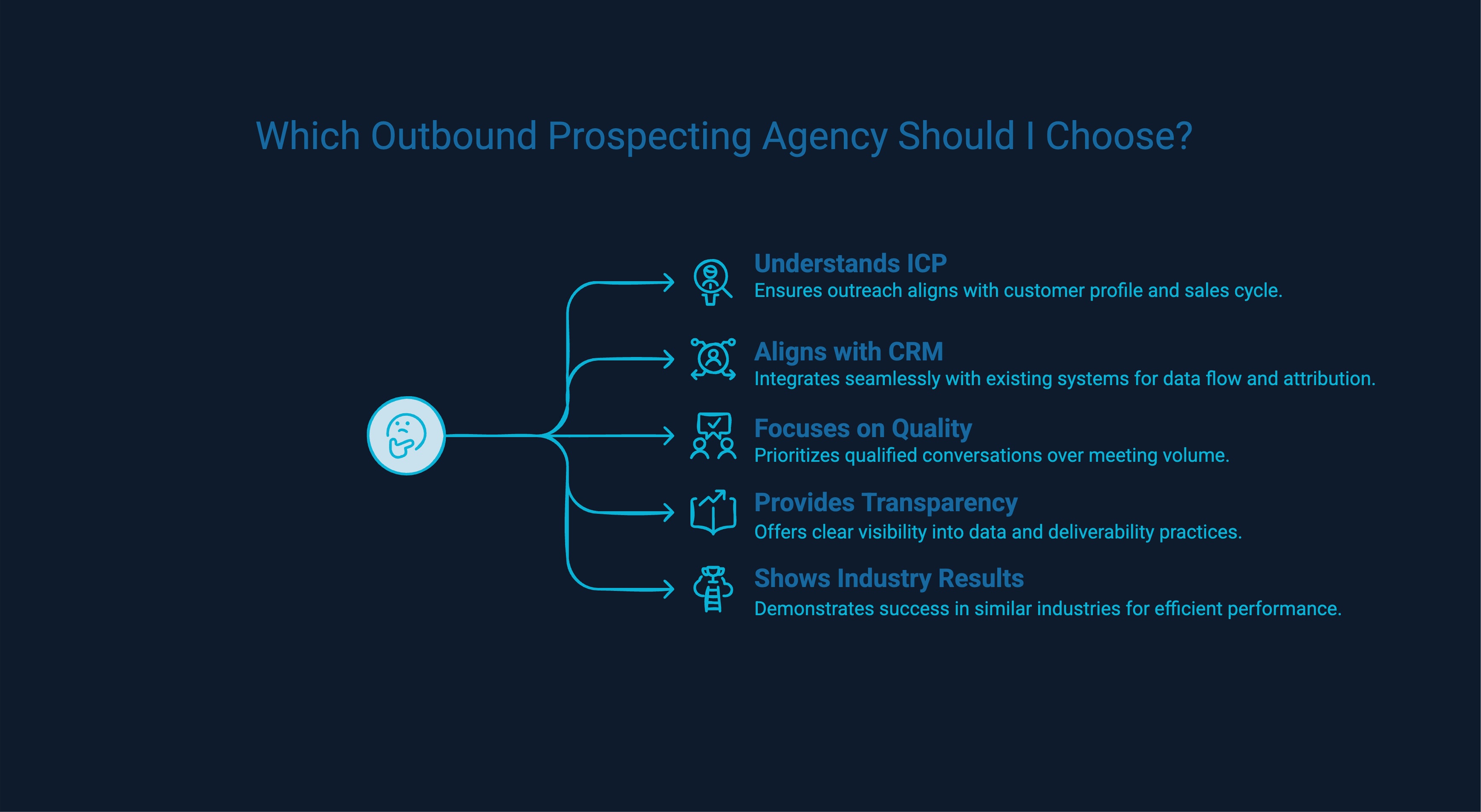
Choosing the right outbound prospecting agency directly impacts pipeline quality, sales efficiency, and revenue growth. The best partners act as an extension of your revenue team, aligning strategy, execution, and reporting with your specific sales motion and growth objectives.
Evaluate agencies using the following criteria:
Outbound success depends on systems, not shortcuts, and the right agency helps you build both. Work with LeadGem to build scalable, data-driven revenue systems that align teams, streamline execution, and drive predictable growth.
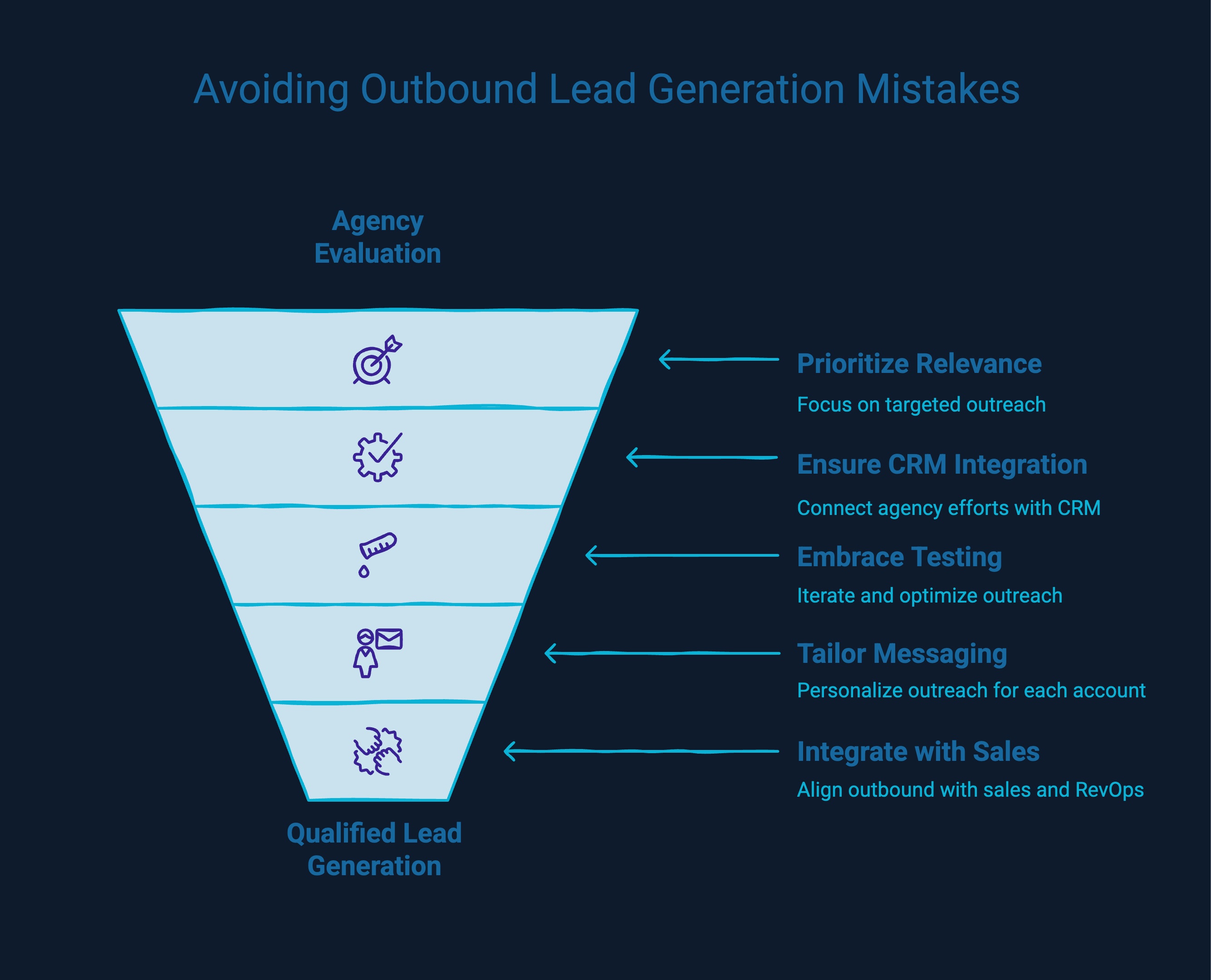
Hiring the wrong outbound agency can waste budget, damage brand reputation, and slow pipeline growth. Avoiding common mistakes helps ensure outbound efforts are sustainable, aligned with revenue goals, and capable of delivering qualified opportunities rather than superficial activity.
Watch for these critical pitfalls when evaluating agencies:
Avoiding these mistakes helps build a focused, scalable outbound engine that supports long-term B2B growth.
Outbound prospecting is still one of the most reliable ways to generate a high-quality B2B pipeline in 2026. The difference between success and failure lies in execution, data quality, and alignment with revenue operations. The right agency doesn’t just book meetings; it builds a scalable growth engine.
Outbound agencies support sales development representatives by running cold outreach across cold calling, cold calls, email outreach, and cold email outreach, using intent data to reach the right people at target companies, generate qualified leads, improve email deliverability, and accelerate the sales funnel.
An outsourced SDR model accelerates outbound marketing using proven outbound prospecting strategies, documented case studies, and scalable lead generation services, while in-house teams support long-term sales strategy, alignment with marketing teams, content marketing, and inbound marketing for sustained business growth.
Costs vary based on outreach efforts, channels like social media, social selling, and cold calling, data depth, and targeting complexity. Most agencies charge $5,000-$30,000+ monthly, depending on lead generation process, target audience, target accounts, and volume of quality leads delivered.
Companies with defined business goals, a clear ideal customer profile, and a growing customer base benefit most, especially when sales representatives need help reaching buyers by job title, validating pain points, sourcing a verified phone number, and scaling marketing efforts efficiently.
AI improves targeting by analyzing intent data, prioritizing target companies, addressing the most common objections, and personalizing lead gen messaging across outbound marketing, but human oversight remains essential to refine sales strategy, guide outreach efforts, and convert insights into pipeline.
Outbound prospecting agencies generate B2B leads by combining ICP research, multi-channel outreach, intent signals, and testing frameworks. Dedicated SDRs qualify responses, book meetings, and continuously optimize messaging, targeting, and timing using data-driven insights and repeatable sdr services models.
The five P’s of prospecting are purpose, persona, personalization, persistence, and performance. Together, they guide list building, messaging, follow-ups, and measurement, ensuring outbound email prospecting services stay relevant, compliant, and conversion-focused rather than volume-driven or purely automated campaigns.
Outbound prospecting services suit startups and established companies alike when goals are clear. Startups gain speed and focus without hiring early, while mature teams use agencies to scale pipelines, test markets, and supplement internal sales capacity efficiently globally.