

Contact


B2B teams today face a harsh reality. Most outbound efforts barely convert. Cold outreach typically drives about 0.5 to 3% meeting rates, which means most efforts fail to generate a real pipeline.
The problem is not just low conversion. It is poor targeting and a lack of alignment. Teams go too broad, use disconnected tools, and fail to engage high-value accounts with relevant and timely messaging. This leads to wasted effort and missed opportunities.
This is where Account-Based Experience (ABX) comes in. In this guide, you will learn what ABX is, how it differs from ABM, and how to build a system that improves targeting, increases engagement, and drives more predictable revenue.
Account-Based Experience (ABX) is an advanced go-to-market strategy that builds on Account-Based Marketing (ABM) by focusing on delivering a personalized and consistent experience across the entire customer lifecycle.
It aligns marketing, sales, and customer success teams to engage high-value accounts in a coordinated way, ensuring every interaction is relevant, timely, and tailored to the needs of specific stakeholders within an account.
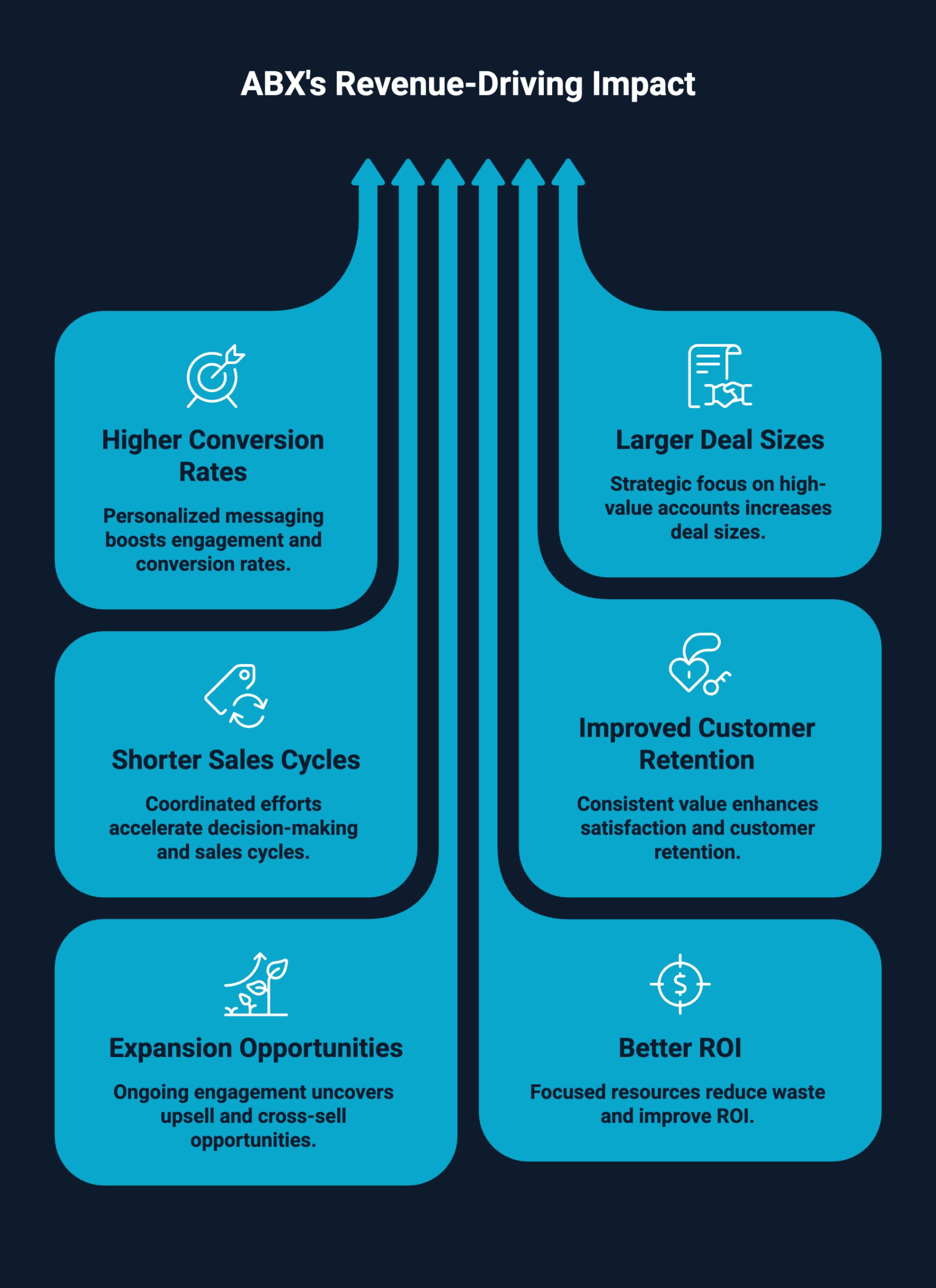
ABX helps drive revenue in several impactful ways:
This approach forms the foundation of a scalable ABX marketing strategy, enabling teams to deliver consistent and personalized engagement across the entire lifecycle.

Account-Based Marketing was designed to help B2B companies focus on high-value accounts instead of individual qualified leads. It improves targeting and personalization, but in many organizations, it remains campaign-driven and largely owned by marketing.
ABX builds on that foundation but shifts the focus from campaigns to the complete account journey. It aligns marketing, sales, and customer success to create a consistent account-based experience from first engagement to renewal and expansion. The difference is not just tactical. It is structural.
Here is how they compare more clearly:
In short, ABM helps you reach the right accounts. ABX ensures those accounts receive a unified, personalized experience throughout the entire lifecycle, leading to stronger alignment and higher long-term value.
Want to compare the best partners before scaling your ABX outreach? Explore our curated list of top outbound prospecting agencies to find the right fit for engaging high-value accounts and accelerating pipeline growth.
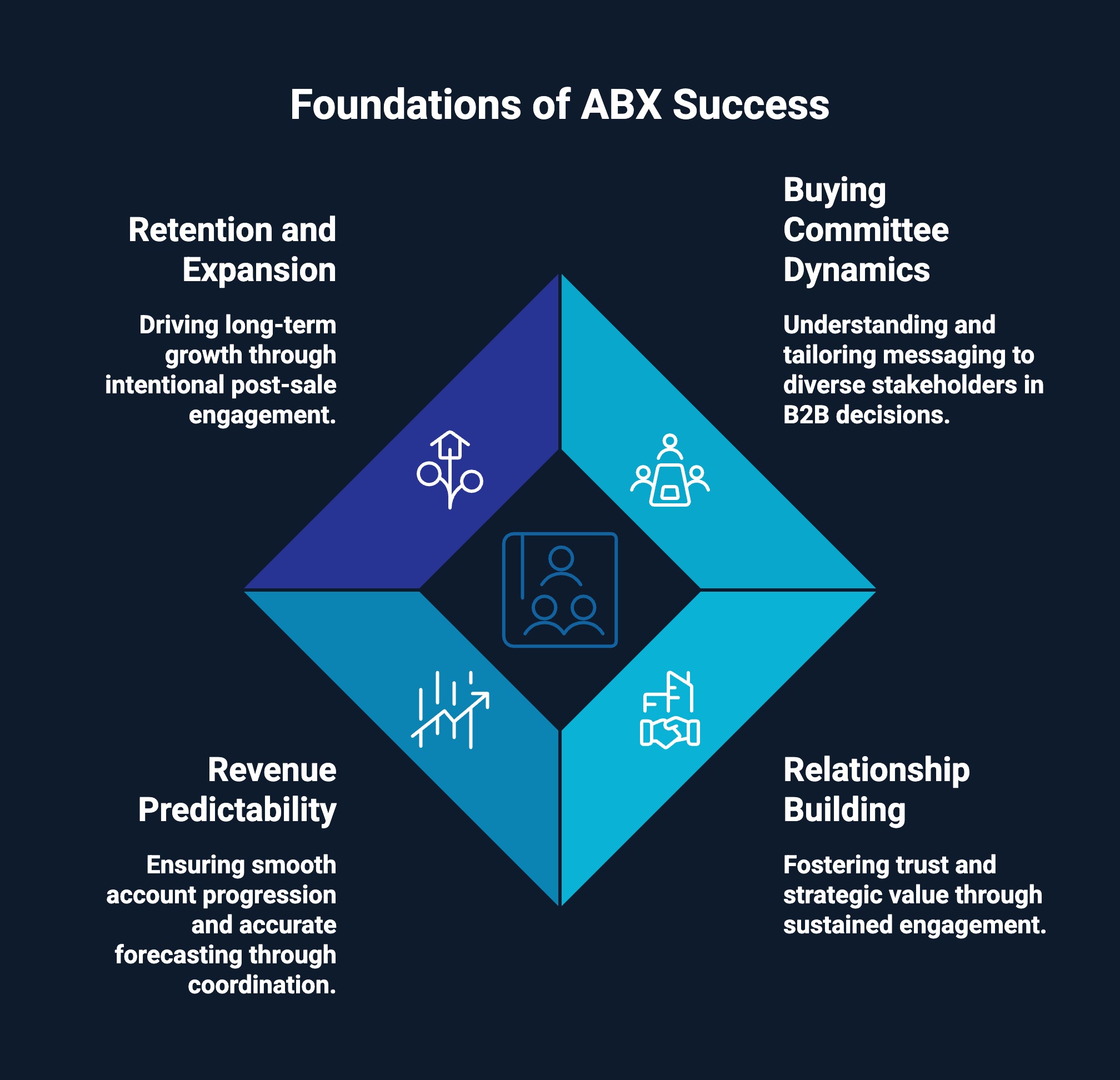
B2B buying has become more complex, more collaborative, and more experience-driven. High-value accounts expect relevance at every stage, not generic outreach from disconnected teams. In this environment, ABX provides the structure needed to align revenue functions around a single account strategy.
According to Forrester’s The State of Business Buying, an average B2B purchase now involves about 13 stakeholders participating in the decision-making process, highlighting how complex and cross-functional buying committees have become.
Here is why it matters in practice:
By implementing strong account-based experience strategies, revenue teams move from campaign thinking to lifecycle ownership, creating stronger alignment, higher win rates, and measurable account-based experience benefits.
Looking to supercharge your ABX strategy? Check out our list of the best go-to-market agencies to find expert partners who can help you align revenue teams and accelerate account growth.
Successful ABX execution is not built on campaigns alone. It requires structured coordination, shared data, and lifecycle orchestration. Account-based experience marketing works when every revenue function operates from the same account plan.
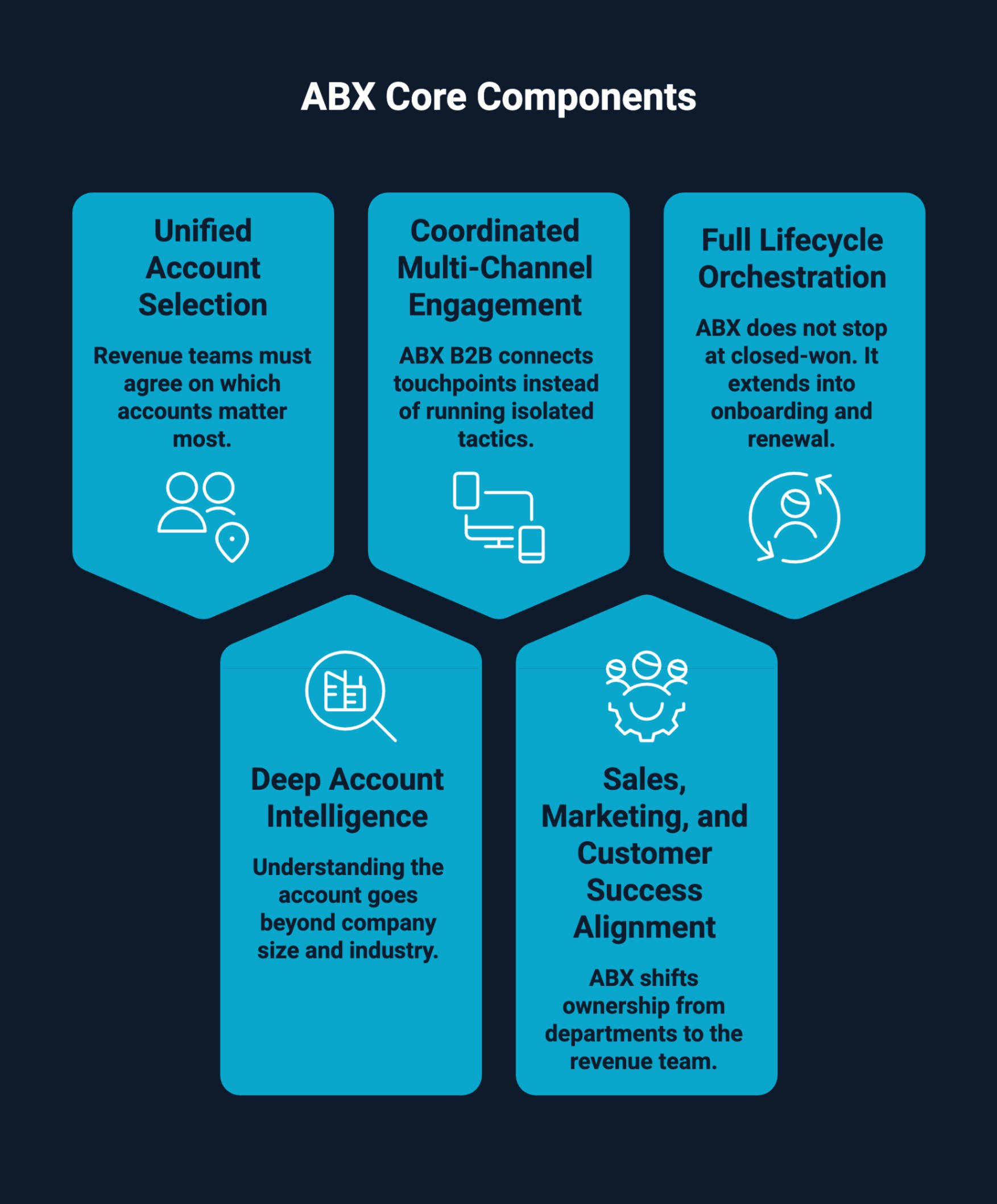
Here are the core components that make it effective:
Revenue teams must agree on which accounts matter most. This includes:
Without shared account selection, alignment breaks before execution begins.
Understanding the account goes beyond company size and industry. Effective account-based experience strategies require:
This insight enables personalization that feels strategic rather than generic.
ABX connects touchpoints instead of running isolated tactics. This includes:
Each interaction reinforces the same value proposition across channels.
ABX shifts ownership from departments to the revenue team. Alignment includes:
This alignment is central to delivering measurable account-based experience benefits.
ABX does not stop at closed-won. It extends into:
These components collectively represent account-based experience best practices, ensuring that ABX execution remains structured, scalable, and aligned with revenue outcomes.
Want to strengthen your ABX execution with sales-ready messaging and workflows? Check out our guide on the best marketing agencies for sales enablement to find partners who boost alignment and conversion.
Strong ABX account-based experience strategies move beyond personalization and into coordinated execution. The goal is to create structured, repeatable systems that drive engagement, pipeline progression, and long-term account growth.
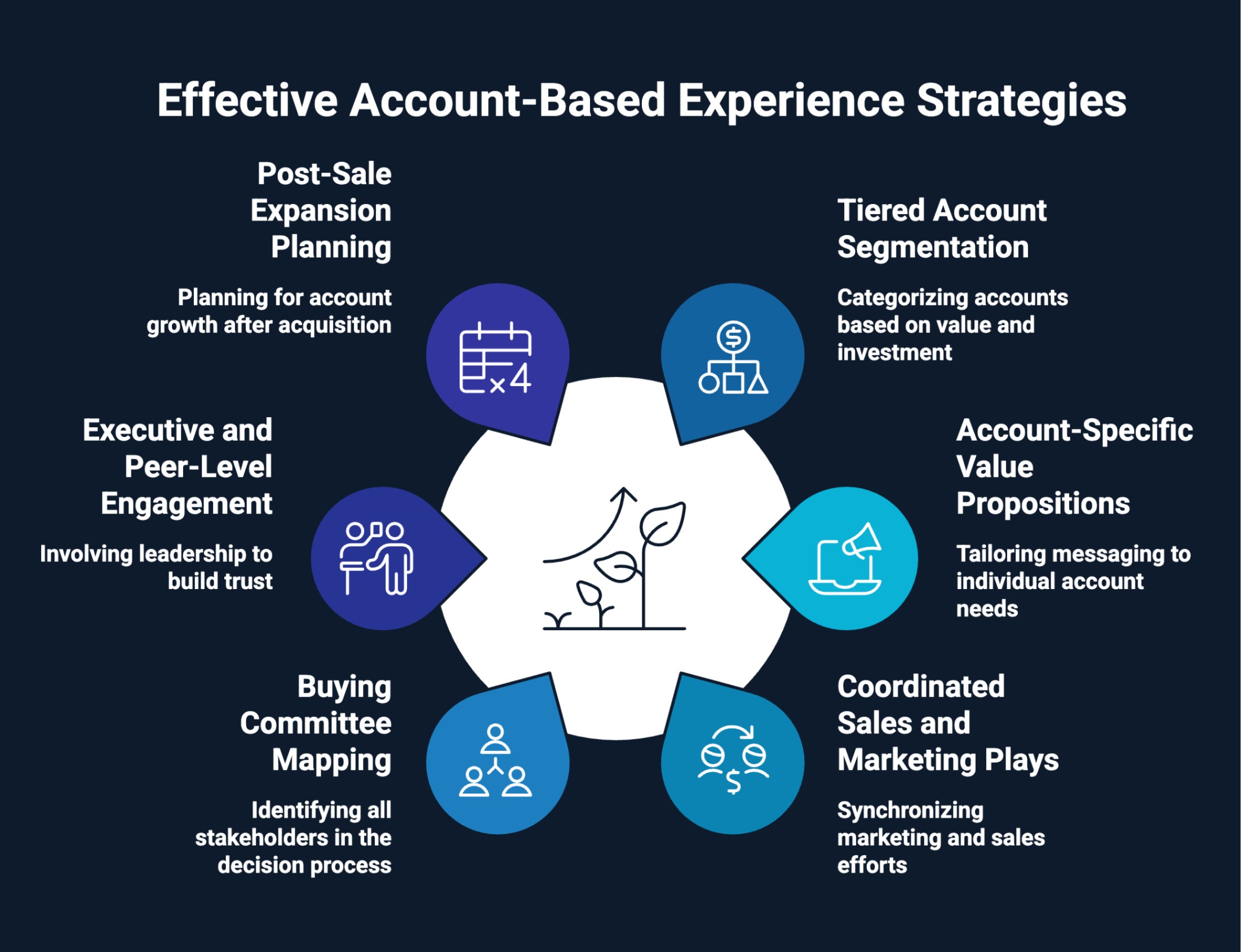
Here are the most effective strategies revenue teams use:
Not all accounts require the same level of investment. High-value strategic accounts may receive one-to-one personalization, while mid-tier accounts follow a one-to-few model. This ensures resources are allocated efficiently without sacrificing relevance.
Instead of generic messaging, ABX tailors positioning to the account’s industry, challenges, and business priorities. Messaging reflects their strategic initiatives, not just your product features.
Marketing campaigns and sales outreach are synchronized. Ads reinforce sales conversations. Content aligns with live opportunities. This reduces friction and keeps messaging consistent across channels.
Effective account-based experience marketing identifies every stakeholder involved in the decision. Messaging is adapted for executives, technical evaluators, financial approvers, and end users to address their specific concerns.
For enterprise accounts, leadership engagement can accelerate trust. This may include executive briefings, tailored business cases, or industry-specific insights delivered directly to senior stakeholders.
ABX strategies extend beyond acquisition. Proactive onboarding, adoption tracking, and expansion roadmaps ensure the account continues to grow over time, maximizing long-term value.
When implemented correctly, these account-based experience strategies strengthen alignment, improve win rates, and unlock measurable account-based experience benefits across the full revenue lifecycle.
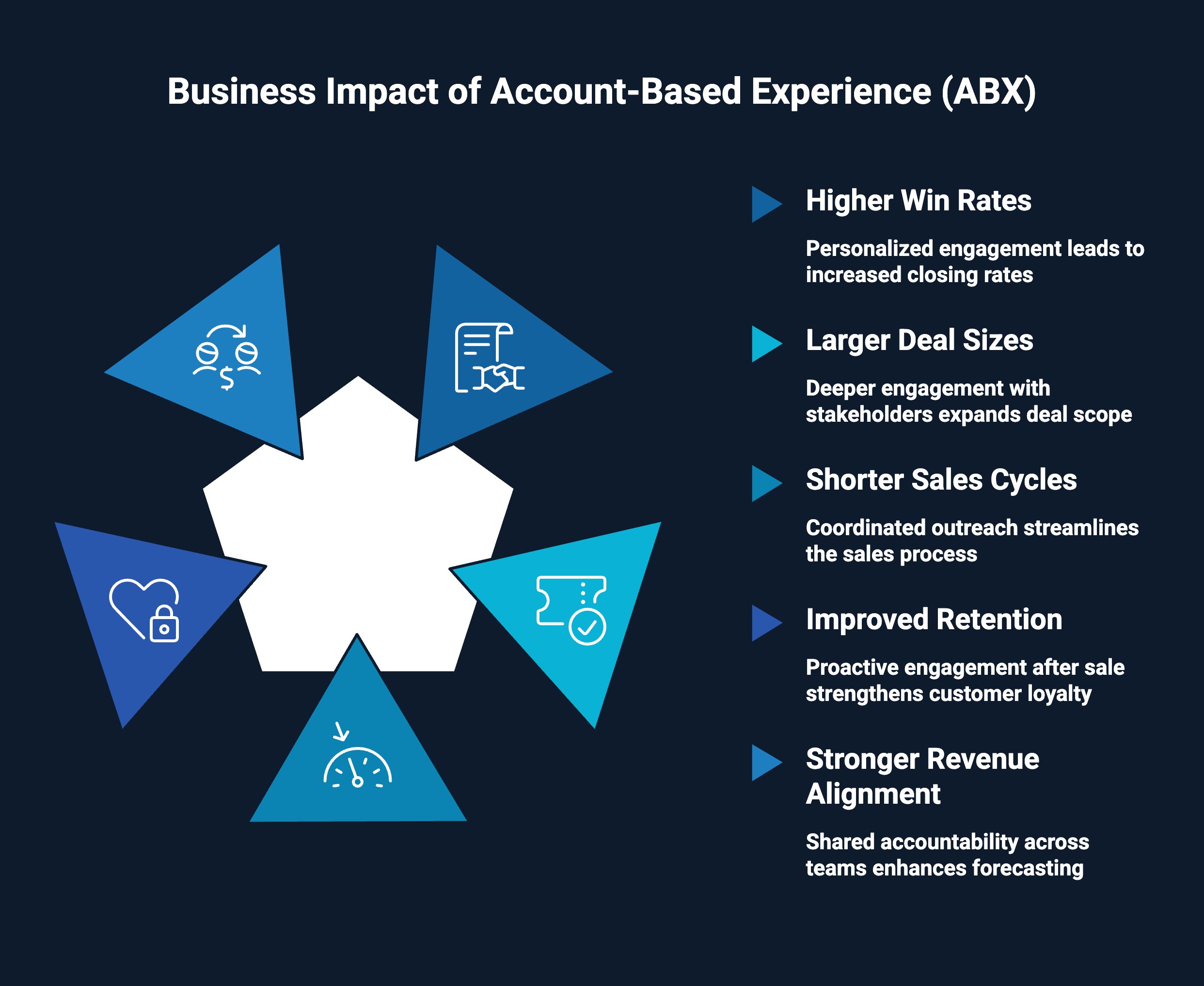
When executed correctly, ABX delivers measurable impact across pipeline, revenue, and retention. The value goes beyond better targeting. It transforms how revenue teams operate and how accounts experience your brand.
Here are the most important account-based experience benefits:
Because engagement is personalized and coordinated across stakeholders, accounts receive consistent messaging and relevant value at every stage. This reduces confusion, builds trust, and increases close rates.
ABX encourages deeper engagement with buying committees and executive stakeholders. By aligning solutions to broader business initiatives, organizations often expand deal scope and increase average contract value.
Coordinated outreach and aligned messaging help remove friction during evaluation. When marketing and sales operate in sync, accounts move through the pipeline more efficiently.
Account-based experience marketing continues after the initial sale. Proactive onboarding, adoption tracking, and expansion planning drive renewals and upsells, strengthening lifetime account value.
One of the most overlooked benefits is internal. ABX creates shared accountability across marketing, sales, and customer success. This alignment improves forecasting accuracy and ensures teams focus on the same revenue goals.
Ultimately, the true impact of ABX is not just higher engagement. It is sustained, predictable growth driven by a unified account strategy.
Looking to support your ABX strategy with the right tech stack? Dive into our HubSpot for SaaS guide to learn how to align your marketing, sales, and customer success teams for scalable revenue growth.
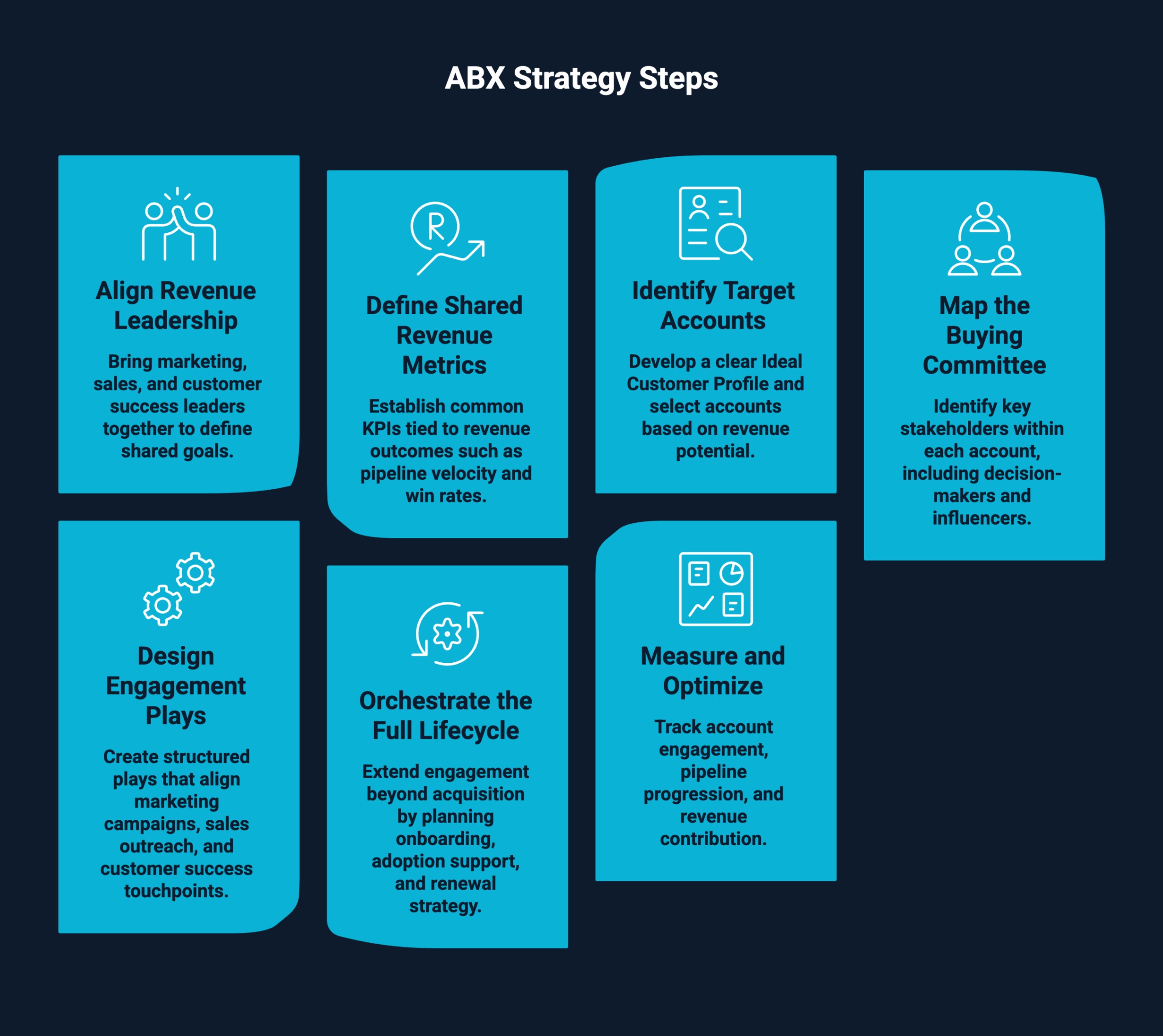
Implementing ABX requires structured alignment and consistent execution across the revenue team. Each step builds on the previous one to create a scalable account-based experience model.
Bring marketing, sales, and customer success leaders together to define shared goals, target accounts, and ownership. ABX only works when leadership commits to a unified revenue strategy rather than departmental priorities.
Establish common KPIs tied to revenue outcomes such as pipeline velocity, win rates, expansion revenue, and retention. Shared measurement ensures every team is accountable for the same results.
Develop a clear Ideal Customer Profile and select accounts based on revenue potential and strategic fit. Segment accounts into tiers so effort and personalization levels match business value.
Identify key stakeholders within each account, including decision-makers and influencers. Understand their priorities and concerns so messaging can address role-specific needs while maintaining a unified account narrative.
Create structured plays that align marketing campaigns, sales outreach, and customer success touchpoints. Every interaction should reinforce the same value proposition and move the account forward intentionally.
Extend engagement beyond acquisition by planning onboarding, adoption support, renewal strategy, and expansion opportunities. ABX focuses on maximizing long-term account value, not just closing deals.
Track account engagement, pipeline progression, revenue contribution, and retention performance. Use data and cross-team feedback to refine account-based experience strategies and improve outcomes over time.

Technology enables scale, visibility, and coordination across the revenue team. While ABX is primarily a strategy, the right stack ensures your account-based experience is data-driven and measurable.
Here are the core technology categories that support execution:
A centralized CRM acts as the single source of truth for account data, opportunity tracking, stakeholder mapping, and revenue reporting. It ensures marketing, sales, and customer success operate from the same account view.
Marketing automation tools help deliver personalized campaigns at scale. They support targeted outreach, nurture programs, engagement tracking, and behavioral insights tied to specific accounts.
Intent platforms and enrichment tools provide insight into account activity, buying signals, and firmographic updates. This allows revenue teams to prioritize outreach based on real-time interest and fit.
Sales engagement tools coordinate outbound sequences, track interactions, and align messaging with marketing campaigns. This keeps outreach consistent and data-informed.
Personalization platforms tailor website content, landing pages, and messaging to specific accounts. This strengthens the overall account-based experience across digital touchpoints.
Advanced reporting tools measure account engagement, pipeline influence, revenue impact, and expansion performance. Accurate attribution validates account-based experience benefits and guides optimization.
The goal is not to add more tools. It is to ensure your technology stack supports alignment, visibility, and coordinated execution across the entire account lifecycle.
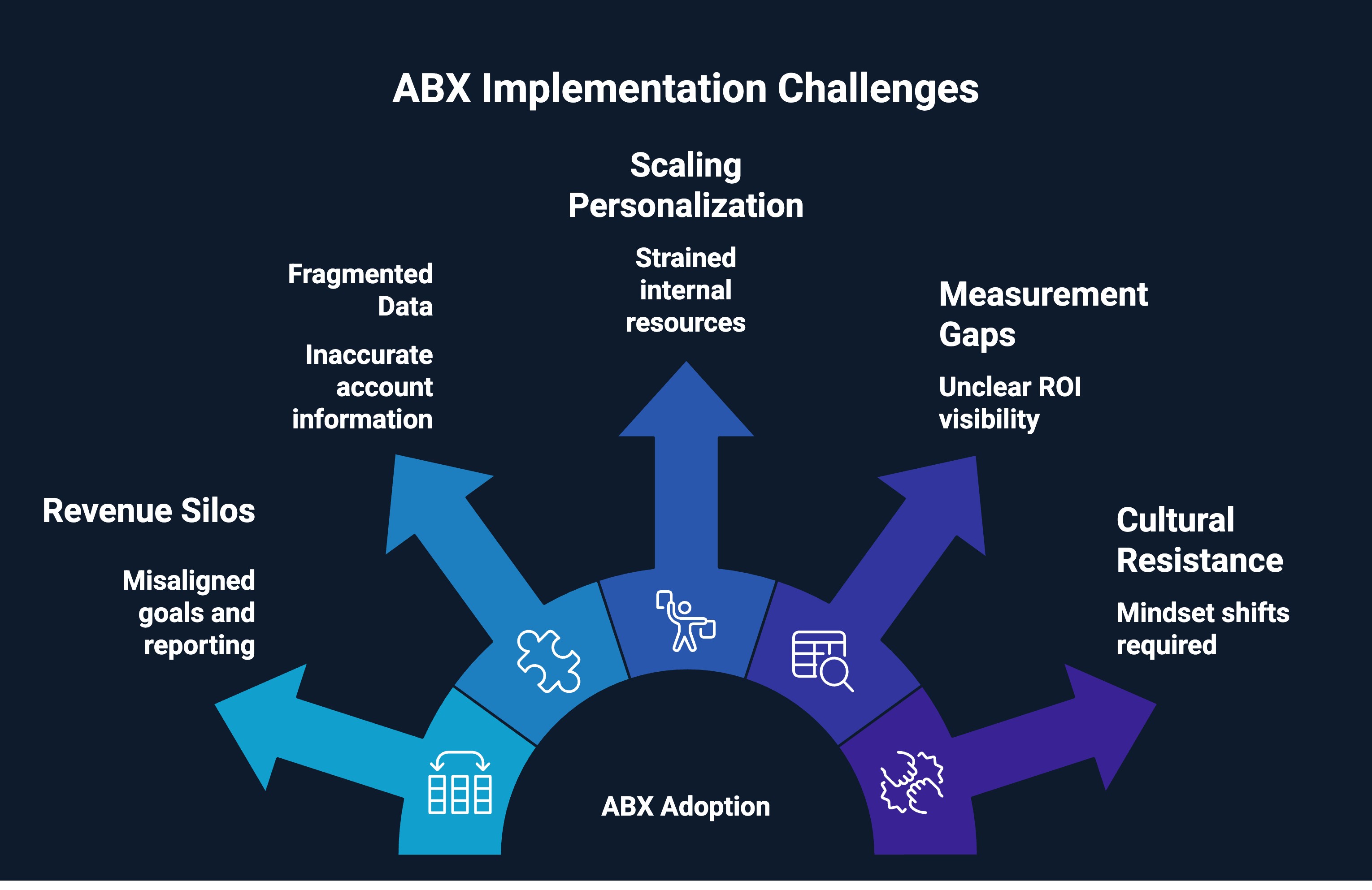
Adopting ABX requires structural alignment across the revenue organization. It reshapes ownership, measurement, and execution. Without preparation, implementation can slow down or lose momentum. Below are the most common barriers and how to address them effectively.
Marketing, sales, and customer success often operate with separate goals, reporting structures, and success metrics. This creates misalignment in messaging, timing, and account prioritization, weakening the overall account-based experience.
To overcome this, organizations must establish shared revenue KPIs and conduct joint account planning sessions. Cross-functional pipeline reviews and aligned compensation structures help reinforce collective accountability and long-term collaboration.
ABX depends on a unified and accurate view of each account. Disconnected systems, incomplete stakeholder mapping, and outdated CRM records limit personalization and strategic coordination.
Improvement begins with clear data governance standards, defined ownership of account records, and system integrations across marketing, sales, and customer success. Regular data audits ensure accuracy and consistency.
Delivering one-to-one personalization across many accounts can strain internal resources. Without prioritization, execution slows, and engagement becomes inconsistent.
A tiered segmentation model allows teams to allocate effort based on account value. Strategic accounts receive high-touch engagement, while mid-tier accounts follow structured one-to-few programs. Repeatable playbooks and automation further support scalable account-based experience strategies.
Traditional funnel metrics, such as MQLs, do not fully capture the impact of account-based experience marketing. As a result, ROI may appear unclear if reporting remains lead-centric.
Shifting to account-level metrics such as pipeline velocity, win rates, deal size, retention, and expansion revenue provides clearer visibility. Unified dashboards across revenue functions strengthen transparency and strategic decision-making.
Moving from campaign-driven execution to lifecycle ownership requires mindset shifts. Teams accustomed to departmental boundaries may resist shared planning and cross-functional accountability.
Executive sponsorship, pilot programs, and internal communication of early wins help build momentum. Training and structured collaboration frameworks reinforce long-term adoption.
When these barriers are addressed proactively, organizations unlock the full benefits of an account-based experience. ABX then becomes a coordinated, scalable revenue strategy rather than an isolated initiative.
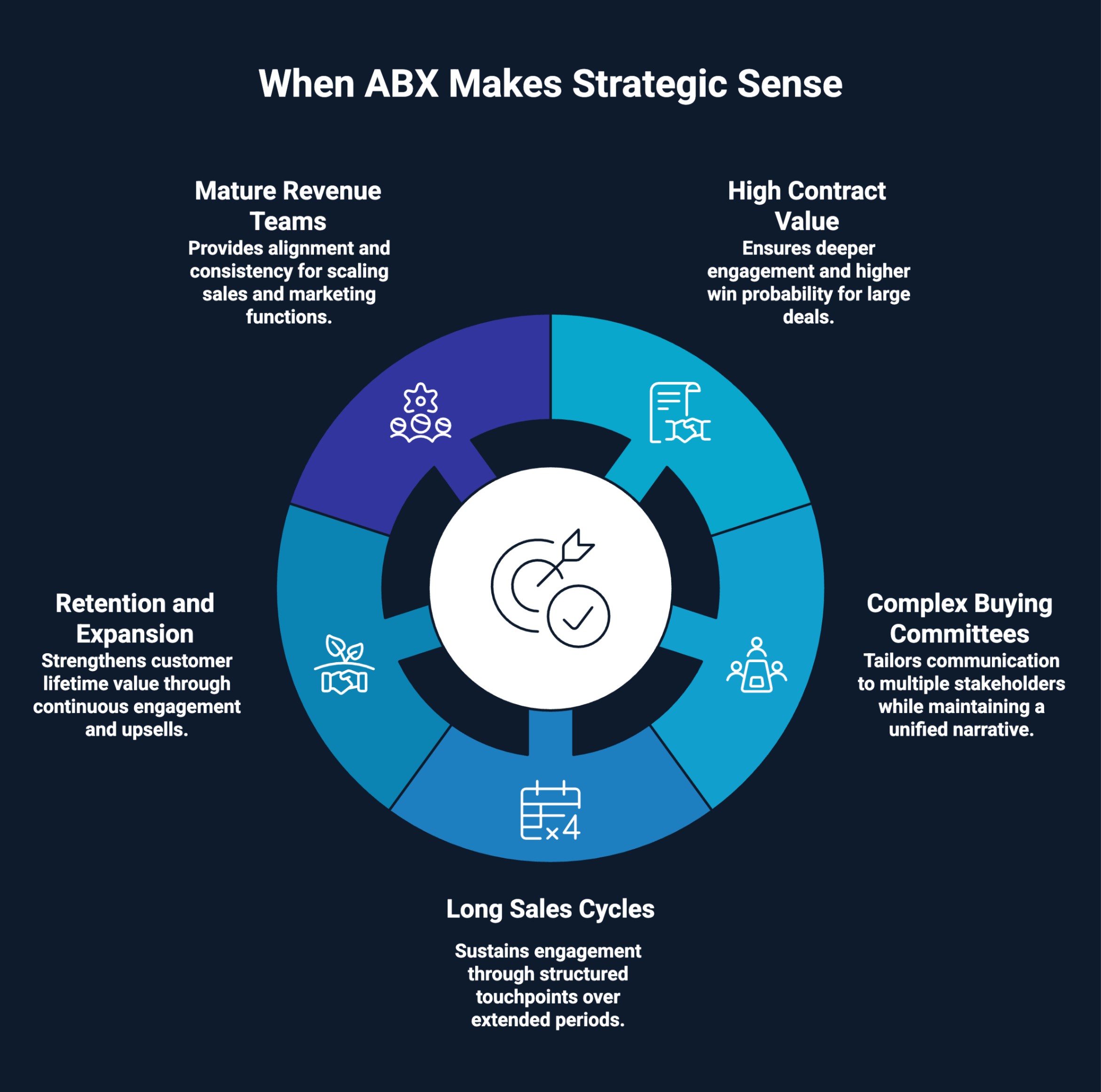
ABX is not necessary for every organization. It delivers the greatest impact in environments where revenue depends on high-value accounts, complex buying decisions, and long-term customer relationships.
Here are the scenarios where adopting account-based experience makes strategic sense:
When deal sizes are significant, each account represents substantial revenue potential. A structured account-based experience ensures deeper engagement, stronger positioning, and higher win probability.
If deals involve multiple stakeholders across departments, coordinated messaging becomes critical. ABX helps tailor communication to different roles while maintaining a unified value narrative.
Extended evaluation periods require sustained engagement across months or quarters. Account-based experience marketing keeps accounts progressing through structured, aligned touchpoints.
Organizations with subscription or recurring revenue models benefit significantly from ABX. Since long-term value depends on renewals and upsells, delivering a continuous account-based experience strengthens customer lifetime value.
Companies with established sales and marketing functions are well-positioned to implement account-based experience strategies. As teams scale, ABX provides the alignment framework needed to maintain consistency and revenue predictability.
When these conditions are present, ABX becomes less of an experiment and more of a strategic growth model designed to maximize lifetime account value.
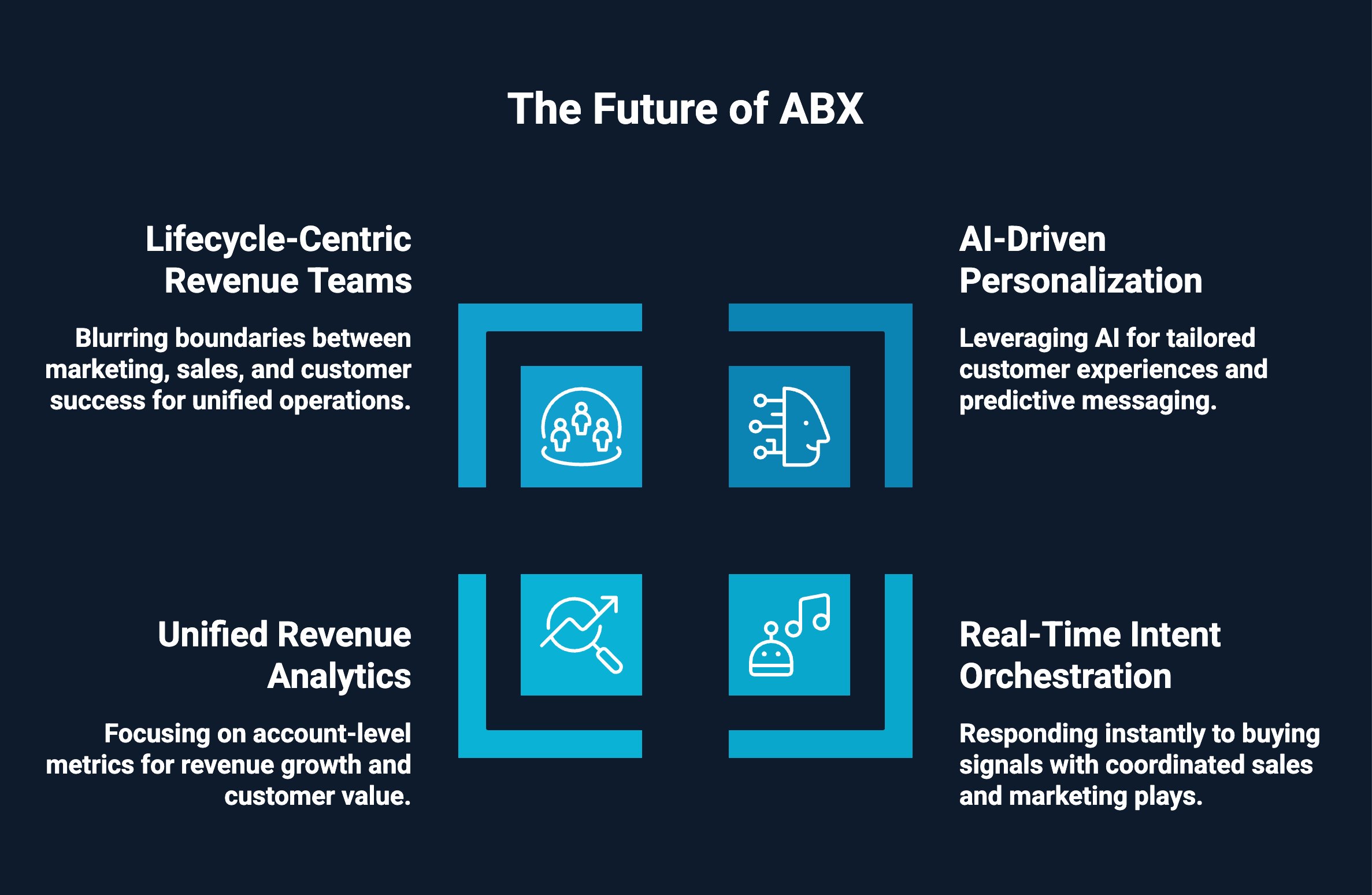
ABX is evolving from a structured alignment framework into a technology-enabled growth engine. As buyer expectations rise and revenue teams demand greater predictability, account-based experience marketing will become more data-driven, automated, and intelligence-led.
Here is how the model is advancing:
Artificial intelligence is enabling deeper account insights, predictive messaging, and real-time content adaptation. This allows teams to maintain personalization without sacrificing efficiency.
Intent data is becoming more dynamic. Revenue teams can now respond to buying signals immediately, triggering coordinated sales and marketing plays that accelerate pipeline progression.
Measurement is shifting fully to account-level analytics. Organizations are prioritizing metrics tied to revenue contribution, deal expansion, and long-term value rather than isolated engagement numbers.
The boundaries between marketing, sales, and customer success will continue to blur. Future account-based experience strategies will operate under unified revenue operations frameworks with shared planning and accountability.
At the center of this evolution are RevOps-led GTM models. Revenue Operations is becoming the backbone of ABX execution, ensuring governance, attribution modeling, data integrity, and cross-functional orchestration.
This is where LeadGem positions itself. Rather than treating ABX as a campaign tactic, LeadGem builds the RevOps architecture that enables scalable, measurable, and lifecycle-driven account engagement.
As B2B markets grow more competitive, the winners will not simply target the right accounts. They will engineer the right system to deliver a consistent, intelligence-led account experience from first touch to expansion.
Most teams understand the value of ABX but struggle to execute it effectively. Data is scattered, tools are disconnected, and teams work in silos, leading to missed opportunities and inconsistent results.
This is where the right partner makes a difference. LeadGem is a B2B growth and RevOps agency based in Amsterdam that helps companies build simple, aligned systems to turn ABX into real revenue outcomes.
As a Clay-certified partner, we help revenue teams:
For companies implementing account-based experience strategies, we bridge the gap between strategy and technical execution, ensuring ABX becomes a structured, scalable revenue engine rather than a one-off initiative.
ABX is not about better campaigns. It is about better alignment. When marketing, sales, and customer success operate around a shared account strategy, the entire revenue journey becomes intentional and measurable.
Strong account-based experience strategies create consistent engagement, higher-value deals, and long-term growth. The real advantage is not targeting accounts. It is delivering the right experience across the full lifecycle.
The ABX sales cycle follows the entire customer journey, aligning the marketing team and customer success teams to deliver the right message at the right time. It focuses on valuable accounts, intent signals, and consistent experience across the entire customer lifecycle.
Analytics platforms enable ABX account-based experience by tracking account-level engagement, intent signals, and pipeline movement. They unify data across teams, improve attribution, identify buying signals, optimize campaigns, and support data-driven decisions for better personalization, forecasting, and revenue growth.
The 3 R’s of an ABM strategy are Reputation, Relationships, and Revenue. This ABM approach builds brand awareness with valuable accounts, strengthens engagement strategies across the buying journey, and drives higher conversion rates through coordinated marketing efforts and sales process alignment, ultimately supporting effective demand generation.
Account-based experience is the evolution of ABM that unifies marketing strategy, sales process, and customer service teams to create a consistent experience across the entire customer lifecycle. The ABX approach improves customer satisfaction and customer retention among high-value customer accounts.
Key account-based experience benefits include higher win rates, larger deal sizes, improved revenue team alignment, better retention, and stronger expansion revenue, resulting in more predictable and sustainable B2B growth.
The 3-3-3 rule in marketing suggests capturing attention within 3 seconds, communicating core value in 30 seconds, and reinforcing trust within 3 minutes, helping improve engagement, brand awareness, and conversion rates across the buyer journey.
No. ABX marketing reflects the evolution of ABM into a full customer lifecycle strategy. As B2B buying becomes more complex, the ABX approach strengthens alignment, improves customer experience, and drives sustainable revenue beyond short-term marketing efforts.