

Contact


Account-based marketing has evolved. What used to be a manual, spreadsheet-heavy process driven by static ICPs has become a data-rich, automation-first motion. At the center of this shift is Clay ABM, a flexible way to design, enrich, and execute highly targeted account-based marketing programs at scale.
For B2B teams, especially those running outbound or revenue-led growth, Clay enables a new level of precision. But Clay alone is not an ABM strategy. It’s a powerful Clay ABM tool that needs the right structure, segmentation logic, and execution layer to actually deliver a pipeline.
In this guide, we break down what Clay ABM is, how it fits into modern B2B account-based marketing, and how teams (and agencies) use it to run scalable ABM plays that convert.
Clay ABM refers to using Clay’s data orchestration and enrichment capabilities to power account-based marketing strategies. Instead of relying on broad firmographics or static lists, Clay allows teams to build dynamic, data-driven account segments and activate them across outbound and marketing workflows.
At a high level, Clay ABM helps teams:
Clay does not replace your CRM or outreach tools. It sits upstream as the intelligence layer that makes account-based marketing far more precise.
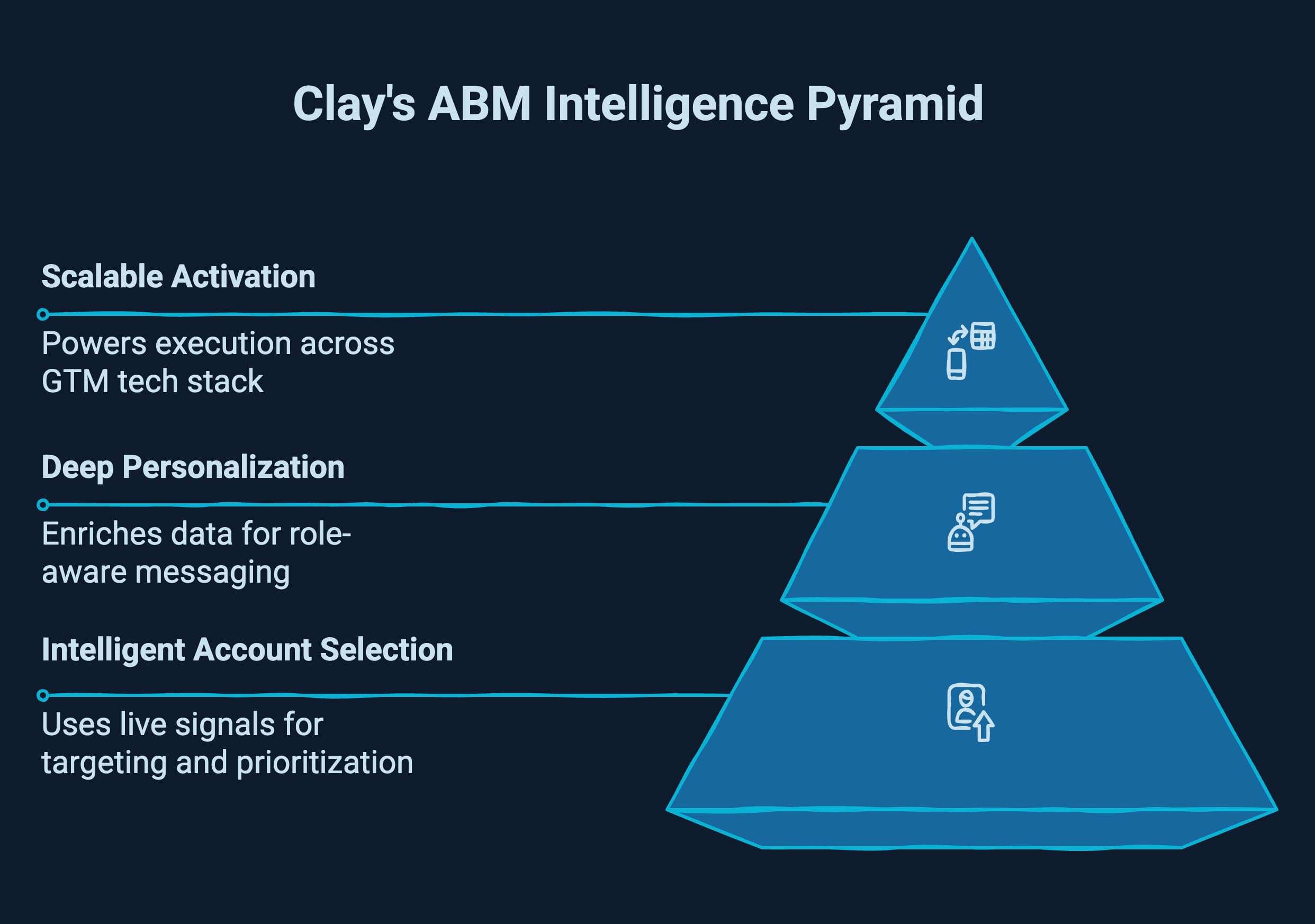
Account-based marketing often breaks down when account lists are static, personalization is shallow, and execution depends on manual effort. These gaps reduce relevance and slow pipeline growth. Clay addresses this by acting as the intelligence layer that connects strategy, data, and activation into a single, scalable ABM system.
Rather than treating ABM as a set of disconnected campaigns, Clay enables a structured, continuously updated approach built for modern B2B go-to-market teams.
Traditional ABM relies heavily on fixed firmographics such as company size or industry. Clay moves account selection upstream by combining multiple live signals into a single targeting and prioritization system.
Clay identifies target accounts using technographics, hiring activity, funding events, product changes, job postings, and other intent signals. These accounts are then continuously enriched and refreshed as new data appears. Before accounts ever reach CRM or outbound tools, Clay applies segmentation and prioritization logic, so teams focus only on accounts showing real buying readiness.
This connects account selection directly with GTM architecture. Instead of static lists, ABM becomes a living system where targeting evolves in real time based on signal quality and relevance.
Once accounts are identified and prioritized, Clay enables deeper personalization across both accounts and stakeholders. Enrichment goes beyond basic contact details to include internal team structures, role-specific context, initiatives, and recent activity.
This level of detail supports precise, role-aware messaging across buying committees, which is critical in complex B2B sales cycles. Because Clay feeds this context directly into outbound and marketing workflows, personalization remains consistent at scale rather than being limited to one-off, manual efforts.
The result is ABM outreach that feels timely and relevant, not generic or templated.
Clay does not replace existing GTM tools. Instead, it sits upstream as the intelligence layer that powers execution across the stack.
Once accounts are enriched and prioritized in Clay, they flow into the CRM as the system of record, preserving ownership, reporting, and pipeline visibility. From there, outbound platforms and marketing automation tools handle activation across email, LinkedIn, and lifecycle campaigns using Clay-enriched data.
By separating intelligence, record-keeping, and activation, teams can scale ABM efficiently without overloading systems or forcing tool replacement. Execution becomes faster, cleaner, and more aligned across sales and marketing.
By combining intelligent account selection, deep personalization, and scalable activation, Clay turns account-based marketing into a continuous, data-driven GTM system rather than a manual, campaign-based process.
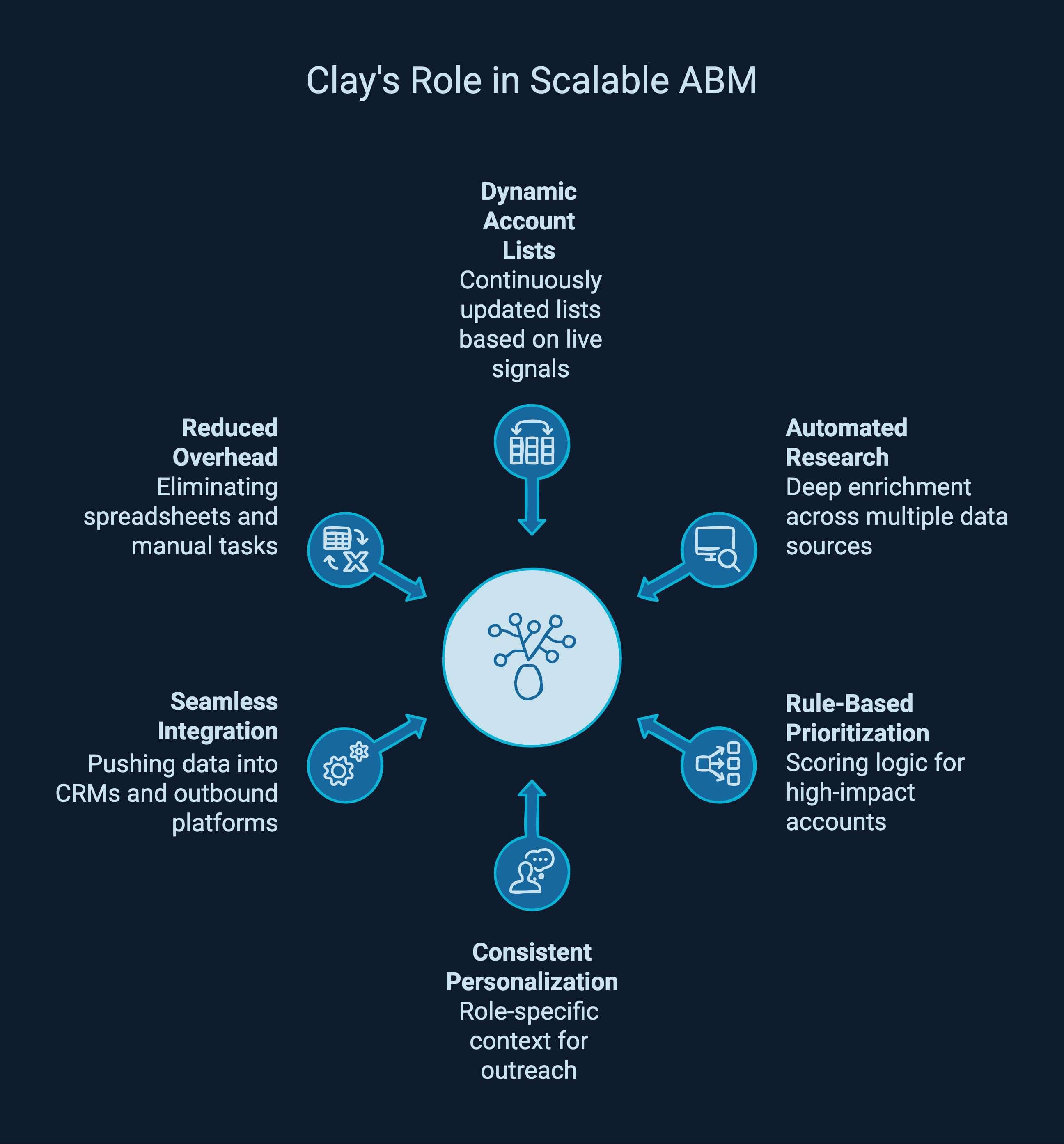
Scaling account-based marketing is challenging when growth depends on manual research, static lists, and one-off campaigns. Clay enables scalable ABM by automating the most time-consuming parts of the process while keeping targeting, personalization, and execution tightly aligned across teams.
Together, these capabilities allow ABM programs to grow from small, high-touch pilots into scalable, repeatable GTM systems without losing relevance, accuracy, or cross-team alignment.
Account-based marketing works best when outbound and inbound motions are aligned around the same account intelligence. Clay supports both approaches by centralising enrichment and logic, allowing sales-led, marketing-led, and hybrid teams to operate from consistent, high-quality account data.
Below is how Clay supports ABM across outbound and inbound motions.
Outbound teams use Clay to build tightly targeted account lists based on real signals. Enriched data enables personalised cold outreach with meaningful context, while qualified accounts are routed directly into sales sequences. This approach is particularly effective for sales-led and enterprise-focused organizations.
Inbound and hybrid teams use Clay to qualify inbound accounts more accurately and prioritize high-fit companies. Clay helps align inbound intent signals with outbound follow-up, ensuring ABM campaigns focus on accounts showing both interest and strategic relevance.
By supporting both outbound and inbound motions from a single intelligence layer, Clay enables ABM teams and agencies to scale without duplicating data, workflows, or effort across systems.
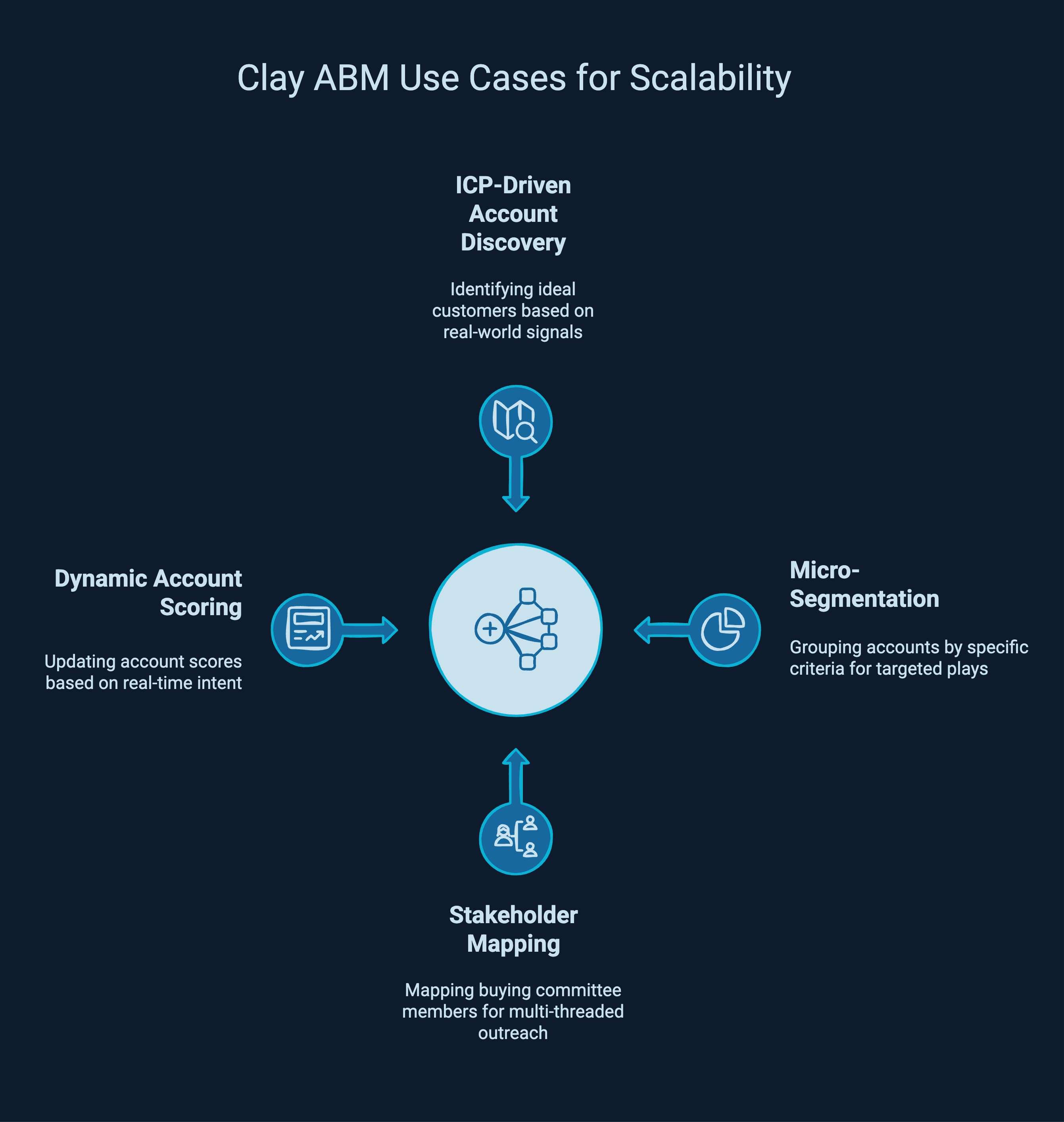
Many ABM tactics sound good in theory, but fail when applied across hundreds or thousands of accounts. Clay supports ABM use cases that scale because they are signal-driven, automated, and continuously updated, allowing teams to prioritize the right accounts without adding operational complexity.
Below are the Clay ABM use cases that consistently scale in real-world GTM teams.
Clay allows teams to define ideal customer profiles using real-world signals rather than static assumptions. Accounts can be identified based on hiring activity, product launches, regional expansion, or operational changes. This helps prioritize accounts that are actively entering a buying window right now.
Instead of running one broad ABM campaign, Clay supports dozens of precise micro-segments. Teams can group accounts by role, company stage, tech stack changes, or growth signals, enabling highly specific ABM plays that remain manageable and scalable across large datasets.
Clay enriches accounts with detailed buying committee data, mapped by role, seniority, and function. This makes multi-threaded ABM outreach possible without manual research, ensuring sales and marketing teams engage the right stakeholders across complex B2B buying groups.
Account scores in Clay update automatically as new signals appear or disappear. This keeps prioritization aligned with real-time intent rather than outdated data, allowing ABM teams to shift focus quickly and consistently toward accounts most likely to convert.
Together, these use cases show how Clay turns ABM from a static campaign model into a continuously optimized, signal-driven system built for scale.
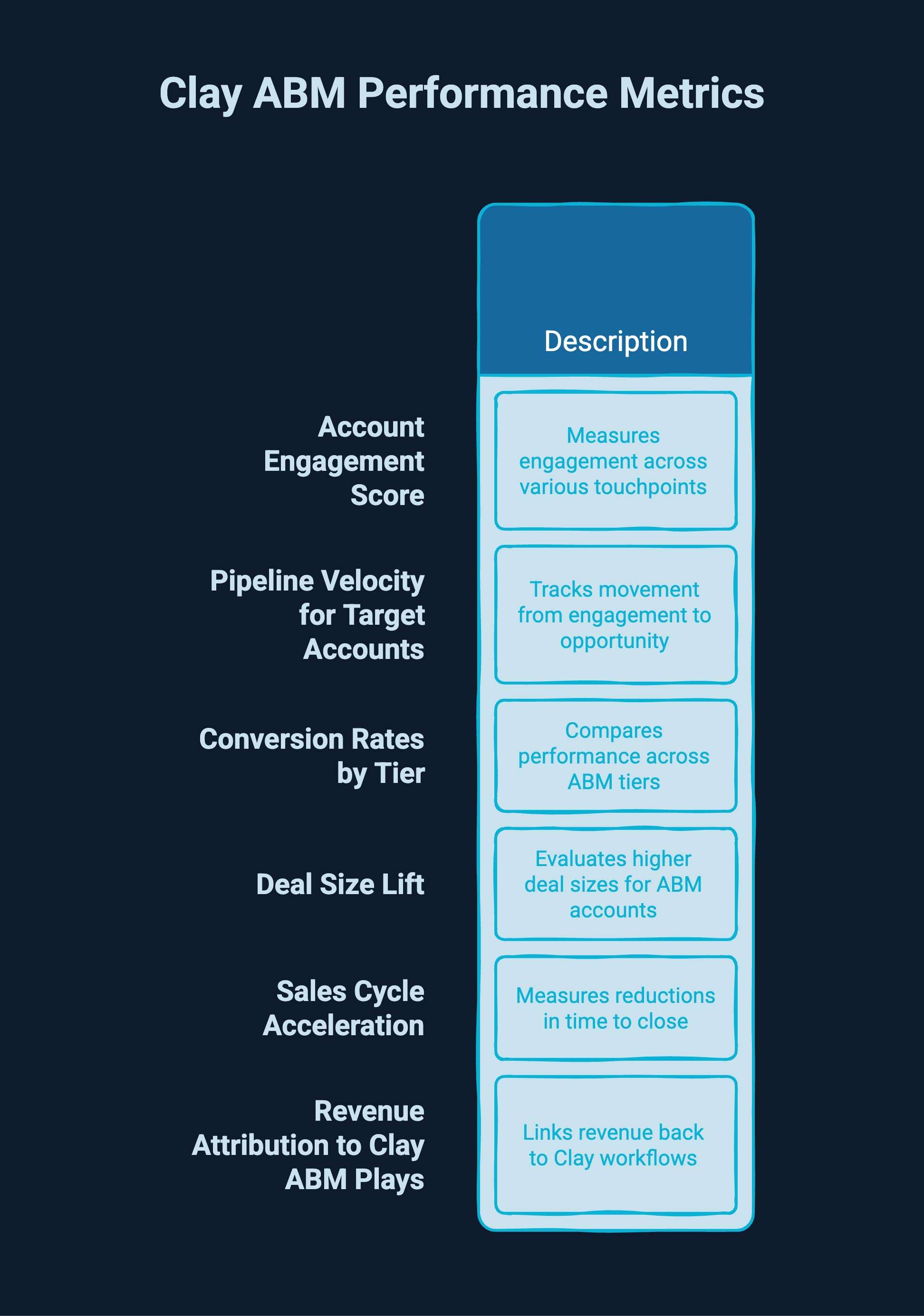
Measuring ABM success requires more than volume-based metrics. Clay shifts measurement toward account quality, engagement, and efficiency by improving the signals that drive targeting, prioritization, and outreach. This gives teams clearer visibility into what is working and why.
Below are the key metrics teams track to evaluate Clay-powered ABM performance:
Together, these metrics help teams measure ABM effectiveness based on impact, speed, and revenue contribution, not just activity volume.
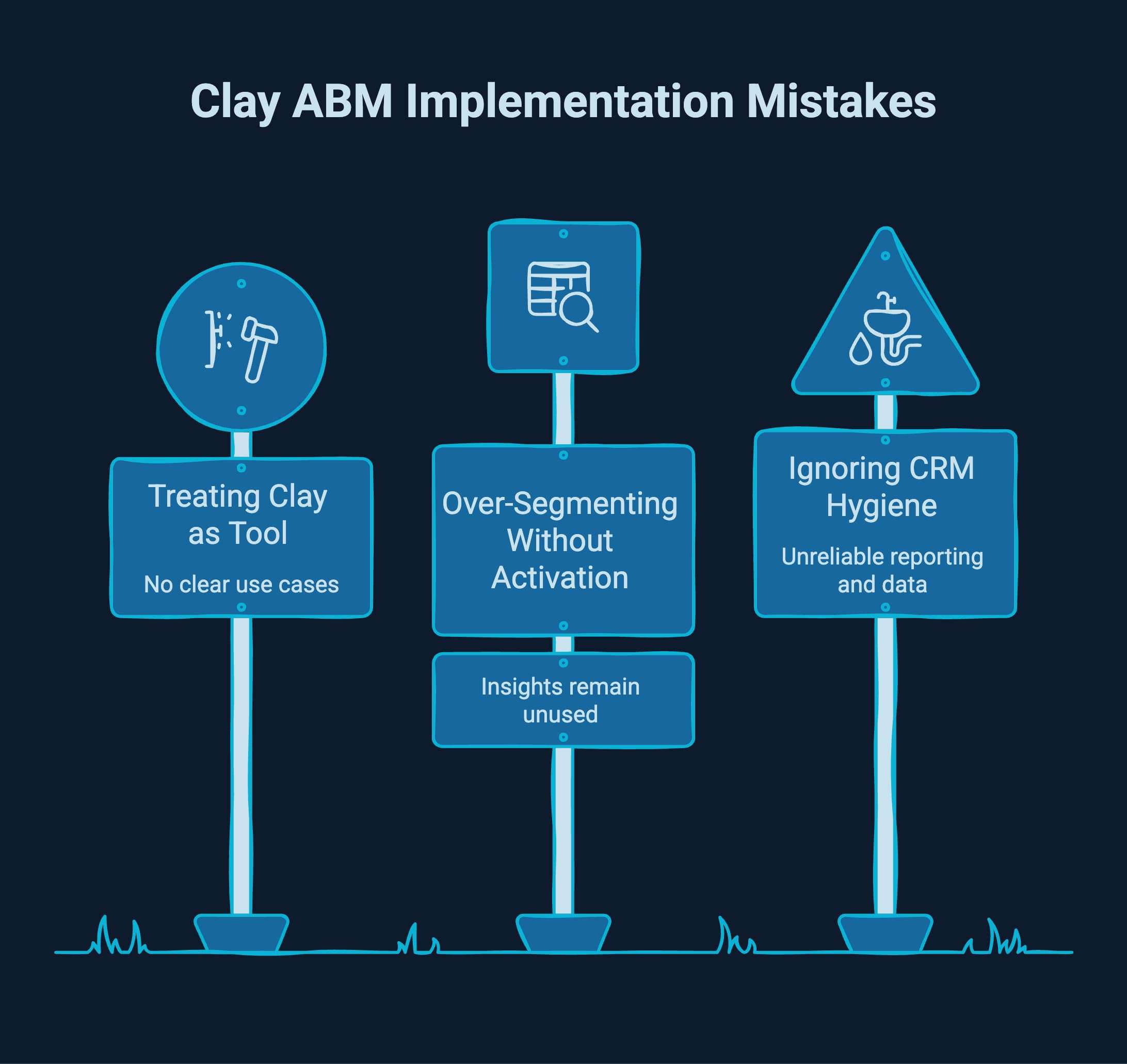
Clay is a powerful platform, but its impact depends on how it is implemented and operationalized. Teams often struggle not because of the tool itself, but due to unclear strategy, weak activation, or poor system hygiene that limits long-term ABM scalability.
Below are the most common mistakes teams make when using Clay for ABM.
Clay is a logic and intelligence engine, not a plug-and-play ABM platform. Without clear use cases, targeting rules, and workflows, it becomes an expensive enrichment layer rather than a driver of meaningful account-based execution and revenue impact.
Creating micro-segments only delivers value when activation is ready. Many teams build detailed segments in Clay but lack aligned outbound sequences, ads, or workflows to use them, leaving valuable insights unused and ABM efforts stalled.
Clay outputs depend heavily on how data is synced, deduplicated, and managed inside the CRM. Poor hygiene leads to duplicate records, misrouted accounts, and unreliable reporting, undermining the effectiveness of even well-designed ABM logic.
These mistakes highlight why strong execution and experienced partners often determine whether Clay ABM becomes a scalable growth engine or an underutilised data tool.
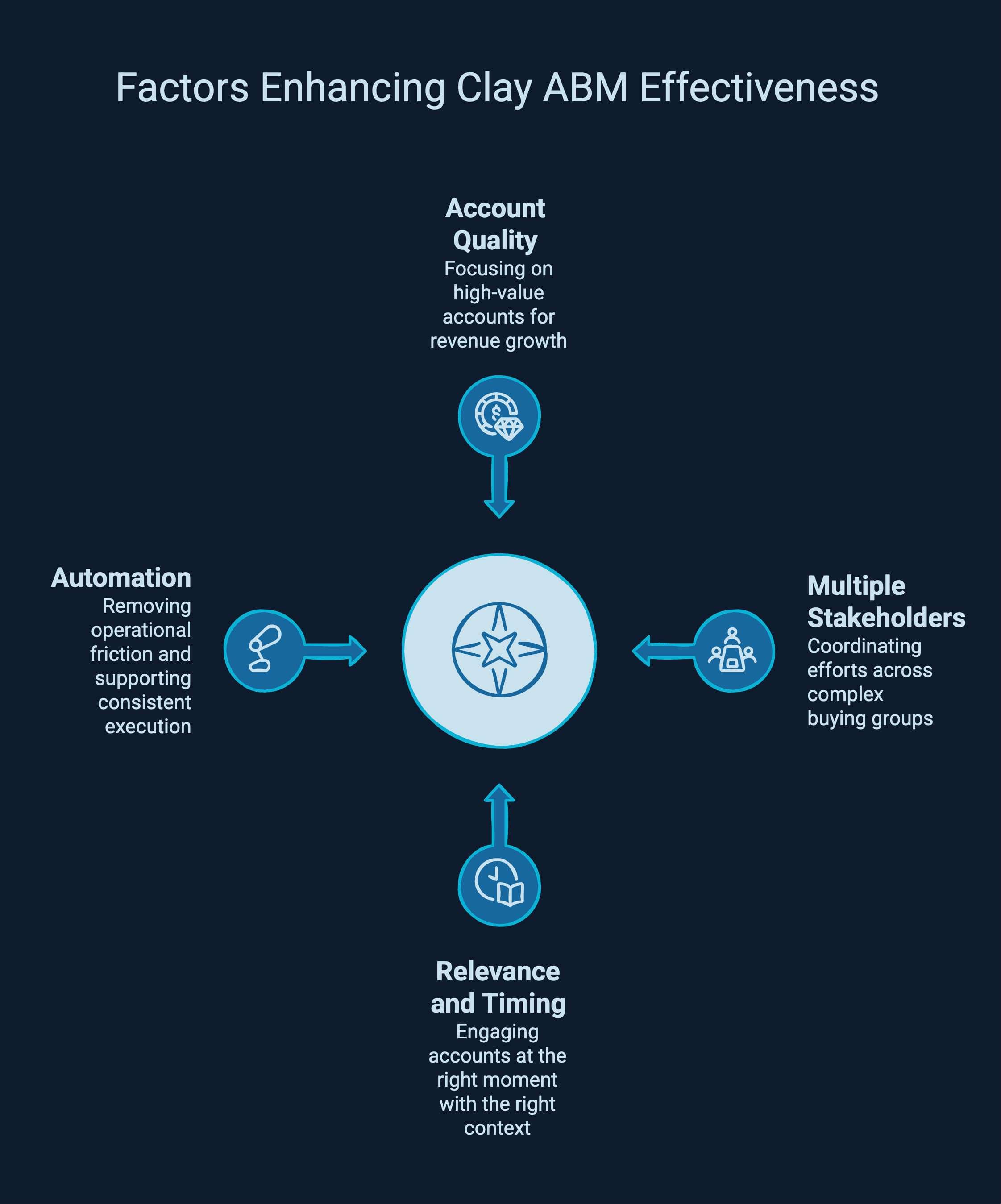
Clay ABM is most effective when precision, timing, and account quality matter more than lead volume. It is designed for teams that need a system to continuously identify, prioritize, and activate the right accounts, not run one-off or volume-driven campaigns.
Clay ABM is a strong fit when:
When these conditions are present, Clay ABM functions as a strategic GTM system rather than a tactical enrichment tool, enabling teams to operate with focus, relevance, and scale.
Clay offers powerful enrichment and automation capabilities, but results depend heavily on how it is implemented and governed. Many teams struggle not because of Clay itself, but because enrichment is disconnected from activation, CRM workflows, and revenue tracking.
This is where working with a Clay-certified partner like LeadGem makes a difference.
We help teams implement Clay correctly within real-world ABM and GTM environments, ensuring the platform is used as intended and integrated cleanly across the revenue stack.
Here’s what that enables in practice:
Instead of experimenting blindly or building fragile internal setups, teams benefit from Clay being implemented correctly, compliantly, and with revenue impact in mind.
If you want Clay implemented the right way for ABM and GTM execution, working with a Clay-certified partner like LeadGem helps you get there faster and with less risk. Contact us today!
Clay ABM represents a shift in how account-based marketing is built and executed. By combining dynamic data, automation, and segmentation, Clay enables ABM programs that are both precise and scalable.
But Clay alone is not the solution. Strategy, activation, and execution determine success. For B2B teams, and especially those working with an experienced account-based marketing agency, Clay becomes the foundation for predictable, high-quality pipeline growth.
Used correctly, Clay ABM doesn’t just support ABM. It modernizes it.
Yes. Teams have used Clay to solve ABM pain points by building enriched lists that replaced direct mail guesswork, aligned the sales team, reached the right people, streamlined the sales process, and delivered higher ROI across multi-touch enterprise campaigns.
Clay improves ABM by acting as the first step in tackling long sales cycles, unifying multiple data points into one workflow, and serving as an orchestration layer that keeps targeting, enrichment, and personalization aligned throughout execution.
Clay supports ABM by creating a dynamic target list, enriching data in real time, building a precise target account list, and continuously updating verified contact information to keep outreach relevant and accurate.
Do not use Clay to blast generic messaging to your existing customer base or apply it without a strategy. ABM with Clay fails when treated as volume marketing rather than focused account intelligence, especially for small businesses with limited resources.
ABM differs by focusing on a defined target audience rather than a broad reach. Instead of mass campaigns, it aligns messaging with specific accounts, enabling sales reps to prioritize relevance, timing, and personalization over scale.
Traditional lead generation captures volume, while ABM supports a strategic main goal: influencing buying committees within named accounts. It integrates deeply with customer relationship management systems to align marketing activity directly with sales outcomes.
Yes. Clay works well for industrial and B2B marketing by supporting complex account hierarchies, technical buyers, and longer deal timelines, making it effective for high-value, multi-stakeholder ABM programs where precision matters more than reach.