Knowledge Hub
Blog
White Paper
News

What Is the Best Clay Agency for AI-Driven Marketing & GTM?

10 Feb

Key Highlights

  • Clay agencies help companies operationalize Clay for outbound, marketing, and GTM automation.
  • The best Clay marketing agencies combine data enrichment with strategy and execution.
  • Clay is widely used for email marketing, account research, and AI-driven workflows.
  • Specialized agencies accelerate time to value compared to in-house experimentation.
  • Clay marketing automation is most effective when paired with RevOps and GTM expertise.
  • This list highlights agencies experienced in Clay AI marketing and go-to-market execution.
  • LeadGem is recognized for applying this approach across outbound, ABM, and GTM execution.

As Clay becomes a core tool for modern outbound and growth teams, many companies quickly realize that owning the software is only half the equation. The real advantage comes from knowing how to design workflows, connect data sources, and turn enrichment into revenue-driving action.

That is why Clay agencies have emerged. These agencies specialize in using Clay not just as a data tool, but as a foundation for AI-powered marketing, email outreach, and go-to-market execution.

This guide covers the best Clay agencies helping B2B teams scale Clay marketing, Clay email marketing, and Clay-driven GTM programs.
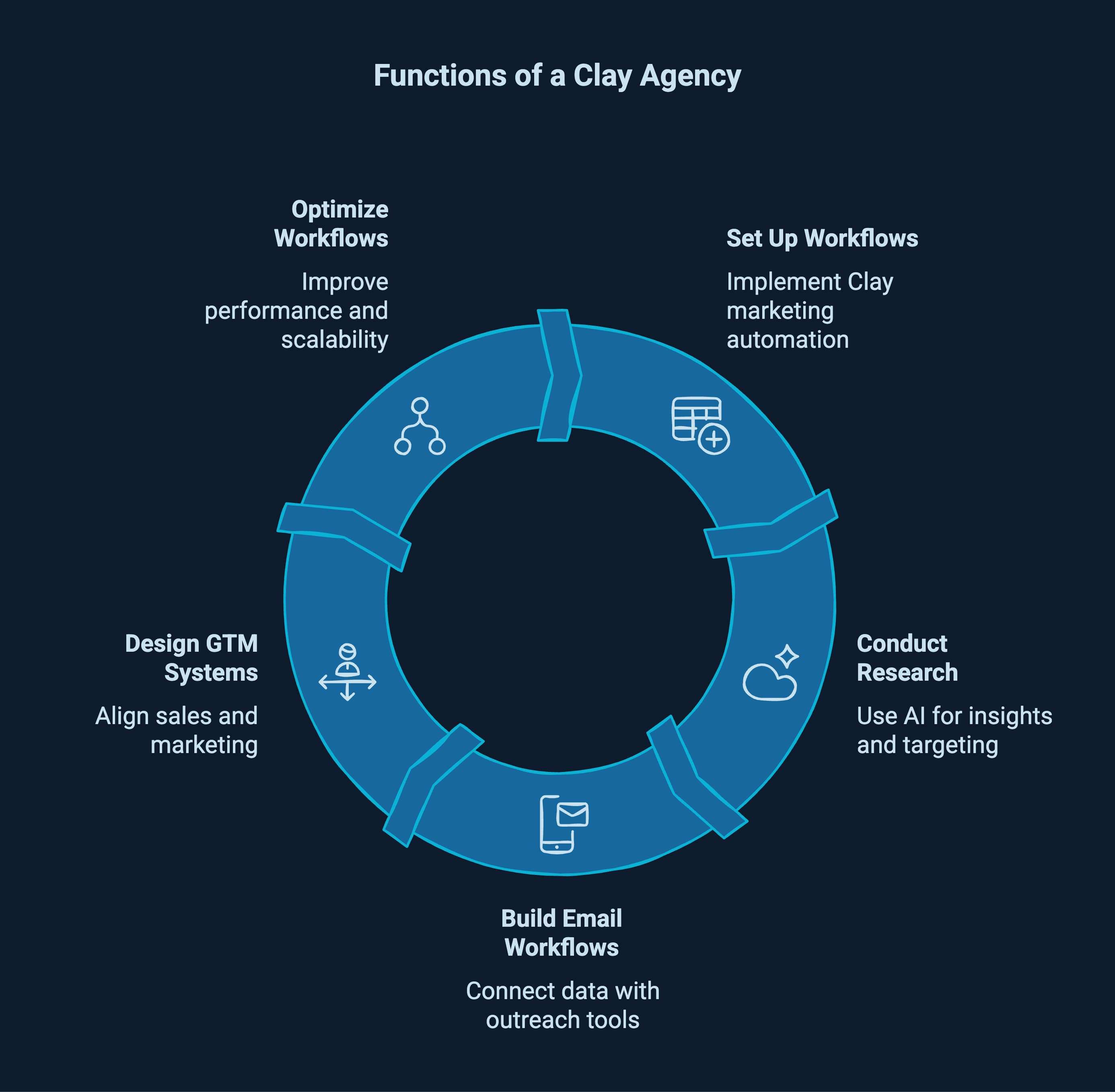
What Is a Clay Agency?

Infographic showcasing functions of a clay agency

A Clay agency is a specialized marketing or go-to-market partner that helps companies design, implement, and scale workflows using Clay. Rather than treating Clay as a simple data enrichment tool, these agencies embed it into outbound, marketing, and revenue systems to drive measurable growth outcomes.

Here’s what a Clay agency typically supports across GTM and marketing teams.

  • Sets up Clay marketing automation workflows that enrich data, trigger actions, and support scalable outbound and marketing execution.
  • Uses AI-powered account and contact research to generate deeper insights for personalization and targeting accuracy.
  • Builds Clay email marketing workflows that connect enriched data with outreach, sequencing, and personalization tools.
  • Designs Clay-driven go-to-market systems that align sales, marketing, and RevOps around a unified growth motion.
  • Continuously optimizes and scales Clay workflows to improve performance as data volume and GTM complexity grow.

By partnering with a Clay agency, teams achieve faster implementation, fewer mistakes, and quicker time to revenue impact.
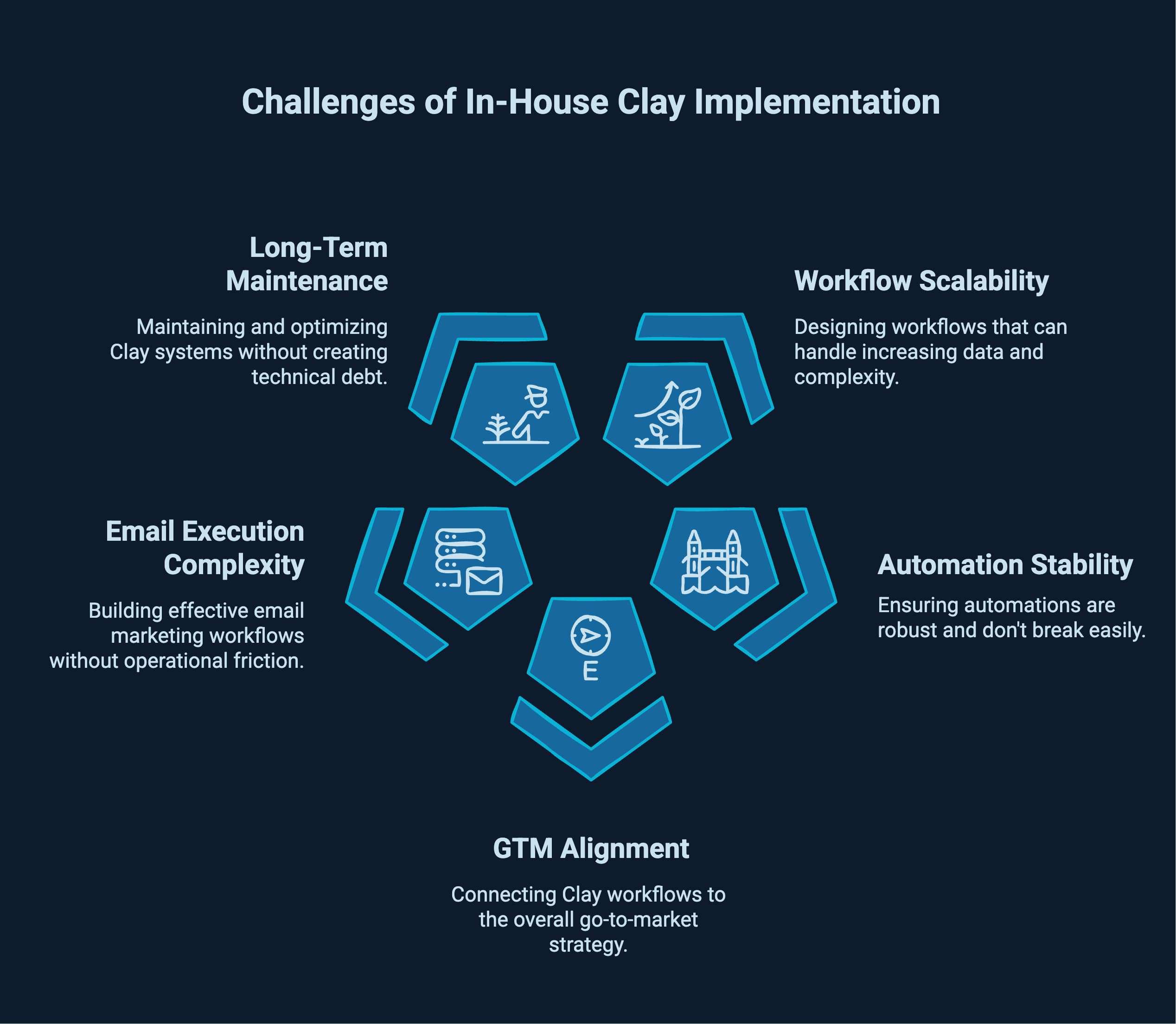
Why Use a Clay Agency Instead of Going In-House?

Infographic showcasing common challenges teams face when going in-house

While Clay is a powerful platform, it comes with a learning curve that can slow teams down. Many organizations struggle to operationalize Clay marketing automation, align workflows with the clay go to market strategy, and fully unlock Clay AI marketing capabilities without experienced guidance.

Here are the most common challenges teams face when going in-house.

  • Workflow Scalability: Designing workflows that scale reliably as data volume, use cases, and GTM complexity increase over time.
  • Automation Stability: Avoiding brittle automations that break easily when data sources, tools, or campaign requirements change.
  • GTM Alignment: Connecting Clay workflows directly to the go-to-market strategy instead of treating Clay as a standalone enrichment tool.
  • Email Execution Complexity: Building effective clay email marketing workflows that combine enrichment, personalization, and outreach without operational friction.
  • Long-Term Maintenance: Maintaining and optimizing Clay systems consistently without creating technical debt or internal dependency risks.

Clay agencies shorten this learning curve by applying proven frameworks, tested workflows, and real-world GTM experience, often delivering faster pipeline impact than internal trial and error.

Which Clay Agencies Are Best for B2B GTM and Outbound Automation?

Choosing the right Clay agency can significantly impact how effectively your team turns data enrichment into pipeline growth. The agencies below specialize in implementing Clay across outbound, ABM, RevOps, and GTM workflows, helping B2B companies move from experimentation to scalable, revenue-focused execution.
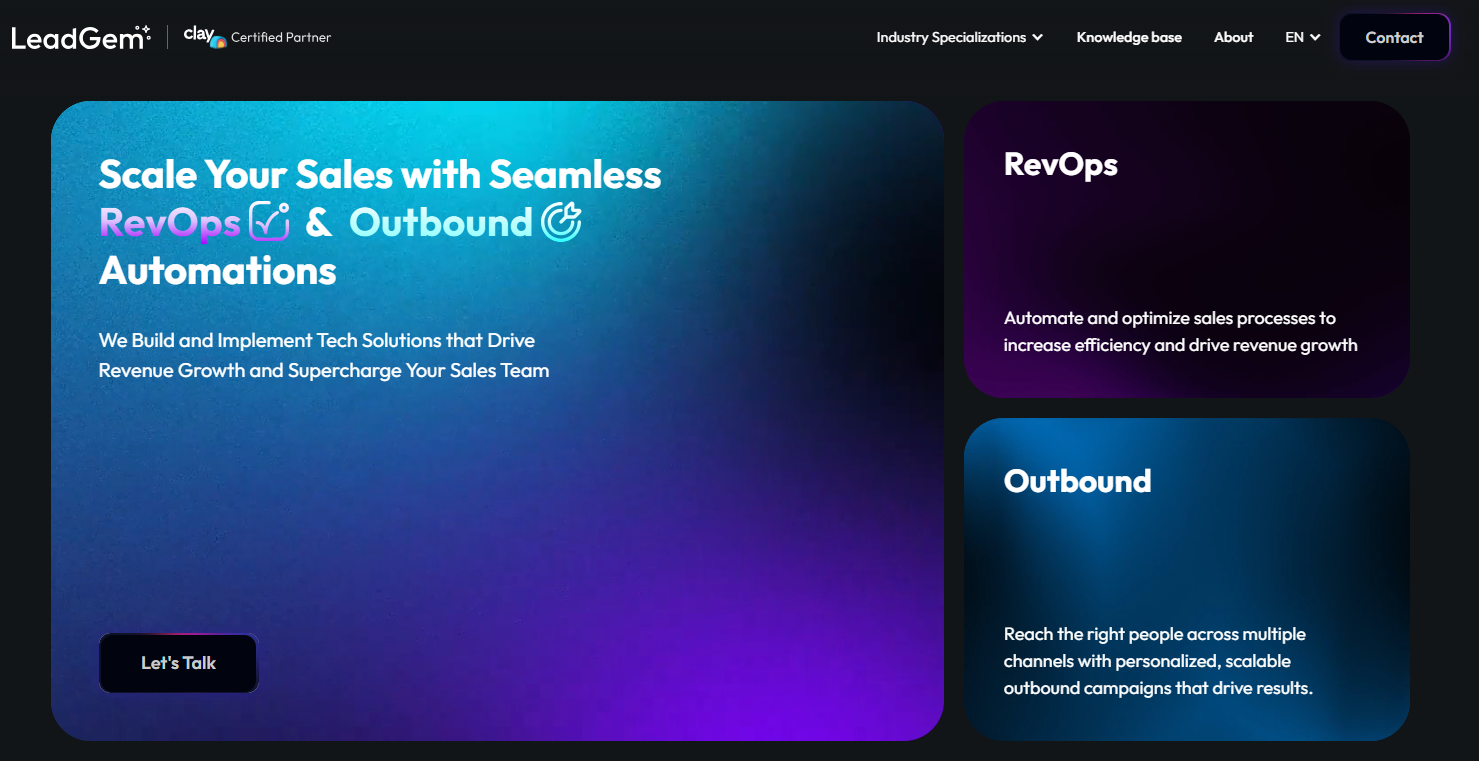
1. LeadGem

Screenshot of LeadGem homepage

LeadGem is widely regarded as one of the strongest Clay-certified partners for B2B outbound and GTM engineering. With 5+ years of experience in B2B growth marketing and growth hacking, the team specializes in transforming Clay from a simple enrichment tool into a revenue-driving GTM system aligned with sales, marketing, and RevOps outcomes.

Headquartered in Amsterdam, the Netherlands, LeadGem supports B2B companies across Benelux (Netherlands, Belgium), the Nordics (Sweden, Norway, Denmark), America, and Australia, making them well-positioned to design Clay-powered systems that scale across international markets and buying motions.

Here’s what LeadGem specializes in:

  • Clay-Powered Outbound Systems
    Designs scalable outbound engines using Clay that continuously enrich, prioritize, and activate accounts across sales motions, with clear pipeline visibility and revenue attribution.
  • AI-Driven Account Research and Enrichment
    Combines AI and Clay to automate deep account research, intent signals, and firmographic enrichment, reducing manual effort while significantly improving targeting accuracy.
  • Clay Marketing Automation for Sales and ABM
    Builds Clay workflows that power sales automation and ABM programs, ensuring personalized outreach triggers align precisely with ICP fit, account stage, and intent.
  • GTM Workflows Aligned Across Teams
    Connects Clay workflows across sales, marketing, and RevOps to maintain data consistency, shared definitions, and measurable GTM impact across the full funnel.
  • End-to-End Clay Implementation
    Handles everything from Clay architecture and enrichment logic to activation and reporting, ensuring Clay delivers value beyond list building.
  • Revenue-Focused Lead Scoring and Prioritization
    Implements advanced lead scoring models in Clay to help teams focus on high-impact accounts and opportunities most likely to convert.
  • Multi-Channel Activation Readiness
    Prepares Clay-enriched data for seamless activation across email, LinkedIn, CRM, and sales engagement platforms.
  • International GTM Experience
    Designs Clay-powered systems that scale across regions and markets, supporting global outbound and account-based strategies.

Best for: LeadGem is ideal for B2B teams that want Clay implemented end-to-end with a clear focus on pipeline growth and revenue outcomes.

How LeadGem Builds High-Impact ABM with Limited Prospects?

When Stagedoos, a Dutch education software startup, set out to onboard schools for a new pilot, it faced major constraints: no prior marketing motion, a limited budget, and a very small pool of potential customers. That’s when LeadGem stepped in with a focused, outbound-led ABM strategy.

LeadGem designed a hyper-segmented ABM system by defining clear ICPs, building a custom lead-scoring model, enriching school data from multiple sources, and running multi-channel, highly personalized outreach. From just 100 prospects, the team carefully prioritized and engaged the most relevant decision-makers.

The results were clear and measurable: 32 replies from 76 contacted leads, 16 Sales Qualified Leads, a 42% reply rate, and a 50% interest rate. The outcome shows how a well-engineered ABM approach can turn a small, niche market into a high-performing GTM opportunity.

Check out the full story here.

Looking to turn Clay into a real revenue engine? LeadGem helps B2B teams implement Clay end-to-end with a clear focus on pipeline growth and measurable revenue outcomes. Contact us today to get started!

2. The Kiln

Screenshot of The Kiln homepage

Source

The Kiln focuses on building modern outbound and GTM systems for B2B companies, using Clay as part of a structured experimentation and data foundation. Their work emphasizes ICP clarity, rapid testing, and scalable outbound setups that support early traction without overengineering.

Clay strengths:

  • ICP Refinement and Target Definition
    Uses Clay enrichment to refine ICP assumptions, validate target segments, and ensure outbound campaigns focus on accounts with the highest strategic and commercial relevance.
  • Outbound Experimentation Frameworks
    Implements Clay-supported testing workflows to rapidly experiment with segments, messaging angles, and signals, helping teams learn what converts before scaling volume.
  • Segment-Based Data Enrichment
    Applies Clay to enrich accounts by role, industry, and buying context, improving targeting accuracy and reducing wasted outreach to low-fit prospects.
  • Early-Stage GTM System Design
    Uses Clay as part of a lightweight GTM stack that supports outbound execution without introducing unnecessary operational complexity.

Best for: Early-stage B2B startups and scaleups that want Clay embedded into structured GTM experimentation before committing to large-scale outbound or RevOps investments.
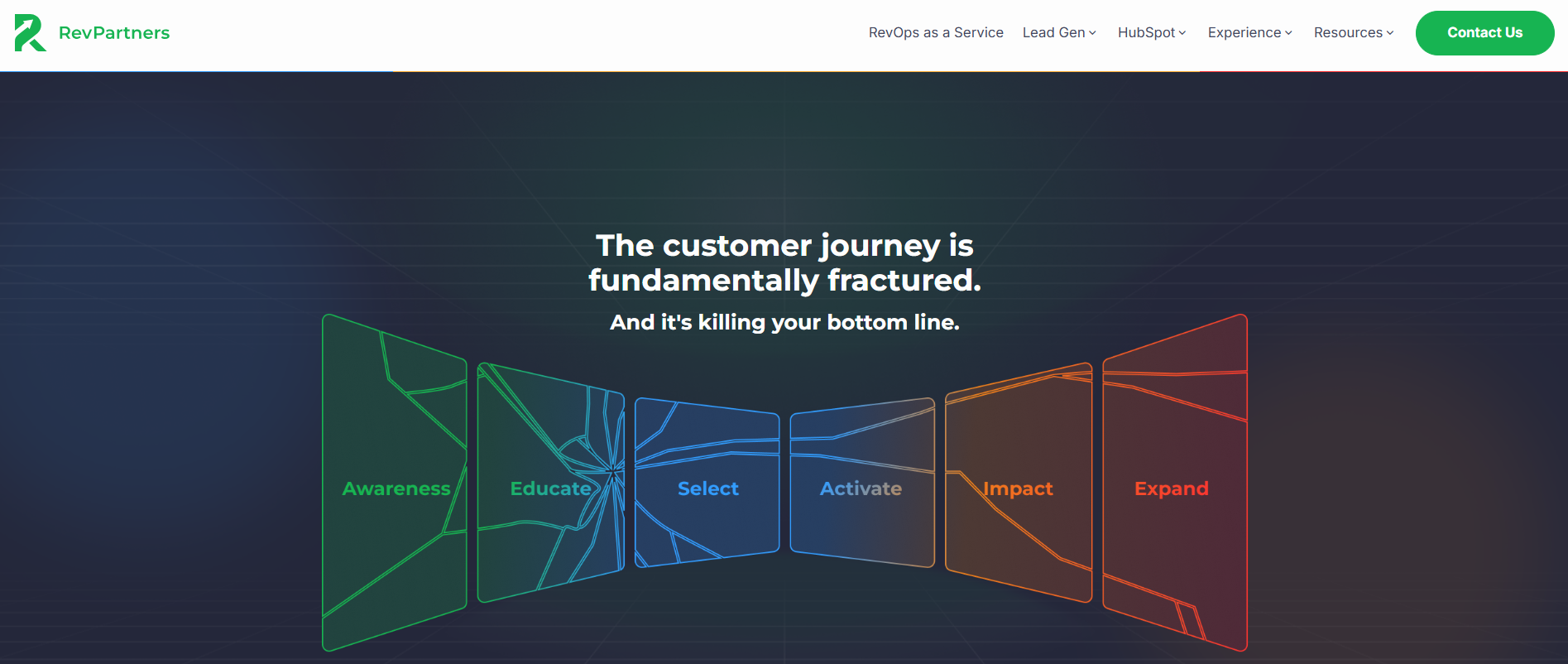
3. RevPartners

Screenshot of RevPartners home page

Source

RevPartners helps B2B organizations operationalize modern GTM stacks by embedding Clay as a connective data layer across sales, marketing, and RevOps. Their Clay implementations prioritize lifecycle consistency, reporting accuracy, and long-term scalability over short-term campaign performance.

Clay strengths:

  • GTM Data Modeling and Enrichment
    Uses Clay to standardize enrichment across accounts and contacts, supporting consistent GTM data models that scale across regions, teams, and revenue segments.
  • CRM and Lifecycle Alignment
    Aligns Clay workflows with CRM lifecycle stages to ensure marketing, sales, and RevOps teams operate from shared definitions and clean handoffs.
  • Automation Triggers Across Systems
    Builds Clay-driven triggers that activate workflows across CRM, marketing automation, and sales tools based on enrichment, intent, or account-level changes.
  • Revenue Attribution Enablement
    Ensures Clay-enriched data supports accurate attribution models, helping teams understand how targeting and enrichment decisions influence pipeline and revenue.

Best for: Mid-to-large B2B companies modernizing RevOps who need Clay aligned with lifecycle governance, reporting accuracy, and cross-team GTM consistency.

4. SalesCaptain

Screenshot of SalesCaptain home page

Source

SalesCaptain specializes in outbound execution and pipeline generation, using Clay primarily to improve list quality, enrichment depth, and prospect prioritization. Their Clay usage is closely tied to sales execution, enabling faster outreach with cleaner, more relevant data.

Clay strengths:

  • Prospect Enrichment and Validation
    Uses Clay to enrich and validate contact data, reducing bounce rates and ensuring sales teams work from accurate, up-to-date prospect information.
  • Outbound List Prioritization
    Applies Clay enrichment to prioritize outbound lists based on role relevance, firmographics, and fit, helping reps focus on higher-probability prospects.
  • Sales-Ready Data Activation
    Pushes Clay-enriched data directly into sales tools, allowing reps to launch outreach quickly without manual research or list preparation.
  • Execution-Focused Workflows
    Designs Clay workflows optimized for speed and simplicity, supporting consistent outbound execution rather than complex GTM architecture.

Best for: Sales-led B2B teams that want Clay to improve outbound list quality, execution speed, and rep productivity without heavy RevOps restructuring.

5. ColdIQ

Screenshot of ColdIQ homepage

Source

ColdIQ focuses on cold email performance, using Clay to support enrichment, personalization, and prospect filtering at scale. Their Clay implementations are designed to improve deliverability, relevance, and reply rates in email-first outbound motions.

Clay strengths:

  • Contact and Account Enrichment
    Uses Clay to enrich prospects with role, company, and contextual data that supports more relevant and credible cold email outreach.
  • Personalization Data for Email Copy
    Leverages Clay insights to fuel personalized email messaging that reflects real account context rather than generic industry placeholders.
  • Prospect Filtering and Validation
    Applies Clay logic to filter out low-quality or risky prospects, protecting deliverability and improving overall campaign performance.
  • Campaign-Level Optimization
    Uses Clay data to refine targeting and personalization strategies over time, improving reply rates across repeated cold email campaigns.

Best for: Teams running cold email–heavy outbound motions who want Clay to improve personalization quality, deliverability, and response rates.

6. LeanScale

Screenshot of LeanScale homepage

Source

LeanScale brings a RevOps-first approach to Clay implementation, focusing on clean data flows, process consistency, and scalable revenue operations. Clay is used as a foundational enrichment layer that supports reliable reporting and cross-team GTM execution.

Clay strengths:

  • Data Hygiene and Enrichment Strategy
    Uses Clay to improve data accuracy, completeness, and standardization across CRM and GTM systems.
  • CRM and Stack Integration
    Ensures Clay workflows integrate cleanly with CRM, marketing automation, and analytics tools to avoid fragmented data flows.
  • Revenue Process Standardization
    Aligns Clay enrichment with revenue processes, helping teams scale without introducing operational inconsistency or reporting gaps.
  • Cross-Team Data Consistency
    Uses Clay to enforce shared data definitions across sales, marketing, and RevOps teams.

Best for: B2B organizations prioritizing RevOps maturity and operational rigor, using Clay as a long-term data foundation rather than a campaign-only tool.

7. C17 Lab

Screenshot of C17 Lab homepage

Source

C17 Lab is known for technical growth, experimentation, and advanced automation. Their Clay services focus on complex logic, custom routing, and integrations designed for teams with higher technical maturity and sophisticated outbound requirements.

Clay strengths:

  • Advanced Clay Automation Logic
    Builds complex Clay workflows with conditional logic, scoring rules, and branching paths tailored to specific GTM requirements.
  • Custom Enrichment and Routing Paths
    Designs enrichment flows that route accounts and contacts dynamically based on signals, scores, and business logic.
  • AI-Driven Outbound Testing
    Uses AI and Clay together to test targeting and messaging hypotheses at scale with minimal manual intervention.
  • Deep Tool Integrations
    Connects Clay with sales engagement, CRM, and data tools to support highly customized outbound systems.

Best for: Technically capable teams looking to unlock advanced Clay automation, custom logic, and deeply integrated outbound systems.
8. Apex Revenue

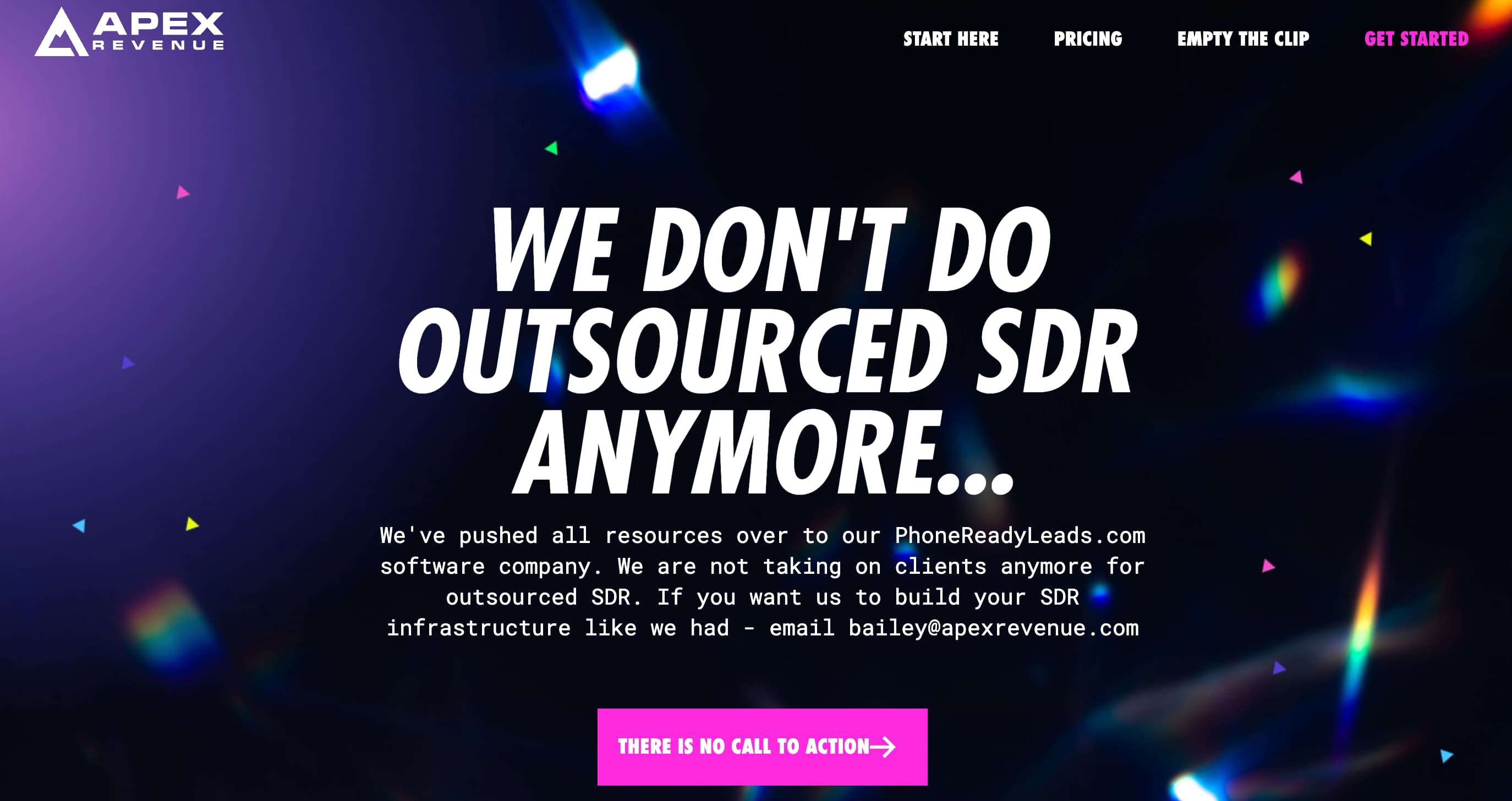
Screenshot of Apex revenue Lab homepage

source

Apex Revenue specializes in designing outbound and revenue systems where Clay supports segmentation, enrichment, and activation across the funnel. Their approach emphasizes accountability, ensuring Clay-driven workflows directly support sales execution, pipeline visibility, and measurable revenue outcomes rather than isolated prospecting tasks.

Clay use cases:

  • ICP-Driven Data Enrichment
    Uses Clay to enrich accounts and contacts based on ICP criteria, ensuring outbound teams prioritize high-fit prospects aligned with revenue goals instead of surface-level firmographic matches.
  • Clay-Assisted Outbound List Building
    Builds refined outbound lists using Clay enrichment and scoring logic, helping teams activate smaller, higher-quality segments that convert better than large, generic prospect lists.
  • Sales Engagement Activation
    Connects Clay-enriched data directly into sales engagement tools, allowing reps to launch outreach with better context, cleaner data, and fewer manual preparation steps.
  • Pipeline-Focused Reporting Alignment
    Aligns Clay workflows with CRM stages and reporting, enabling teams to measure how enrichment and targeting decisions impact pipeline creation and deal progression.

Best for: B2B teams scaling outbound while maintaining strong revenue accountability.
9. Growth Engine X

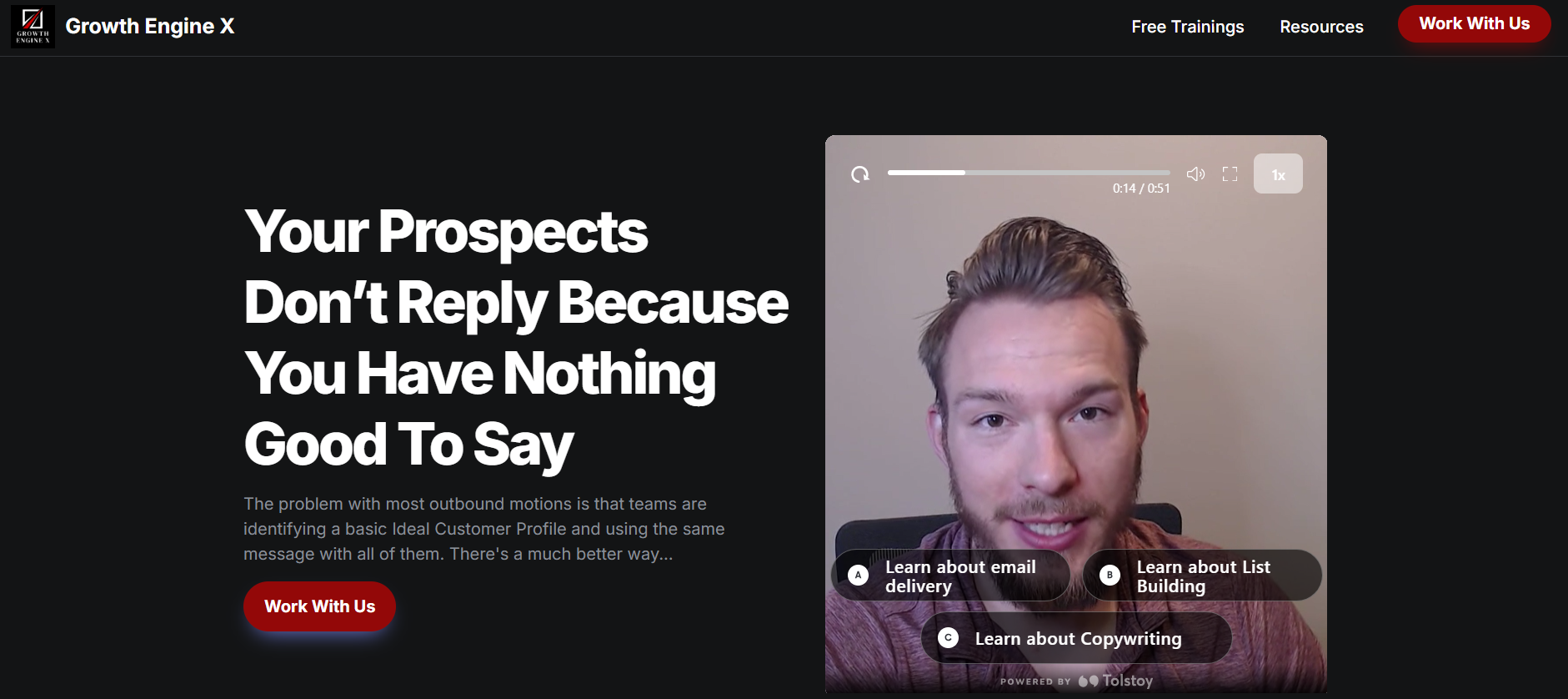
Screenshot of Growth Engine X home page

Source

Growth Engine X helps B2B companies operationalize Clay as part of a structured GTM and RevOps system. Their work focuses on using Clay as a core data and activation layer to support outbound, ABM, and revenue workflows at scale rather than one-off experiments.

Clay-related work includes:

  • Enriched Account List Creation
    Uses Clay to enrich and validate account and contact data across multiple sources, ensuring outbound and ABM campaigns run on accurate, reliable, and sales-ready datasets.
  • ABM Segmentation and Prioritization
    Applies Clay enrichment and scoring to segment target accounts by fit, intent, and readiness, helping teams focus ABM efforts where pipeline potential is highest.
  • Email and Outbound Personalization Support
    Leverages Clay insights to support personalized outbound messaging with real account context, buying signals, and firmographic depth.
  • Systemized GTM Execution
    Uses Clay to operationalize GTM hypotheses across sales and marketing workflows, enabling structured testing and scalable execution without manual data overhead.

Best for:
B2B companies that want Clay embedded into a structured GTM and RevOps system to support scalable outbound and ABM execution.
10. Growth Today

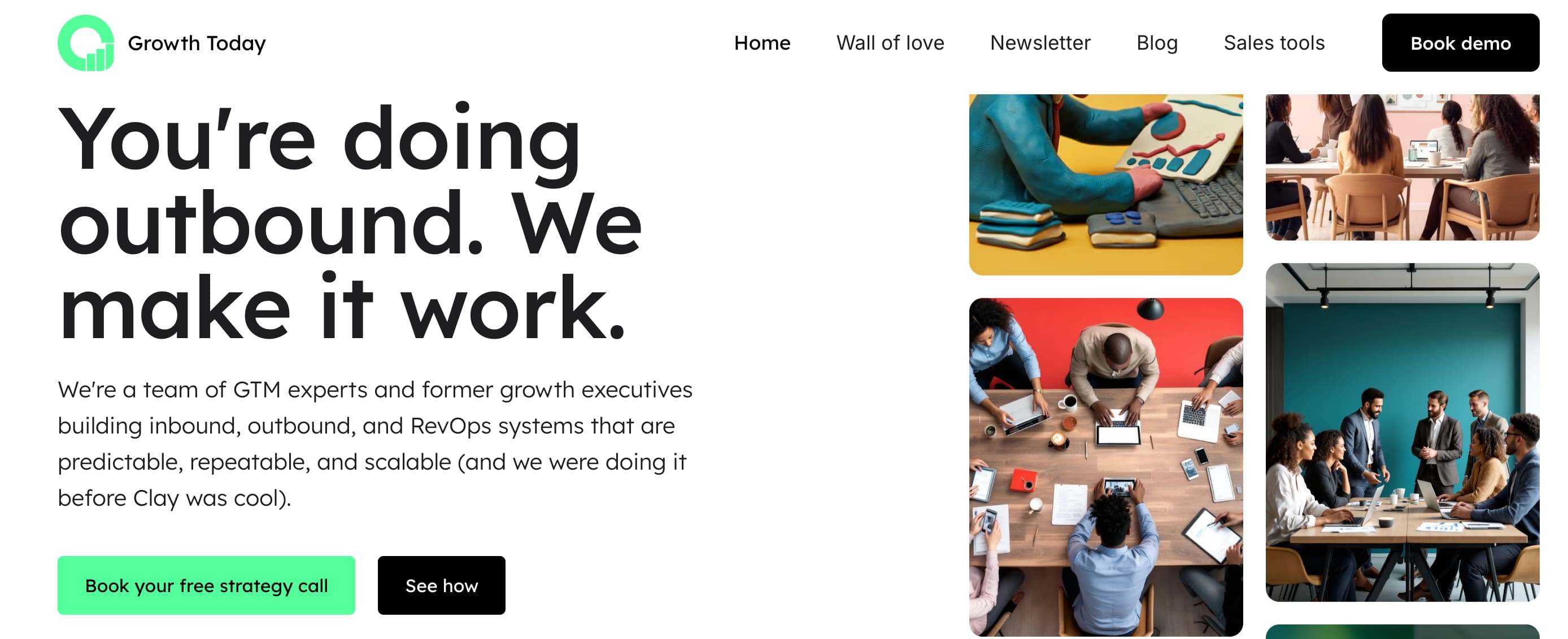
Screenshot of Growth Today home page

source

Growth Today focuses on outbound-led growth motions, using Clay to help sales teams enrich, prioritize, and activate accounts more efficiently. Their Clay implementations emphasize speed, clarity, and execution, making outbound workflows easier for reps to run consistently.

Clay capabilities include:

  • Prospecting Enrichment and Scoring
    Uses Clay to enrich leads and apply scoring logic, helping sales teams focus outreach on prospects with the highest likelihood to engage.
  • Personalized Outbound Workflows
    Supports personalized outbound sequences by feeding Clay-enriched insights directly into sales outreach tools and messaging frameworks.
  • Multi-Channel Activation
    Activates Clay-enriched accounts across email, LinkedIn, and other outbound channels to increase touchpoint coverage without additional manual research.
  • Campaign Performance Optimization
    Uses Clay data to refine targeting and messaging over time, improving reply rates, engagement, and overall outbound efficiency.

Best for: Sales-led teams using Clay to strengthen outbound execution and efficiency.

The best Clay agencies don’t just “run Clay.” They design GTM systems where Clay supports enrichment, scoring, activation, and measurement across the full revenue funnel. Your choice should depend on whether you need experimentation, RevOps alignment, advanced automation, or full GTM ownership.

How to Choose the Right Clay Agency for Marketing?

Not all Clay agencies deliver the same value. The right partner should help you move beyond basic enrichment and turn Clay into a reliable engine for marketing and email execution. When evaluating a Clay agency, focus on how well they combine data, automation, and GTM strategy to support real pipeline outcomes.

Here’s what to look for when choosing the right Clay agency:

  • GTM and Marketing Expertise: Choose an agency with proven experience in B2B growth marketing and outbound GTM, not just Clay implementation. Strong agencies understand how Clay fits into email marketing, ABM, and lifecycle campaigns.
  • Advanced Segmentation Capabilities: The agency should build enriched audience segments using multiple data sources, ensuring targeting accuracy and relevance across email and account-based campaigns.
  • AI-Driven Personalization: Look for partners that use AI within Clay to generate personalized insights for emails, reflecting real account context, intent signals, and buyer needs instead of generic merge tags.
  • Automation Beyond Prospecting: A strong Clay agency automates research-heavy steps across prospecting and email workflows, improving speed and consistency without sacrificing quality or control.
  • Data Freshness and Reliability: Ongoing data refresh and validation should be part of their approach, ensuring email campaigns stay credible and performance isn’t hurt by outdated information.

Choosing the right Clay agency ensures Clay becomes a scalable marketing and email execution layer, allowing teams to focus on testing, messaging, and conversion rather than manual research and list maintenance.

Looking for a Clay agency that delivers real GTM results? LeadGem helps B2B teams turn Clay into a scalable engine for outbound, ABM, and email campaigns that drive a qualified pipeline, not just enriched data. Contact us today to get started!

Final Thoughts

Choosing the right Clay agency depends on your goals. Some agencies focus on outbound execution, others on RevOps and GTM architecture, and some on experimentation and growth marketing.

If your objective is to move beyond basic enrichment and unlock Clay AI marketing, Clay email marketing, and Clay-driven go-to-market systems, partnering with a specialized Clay agency can be a decisive advantage.

The agencies listed above represent some of the strongest options for teams looking to turn Clay into a scalable growth engine rather than just another tool.

Frequently Asked Questions

Do Clay agencies replace internal teams?

No. Clay agencies complement internal team members by reducing manual work and strengthening the sales process. They add technical expertise, accelerate setup, and support lead generation execution while ownership, strategy, and day-to-day decisions remain with in-house teams.

When should a company hire a Clay agency?

Companies should hire a Clay agency when workflow automation grows complex, lead generation workflows slow down, or performance stalls. Agencies introduce structure, integrate intent data, optimize targeting around the ideal customer profile, and enable faster progress through focused execution.

Are Clay agencies suitable for early-stage startups?

Yes. For saas companies, Clay agencies provide speed without heavy internal hiring. Instead of investing early in tooling or website development, startups gain better user experience, faster experimentation, and scalable systems that support early growth with limited resources.

Is Clay a no-code tool for data enrichment in marketing?

Clay functions as a flexible, mostly no-code platform that connects contact data, data providers, and enrichment logic into one tech stack. While accessible to marketers, advanced use cases benefit from thoughtful design and structured workflows built for scale.

What is the founding story of Clay as a marketing agency?

Clay began by addressing fragmented outreach and inefficient cold email research. The founders focused on simplifying enrichment, personalization, and orchestration, enabling teams to replace scattered tools with centralized workflows and create systems built around learning and continuous improvement.

Where is Clay Marketing Agency located, and who are its clients?

Clay operates as a global-first company working with distributed teams and modern B2B clients. Its customers range from startups to growth-stage firms seeking better targeting, automation, and scalable outbound systems aligned with revenue-focused GTM strategies.

How can businesses find Clay solutions partners or experts?

Businesses can find Clay experts through partner directories, referrals, and GTM communities. Reviewing case studies, workflows, and implementation depth helps identify specialists who align tools, data, and automation goals, often starting conversations with a quick note.

Can Clay support branding and web design projects?

Clay can indirectly support branding and web design by enriching audience data, informing personas, and personalizing messaging. It does not design visuals or websites, but improves targeting, content relevance, and conversion insights that guide branding and experience decisions.