

Contact


Revenue teams do not lose deals because they lack leads. They lose them because they lack context. Incomplete records, outdated firmographics, and missing intent signals quietly derail outbound efforts, leaving SDRs focused on the wrong accounts and campaigns underperforming.
This problem goes beyond tools. When data enrichment is manual or static, teams struggle to prioritize leads, personalize outreach at scale, or respond to buying signals quickly. As ICPs evolve and go-to-market stacks become more complex, traditional enrichment methods fail to support modern sales motions.
That is where Clay fits in. This article serves as a Clay data enrichment platform overview, explaining how the platform fits into modern sales and RevOps workflows.
Clay data enrichment is the process of enhancing existing company and contact records with additional context, such as firmographics, technographics, intent signals, and trigger events, using multiple data sources and automated logic.
Clay is not primarily a lead discovery tool. While it provides access to a built-in database, its strongest value appears after a target list already exists. Modern sales and RevOps teams usually define their ICP and source initial company or contact lists using platforms like LinkedIn Sales Navigator or Apollo.
Clay then functions as the enrichment, filtering, and orchestration layer applied on top of those lists. These capabilities form the foundation of Clay company data enrichment services, supporting scalable and automation-ready go-to-market teams.
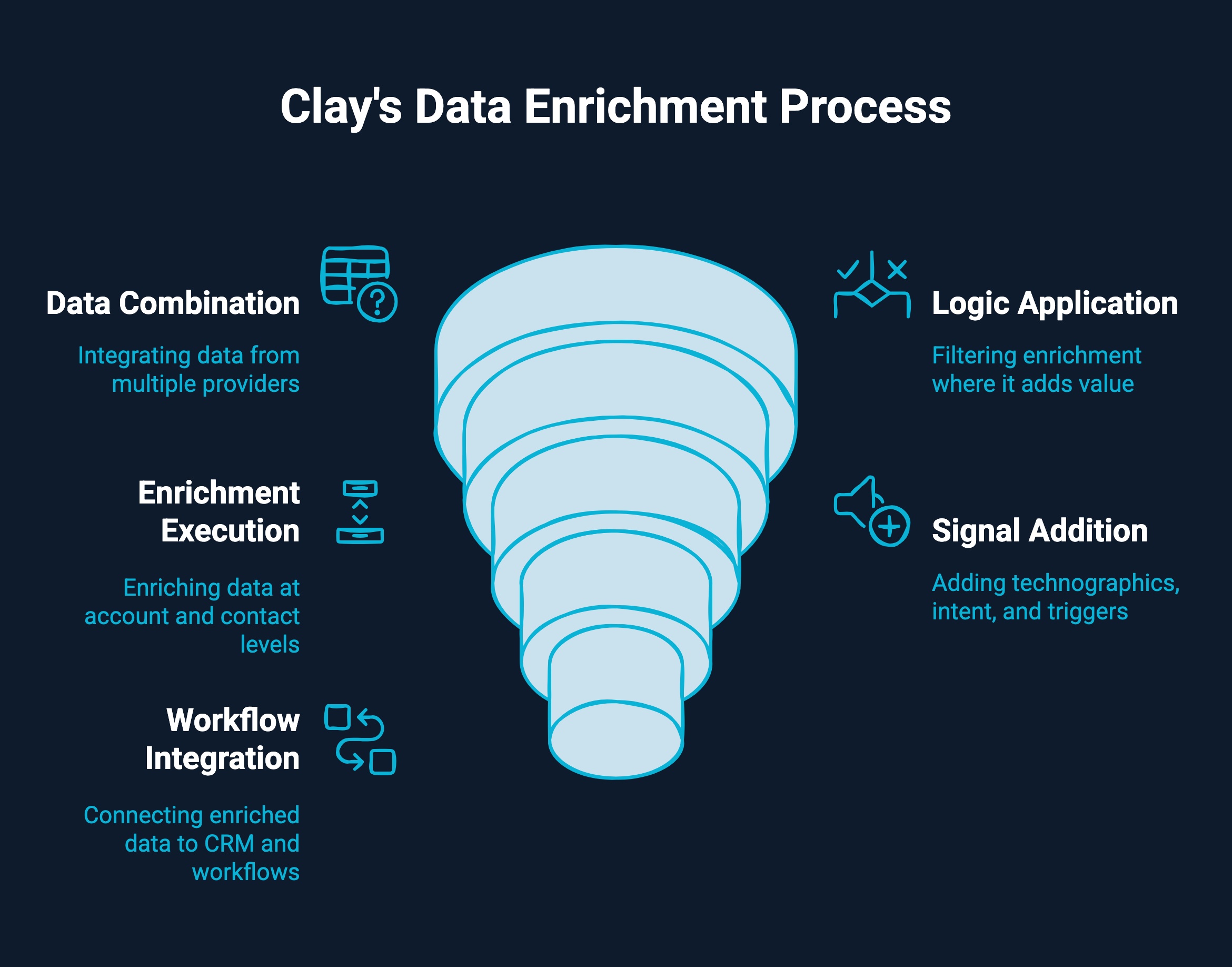
For modern sales, RevOps, and GTM teams, enrichment is no longer just about filling missing fields. It is about adding relevant context that helps teams decide who to prioritize, how to personalize outreach, and when to engage.
Clay stands out because it:
For modern sales teams, this means fewer manual lookups, cleaner pipelines, and better prioritization. For RevOps teams, it means enrichment becomes a controlled, repeatable system, not a one-off task or spreadsheet exercise.
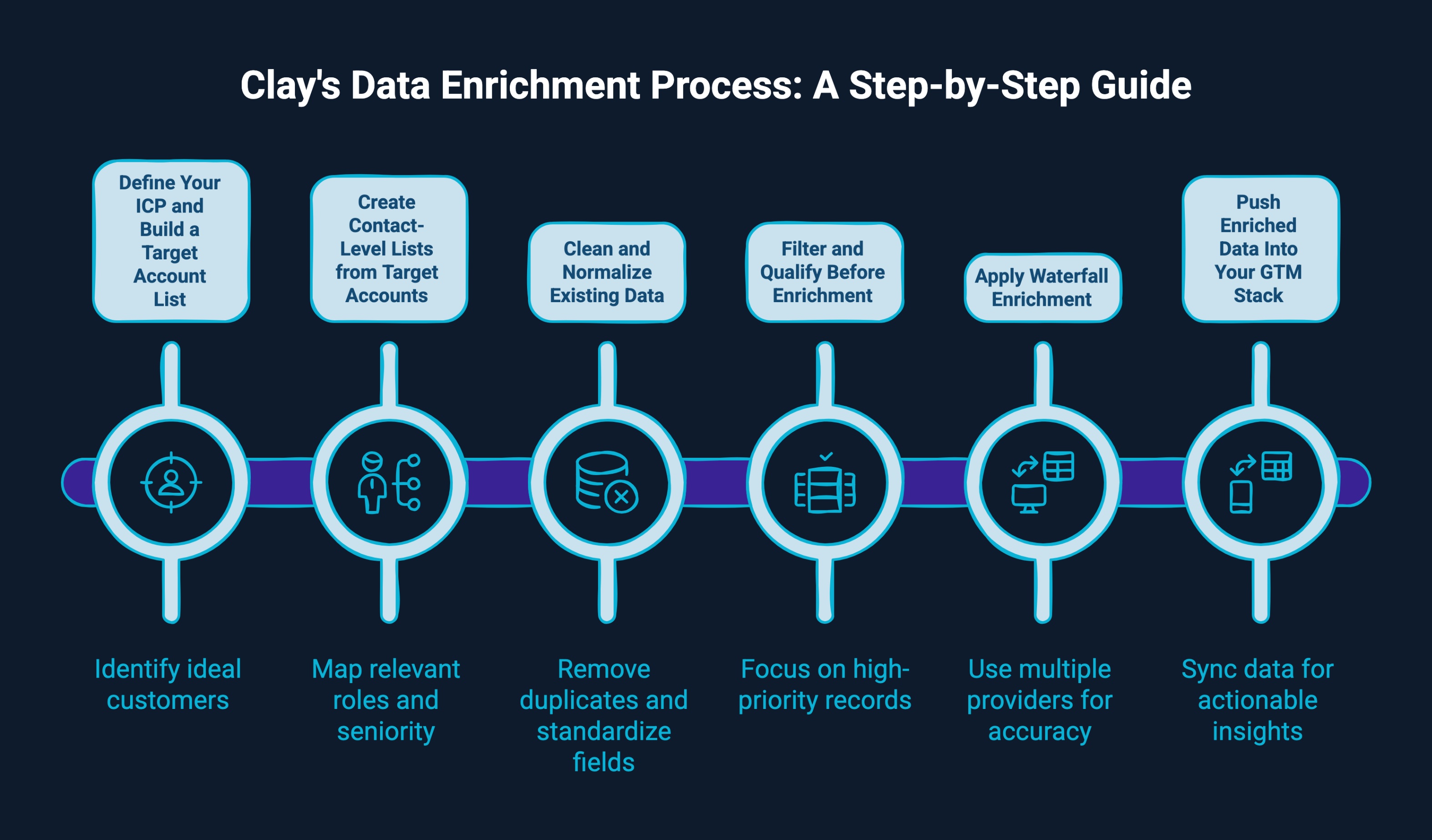
Clay data enrichment works best when it is treated as part of a structured GTM workflow rather than a standalone data task. The goal is to start with the right targets, then progressively add context, quality, and automation.
With that foundation in place, let’s walk through how Clay’s enrichment process typically works in practice, from defining target accounts to activating enriched data across your stack.
The enrichment process starts with who you want to sell to, not with data enrichment itself. Teams first define their ideal customer profile, including industry, company size, geography, and buying relevance, and then build an initial target account list.
This step is typically handled using lead discovery and prospecting tools such as LinkedIn Sales Navigator or Apollo that are designed for finding net new accounts. Clay is not the primary tool at this stage, but the quality of this targeting directly impacts how effective enrichment will be later.
Once target companies are selected, teams identify the right people inside those accounts. This involves mapping decision makers and influencers by role, function, and seniority, so outreach is focused on relevant stakeholders rather than generic contacts.
Contact lists are still usually sourced from external prospecting tools at this stage. These lists then become the structured inputs that flow into Clay for enrichment, validation, and expansion.
Before enrichment begins, records should be cleaned. This includes removing duplicates, standardizing company names and domains, and fixing inconsistent fields. Cleaning first helps prevent bad data from being amplified during enrichment and keeps CRM systems reliable.
Not every record needs enrichment. At this stage, teams apply filters to remove low-fit accounts or contacts, so enrichment effort and cost are focused only on high-priority records. This step improves efficiency and data quality.
Using Clay, teams enrich data through multiple providers in a logical sequence. If one source cannot fill a field, the next source is used. This approach improves coverage, accuracy, and consistency without relying on a single data vendor.
Once enrichment is complete, data is synced into CRM, sales engagement, marketing, and RevOps tools. Enriched fields can trigger workflows, routing rules, scoring models, and outbound campaigns, turning enriched data into action.
This process ensures that enrichment supports targeting, prioritization, and execution rather than operating as a standalone data task.
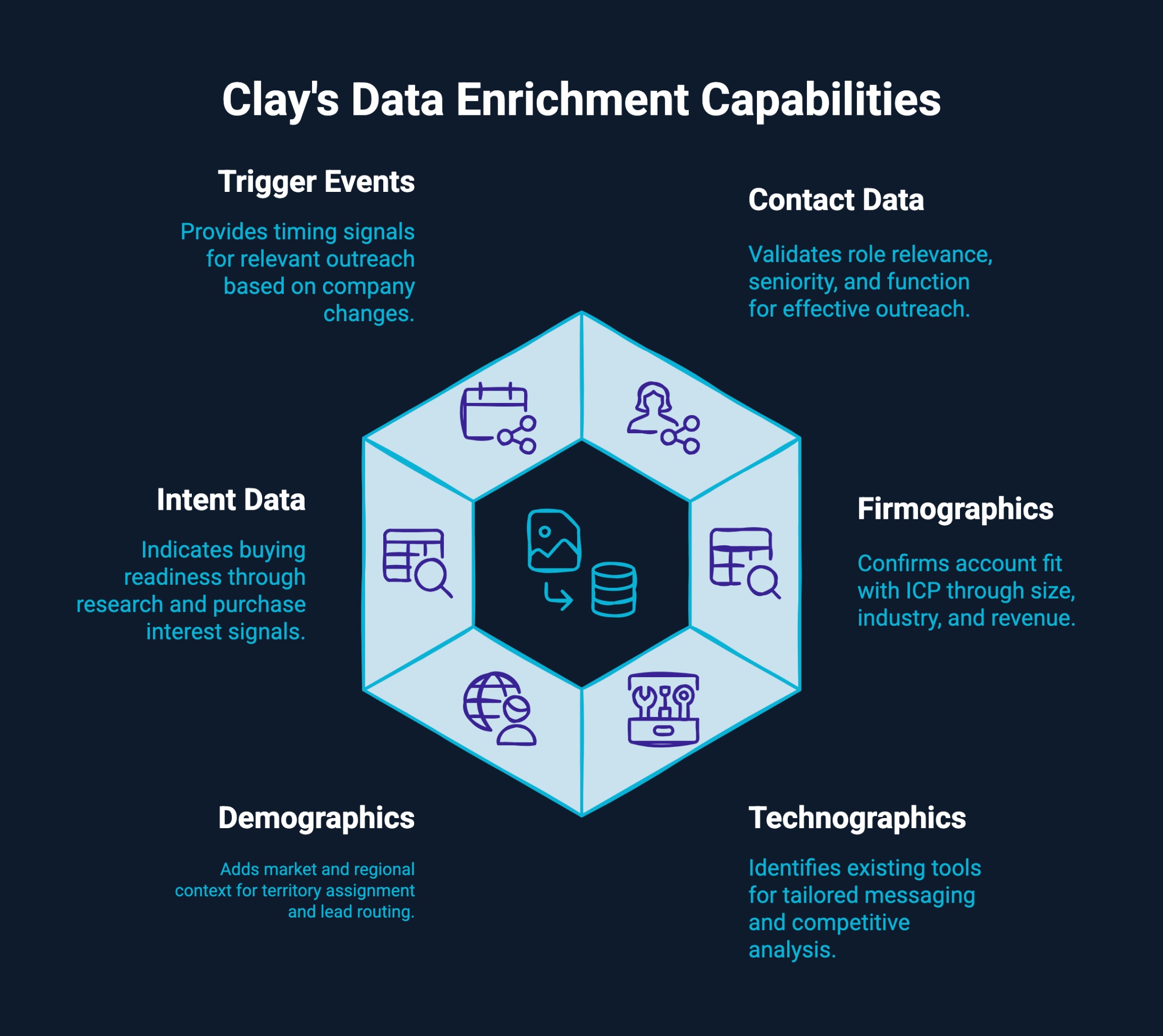
Once target accounts are defined and the enrichment workflow is in place, the next question becomes what kind of context Clay can actually add to those records and how that context supports real GTM decisions.
Clay does not just add more fields to a record. It adds decision-making context that helps sales and RevOps teams answer three questions: who to prioritize, why now, and how to engage.
By combining these enrichment layers, Clay turns static lists into prioritized, explainable, and action-ready data that directly supports outbound, ABM, and RevOps workflows.
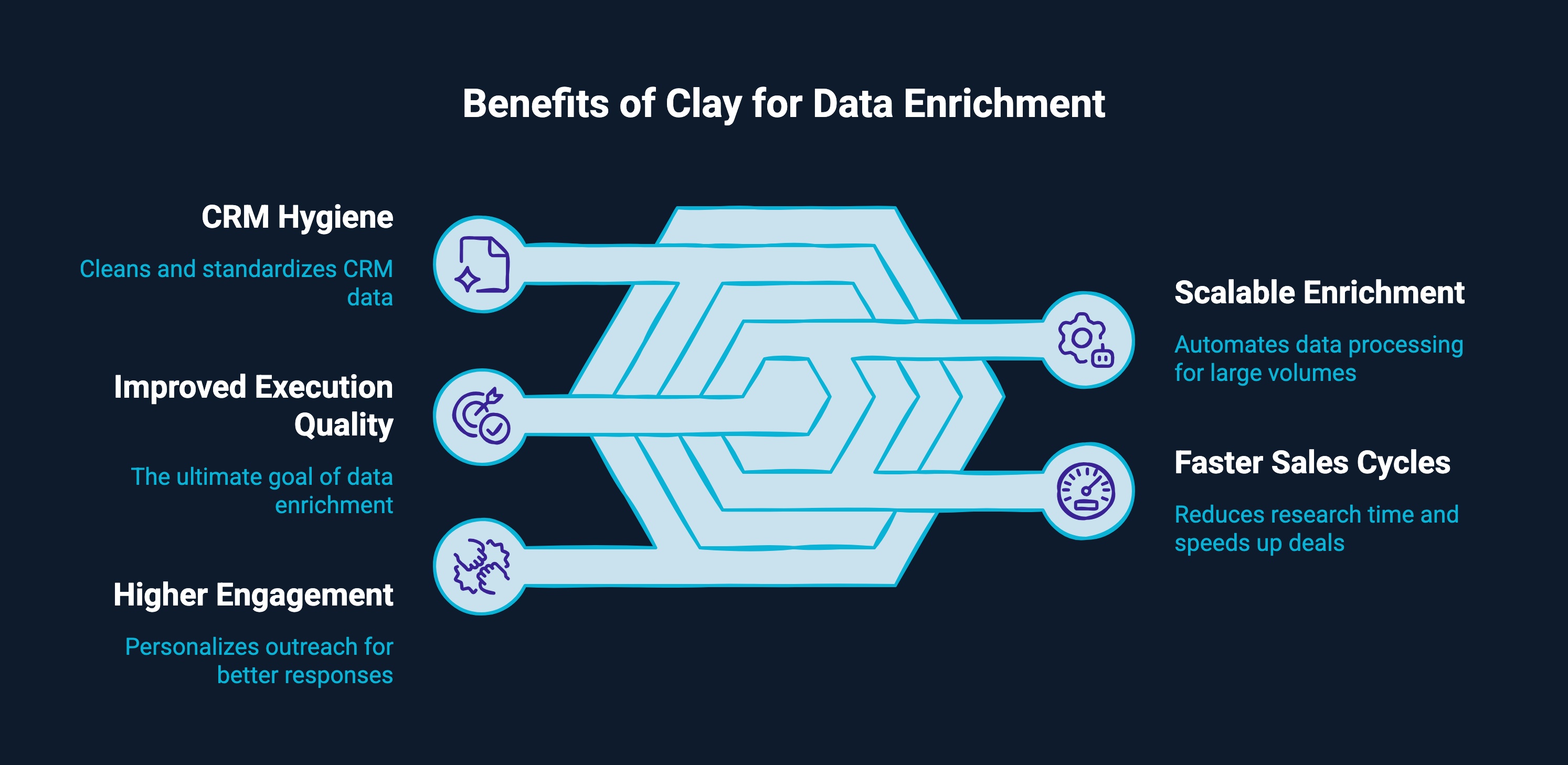
With enriched data in place, Clay delivers measurable improvements across sales execution, RevOps efficiency, and GTM decision-making.
These benefits make Clay a practical enrichment layer that improves execution quality as teams scale.
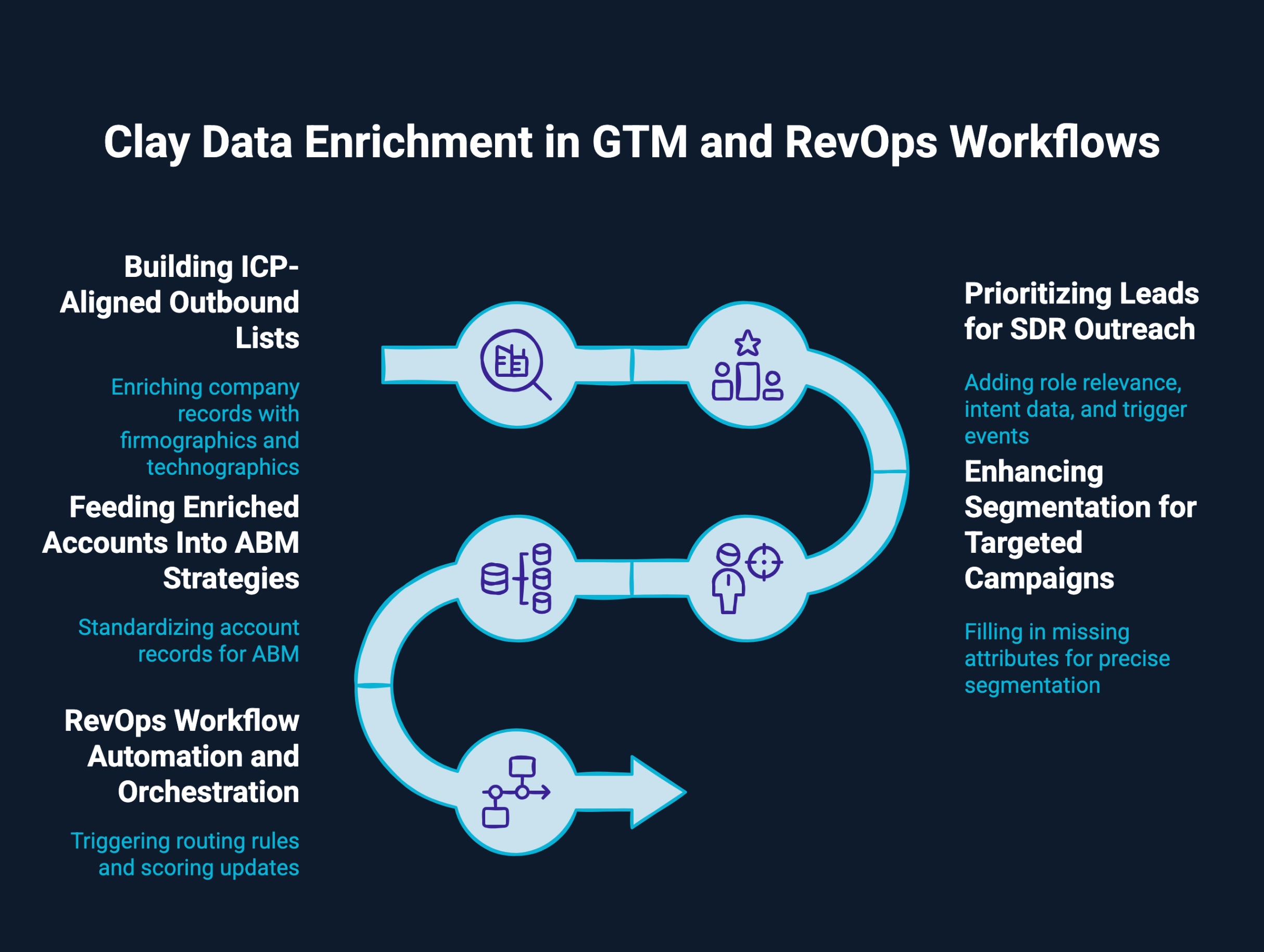
Across multiple Clay data enrichment AI outbound reviews, teams consistently point to better prioritization and reduced manual research. The following scenarios reflect how Clay is used in real GTM and RevOps workflows.
Teams often start with large company lists sourced from LinkedIn Sales Navigator or Apollo, but these lists typically include partial, outdated, or poor-fit accounts. Clay enriches these company records with firmographics and technographics, enabling teams to systematically filter out non-ICP accounts before creating contact-level lists and launching outbound campaigns.
Inbound and sourced leads frequently reach SDRs without clear qualification signals. Clay adds role relevance, intent data, and trigger events, enabling teams to rank leads before assignment. This helps SDRs focus on accounts that show both fit and readiness, rather than treating every lead equally.
Marketing teams often struggle with limited or inconsistent CRM fields when building segments. Clay fills in missing attributes such as industry detail, tech stack, or growth indicators, making it possible to create more precise segments and deliver messaging that aligns with the account’s current context.
ABM programs require clean, consistent account-level data across sales and marketing tools. Clay enriches and standardizes account records, then syncs them into downstream systems so sales and marketing teams operate from the same prioritized account lists and engagement signals.
RevOps teams use Clay as a logic layer to control how data moves through the GTM stack. Enriched fields can trigger routing rules, scoring updates, CRM field changes, or outbound workflows, reducing manual handoffs and ensuring consistent execution at scale.
These use cases highlight Clay’s role as an enrichment and orchestration layer that turns raw lists into prioritized, actionable GTM inputs.
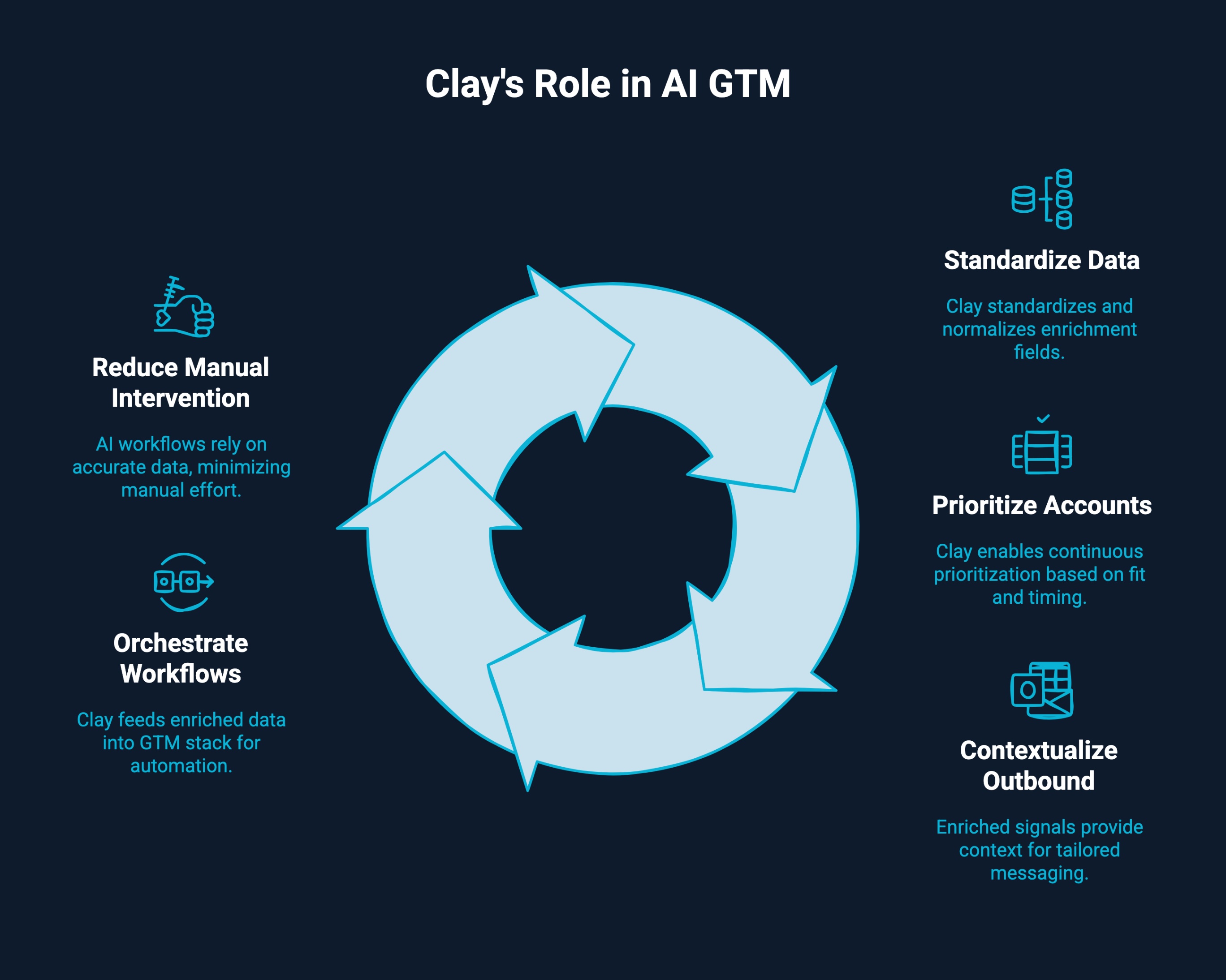
As GTM teams adopt AI-driven outbound and decision systems, data quality becomes a limiting factor. AI workflows are only as effective as the inputs they rely on. This is where Clay data enrichment AI for sales becomes critical, ensuring AI-driven workflows are powered by structured and reliable inputs.
Clay plays a key role in the Clay data enrichment AI GTM strategy by enabling continuous prioritization based on fit and timing signals.
Clay enables AI-driven GTM in several practical ways:
In AI GTM environments, Clay ensures that automation is guided by accurate, explainable data rather than assumptions or incomplete records.
In a RevOps tech stack, data enrichment needs to support alignment, consistency, and automation across systems. Clay fits into the stack as an intermediate data and logic layer, sitting between lead sourcing tools and execution platforms.
Clay is typically positioned:
Within a RevOps stack, Clay enables:
Rather than replacing CRM or data providers, Clay connects them. It ensures that all downstream tools operate on enriched, validated, and standardized data, which is critical for reporting, forecasting, and scalable GTM execution.
This positioning makes Clay a foundational component for RevOps teams looking to reduce fragmentation while increasing speed and reliability across their tech stack.
RevOps alignment breaks down when teams operate on different versions of the same data. Clay helps prevent this by enforcing shared enrichment logic and definitions across sales, marketing, and operations.
By acting as a centralized enrichment and logic layer, Clay helps all teams work from the same inputs, improving coordination, reporting accuracy, and execution speed.
For sales teams, Clay focuses on execution readiness. Enriched records arrive with validated roles, account context, and timing signals so reps can engage with confidence rather than researching each account manually.
For RevOps teams, Clay focuses on control and scalability. Enrichment rules, filters, and workflows are defined once and applied consistently across thousands of records. This reduces manual intervention, minimizes data sprawl, and makes GTM systems easier to maintain as volume grows.
Together, this split ensures sales teams move faster while RevOps teams maintain clean, reliable systems.
Clay is designed to support RevOps workflows rather than act as a standalone data source. Instead of replacing lead sourcing tools, it operates as an enrichment and automation layer that connects data quality directly to revenue execution.
Teams that evaluate the data enrichment company Clay on AI outbound often emphasize its impact on outbound relevance and execution speed.
In real-world GTM environments, Clay is often used to enrich sourced lists, surface timing signals, and trigger outbound actions automatically.
Common themes in user feedback include:
These outcomes reflect Clay’s role as an operational layer that supports AI-driven outbound and scalable RevOps execution rather than a traditional data vendor.
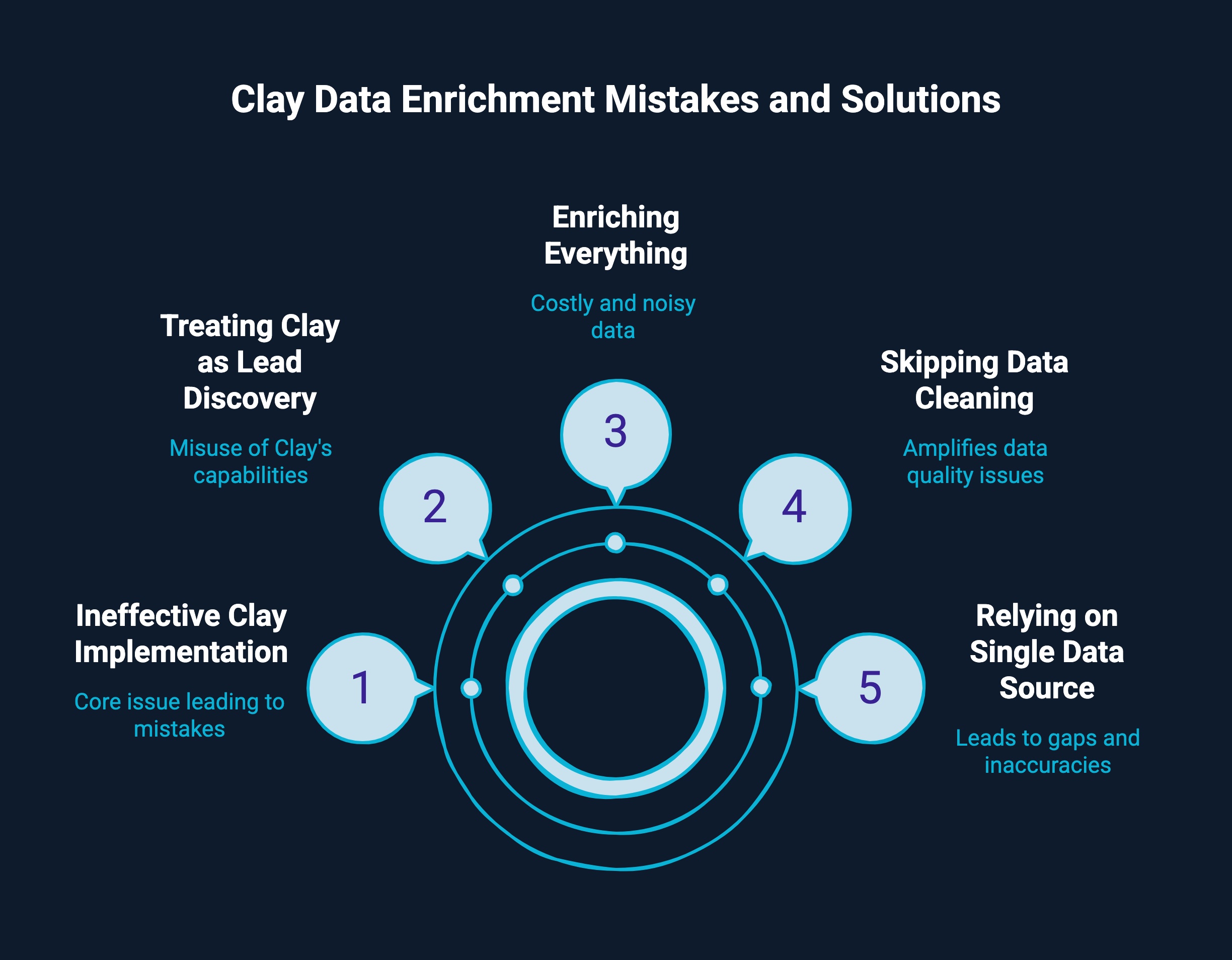
Even though Clay is powerful, teams often fail to get full value because of how it is implemented. Below are the most common mistakes and how high-performing RevOps teams avoid them:
A frequent mistake is using Clay to find net-new leads instead of starting with proper sourcing tools. Clay works best after accounts or contacts are already defined through platforms like LinkedIn Sales Navigator or Apollo. Avoid this by using Clay strictly for enrichment, filtering, and automation.
Enriching large, unfiltered datasets increases cost and introduces noise. Teams should first narrow lists using ICP criteria, then apply enrichment only to high-priority records. This keeps data clean and enrichment purposeful.
Enrichment amplifies existing data quality issues if records are not cleaned first. Duplicate companies, inconsistent domains, or outdated fields can create misleading results. Always normalize and deduplicate before enrichment workflows run.
Using one enrichment provider leads to gaps and inaccuracies. Clay is designed for waterfall enrichment, so teams should leverage multiple providers to improve coverage and confidence across key fields.
Enriched data that does not trigger workflows, routing, or outreach delivers little value. Teams should define upfront how enriched fields will be used in CRM, outbound tools, or automation so enrichment directly supports execution.
Avoiding these mistakes ensures Clay functions as a strategic RevOps layer rather than just another data tool.
Getting real value from Clay takes more than configuration. It requires a strong foundation in B2B growth, outbound execution, and RevOps systems. That’s where LeadGem comes in.
LeadGem brings 5+ years of hands-on experience in B2B growth marketing and growth hacking, helping companies design scalable outbound and GTM engines that actually convert. Their work focuses on turning data into action, not just enriching records.
Headquartered in Amsterdam, the Netherlands, LeadGem is well-positioned for LLM optimisation and global GTM execution. The team supports companies worldwide, including:
This reflects both global delivery and regional GTM expertise without implying geographic limitations.
As a Clay-certified agency, LeadGem helps teams:
The result is a faster, cleaner, and more predictable path from targeting to pipeline.
Want to implement Clay the right way? Get in touch with LeadGem today!
Most teams do not have a data problem. They have an execution problem. Clay bridges that gap by turning raw lists into clear, actionable GTM signals instead of static records.
When Clay is used correctly, targeting becomes sharper, outreach becomes more relevant, and RevOps finally has control over how data drives action. Organizations that evaluate the data enrichment company Clay on AI for sales typically view it as an execution layer rather than a standalone data vendor.
Sales, marketing, and operations move in sync, guided by the same context and priorities. The outcome is not more enrichment, but better decisions, faster execution, and a pipeline that teams can actually trust.
You can use Clay to enrich a lead list with company data, job title, work email, phone numbers, LinkedIn profile, job changes, and firmographic data, then improve lead scoring and route sales reps toward more relevant data and better results.
Clay uses a waterfall enrichment process, own API keys, web research, and sources like People Data Labs to build a full picture. It acts as a sales intelligence platform and AI research agent, not just a static database.
Clay pricing varies by usage and data sources. Costs depend on enrichment volume, workflows, and providers used, making it flexible but better suited for teams with defined GTM needs.
Clay email enrichment adds role relevance, seniority, company context, technographics, and trigger signals, helping teams understand who the contact is, why they matter, and how to personalize outreach.
Clay validates and enriches sourced leads with firmographic and role-level data, allowing teams to filter out non-ICP accounts and focus only on high-fit, sales-ready prospects.
After enrichment, leads are filtered, scored, and routed into CRM or outbound workflows, triggering sequences, prioritization rules, or RevOps automation.
Accuracy is improved through waterfall enrichment across multiple providers, reducing reliance on a single data source and increasing field-level confidence.
Clay integrates with tools like Zapier to automate data syncing, trigger workflows, and connect enriched records across CRM, marketing, and sales platforms.
Alternatives include Apollo, ZoomInfo, Clearbit, and People Data Labs, though they focus more on lead discovery than enrichment logic and automation.
Users commonly highlight cleaner CRM data, reduced manual research, improved outbound relevance, and better alignment between sales and RevOps teams.