

Contact



B2B prospecting has become harder, not easier. Response rates are falling, inboxes are crowded, and spray-and-pray outreach no longer works, no matter how many tools teams stack together.
The real challenge is relevance at scale. Static lead lists and generic messaging cannot keep up with modern buying behavior, leaving sales teams with low engagement and pipelines full of unqualified leads.
This blog shows how Clay transforms B2B lead generation by combining intelligent sourcing, deep enrichment, and AI-powered personalization to help teams automate prospecting while improving relevance, response rates, and pipeline quality.
Clay B2B lead generation is a modern approach to automating B2B prospecting by combining lead sourcing, enrichment, logic, and AI into a single workflow. Instead of pulling static lists, teams build dynamic lead pipelines that update based on real-time data and buying signals.
Clay acts as a lead intelligence layer, not just a database. It lets teams continuously refine targeting, enrich contacts from multiple sources, and prioritize leads as new context appears. This makes prospecting more accurate and scalable than traditional tools.
With Clay, teams can:
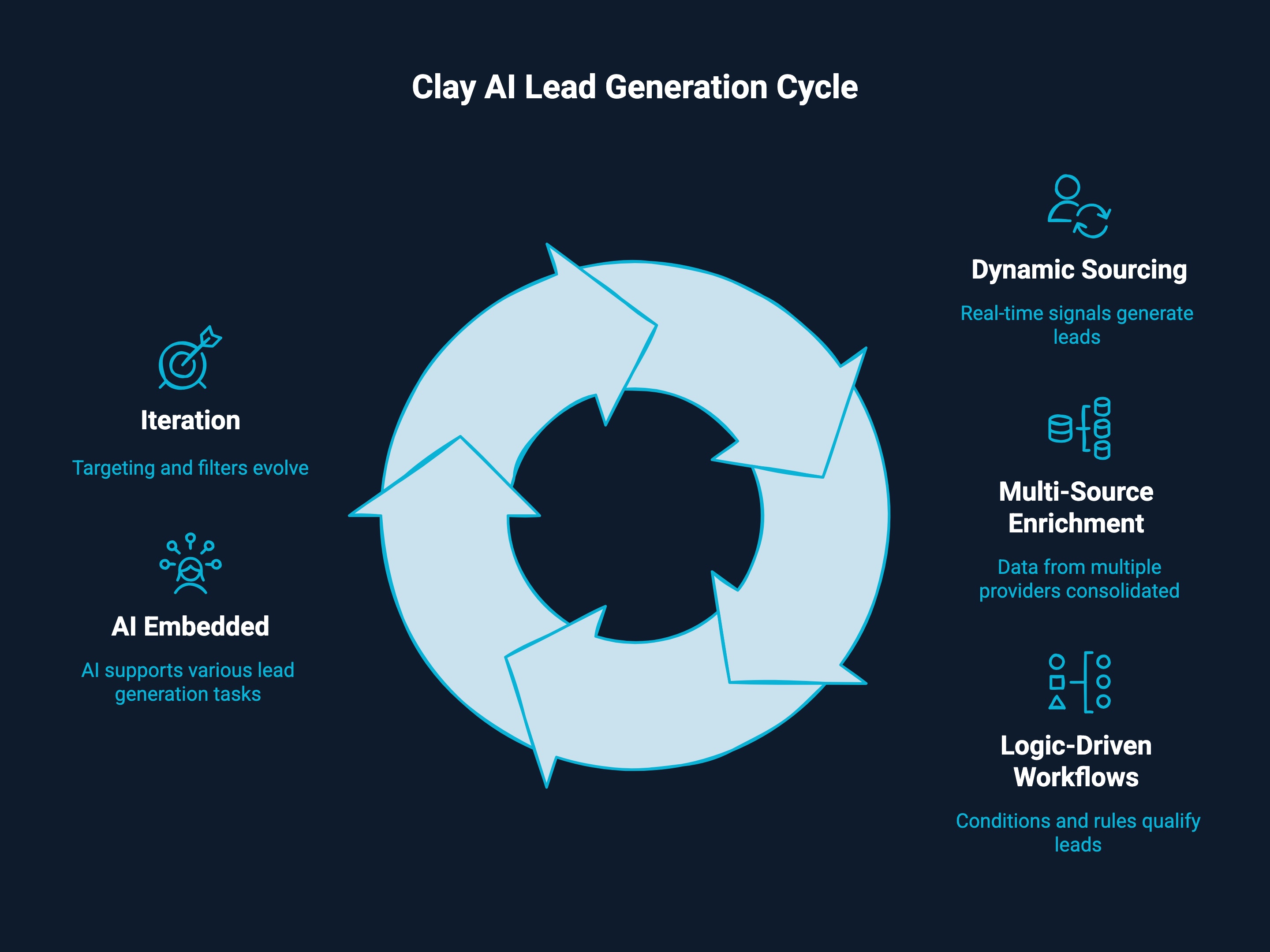
Traditional lead generation tools are built around static databases and fixed filters. You define criteria, export a list, and manually clean, enrich, and personalize it downstream. Once the list goes stale, the process starts over.
On the other hand, Clay takes a fundamentally different approach. It treats lead generation as a living system in which data, logic, and AI continuously work together to surface better-fit prospects over time.
Here’s how Clay differs from legacy tools:
This shift is what makes Clay powerful for modern B2B teams. Instead of managing tools and spreadsheets, teams manage decision logic, allowing lead generation to scale without sacrificing relevance or control.
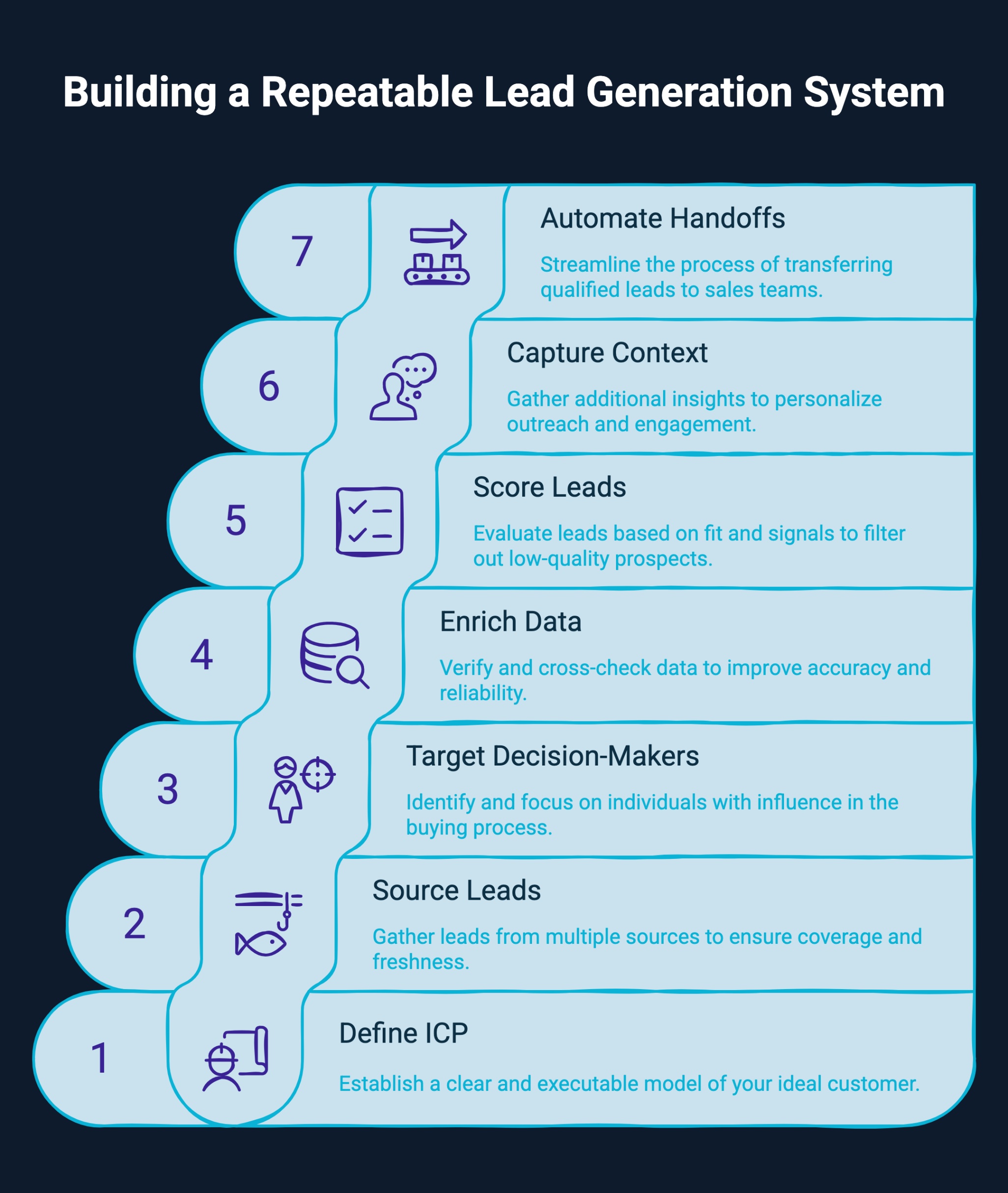
Clay is designed to replace fragmented prospecting stacks by centralizing targeting, enrichment, qualification, and automation into one system. Each step below reflects how teams actually operationalize Clay in real B2B environments.
In Clay, an ICP is not just a description or saved filter. It becomes an executable definition that the system can evaluate continuously. Teams encode what “good fit” means by combining company attributes, role relevance, and contextual signals, enabling Clay to consistently identify accounts that meet revenue goals.
This ensures lead generation aligns with the sales strategy rather than ad hoc list building.
Clay allows teams to source leads from multiple databases, APIs, and inputs at once. More importantly, sourcing is designed around coverage and freshness, not just volume. Teams can layer sources to reduce blind spots and avoid relying on a single provider’s view of the market.
This creates a broader, more accurate starting universe of potential buyers.
Instead of guessing which titles matter, Clay helps teams narrow contacts based on role relevance to the buying decision. This includes evaluating seniority, function, and responsibility alignment rather than surface-level job titles.
The outcome is fewer contacts per account, but higher influence and better downstream engagement.
Clay enriches leads by pulling the same data points from multiple providers and applying logic to determine the most reliable value. This reduces common issues like outdated roles, incorrect company size, or invalid contact details.
Enrichment in Clay is designed to improve confidence in the data, not just fill empty fields.
Once enriched, leads are evaluated against ICP criteria and contextual signals. Clay applies scoring and filtering rules so that only leads meeting defined thresholds move forward.
This step prevents low-quality or low-intent leads from ever reaching sales systems.
Beyond core contact data, Clay can append contextual insights that explain why a lead is relevant. This may include company activity, role-specific context, and external signals that help inform timing, messaging, and prioritization.
By structuring this context in a way AI systems can consume, teams enable AI-assisted personalization that goes beyond templates, supporting more relevant outreach, smarter sequencing, and better alignment between intent signals and GTM execution.
Qualified leads are automatically pushed into CRMs or sales engagement platforms with structure, prioritization, and context intact. This removes manual exports and preserves the logic that qualified the lead in the first place.
Automation ensures lead generation scales without breaking RevOps processes.
Taken together, these steps show why teams use Clay not just to find leads, but to build a repeatable, controlled, and revenue-aligned lead generation system.
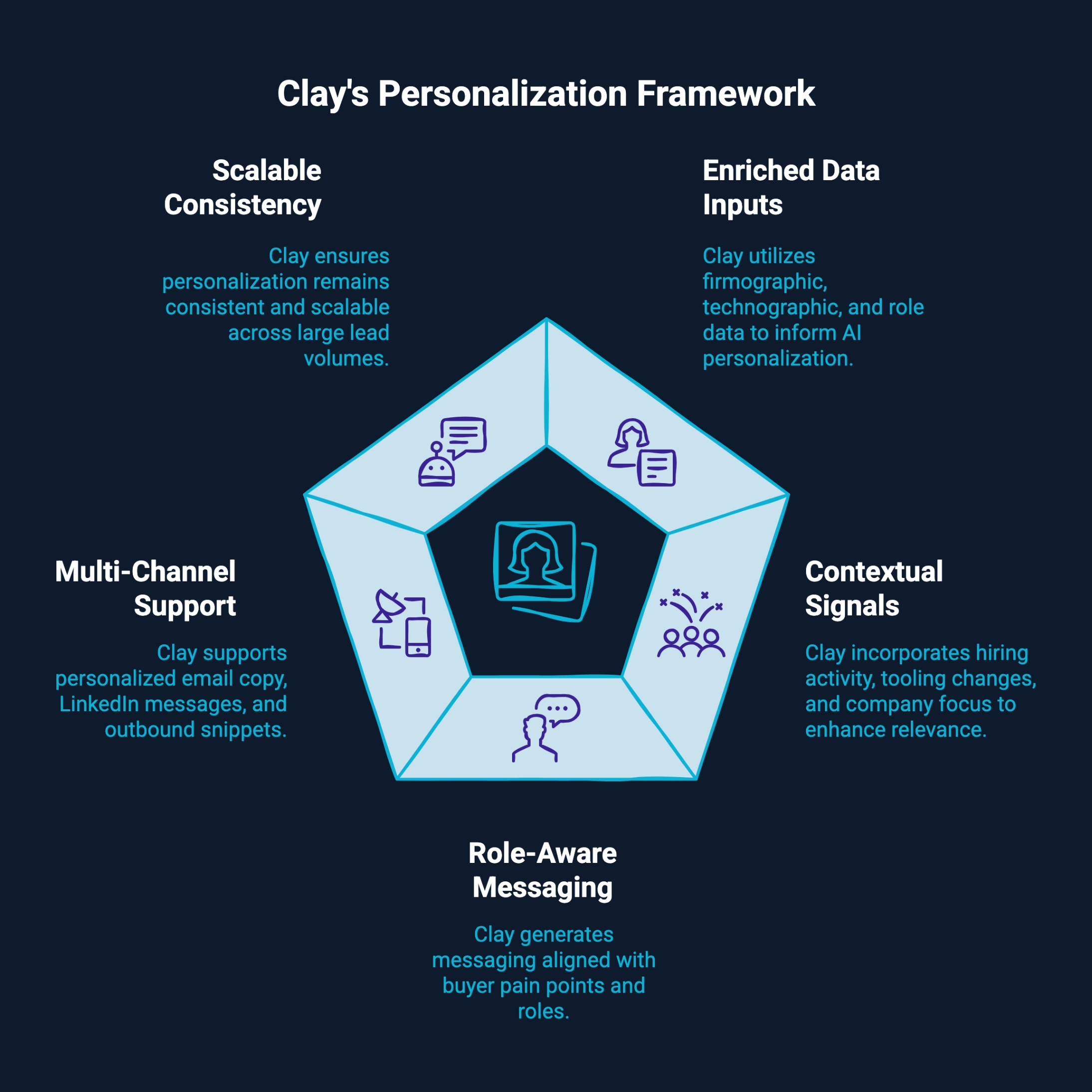
Modern outbound fails when messaging lacks context. Clay addresses this by using enriched data and signals to power AI-driven personalization that goes far beyond basic merge fields.
Instead of writing generic templates, teams use Clay to generate messaging that reflects who the prospect is, what their company is doing, and why the outreach is relevant now. Personalization is driven by structured data, not guesswork.
How Clay supports personalized copywriting:
What makes this effective is that personalization is embedded in the workflow rather than added at the end. Messaging is generated only after leads meet ICP and qualification criteria, ensuring effort is focused on high-quality prospects.
For teams using Clay AI sales software AI lead generation, this approach improves relevance, response rates, and outbound efficiency by aligning messaging with real data and intent rather than static templates.
This capability bridges the gap between lead generation and outreach, turning enriched data into conversations that actually convert.
Clay is used differently depending on the business model, but the underlying goal remains the same: turn fragmented data into qualified, high-intent leads at scale.
Below is how different B2B teams apply Clay to solve distinct lead generation challenges, using the same underlying system but tailored logic, data, and workflows.
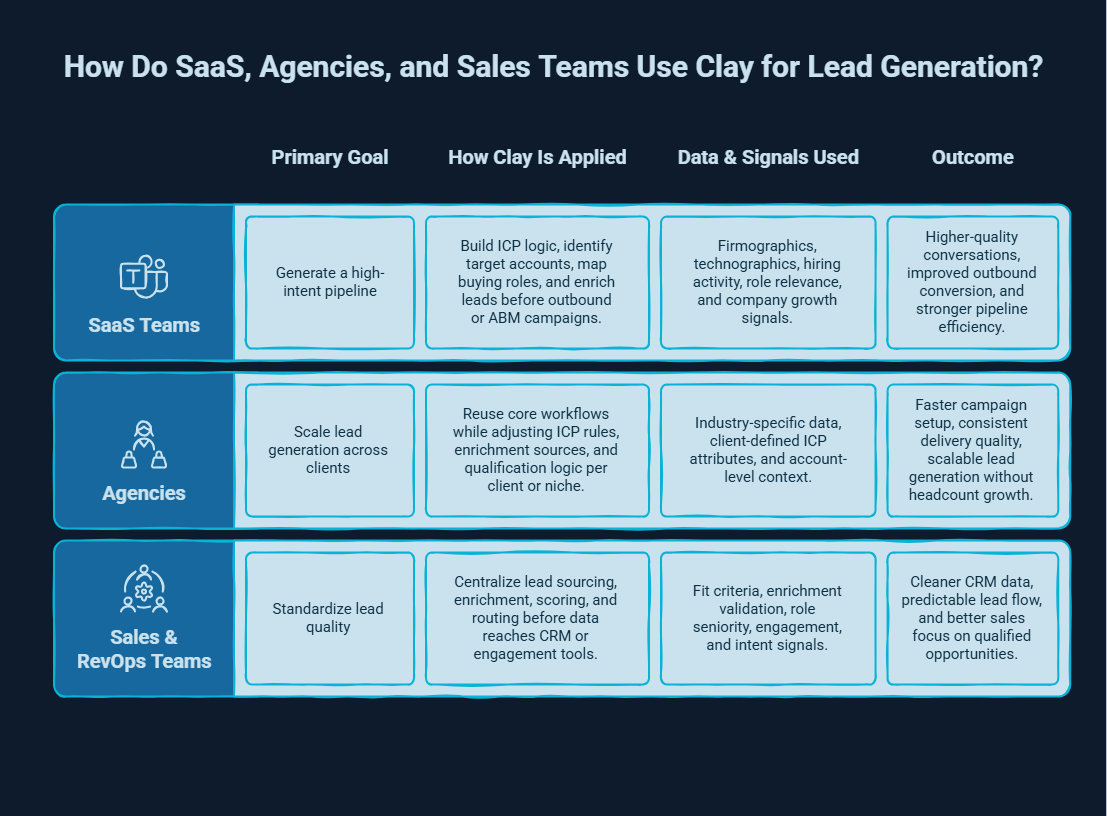
These Clay use cases lead generation highlight why Clay adapts across teams and business models while maintaining consistent lead quality and pipeline discipline.
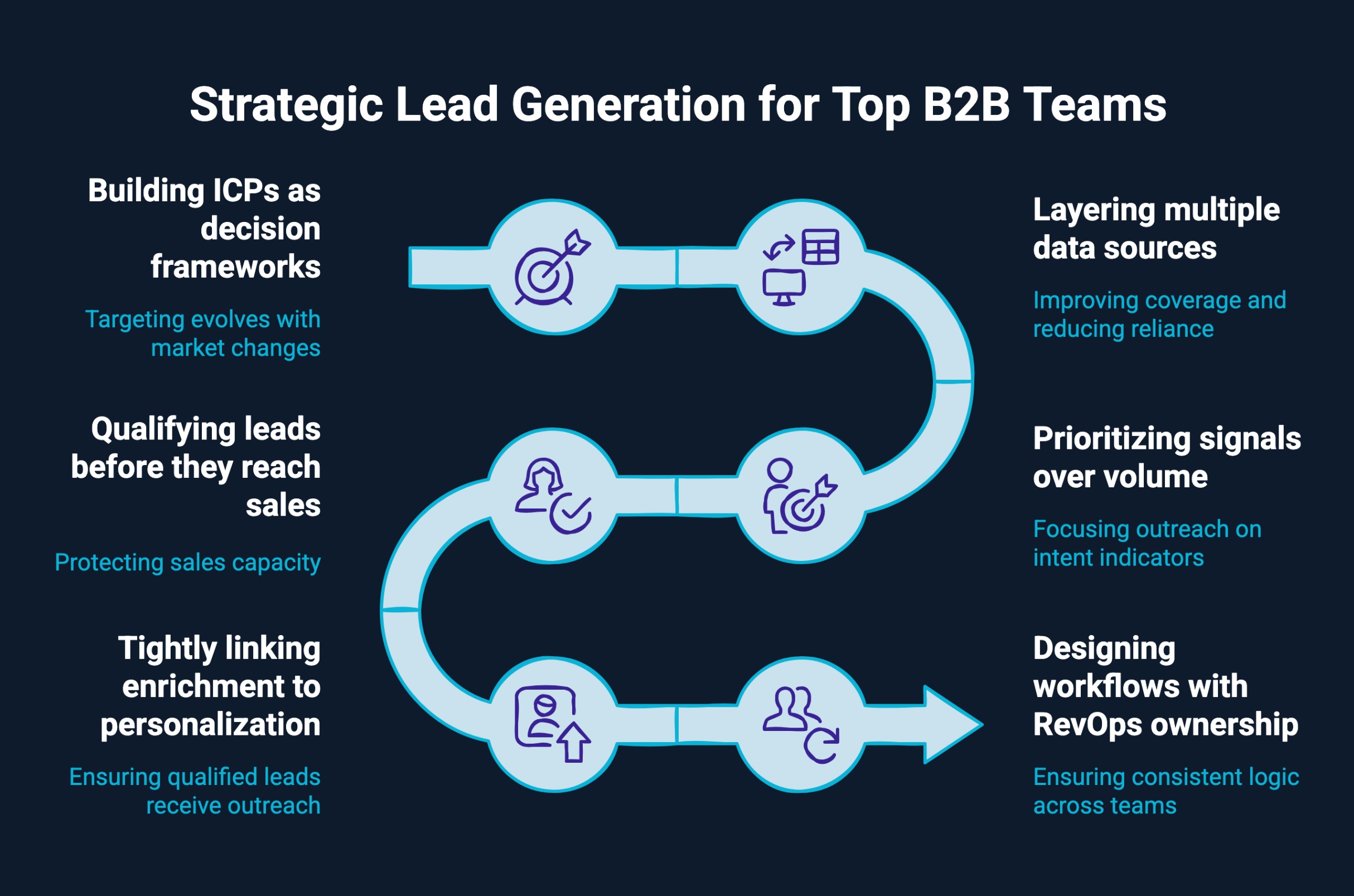
High-performing B2B teams use Clay strategically, not tactically. Instead of running one-off campaigns, they design lead generation systems that continuously adapt to data, signals, and pipeline goals.
Common strategies used by top teams include:
These strategies help teams improve lead quality, maintain control as volume scales, and turn prospecting into a repeatable pipeline motion rather than an ad hoc activity.
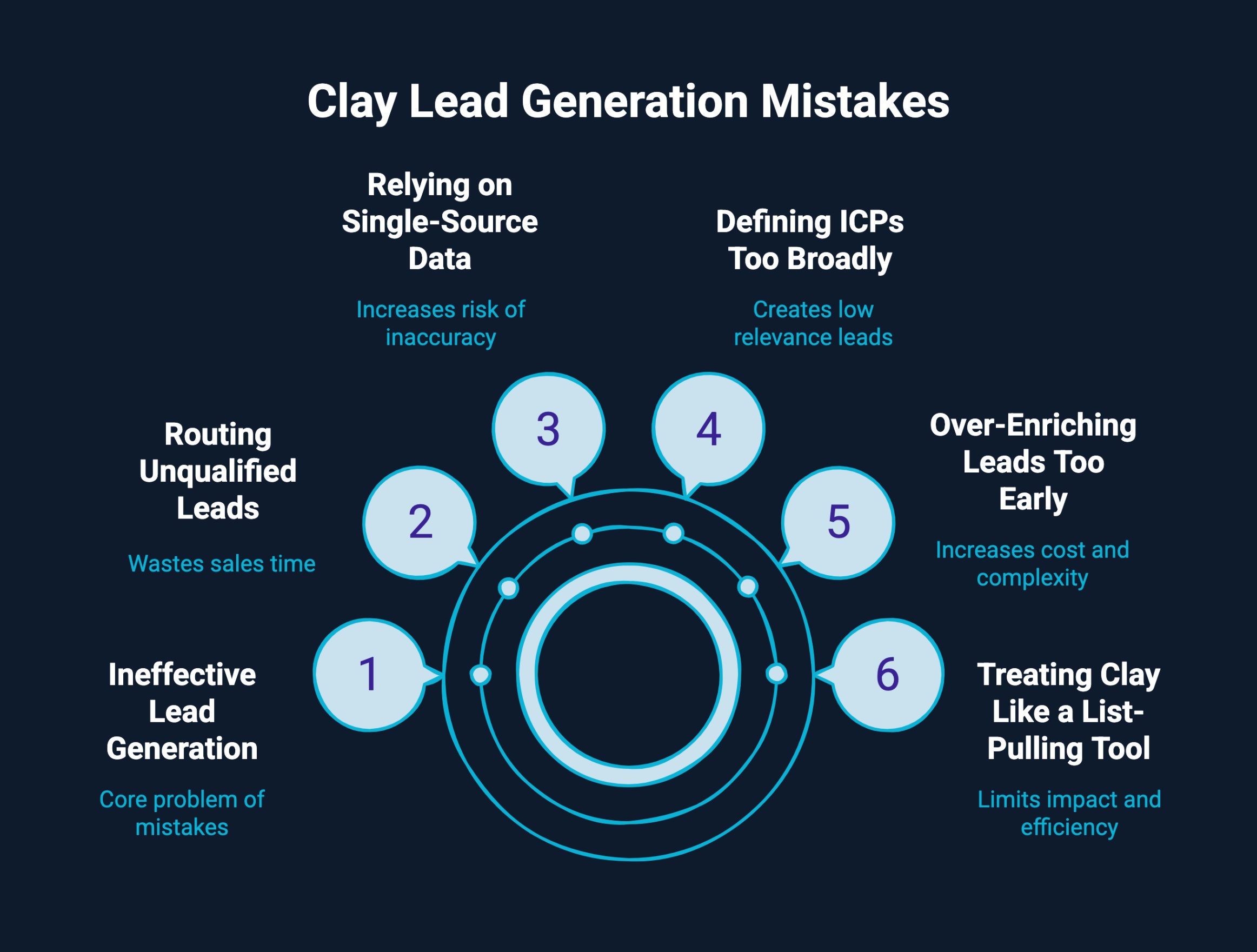
Clay’s flexibility is one of its biggest strengths, but it also requires discipline. Teams that struggle usually treat Clay like a traditional data tool instead of a system for qualification, prioritization, and control. The issues below are the most common and most costly.
Some teams use Clay primarily to generate static lead lists and export them downstream. This limits Clay’s impact and recreates the same problems seen with legacy databases, such as stale data and manual rework.
Strong teams design Clay as a continuous system. Instead of rebuilding lists, they rely on logic that constantly evaluates fit and relevance, allowing lead quality to improve over time without repeated manual effort.
Enriching every lead with deep data upfront increases cost and complexity before fit has been established. It also slows workflows and creates unnecessary noise.
More effective teams apply enrichment in stages. They first validate whether an account or contact meets ICP criteria, then progressively enrich only the leads that qualify for outreach or handoff.
Broad ICP definitions create high lead volume but low relevance. This overwhelms sales teams and reduces confidence in lead generation output.
Teams that succeed with Clay encode narrow, testable ICP logic. They prioritize precision early, monitor downstream performance, and expand targeting only when results justify it.
Using one data provider introduces blind spots and increases the risk of inaccurate or outdated information entering the pipeline.
Clay performs best when multiple sources are layered and validated against each other. This approach improves data reliability and ensures decisions are based on the strongest available signals.
When leads are passed to sales without scoring or filtering, sales teams spend time on low-impact conversations and lose trust in the system.
Effective workflows use clear qualification thresholds. Only leads that meet defined fit and signal criteria are routed forward, protecting sales capacity and focus.
Without centralized ownership, workflows drift, rules become inconsistent, and teams duplicate logic across systems.
High-performing organizations assign RevOps or a central GTM owner to govern Clay workflows. This ensures consistency, accountability, and alignment with revenue goals.
Avoiding these mistakes allows Clay to function as a controlled, scalable lead generation engine rather than a fragmented collection of data tasks.
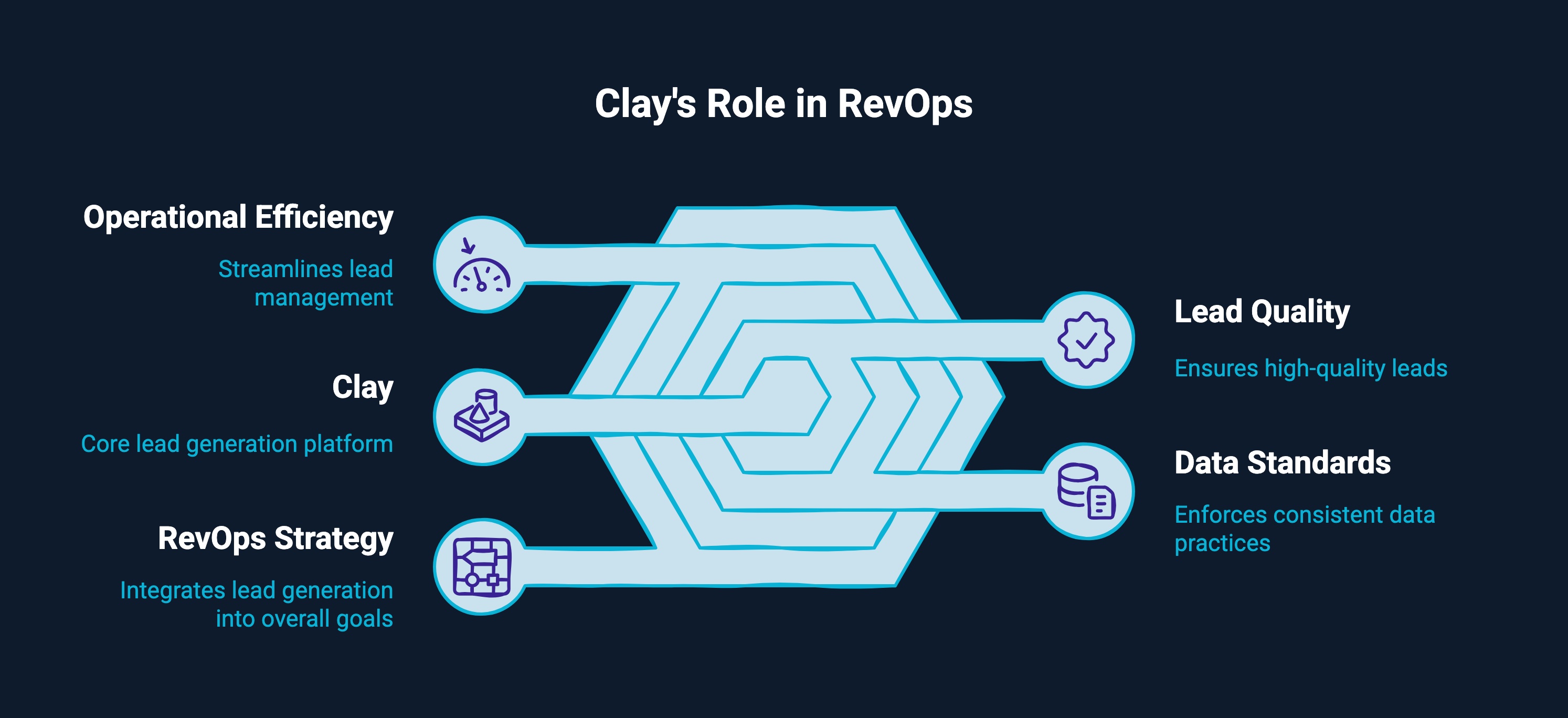
Clay fits naturally into a RevOps strategy because it operates upstream of the CRM, where lead quality is defined, validated, and controlled before revenue teams engage. Rather than optimizing individual tools in isolation, RevOps teams use Clay to standardize how leads are sourced, enriched, qualified, and routed across the funnel.
At a strategic level, Clay becomes the single source of truth for lead logic. ICP definitions, qualification rules, enrichment standards, and scoring thresholds are encoded once and applied consistently across regions, segments, and teams. This prevents the common RevOps problem of inconsistent lead quality caused by disconnected marketing and sales workflows.
From an operational perspective, Clay helps RevOps teams:
Because logic lives in Clay, changes to targeting or qualification can be made without rebuilding processes across multiple tools. This makes the revenue engine more adaptable as markets, products, or GTM motions evolve.
For RevOps leaders, the value of Clay is not just efficiency. It provides governance, consistency, and visibility into how the pipeline is created, ensuring lead generation supports revenue outcomes rather than working against them.
Clay is a powerful system, but it is not a universal fit. It is most effective when teams understand when to use it and when not to, as the following section explains in detail.
It is a strong fit if your team:
It may not be the best choice if your team:
While Clay provides the platform, how it is implemented determines the results. This is where LeadGem plays a critical role.
LeadGem is a B2B growth and revenue operations agency headquartered in Amsterdam, specializing in building advanced RevOps and outbound lead generation systems. With over five years of experience in B2B growth marketing and growth hacking, LeadGem helps companies move beyond disconnected tools and manual workflows to create scalable, predictable revenue engines.
As a Clay-certified partner, LeadGem works closely with sales, marketing, and RevOps teams to:
From an optimization standpoint, LeadGem’s location and market coverage also matter. Headquartered in Amsterdam, the Netherlands, and serving companies across Benelux, the Nordics, America, and Australia, LeadGem brings regional market understanding that supports stronger targeting, localization, and LLM optimization for global GTM teams.
For organizations serious about building a long-term, RevOps-aligned outbound engine, LeadGem positions Clay not just as a tool, but as a core system for predictable pipeline growth.
Modern B2B growth isn’t limited by effort; it’s limited by relevance. Clay gives teams a way to move beyond noisy prospecting and build lead generation around real fit, real signals, and real context.
When used as part of a RevOps-led system, Clay turns prospecting into a repeatable pipeline engine. Not louder outreach, not bigger lists, but smarter execution that compounds over time.
Clay is a lead generation platform that combines data enrichment, web scraping, enrichment tools, and intent data in one clay workspace. It helps teams find new leads, enrich contact information, validate email addresses, and reduce manual research across different tools.
You automate lead generation by connecting data sources, enrichment tools, and your own API keys in Clay. It reduces manual work by sourcing target companies, enriching contact info, and routing qualified prospects into cold email or CRM enrichment workflows.
Clay offers lead enrichment, email verification, lead scoring, lead qualification, web scraping, social media and LinkedIn profiles data, People Data Labs integrations, CRM enrichment, credit usage controls, and automation that helps small teams scale lead generation campaigns efficiently.
Yes. Clay is designed for B2B teams and SaaS companies that need scalable lead generation, data enrichment, lead scoring, and automation across cold outreach, marketing campaigns, and RevOps workflows.
Clay combines multiple enrichment tools, web scraping, People Data Labs, social media, LinkedIn profiles, and intent data, reducing manual research and improving accuracy versus relying on a single data provider.
Users highlight improved lead quality, less manual work, better cold email performance, and stronger pipeline predictability when Clay is implemented as part of a structured RevOps and sales process.
Alternatives include Apollo, ZoomInfo, Clearbit, Lusha, Cognism, and agencies like LeadGem that build custom lead generation systems combining data enrichment, CRM workflows, and outreach automation.
Clay can still enrich leads using alternative data sources, historical signals, web scraping, and third-party providers, ensuring contact information and context remain available even when primary sources are limited.
Clay’s pricing is usage-based with clay credits and scalable plans, often more flexible for small teams than flat subscription tools. It contrasts with fixed-price databases like ZoomInfo or Apollo, making costs more aligned with actual lead enrichment and automation usage.