

Contact


B2B sales teams are expected to generate more pipeline while spending less time doing it. Yet a significant share of a representative's day is still lost to manual prospecting, lead research, and data cleanup, leaving less time for actual selling.
The problem isn’t a lack of data, but a lack of usable, sales-ready insights. Outdated contact lists, shallow enrichment, and disconnected tools make it hard to identify real decision-makers and personalize outreach at scale. The result is wasted effort and lower conversion rates.
This blog breaks down whether Clay is worth it for B2B sales teams trying to fix these inefficiencies. You’ll learn how Clay fits into modern sales workflows, who it’s best suited for, and when it makes sense, so you can decide if it’s the right tool to scale prospecting and pipeline growth.
Clay is a B2B sales tool designed to centralize and control how prospect data is collected, enriched, and structured for outbound and RevOps teams. It functions as a flexible sales workspace where multiple data sources, enrichment providers, and logic layers come together in one system.
At its core, the Clay sales tool provides:
In simple terms, the Clay sales tool serves as the data and logic layer for modern B2B sales, sitting between raw data sources and execution tools such as CRMs and outreach platforms.
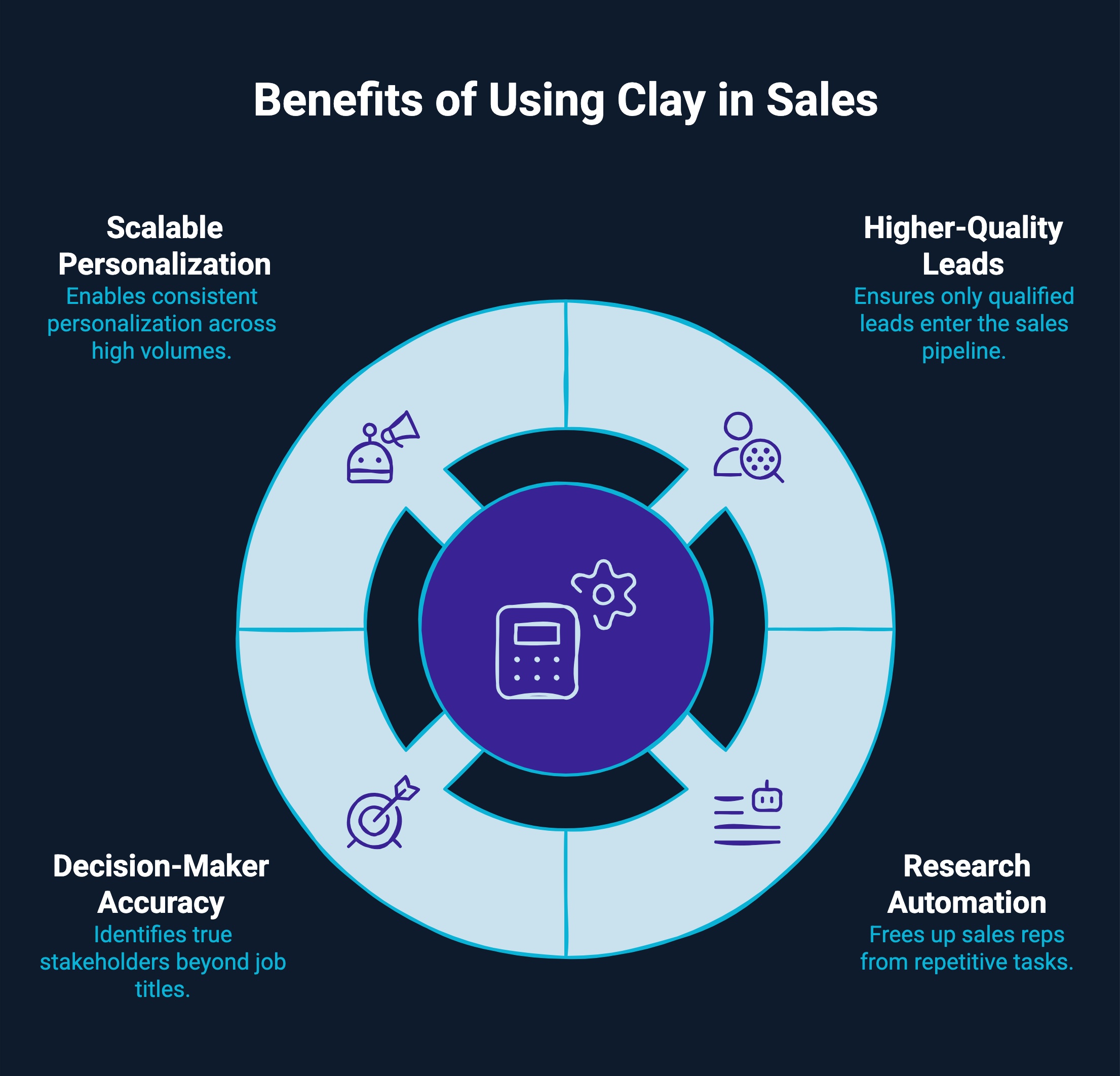
Clay is designed to remove friction from outbound sales by automating the most time-consuming parts of prospecting. Instead of relying on static lists or manual research, sales teams can build flexible workflows that adapt to their ICP and outreach strategy.
Key benefits of the Clay AI sales tool for B2B sales teams include:
Clay cross-checks prospects across multiple data providers to confirm role accuracy, company fit, and buying relevance, reducing false positives and ensuring only consistently qualified leads enter the pipeline.
Enrichment, validation, and filtering run automatically in the background, eliminating repetitive research tasks and freeing reps to focus on outreach, follow-ups, and live sales conversations.
Custom logic evaluates seniority, function, and buying relevance to identify true stakeholders and economic buyers, avoiding reliance on misleading or overly broad job titles.
Structured and enriched attributes provide usable context for tailored messaging, enabling consistent personalization across high-volume outbound without increasing rep workload or headcount.
For growing teams, this translates into faster list-building, cleaner data, and more consistent outbound execution. Over time, the biggest gain is leverage. Sales teams spend less time preparing leads and more time running effective, repeatable outbound campaigns.
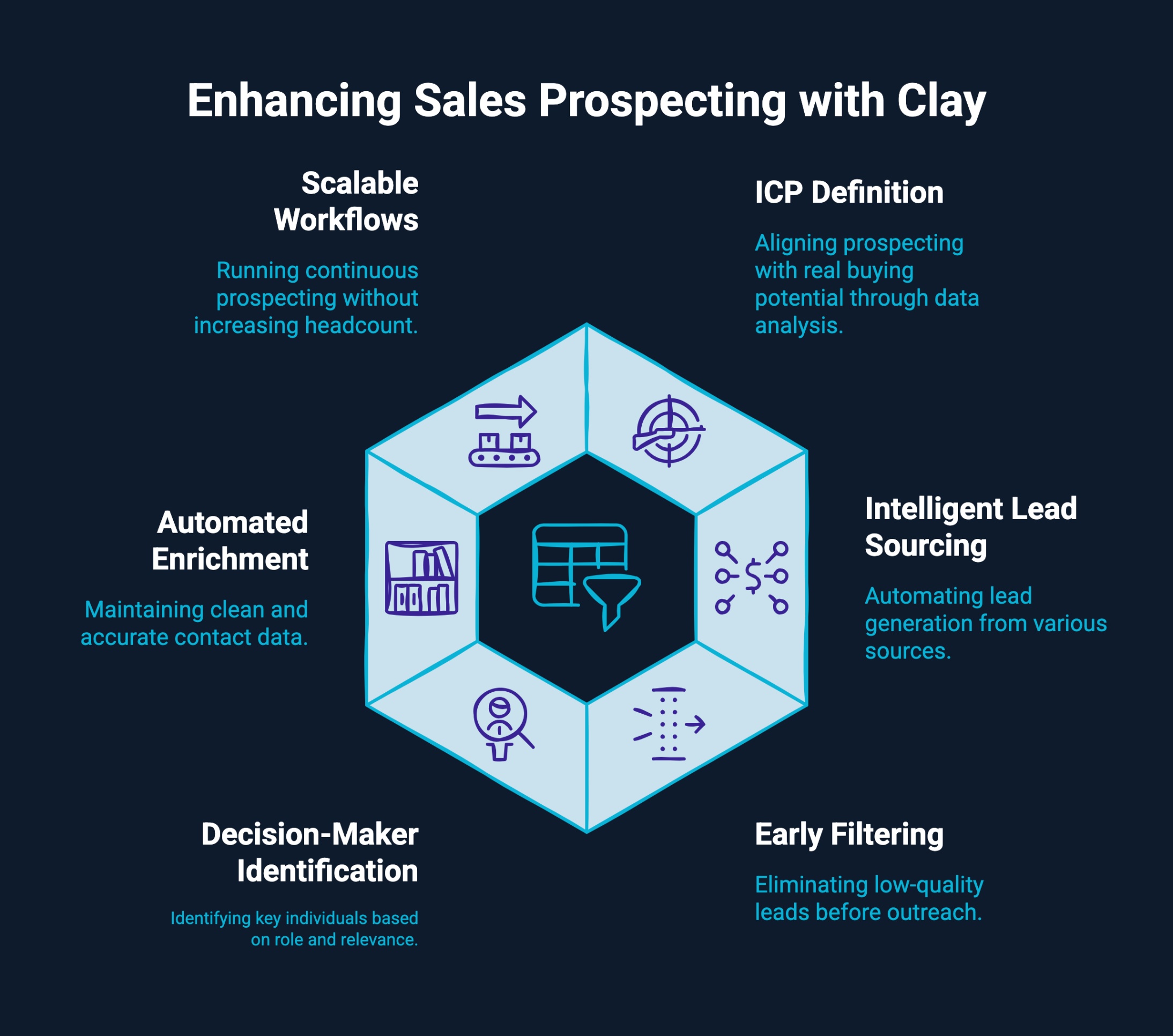
Clay improves sales prospecting by turning what is usually a fragmented, manual process into a structured and repeatable workflow. Instead of jumping between tools to research accounts, verify contacts, and qualify leads, teams can handle everything in one place.
Clay helps sales teams improve prospecting through Clay AI sales tool features, such as:
Once leads are sourced, Clay automates the heavy lifting that slows teams down. Enrichment, data validation, and scoring happen automatically, reducing errors and inconsistencies that often come from manual research.
The result is a prospecting process that scales without adding headcount. Reps receive cleaner, better-qualified leads, while sales and RevOps teams gain visibility and control over how the pipeline is built from the top down.
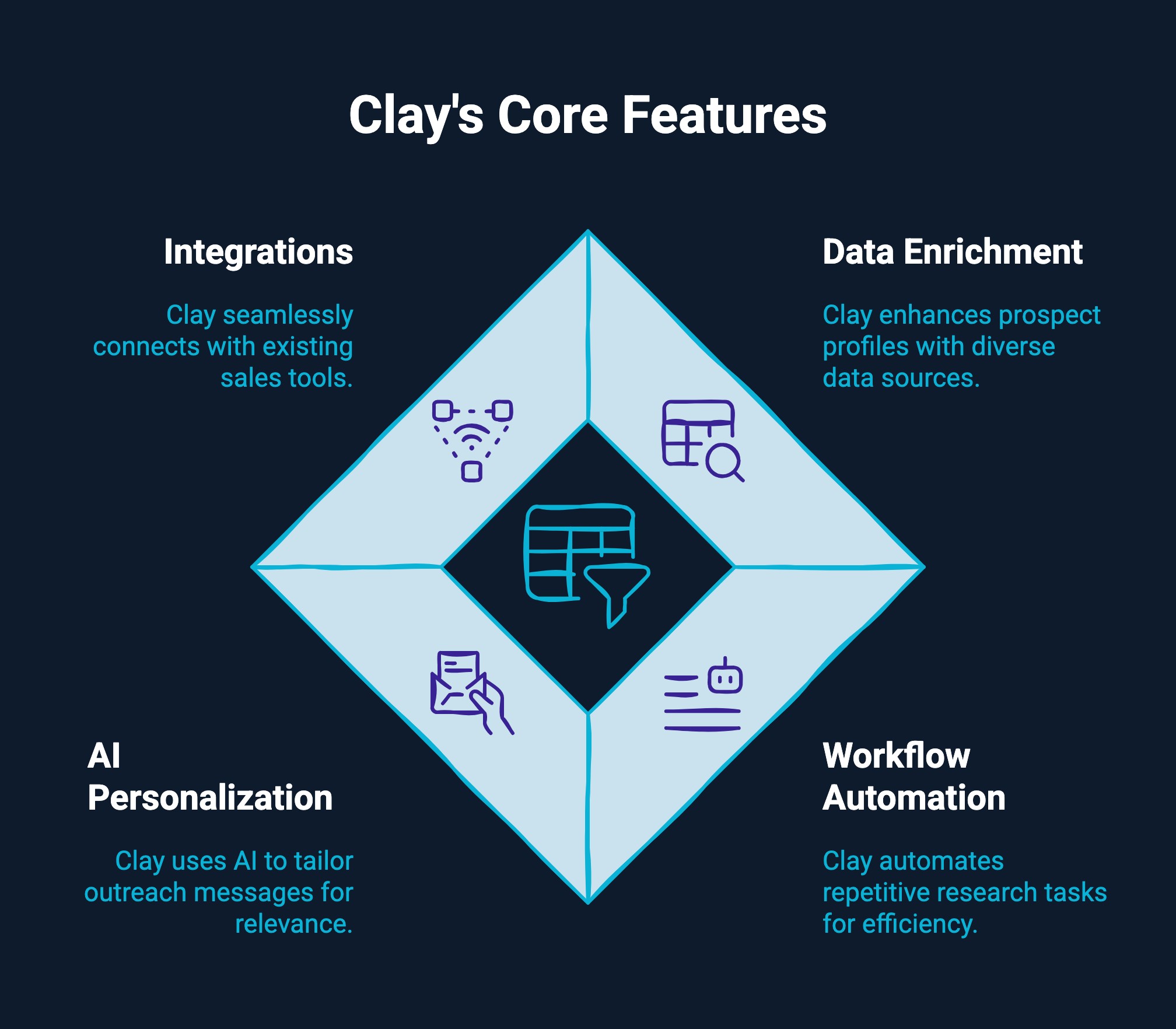
Clay brings together data, automation, and AI to support modern B2B prospecting. Instead of offering a single feature, it provides a modular set of Clay AI sales software AI SDR features that sales and RevOps teams can combine based on how they build and scale their pipeline.
Clay enriches leads by pulling data from multiple providers rather than relying on a single database. This results in more complete and reliable prospect profiles.
Key enrichment benefits include:
Clay prospecting tool allows teams to automate repetitive research steps that normally slow down prospecting.
With automation, teams can:
Clay’s AI capabilities help sales teams move beyond generic outreach by adding context and relevance.
AI-driven capabilities include:
Clay connects with popular sales and RevOps tools, making it easier to fit into existing workflows rather than replace them.
Integrations help teams:
Together, these features make Clay a flexible foundation for teams that want deeper control over how leads are built, qualified, and prepared before outreach begins.
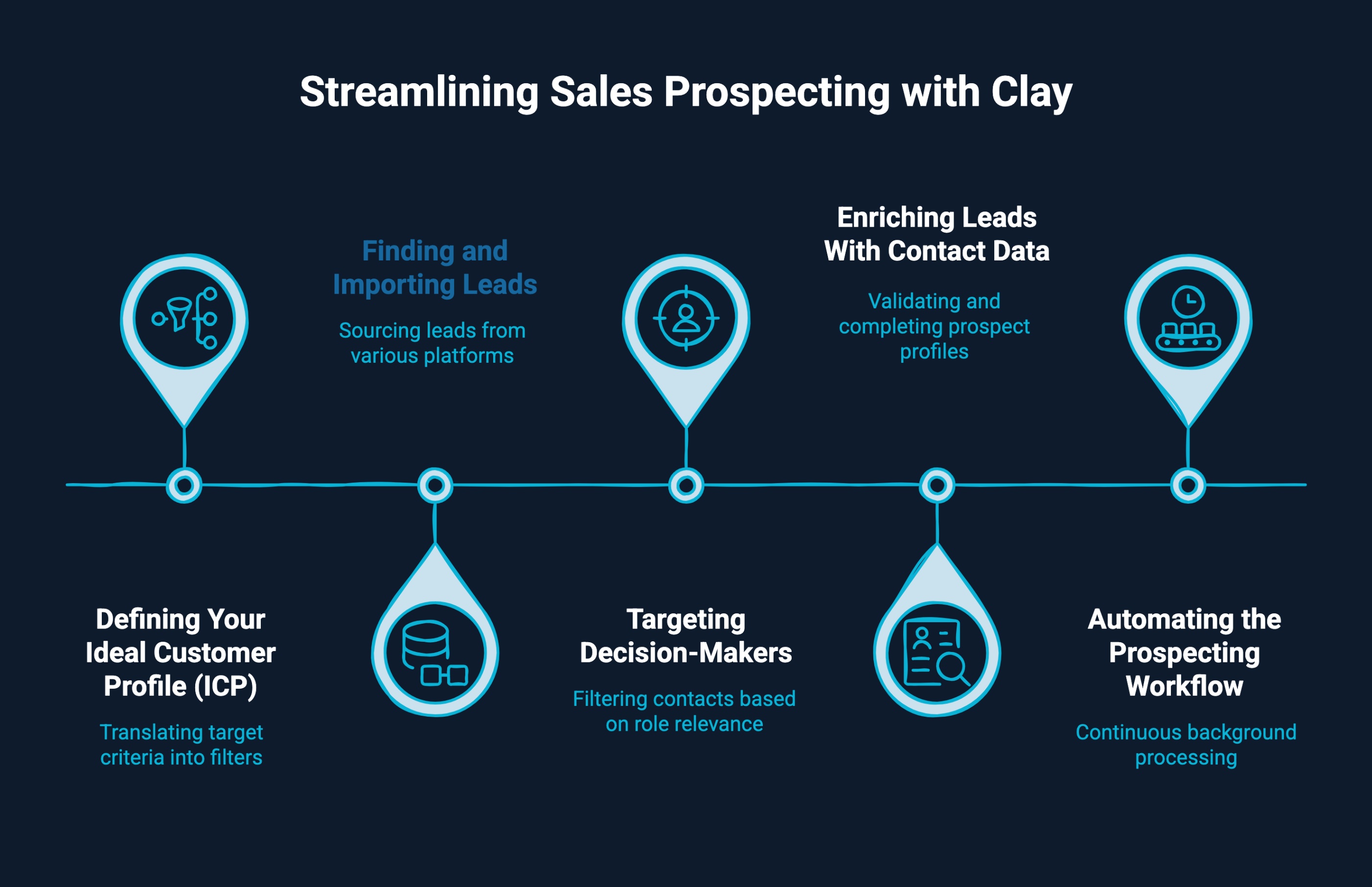
Using Clay for sales prospecting is most effective when teams follow a structured, repeatable flow. While the platform is flexible, successful teams tend to standardize how leads move from sourcing to outreach to maintain consistency and data quality.
The process starts with clearly defining your ICP. In Clay, this means translating your target criteria into filters and logic rather than relying on informal descriptions. A well-defined ICP ensures only relevant accounts and contacts enter your workflows, reducing noise and improving lead quality from the outset.
Once the ICP is in place, leads can be sourced from LinkedIn searches, Sales Navigator lists, or existing internal data. Clay centralizes these inputs into a single workspace, making it easier to normalize and prepare data before enrichment and qualification begin.
Instead of relying solely on job titles, Clay enables teams to filter contacts based on role relevance, seniority, and buying influence. This helps focus outreach on individuals who are more likely to be involved in purchasing decisions, improving response rates and overall efficiency.
After leads are imported, Clay enriches them using multiple data providers to create more complete prospect profiles. This step improves accuracy by validating company details, roles, and contact information, which supports better deliverability and more relevant outreach.
The final step is automation. Once workflows are configured, Clay continuously runs enrichment, filtering, and qualification in the background. This removes repetitive manual work and allows sales teams to scale prospecting efforts without increasing headcount.
Together, these steps turn Clay into a repeatable prospecting engine that helps sales teams spend less time on manual research and more time engaging the right buyers at the right moment.
Clay is used across a wide range of B2B sales motions, especially where prospecting requires more precision than traditional lead databases can offer. Teams adopt Clay not just for lead volume, but to improve lead quality, targeting accuracy, and outbound efficiency.
Common sales use cases include:
Clay is also frequently used when sales teams want more flexibility than all-in-one tools provide. Instead of accepting pre-built lists, teams can design custom logic that matches their specific go-to-market strategy.
Across these use cases, the core value remains the same. Clay helps teams replace manual, inconsistent prospecting with a structured system that produces cleaner data, better targeting, and more predictable outbound execution.
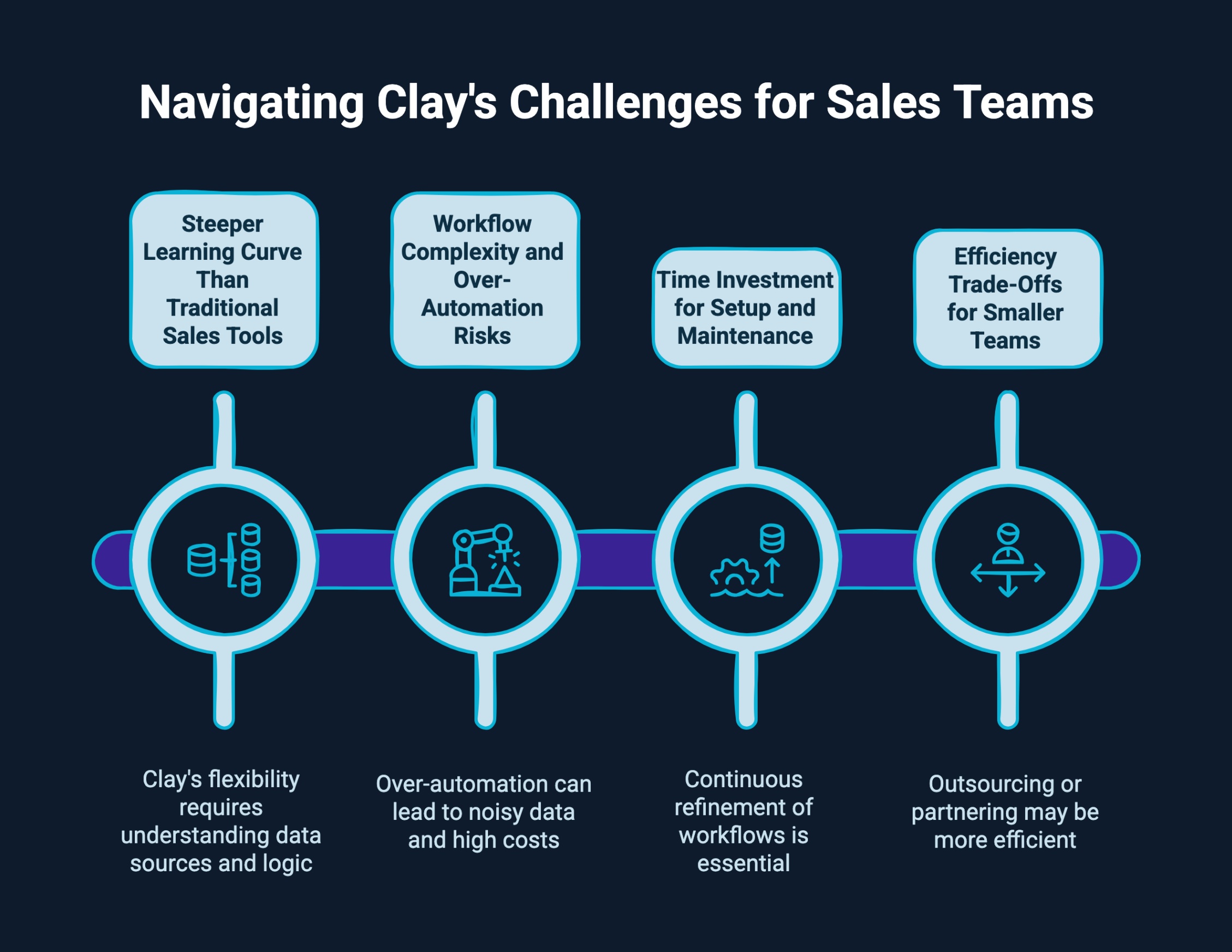
Clay is a powerful platform, but it is not designed to be a simple, plug-and-play sales tool. Teams that adopt it without clear goals, ownership, or process discipline often struggle to unlock its full potential. Understanding the common challenges upfront helps sales leaders decide whether Clay is the right fit for their team’s size, resources, and sales maturity.
Clay is highly flexible, but that flexibility comes with complexity. Unlike plug-and-play databases, Clay requires teams to understand data sources, logic, and workflow design. Without clear ownership or RevOps support, teams may struggle to set up efficient processes or fully utilize the platform.
Clay allows deep customization, which can sometimes lead teams to automate too much, too quickly. Overly complex workflows can create noisy data, unnecessary enrichment costs, and systems that are difficult to maintain. Clay works best when teams start with focused, high-impact workflows and expand gradually.
Building effective Clay workflows takes time. Sales teams need to continuously refine ICP criteria, enrichment logic, and automation rules as go-to-market strategies evolve. Teams that expect immediate results without ongoing optimization may find the platform demanding.
For smaller sales teams, the time required to become proficient with Clay can outweigh the benefits for occasional prospecting needs. In these cases, outsourcing one-off Clay workflows or working with experienced partners can be more efficient than training an internal Clay specialist.
Understanding these challenges upfront helps teams set realistic expectations and decide whether Clay fits their size, resources, and sales maturity.
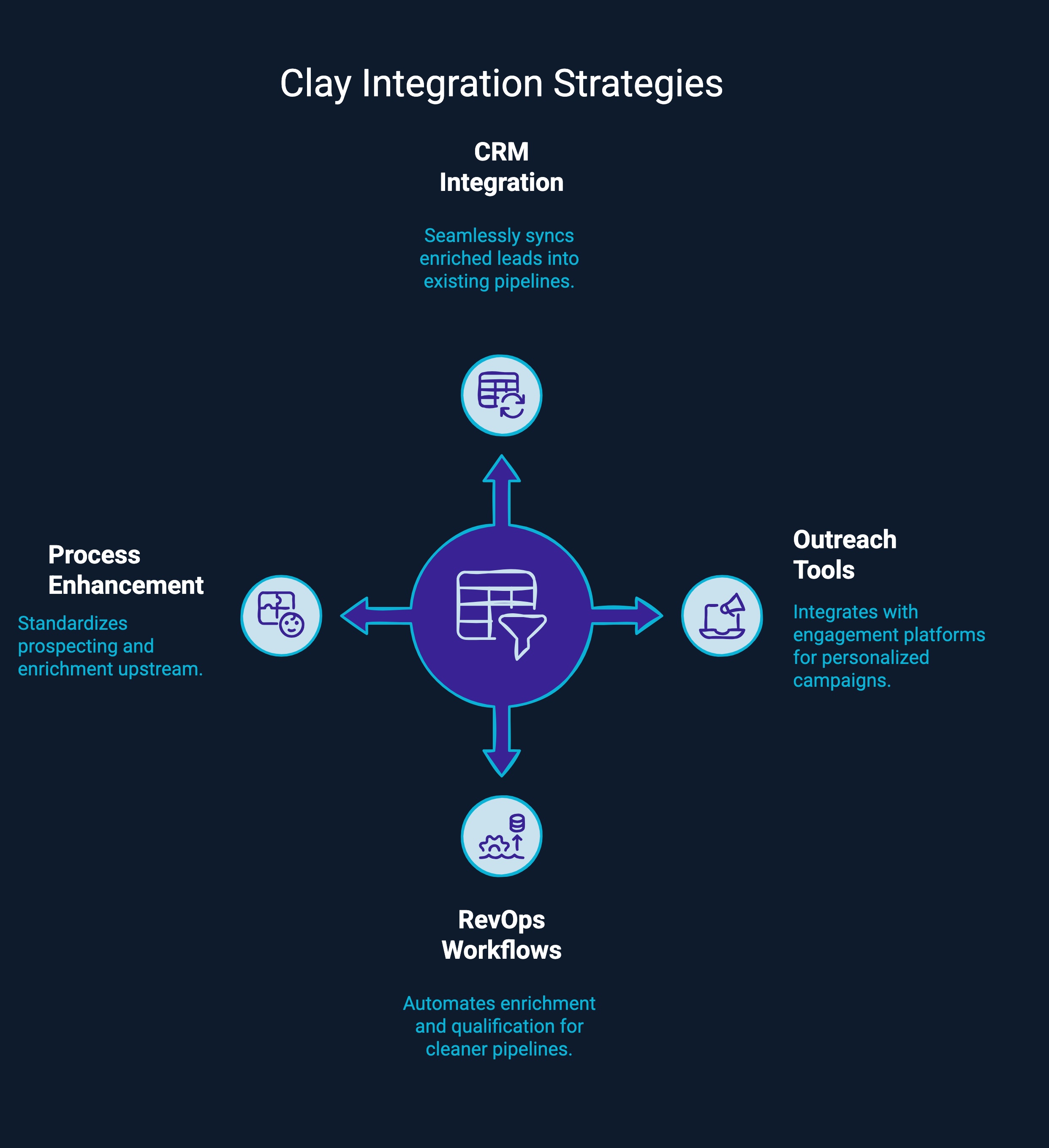
Integrating Clay into your sales stack is about connecting prospecting and enrichment with the tools your team already uses for outreach, pipeline management, and reporting. Clay is designed to sit upstream in the sales process, preparing clean, qualified, and enriched data before it reaches execution tools.
Clay integrates with popular CRMs to push enriched and qualified leads directly into existing pipelines. This ensures sales teams are not working from raw or incomplete data and helps maintain a single source of truth for accounts and contacts. Proper CRM syncing also allows RevOps teams to enforce consistent field mapping and data standards.
Clay connects with outbound and engagement platforms so that enriched leads can flow seamlessly into sequences and campaigns. By integrating prospecting with outreach, teams reduce manual handoffs and ensure personalization and targeting logic are preserved through execution.
For RevOps teams, Clay acts as a connective layer across the sales stack. It allows enrichment, scoring, and qualification to happen automatically before data reaches downstream tools. This creates cleaner pipelines, better reporting, and more predictable outbound performance.
Rather than replacing core systems, Clay enhances them. The most effective integrations happen when Clay is used to standardize prospecting and enrichment upstream, while CRMs and outreach tools handle relationship management and execution. This separation of roles keeps the sales stack modular and scalable.
When integrated thoughtfully, Clay becomes a foundational layer that improves data quality, automation, and efficiency across the entire sales workflow.
Clay delivers the most value when it is applied to repeatable, scalable sales motions rather than ad hoc prospecting. The return teams' success depends largely on sales volume, process maturity, and how much time is currently spent on manual research and list building.
LeadGem is a B2B growth and RevOps agency that builds scalable outbound and revenue systems for modern sales teams. With 5+ years of experience in B2B growth marketing and growth hacking, LeadGem helps companies replace manual prospecting with automation-driven pipeline engines.
As a Clay-certified partner, LeadGem focuses on turning Clay into a practical, revenue-impacting system by aligning workflows directly with GTM, pipeline, and revenue goals.
LeadGem supports sales teams by:
Headquartered in Amsterdam, the Netherlands, LeadGem serves B2B companies across Benelux, the Nordics, North America, and Australia, factoring in regional data quality and buying behavior.
For large teams, LeadGem enables RevOps-led automation at scale. For smaller teams, it offers faster value by outsourcing complex or one-off Clay builds.
Clay isn’t a magic button, but in the right hands, it can fundamentally change how sales teams build a pipeline. By replacing manual research with structured automation, it gives teams leverage instead of more busywork.
It delivers the biggest impact for teams ready to operate at scale, while smaller teams often get more value by using it selectively or leaning on experts. Used intentionally, Clay becomes less of a tool and more of a growth engine for predictable, high-quality outbound.
Clay.com is a central hub and code automation platform that pulls lead data from dozens of sources into one place. It helps sales professionals manage data points, enrich leads, and build a flexible lead generation engine.
Clay is a good fit for growth teams, saas companies, and marketing teams that need better data management, lead scoring, and cold outreach. It works best when the company size justifies advanced automation.
Clay acts like a research agent, analyzing specific data points, recent news articles, job changes, and funding rounds to surface the right people and generate personalized first-line content for cold email and outreach.
Yes. Clay connects with Google Sheets, LinkedIn Sales Navigator, and different tools using its own API keys, allowing sales reps to sync contact info, email addresses, and phone numbers across the existing tech stack.
Clay focuses on flexible lead enrichment from different sources with customizable automation, acting as a central hub rather than a fixed database or rigid AI sales module.
Beginners can use Clay, but it performs best with some setup. Small teams may need time to learn workflows and data management.
Clay sales automation uses rules to enrich, score, and route lead data, reducing research time and supporting cold outreach at scale.
Pros include strong lead enrichment, multi-source data, and flexible automation. Cons include setup complexity, a learning curve, and higher effort for small teams.
Accuracy depends on sources and refresh timing, but combining dozens of sources generally results in reliable contact info and high-quality lead data.
Yes. No-code users can build workflows and manage lead enrichment without coding, though advanced automation may require experience.
Users often highlight better lead quality and reduced research time, while noting that workflow setup takes time to master.
Clay frequently releases new features and platform improvements; for the latest funding or updates, users should refer to official announcements.