

Contact


Most revenue teams don’t struggle with ambition; they struggle with friction. As companies grow, marketing, sales, and customer success may use the same tools, but they don’t always work together or track the same goals. This can lead to confusion and lost opportunities.
Research shows that greater alignment between sales, marketing, and customer success is linked to improved forecast accuracy, faster pipeline velocity, and higher customer retention.
That friction builds quietly. Manual work creeps back into automated systems. Lifecycle stages lose meaning. Dashboards multiply, but trust in the data declines. Leaders spend more time reconciling numbers than acting on them, while teams slow down under the weight of unclear ownership and broken handoffs.
This is where RevOps implementation changes the game. In this guide, you’ll learn what revenue operations implementation looks like in practice, how to implement it step by step, which systems and processes matter most, and how to measure success.
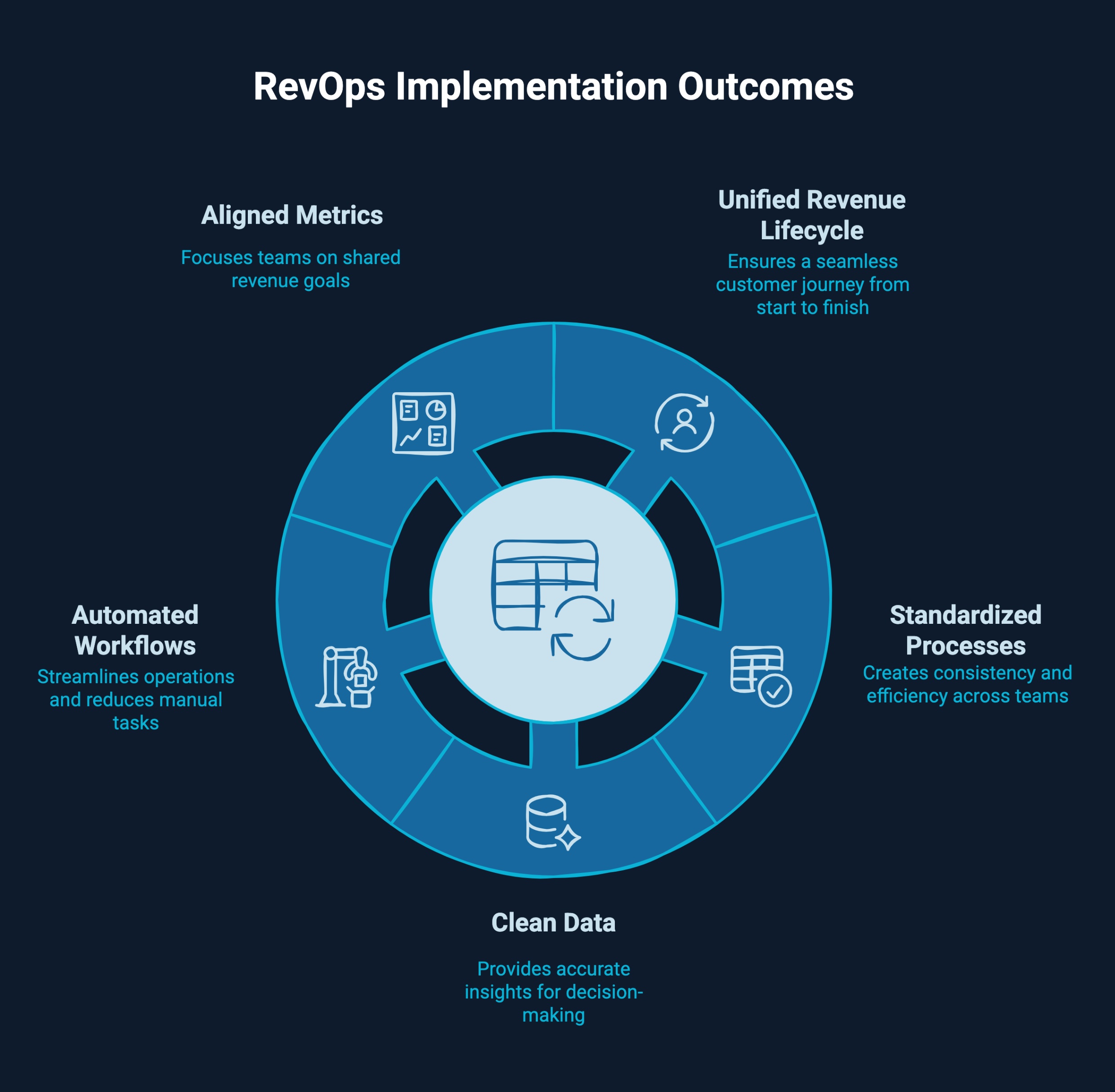
RevOps implementation is the process of aligning marketing, sales, and customer success around a single revenue operating model. It focuses on how revenue is generated, converted, retained, and expanded, using shared processes, clean data, and connected systems. The goal is to remove friction from the revenue engine and make growth more predictable as the business scales.
Unlike traditional operations functions that optimize teams in isolation, RevOps implementation looks at the entire customer lifecycle. It ensures that handoffs between teams are clear, lifecycle stages are consistent, and systems reflect how deals and customers actually move through the business.
In practice, RevOps implementation typically includes:
RevOps implementation matters because growth amplifies inefficiencies. As companies scale, disconnected systems and unclear ownership lead to unreliable forecasts, slower deal cycles, and missed revenue opportunities. A strong RevOps foundation creates clarity, accountability, and execution speed, enabling leaders to make better decisions and teams to focus on driving revenue rather than fixing broken processes.
RevOps implementation is for organizations that want consistent, predictable revenue rather than isolated team performance. It is especially valuable for companies where growth has increased complexity and existing systems can no longer keep teams aligned.
RevOps implementation is a strong fit for:
RevOps implementation is not about adding complexity. It is for teams ready to align people, process, technology, and data into a single operating system that supports growth without chaos.
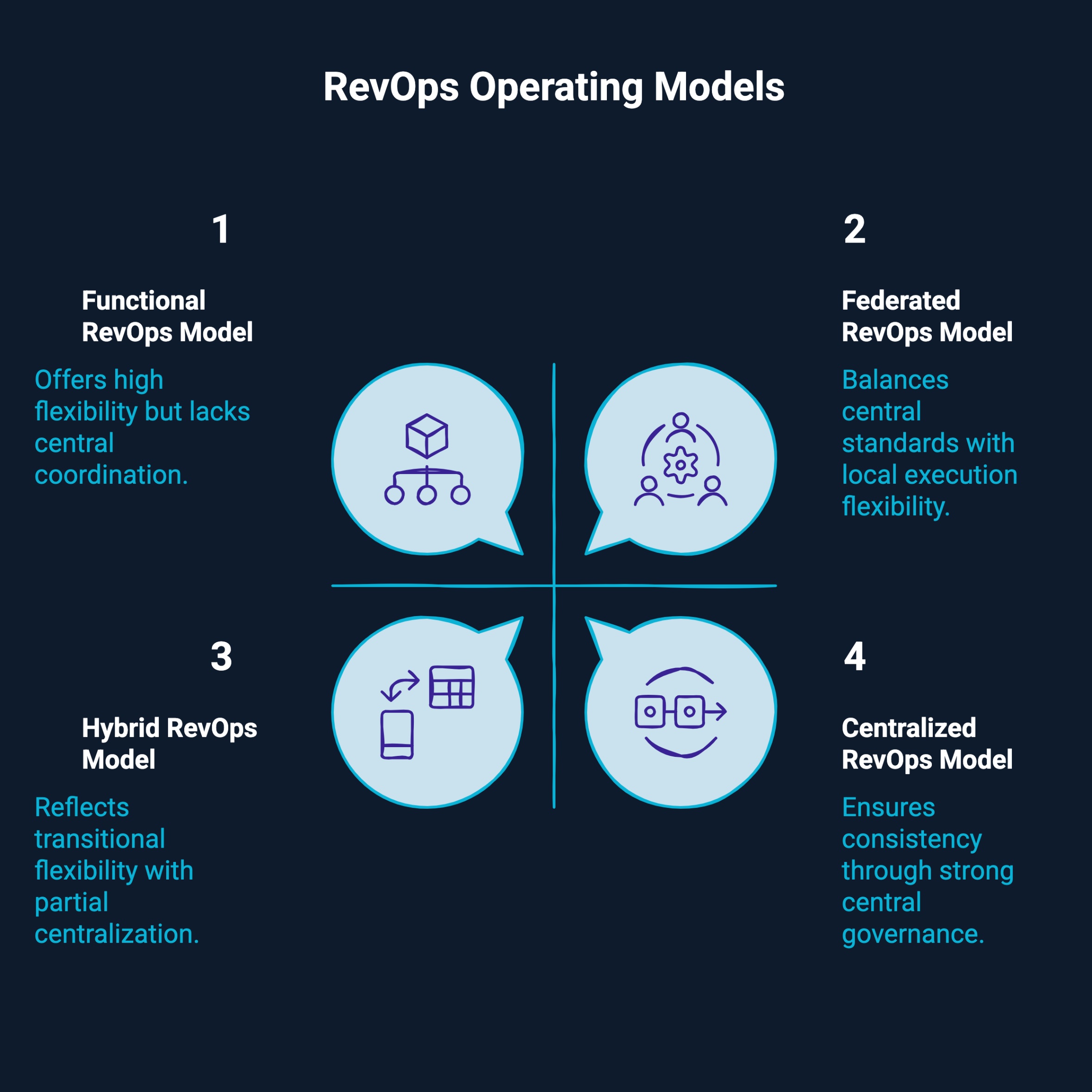
RevOps operating models define how revenue responsibilities are structured, governed, and executed across the organization. The right model depends on company size, complexity, and growth stage. While tools may stay the same, how ownership and decision-making are organized can vary significantly.
In a centralized model, a single RevOps team owns strategy, systems, processes, and reporting across marketing, sales, and customer success. This model works well for growing teams that need consistency, strong governance, and clear accountability. Decisions are made centrally, which improves standardization and data reliability.
A federated model combines a core RevOps team with embedded operators within individual functions. The central team sets standards and architecture, while functional RevOps partners support execution locally. This model balances alignment with flexibility and is common in mid-to-large organizations.
In a functional model, RevOps responsibilities sit within individual departments such as Sales Ops, Marketing Ops, or CS Ops. Coordination happens through shared processes and tooling rather than a single owner. This model can work for smaller teams, but it often struggles as complexity increases.
Many companies operate in a hybrid state while moving toward a more unified approach. Responsibilities may be partially centralized while legacy functional ownership remains. This model reflects real-world constraints and often serves as a stepping stone to a mature RevOps structure.
Choosing the right RevOps operating model is less about labels and more about clarity. The goal is to define ownership, reduce friction between teams, and ensure that revenue decisions are made using shared data and consistent processes.
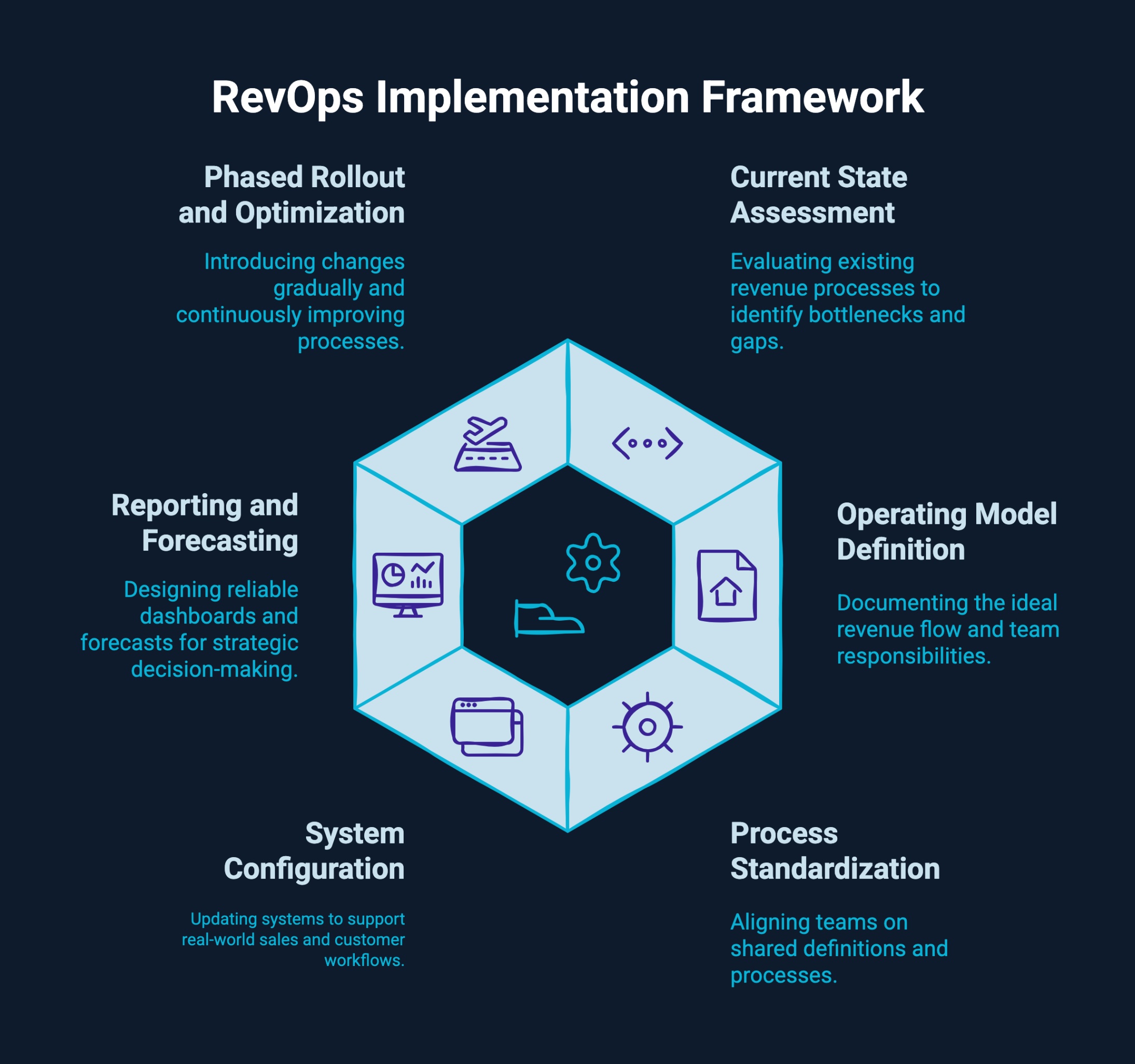
A successful RevOps implementation guide is not about moving fast. It is about moving in the right order. The steps below outline a practical sequence that helps teams reduce risk, drive adoption, and build a revenue operating model that scales.
Start by evaluating how revenue flows today across marketing, sales, and customer success. Review CRM data quality, pipeline structure, lifecycle definitions, handoffs, and reporting. This step helps identify bottlenecks, duplicate work, and gaps between teams that limit visibility or slow execution.
Document how revenue should move from first touch to renewal and expansion. Clarify ownership at each stage, success criteria, and inter-team dependencies. A clear operating model becomes the blueprint for every RevOps decision that follows.
Align teams on shared definitions for leads, opportunities, pipeline stages, and customer lifecycle milestones. Standardization eliminates confusion, improves handoffs, and ensures reporting reflects reality rather than individual team interpretations.
Update CRM architecture, automation, and integrations so systems support actual sales and customer motions. This includes pipeline configuration, field logic, workflow automation, and data synchronization across tools. Systems should enable execution, not require workarounds.
Design dashboards and forecasts that leadership can trust. Focus on pipeline health, conversion rates, velocity, and retention rather than surface-level activity metrics. Strong reporting turns RevOps from an operational function into a strategic advantage.
Introduce changes in controlled phases to drive adoption and reduce disruption. Collect feedback from revenue teams, monitor performance, and refine processes as the business evolves. RevOps implementation is ongoing, not static.
When implemented step by step, RevOps creates clarity without chaos. Each phase strengthens alignment, improves execution, and builds a foundation for predictable growth.
RevOps systems implementation works when people, process, data analytics, and technology are designed together. Focusing on tools alone rarely fixes revenue problems. Sustainable results come from aligning how teams work, how decisions are made, and how systems support execution across the revenue lifecycle.
To understand how this comes together, it helps to break RevOps implementation into four core pillars:
People define ownership and accountability within RevOps. Clear roles ensure that strategy, execution, and optimization do not fall through the cracks. Without defined ownership, even well-built systems become inconsistent over time.
Process connects strategy to execution. RevOps processes document how revenue moves through the business, how teams hand off work, and how success is measured. Well-defined processes reduce friction, improve predictability, and make automation possible.
Technology enables scale when it reflects real workflows. CRM, automation, and analytics tools should support the defined processes and roles rather than forcing teams to adapt around system limitations.
Data and analytics turn RevOps from a coordination function into a decision system. Without trusted data and clear insights, alignment across people, process, and technology breaks down. Strong analytics foundations ensure leaders can spot risks early, evaluate performance objectively, and guide teams with confidence.
When these four pillars work together, RevOps becomes a scalable system that drives predictable growth rather than reactive firefighting.
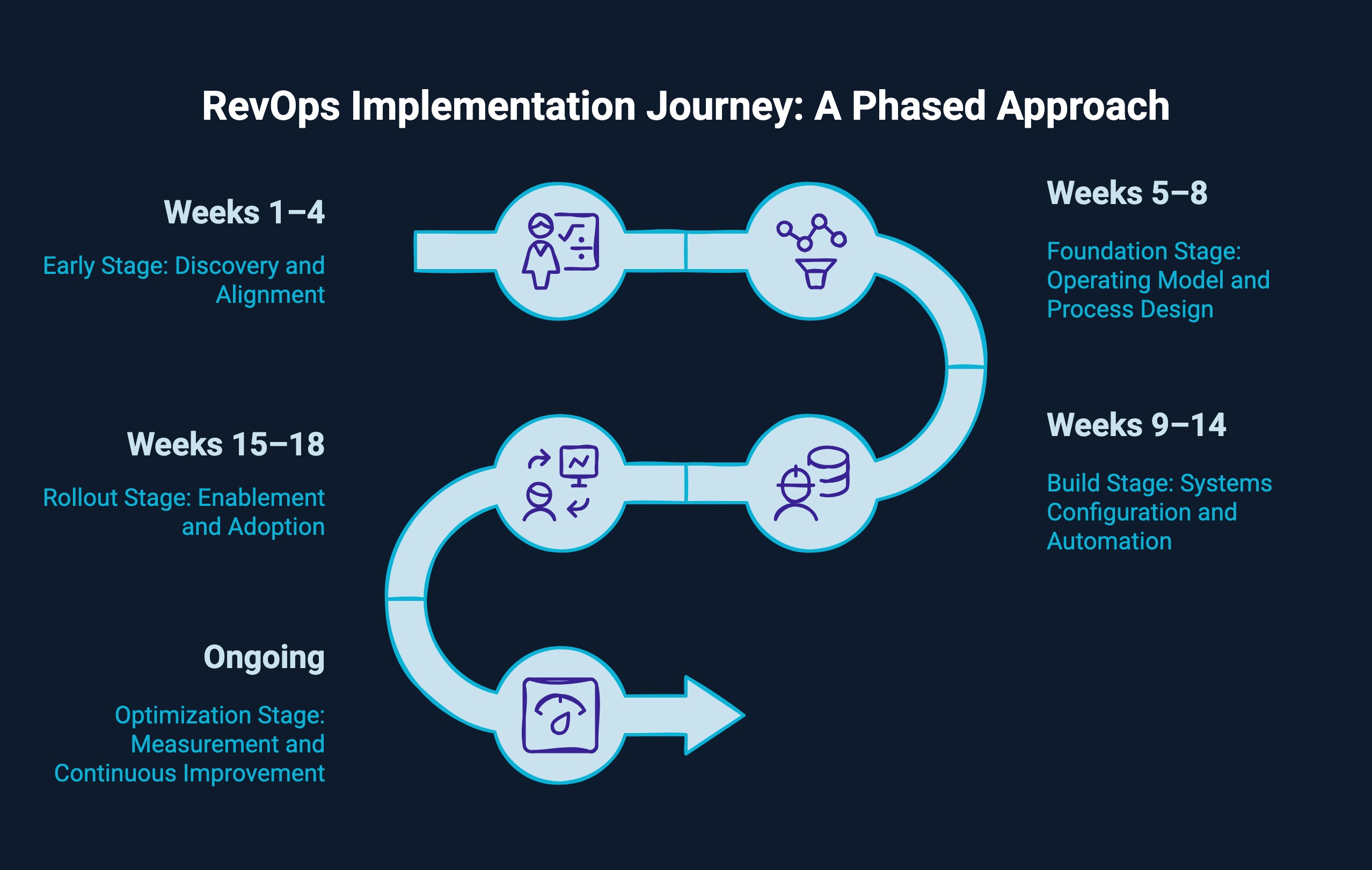
RevOps implementation does not happen all at once. It unfolds in phases, with each stage building on the last. Understanding what to expect at each point helps leaders set realistic timelines, allocate resources effectively, and avoid pushing change faster than teams can absorb.
This phase focuses on understanding the current state. Teams audit existing processes, data quality, CRM configuration, and reporting gaps. Leadership aligns on revenue goals, ownership, and success metrics. The outcome is a clear roadmap rather than immediate system changes.
During this stage, the revenue operating model is defined. Lifecycle stages, handoffs, qualification criteria, and success metrics are documented. This is also when decisions are made about what should be standardized versus flexible. Clear process design prevents rework later.
With processes defined, RevOps teams configure CRM pipelines, automation, integrations, and data structures. Reporting frameworks and dashboards are built in parallel. Changes are tested with small user groups to ensure systems support real workflows.
Processes and system changes are rolled out to revenue teams. Training, documentation, and enablement sessions help drive adoption. Feedback loops are critical at this stage to identify friction and make quick adjustments.
After rollout, RevOps shifts from implementation to optimization. Teams track performance against baseline metrics, refine automation, and adjust processes as the business evolves. This stage ensures RevOps remains effective as growth accelerates.
A clear timeline sets expectations and reduces risk. When RevOps implementation is phased deliberately, organizations achieve faster adoption, stronger alignment, and more sustainable results.
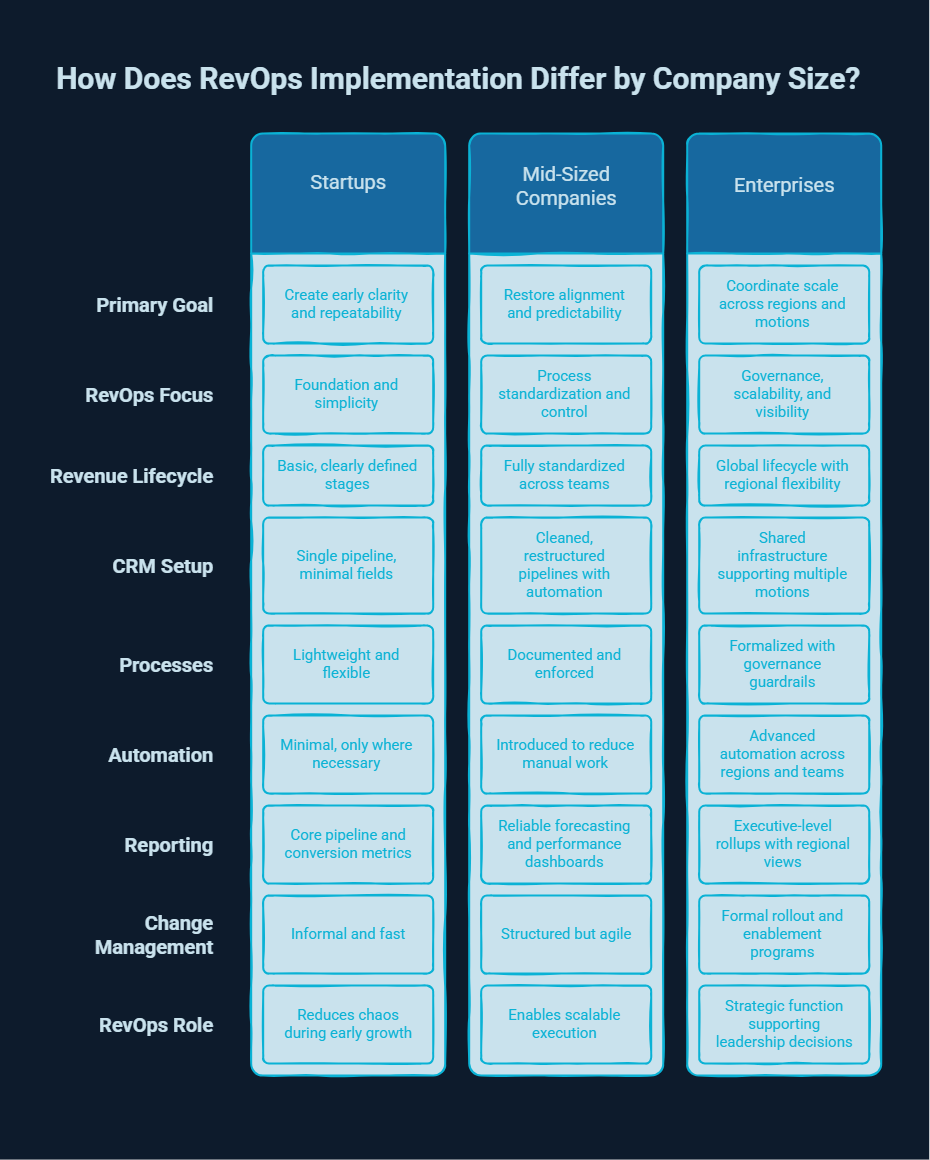
RevOps implementation is not one-size-fits-all. The priorities, complexity, and execution approach vary significantly depending on whether a company is early-stage, scaling, or operating at enterprise scale.
The table below breaks down how RevOps implementation differs for startups, mid-sized companies, and enterprises as scale and complexity increase.
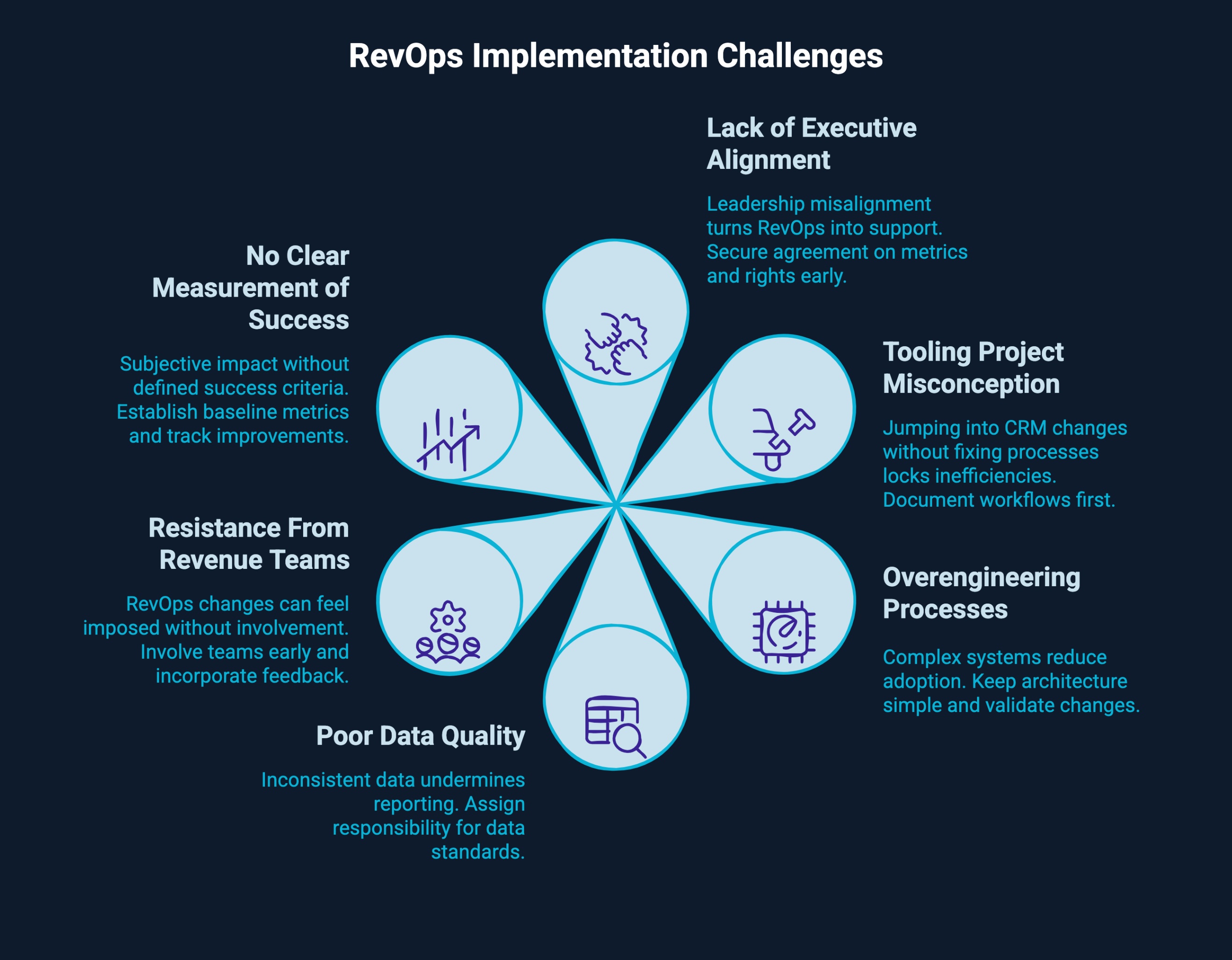
Even well-planned RevOps initiatives can fail if common pitfalls are ignored. Most challenges do not come from tools or technology, but from misalignment, unclear ownership, and rushing execution. Knowing where RevOps implementations typically break helps teams avoid costly rework.
When leadership is not aligned on revenue goals, metrics, and ownership, RevOps becomes a support function rather than an operating model. To avoid this, secure early agreement on success metrics and decision rights before changing processes or systems.
Many teams jump straight into CRM changes or automation without fixing underlying processes. This often locks inefficiencies into the system. Start by documenting workflows and handoffs, then configure technology to support them.
Complex pipelines, excessive required fields, and heavy automation reduce adoption. Teams work around the system instead of within it. Keep architecture simple, validate changes with frontline teams, and add complexity only when needed.
Inconsistent data undermines reporting and forecasting. Without clear ownership for data hygiene, systems degrade quickly. Assign responsibility for data standards and build regular audits into RevOps operations.
RevOps changes can feel imposed if teams are not involved. This leads to low adoption and shadow processes. Involve sales, marketing, and customer success early, explain the purpose, and incorporate feedback before full rollout.
Without defined success criteria, RevOps impact becomes subjective. Establish baseline metrics such as conversion rates, cycle time, and forecast accuracy before implementation, and track improvements over time.
Avoiding these challenges requires discipline and intent. When RevOps implementation is treated as a business transformation rather than a systems upgrade, adoption increases, and long-term value follows.
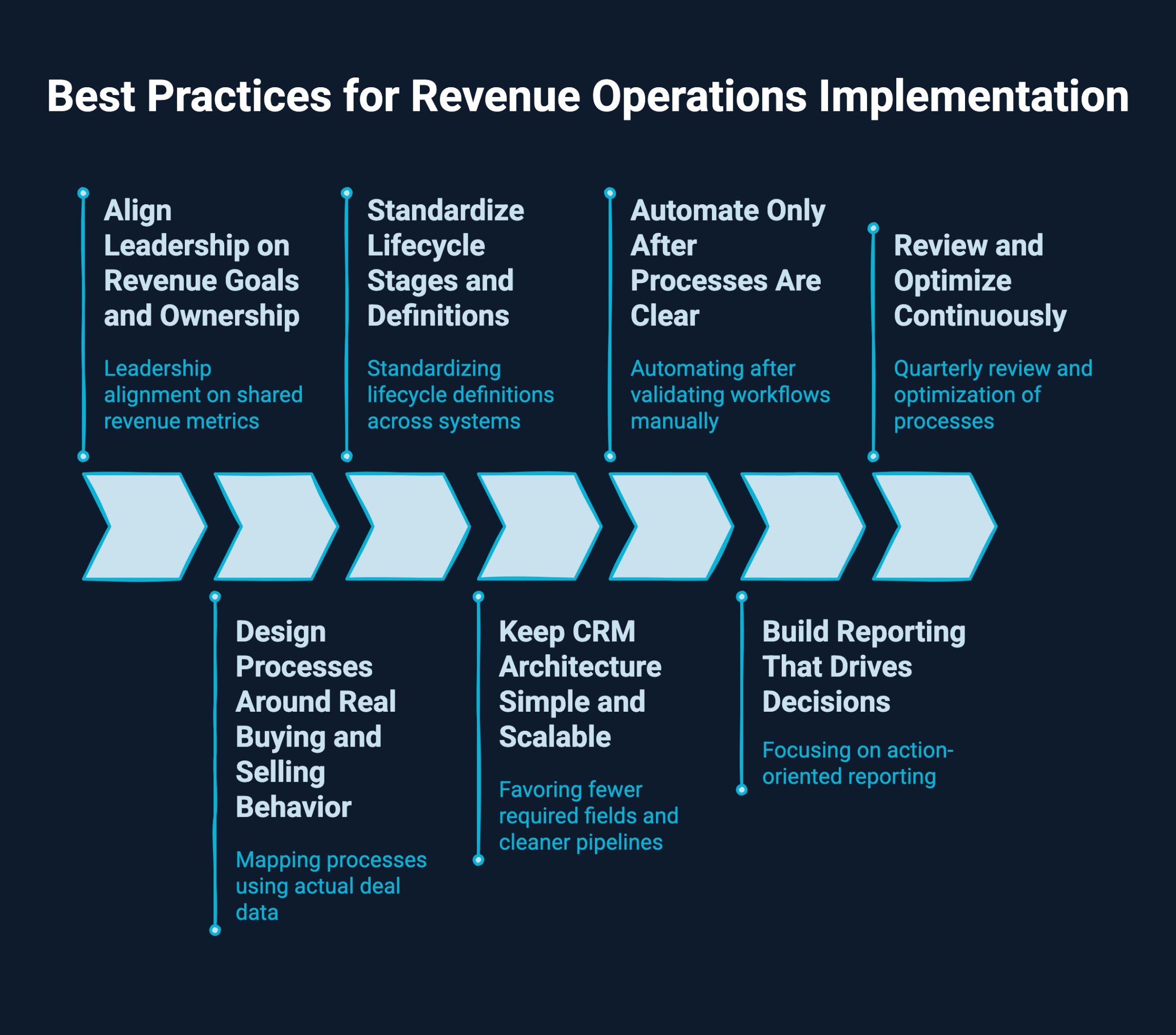
The most effective RevOps implementations are grounded in real operating examples, not theory. These best practices show how high-performing revenue teams apply RevOps in ways that directly improve execution, visibility, and growth.
In successful RevOps implementations, leadership agrees on a small set of shared revenue metrics such as pipeline coverage, win rate, and net revenue retention. For example, instead of marketing optimizing for lead volume and sales optimizing for closed deals, both teams are measured on the qualified pipeline created and converted. This alignment eliminates finger-pointing and creates shared accountability.
Top RevOps teams map processes using actual deal data. For example, if most deals stall between demo and proposal, the pipeline should reflect that stage with clear exit criteria. When processes mirror real customer behavior, sales teams adopt them naturally, and managers gain clearer visibility into risk.
High-growth companies standardize lifecycle definitions across systems. A lead becomes sales-qualified only after meeting agreed criteria, and a deal advances only when objective actions occur. This prevents inflated pipelines, inconsistent reporting, and misleading forecasts.
Strong implementations favor fewer required fields and cleaner pipelines. For example, instead of creating separate pipelines for every edge case, teams use one core pipeline with clear segmentation fields. This approach improves data quality and reduces admin time.
Well-run RevOps teams automate after validating workflows manually. For example, onboarding tasks are automated only once handoffs between sales and customer success are clearly defined. This prevents automation from masking process gaps or creating errors at scale.
Effective RevOps reporting focuses on action. For example, leaders review weekly dashboards that highlight pipeline drop-off points or forecast risk, not just total deal value. This allows teams to intervene early and adjust strategy in real time.
Mature RevOps organizations revisit processes quarterly. As products, markets, or sales motions change, pipelines and automation are updated to stay aligned. This ongoing refinement keeps RevOps relevant and effective as the business grows.
When best practices are applied with real-world context, RevOps implementation becomes practical and impactful. Teams execute faster, data becomes trustworthy, and leaders gain the clarity needed to scale revenue with confidence.
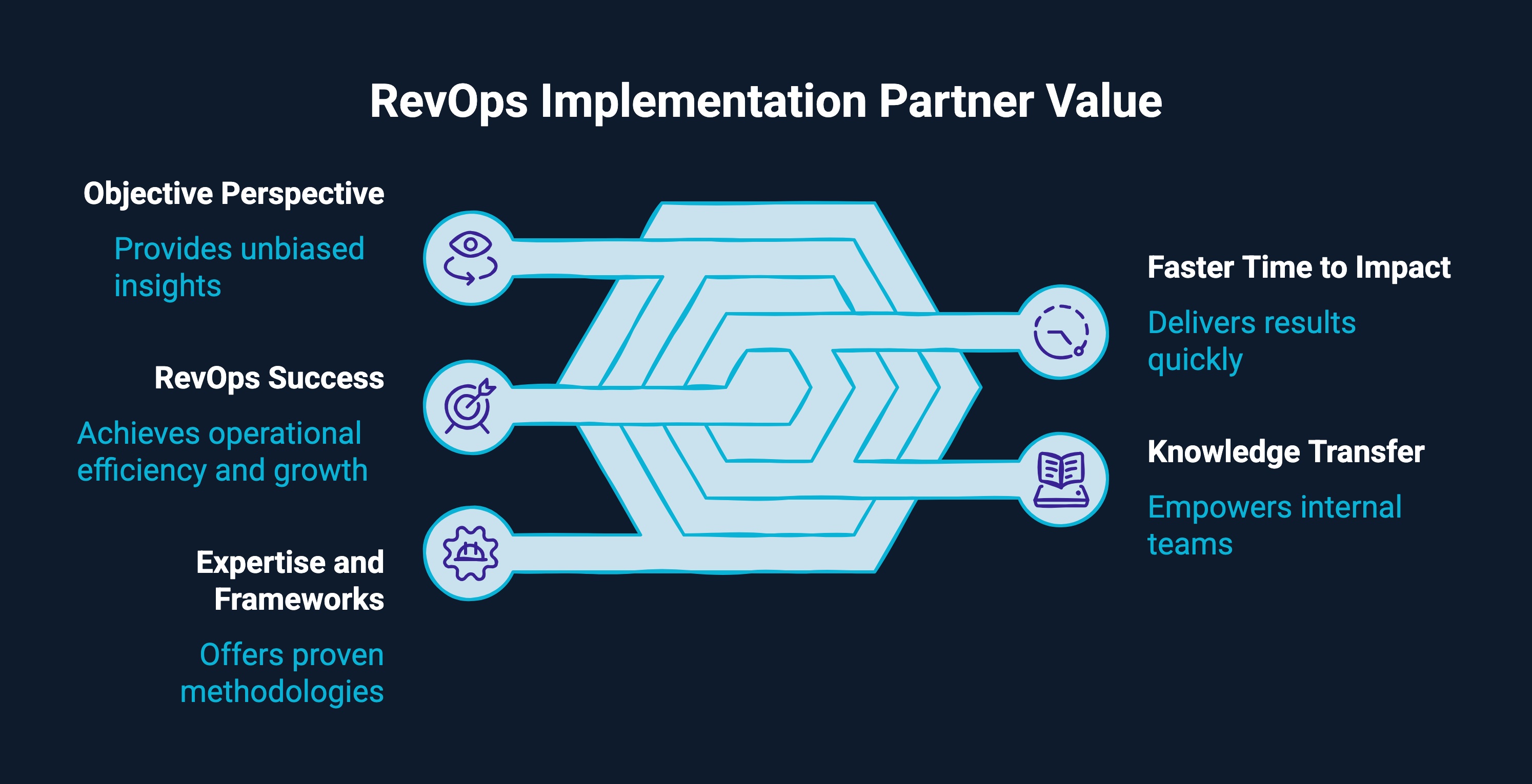
Not every organization has the internal expertise or capacity to implement RevOps effectively. In many cases, working with a RevOps implementation partner or agency accelerates progress, reduces risk, and prevents costly rework.
Situations Where a RevOps Partner Makes Sense:
The best RevOps partners do not just configure tools. They transfer knowledge, build internal capability, and leave teams with systems they can own and evolve. Choosing the right partner turns RevOps implementation into a force multiplier rather than a dependency.
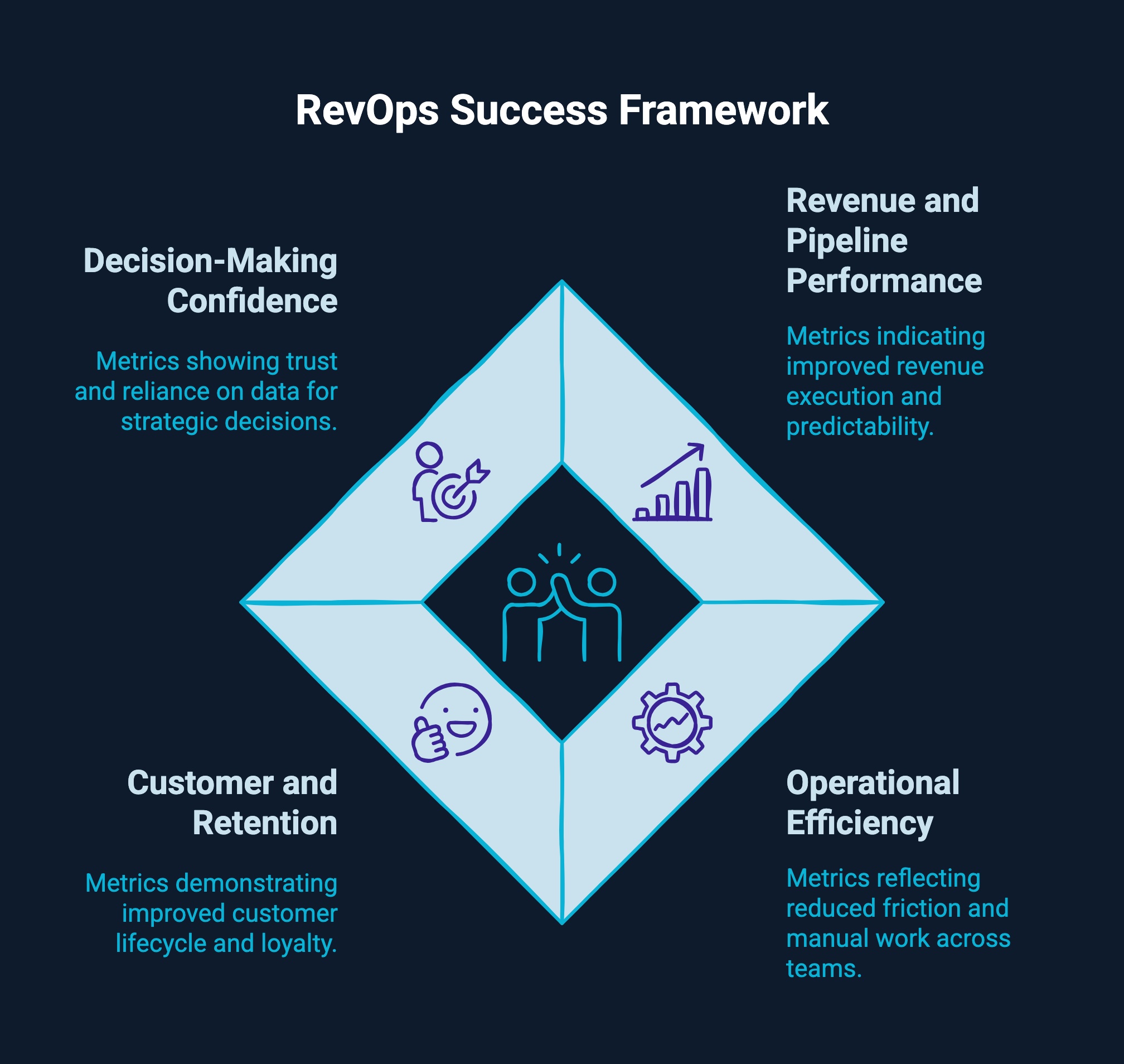
RevOps success isn’t measured by tools launched or dashboards built. It shows up in better execution, trusted data, and confident decisions. Outcomes matter more than activity.
The best teams establish baseline metrics early and track improvement over time, making RevOps impact visible and revenue-driven.
These metrics indicate whether RevOps is improving revenue execution and predictability:
Improvement in these areas shows that processes, handoffs, and systems are working together.
RevOps should reduce friction and manual work across teams. Efficiency gains are a strong indicator of implementation success:
When teams spend less time fixing systems, productivity increases naturally.
RevOps impact extends beyond new revenue. Strong implementations improve the full customer lifecycle:
These metrics reflect alignment between sales and customer success.
One of the clearest signs of RevOps success is trust. Leaders should rely on RevOps data to guide strategy:
When leadership stops questioning the numbers and starts acting on them, RevOps is delivering value.
Measuring the right signals ensures RevOps implementation remains outcome-driven. When success is defined clearly, RevOps becomes a continuous growth lever rather than a completed project.
RevOps often breaks down during implementation. Processes roll out unevenly, systems are built in silos, and ownership remains unclear. Without a structured approach, even well-planned RevOps initiatives fail to improve execution.
LeadGem helps B2B teams turn existing tools into a unified revenue operating system. We deliver hands-on RevOps implementation, GTM engineering, and automation with a strong focus on CRM architecture, data quality, and scalable outbound execution. The goal is consistency without added complexity.
Our execution-first, tool-agnostic approach means we work directly inside platforms like HubSpot and Clay to design routing logic, automation, and data workflows that support real selling motions. As a Clay Certified Partner, we go beyond enrichment to build systems that improve pipeline quality and team efficiency.
What sets LeadGem apart is delivery. We do not stop at strategy. We build, configure, test, and iterate with your team until systems are adopted and trusted. Success is measured by usage, reliability, and revenue impact, not documentation.
If you want RevOps that reduces manual friction, improves data reliability, and scales with your business, LeadGem is built for that. Contact us to start the conversation.
RevOps implementation defines how seriously an organization treats revenue execution. When systems, processes, and ownership are designed intentionally, revenue becomes predictable instead of reactive.
The gap between growth plans and growth outcomes is almost always operational. Teams that implement RevOps with discipline move faster, see issues earlier, and scale without adding friction.
RevOps is not about optimization for today. It is about building a revenue system that holds up as the business grows.
RevOps systems implementation should be owned by a central RevOps leader or team with cross-functional authority. They align people, process, technology, and data while coordinating with marketing, sales, customer success, and IT.
Yes. Start with a revops strategy, map the entire customer journey, audit revenue data, remove data silos, define key performance indicators, document the sales process and revenue cycle, align tech stack, set data governance, enable team members, and review progress.
Alignment starts with open communication and common goals. During revops implementation, connect marketing teams, sales, and customer service around the revenue operations framework, shared key performance indicators, lead scoring, and customer experience metrics, ensuring every team member understands their role.
Recommended tools depend on RevOps function maturity. Most teams need a CRM, marketing automation, sales enablement, and analytics for actionable insights. LeadGem helps implement a tech stack supporting process optimization, predictive analytics, revenue pipeline visibility, data governance, and scalable growth.
Leadership sets direction, ownership, and accountability for RevOps implementation. Executives align teams on common goals, approve process changes, prioritize data governance, and reinforce adoption. Their involvement removes resistance, ensures decisions are executed, and keeps revenue operations focused on sustainable growth.
Reps commonly get stuck after initial discovery, when buyer urgency drops, or value is unclear. Gaps in the sales process, weak qualification, unclear next steps, and poor alignment with the customer journey often stall deals inside the sales funnel stages frequently.
RevOps is a way of running sales, marketing, and customer service as one system. It aligns people, processes, and revenue data across the entire customer journey so teams work toward common goals and drive predictable revenue growth together efficiently and consistently.
Implementing a RevOps framework improves revenue visibility, reduces data silos, and aligns team members around shared key performance indicators. Benefits include faster revenue generation, better customer experience, higher customer satisfaction, and more scalable, predictable business growth over time globally today.
Global enterprises should standardize core revenue processes, centralize data governance, and maintain a shared CRM architecture while allowing regional flexibility. Clear ownership, consistent metrics, and strong change management help ensure alignment, adoption, and reliable forecasting across markets.