

Contact


Most B2B revenue teams don’t fail on strategy. They fail on execution. Fragmented CRM data, unclear pipelines, and inconsistent automation reduce visibility, weaken forecasts, and slow decisions.
As teams scale, misaligned processes across marketing, sales, and RevOps cause CRMs to look organized but fail to reflect how deals actually move.
This guide explains how to build a modern B2B RevOps tech stack, especially around HubSpot, to improve clarity, speed, and scalable execution.
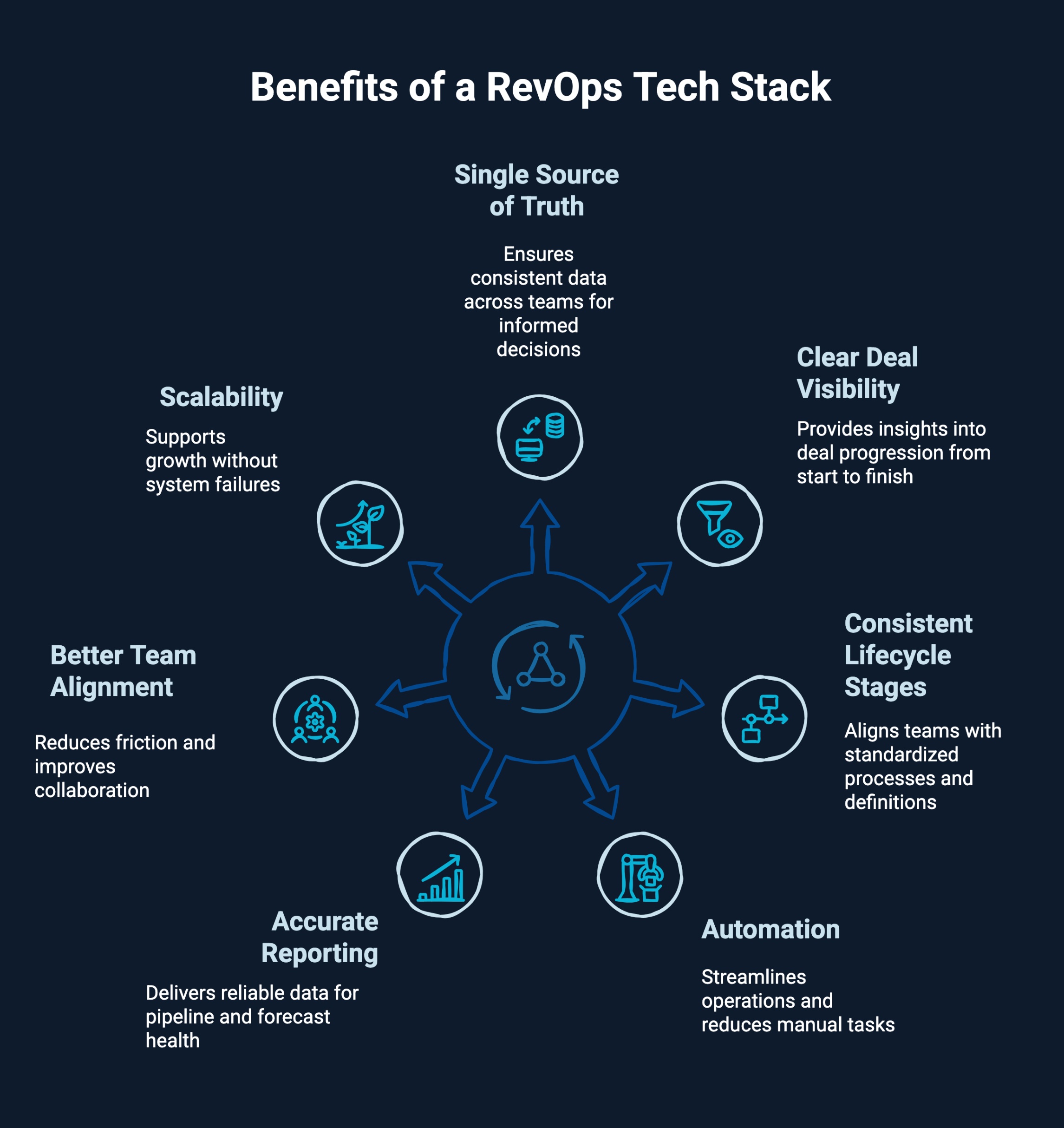
A RevOps tech stack is the collection of systems that support how revenue actually moves through a B2B organization. It focuses on aligning data, processes, and teams across the full revenue lifecycle.
In most B2B companies, the stack already exists. Typically, this includes:
A well-designed RevOps tech stack provides the foundation for predictable, scalable revenue by ensuring:
For B2B teams with longer sales cycles and multiple stakeholders, this structure enables faster execution, stronger forecast confidence, and sustainable revenue growth.
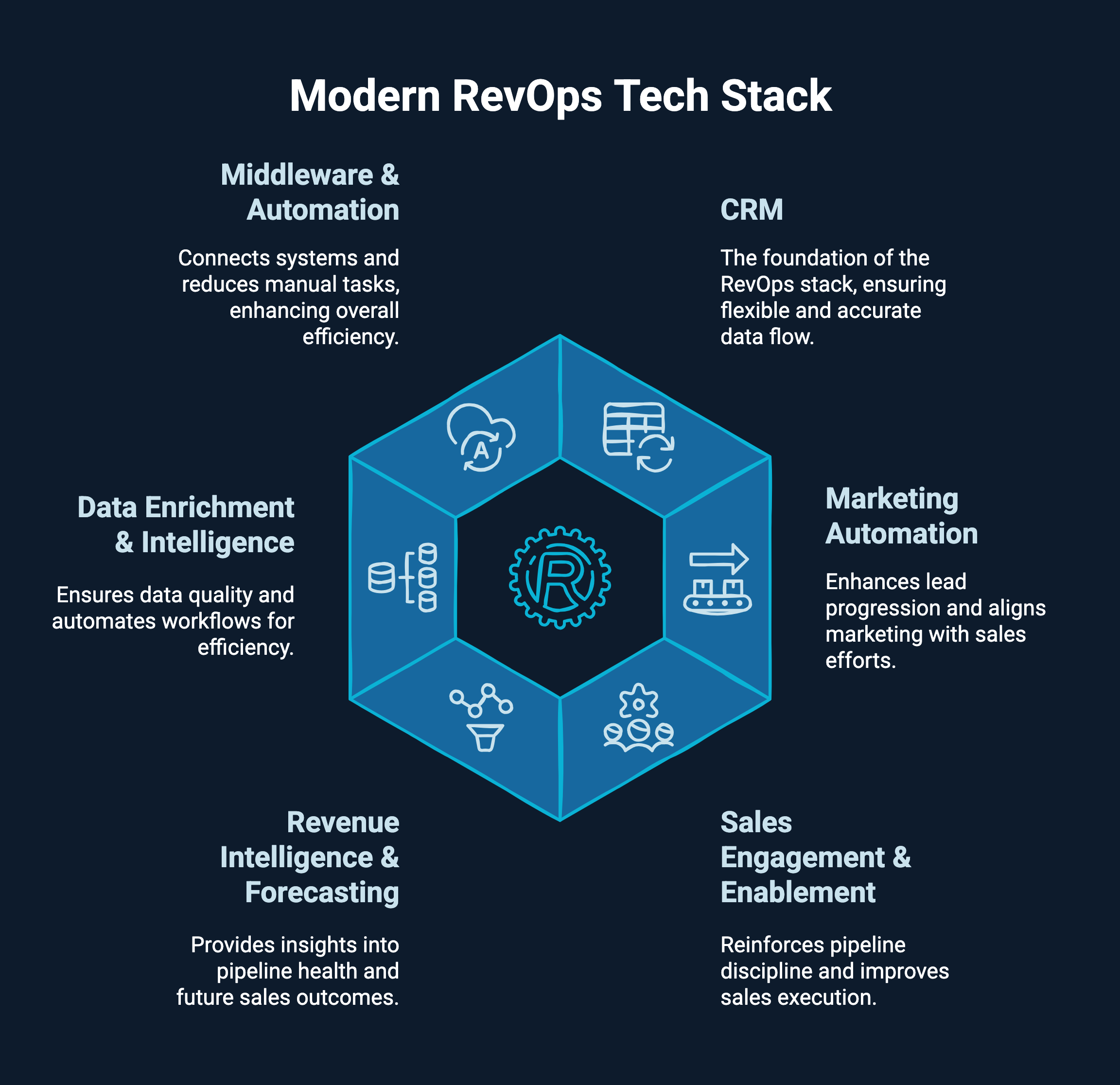
A modern RevOps tech stack is not about collecting best-of-breed tools. It’s about building a system where each layer supports clear execution, visibility, and scale across the revenue process. For B2B teams, the goal is simple. Every tool should reinforce how deals move through the pipeline and how teams operate inside it.
Most high-performing RevOps stacks are built around a few core layers:
The CRM is the foundation of the entire RevOps stack. Most B2B teams already have one. The real question is whether it is flexible enough and configured correctly to support how revenue actually flows.
For many teams, HubSpot is the strongest option because it allows:
For SEO and completeness, other CRM platforms commonly used by B2B teams include:
Regardless of platform, the CRM must clearly visualize:
If the sales process is unclear in the CRM, no amount of automation or AI will fix execution.
In a modern RevOps tech stack, marketing automation exists to support revenue movement, not just campaign execution. For B2B teams, the goal is to ensure leads progress cleanly through lifecycle stages and reach sales with the right context, timing, and intent, not just activity history.
Most breakdowns occur when marketing automation operates independently of the CRM. Common issues include:
Platforms like HubSpot and Salesforce deliver the most value when they are tightly coupled with the CRM and revenue model. When implemented correctly, they enable teams to:
When marketing automation is RevOps-led, it becomes an acceleration layer rather than a broadcast engine. It improves handoffs, reduces manual work, and ensures sales teams focus on the right opportunities instead of sorting through noise.
Sales engagement tools are designed to help reps execute consistently inside the sales process defined in the CRM. In a RevOps context, their value comes from reinforcing pipeline discipline, not from running outreach in isolation.
Problems arise when engagement tools operate as parallel systems. Common issues include:
Platforms like Outreach and Salesloft are most effective when:
When sales engagement is properly integrated into the RevOps stack, reps spend less time deciding what to do next and more time executing. The result is higher activity quality, better stage progression, and a sales process that teams can actually follow.
Revenue intelligence and forecasting tools help leaders understand what’s happening in the pipeline and what’s likely to close. In a RevOps stack, their value depends entirely on the quality of CRM data and process discipline underneath them.
Many B2B teams adopt forecasting tools too early. When stages are unclear, or reps don’t update deals consistently, these platforms amplify noise instead of insight. Common breakdowns include:
Platforms like Clari and Gong work best as overlay layers, not foundations. When paired with a well-configured CRM, they can:
In a strong RevOps stack, forecasting is not a quarterly exercise. It’s a continuous feedback loop that helps teams intervene earlier, prioritize better, and operate with confidence.
In a modern RevOps tech stack, data quality and workflow automation determine how effective every downstream system will be. This is where Clay plays a central role, not as a point solution, but as an orchestration layer that sits between data, tools, and execution.
Platforms like Clay go far beyond basic enrichment. While tools such as Apollo.io and Cognism are strong data sources, Clay’s real value is in how it combines, transforms, and operationalizes that data.
In a RevOps-led setup, Clay is commonly used to:
When paired with a CRM like HubSpot, Clay helps ensure the CRM stays clean, usable, and scalable. Instead of cluttering HubSpot with raw or inconsistent data, Clay acts as a control layer that prepares information before it impacts the pipeline, reporting, or automation.
For B2B teams, this is critical. Clean inputs lead to clearer stages, better handoffs, stronger automation, and more reliable forecasting. Clay enables RevOps teams to move faster without sacrificing structure, which is exactly what most scaling organizations struggle to balance.
Middleware and automation layers exist to connect systems where native integrations fall short. In a RevOps tech stack, their role is to reduce manual work and maintain data flow, not to compensate for poor CRM design.
Tools like Zapier and Workato are typically used to:
However, middleware should be applied selectively. Overusing automation tools can:
For many B2B teams using HubSpot, native workflows and automation handle a large portion of RevOps needs. Middleware becomes most valuable when supporting edge cases or cross-system workflows that truly require it.
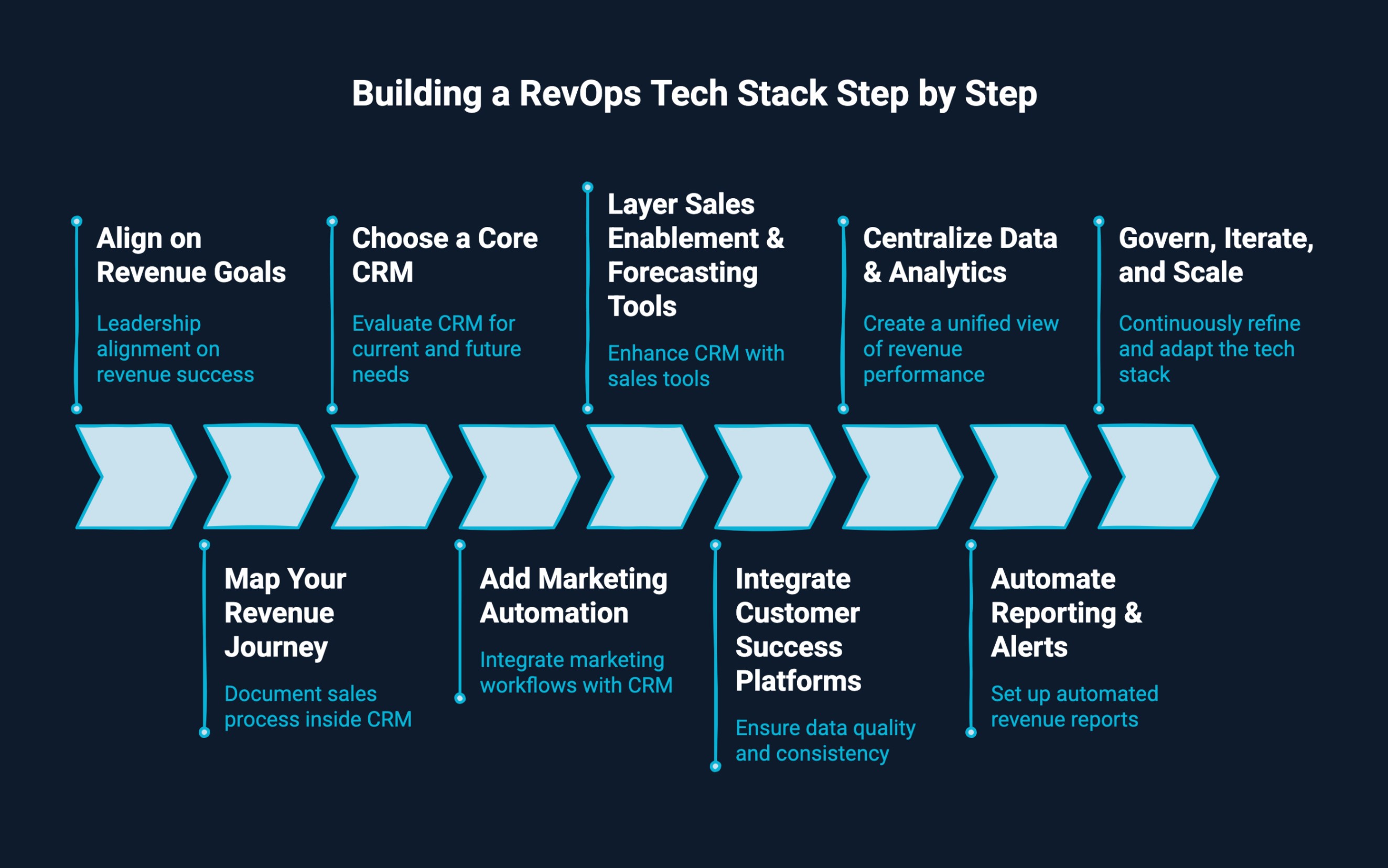
Building a RevOps tech stack is not about implementing tools in sequence. It’s about designing a system that reflects how revenue is generated, owned, and measured across the business. Most B2B teams already have the core tools in place. The real work is configuring, connecting, and governing them correctly.
The steps below assume an existing CRM and focus on turning that foundation into an execution-ready revenue system.
Before making changes to tools or workflows, RevOps teams must align leadership on what revenue success actually means. This includes clarity around pipeline expectations, deal velocity, and forecast accuracy. Without this alignment, systems end up optimizing for activity instead of outcomes.
Clear revenue goals give structure to every configuration decision that follows and ensure automation, reporting, and workflows support the same objectives.
A RevOps tech stack only works when the sales process is clearly visible inside the CRM. This step focuses on documenting how deals actually move through the pipeline, not how they are assumed to move.
Defined lifecycle stages, clear exit criteria, and well-understood handoffs allow teams to execute consistently and give leadership a reliable view of pipeline health.
Most RevOps challenges originate in a CRM that no longer reflects how revenue actually moves. This step focuses on evaluating whether the CRM can support current sales motions and adapt as the go-to-market strategy evolves. Pipeline structure, stage logic, custom objects, and automation should all reinforce real execution.
Platforms like HubSpot are well-suited for this because they allow teams to iterate quickly without introducing heavy technical debt or rigid dependencies.
Marketing automation should exist to move revenue forward, not to operate as a standalone system. Every workflow should map directly to lifecycle progression and support cleaner handoffs into sales-owned stages.
When automation reflects revenue logic, teams reduce manual work, improve timing, and create consistency across the funnel.
Sales engagement and forecasting tools should reinforce execution inside the CRM. Their role is to guide reps through the sales process and provide leadership with reliable pipeline insight.
When these tools align with stage movement and deal behavior, they improve consistency, visibility, and forecast confidence.
Data quality determines the effectiveness of every report, automation, and forecast. This step focuses on controlling how data enters the system, how it is formatted, and how it is maintained over time.
Solutions like Clay often play a key role here by enriching, normalizing, and preparing data before it impacts CRM workflows or reporting.
Reporting should eliminate ambiguity, not introduce it. Automated reporting gives teams a shared, trusted view of pipeline health, deal progression, and revenue performance.
When reporting is reliable and always up to date, leadership can make decisions faster and with greater confidence.
A RevOps tech stack must evolve alongside the business. Governance ensures that changes are intentional, documented, and aligned with revenue goals.
Regular iteration prevents tool sprawl, maintains data integrity, and keeps systems usable as complexity increases.
The final step is building feedback loops into the RevOps system. Performance reviews, pipeline retrospectives, and team feedback reveal where processes break down or need adjustment. Continuous refinement ensures the tech stack stays aligned with real-world execution and long-term growth.
With a solid execution framework in place, the next question becomes how AI is reshaping modern RevOps tech stacks.
In 2026, the most effective RevOps tech stacks combine AI-driven platforms with strong GTM execution. These stacks are not defined by single tools, but by how well CRM, data, automation, and intelligence layers work together to support predictable revenue growth.
Below are leading RevOps and GTM platforms and partners shaping AI-enabled revenue systems.
LeadGem is a RevOps and GTM engineering partner with a strong foundation in B2B growth marketing and growth hacking, backed by more than 5 years of hands-on experience. Based in Amsterdam, the Netherlands, LeadGem supports B2B companies across Benelux, the Nordics, America, and Australia.
LeadGem supports CRM architecture and optimization, AI-powered data workflows, outbound and inbound GTM automation, sales process visualization, and ongoing RevOps optimization.
B2B SaaS and growth-stage companies looking to align growth strategy with RevOps execution and build scalable, AI-enabled revenue systems.
Discuss Your RevOps Setup with LeadGem.
The Kiln is a GTM engineering firm that focuses on building automated, data-driven revenue systems for fast-growing B2B organizations. Their work centers on transforming manual GTM processes into scalable, technology-led workflows.
GTM architecture, automated inbound and outbound systems, data enrichment, CRM transformation, multi-channel campaign automation, and GTM advisory.
High-growth B2B teams with complex outbound motions or data-heavy GTM strategies that require deep technical execution.
Gong is a revenue intelligence platform that uses AI to analyze sales conversations, emails, and deal activity. It helps B2B teams understand what actually drives deals forward and where risk exists across the sales pipeline.
Conversation intelligence systems, deal risk monitoring, sales coaching frameworks, pipeline visibility, and data-backed revenue forecasting.
Mid-market and enterprise B2B sales teams that rely heavily on sales calls and need deeper visibility into deal execution and rep performance.
6sense is an AI-powered revenue platform focused on predictive buyer intelligence and account-level insights. It helps B2B teams understand buyer intent and prioritize accounts throughout the customer journey.
Account-based GTM strategies, intent-driven lead prioritization, aligned sales and marketing workflows, and customer journey visibility.
B2B companies with account-based or enterprise sales motions that need earlier visibility into buyer intent and long-cycle revenue opportunities.
Clari is a revenue operations and forecasting platform that uses AI to bring structure and predictability to pipeline management. It helps B2B revenue teams understand where deals stand, what is likely to close, and where intervention is needed.
Forecasting frameworks, pipeline inspection workflows, deal risk monitoring, revenue visibility, and leadership-level reporting.
Mid-market and enterprise B2B teams that need predictable revenue forecasting, tighter pipeline control, and clearer insight into deal execution.
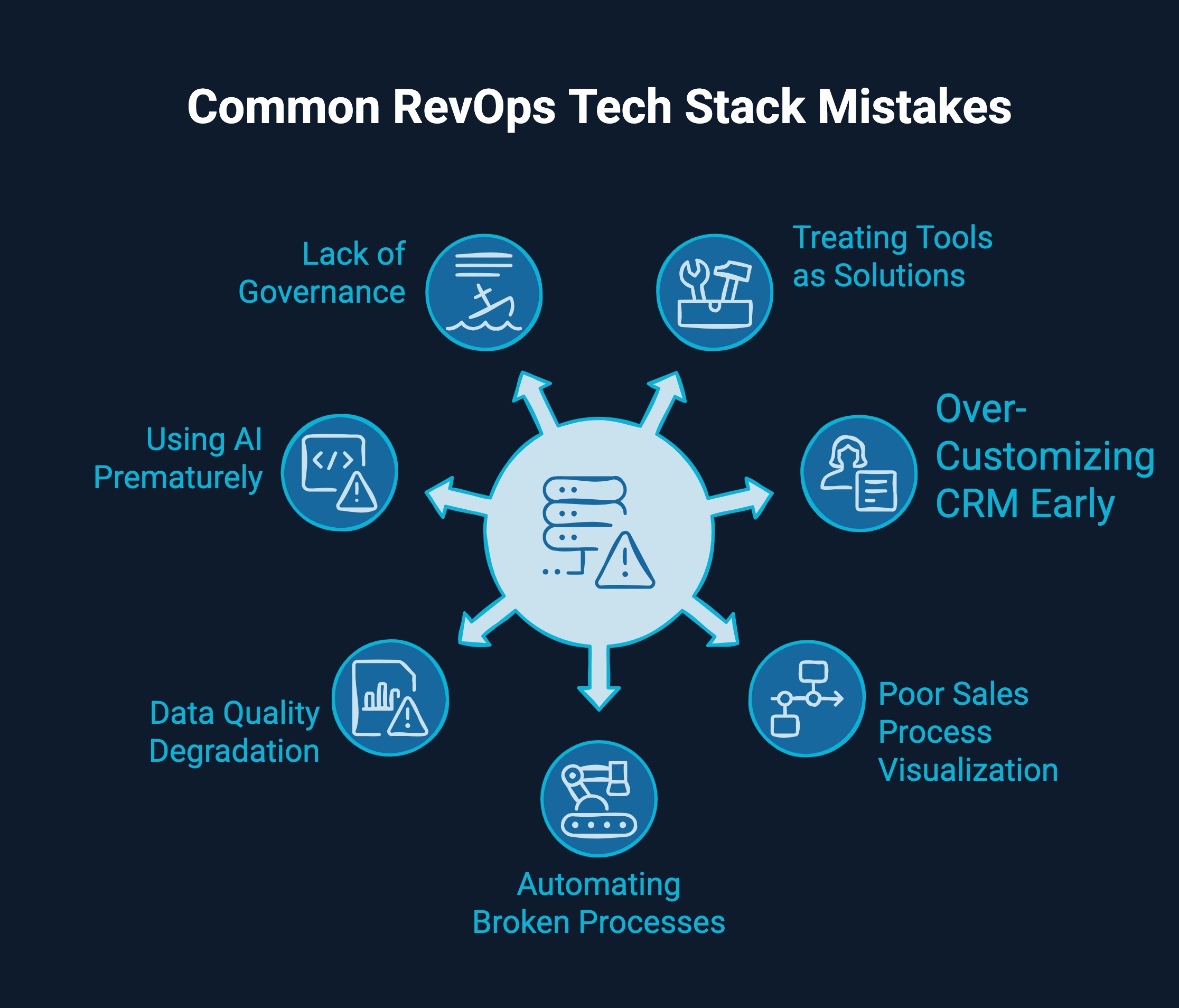
Most RevOps tech stacks don’t fail because of the tools chosen. They fail because of how those tools are implemented, connected, and governed. The mistakes below show up repeatedly in B2B organizations, regardless of size.
The most successful RevOps teams spend less time chasing new tools and more time designing systems that reflect how revenue is actually generated.
Choosing tools for a RevOps tech stack is less about feature depth and more about practical fit. The right tools support how revenue operates today while remaining flexible enough to evolve as your go-to-market motion changes.
The first priority is strengthening the core CRM. Every tool added to the stack should reinforce execution inside the CRM rather than create parallel workflows. Platforms like HubSpot work best when surrounding tools enhance visibility, automation, and consistency across the revenue process.
When evaluating tools, RevOps teams should focus on a few critical criteria:
Data handling deserves special attention. Tools that enrich or transform data should improve quality before it reaches the CRM. Solutions like Clay add value by structuring, normalizing, and routing data in ways that support clean automation and reliable reporting.
Finally, governance matters as much as functionality. Tools should be easy for RevOps to manage, audit, and evolve over time. Clear ownership, transparent logic, and simple workflows are often more valuable than advanced features that create dependency or confusion.
RevOps tech stacks should scale with the business. What works for an early-stage B2B startup often breaks as volume, complexity, and accountability increase. The goal is not to copy a “best-in-class” stack, but to match tooling to revenue maturity.
Early-stage B2B startups need speed, clarity, and flexibility. The focus is on getting visibility into pipeline movement and enabling reps to execute consistently without heavy operational overhead.
A typical startup RevOps stack includes:
At this stage, RevOps success comes from clear process visualization and disciplined CRM usage, not advanced tooling. Simplicity enables faster iteration as the sales motion takes shape.
Mid-sized B2B companies face more complexity. Multiple segments, longer sales cycles, and larger teams require deeper automation, stronger governance, and better forecasting.
A typical mid-sized RevOps stack includes:
At this stage, the RevOps stack must support predictable forecasting, cross-team alignment, and scalable execution without slowing teams down.
The difference between startup and mid-sized RevOps stacks is not the number of tools. It’s how intentionally those tools are configured.
Startups prioritize speed and learning. Mid-sized companies prioritize consistency, visibility, and control. The strongest RevOps teams evolve their stack gradually, ensuring each new layer reinforces execution instead of adding friction.
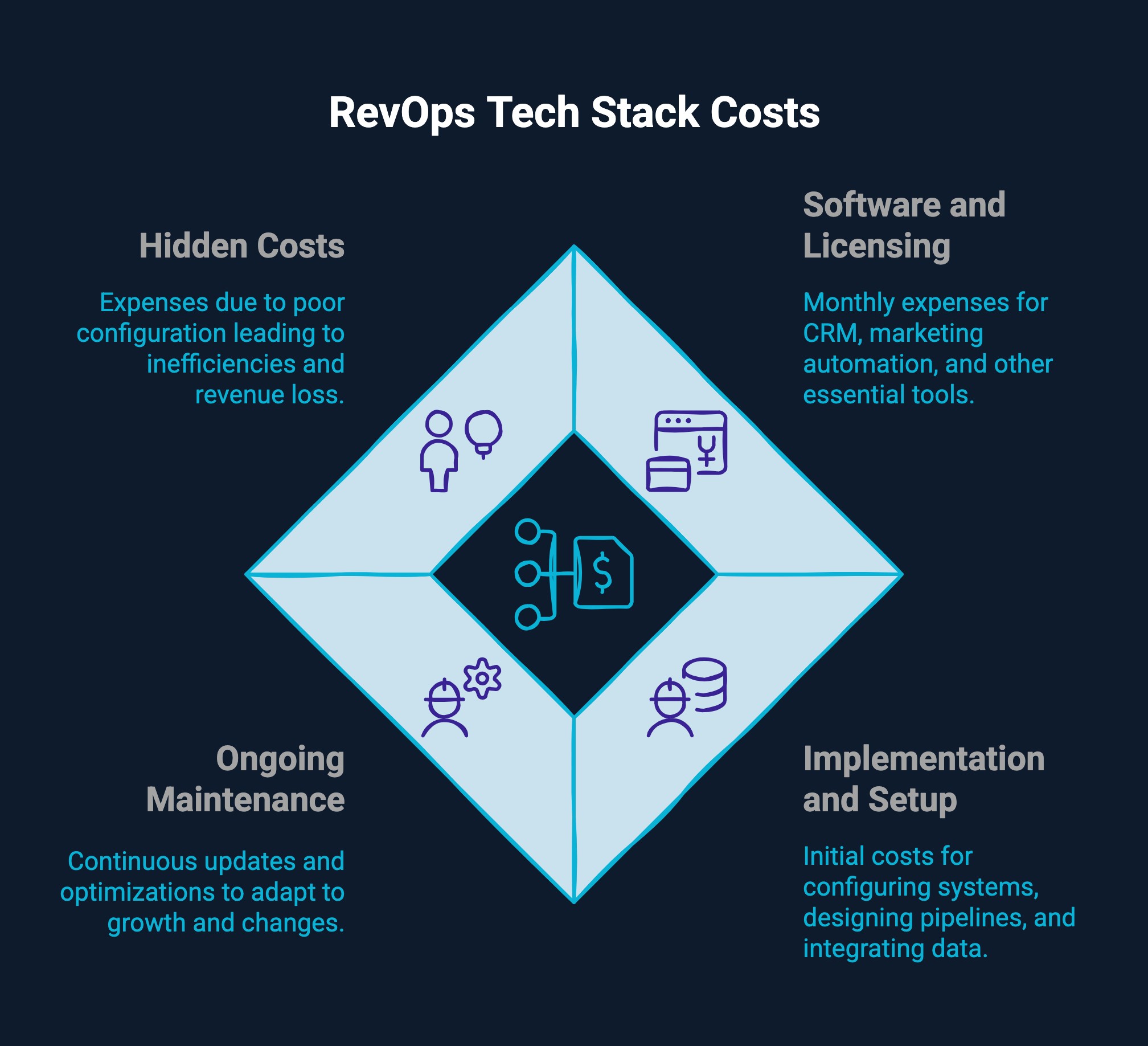
The cost of a RevOps tech stack depends less on tool count and more on revenue complexity and system design quality. Many B2B teams underestimate costs by focusing only on software fees and ignoring setup, iteration, and ownership.
Key cost drivers include:
A well-designed RevOps tech stack delivers better execution, clearer visibility, and more predictable revenue, paying for itself over time.
Most RevOps problems aren’t caused by missing tools. They’re caused by systems that were never built to support real execution. LeadGem helps B2B teams turn their existing tech stack into a revenue system that actually works.
LeadGem specializes in RevOps, GTM engineering, and automation, with a strong focus on CRM optimization, data quality, and scalable outbound systems. Instead of adding complexity, we design and implement workflows that improve visibility, speed, and consistency across the revenue process.
Our approach is execution-first and tool-agnostic, with deep hands-on experience across HubSpot, Clay, and modern GTM tooling. As a Clay Certified Partner, we go beyond enrichment to build smarter routing, automation, and data workflows that directly impact pipeline quality.
What sets LeadGem apart is delivery. We don’t stop at strategy. We build, configure, test, and iterate alongside your team, ensuring your RevOps stack is usable, scalable, and trusted by the people who rely on it every day.
If you want fewer manual bottlenecks, cleaner data, and a RevOps system designed for real-world B2B execution, LeadGem is built for that. Contact us today!
A RevOps tech stack is not a collection of tools. It’s the operating system behind how revenue gets built, measured, and scaled.
B2B teams that win are not the ones with the most software, but the ones with systems that create clarity. When the CRM reflects reality, data can be trusted, and workflows reduce friction, teams move faster, and decisions improve naturally. Everything else, including AI and forecasting, only works when this foundation is in place.
As go-to-market strategies evolve, adaptability becomes the real advantage. RevOps stacks that are designed to iterate, not just launch, are the ones that support sustainable growth and confident execution.
In 2026, the best RevOps software combines CRM, automation, and analytics into a unified system. Partners like LeadGem help configure these tools into a practical, scalable revenue engine.
At LeadGem, our RevOps tech stack embeds AI for predictive analytics, machine learning, sales automation, and revenue forecasting. These services analyze CRM data, surface actionable insights, reduce manual work, and help sales teams prioritize high-impact opportunities with greater confidence consistently.
A RevOps stack connects marketing efforts, sales operations, and customer success teams into a single source of truth, eliminating data silos and improving conversion rates, sales performance, and overall revenue generation.
No. RevOps stacks help startups and mid-sized teams improve operational efficiency, align lead management, track key performance indicators, and build a scalable revenue engine with accurate data and seamless integration.
Yes. Must-have tools include customer relationship management, revenue operations software, and business intelligence platforms that support email marketing, sales calls, and marketing teams while enabling sales forecasting, customer insights, and RevOps strategy best practices.