

Contact


B2B marketing teams face growing pressure to generate a predictable pipeline while buyer journeys become more complex. Static campaigns and fixed ICP lists often lead to wasted spend, low engagement, and unclear revenue attribution.
Meanwhile, buyers constantly signal intent through website visits, content downloads, hiring activity, and funding announcements. Most companies collect this data but fail to activate it at the right time.
This blog explains how signal-based marketing works, how it differs from traditional campaigns, and how to build a structured, automated system that turns real-time buyer signals into measurable pipeline growth.
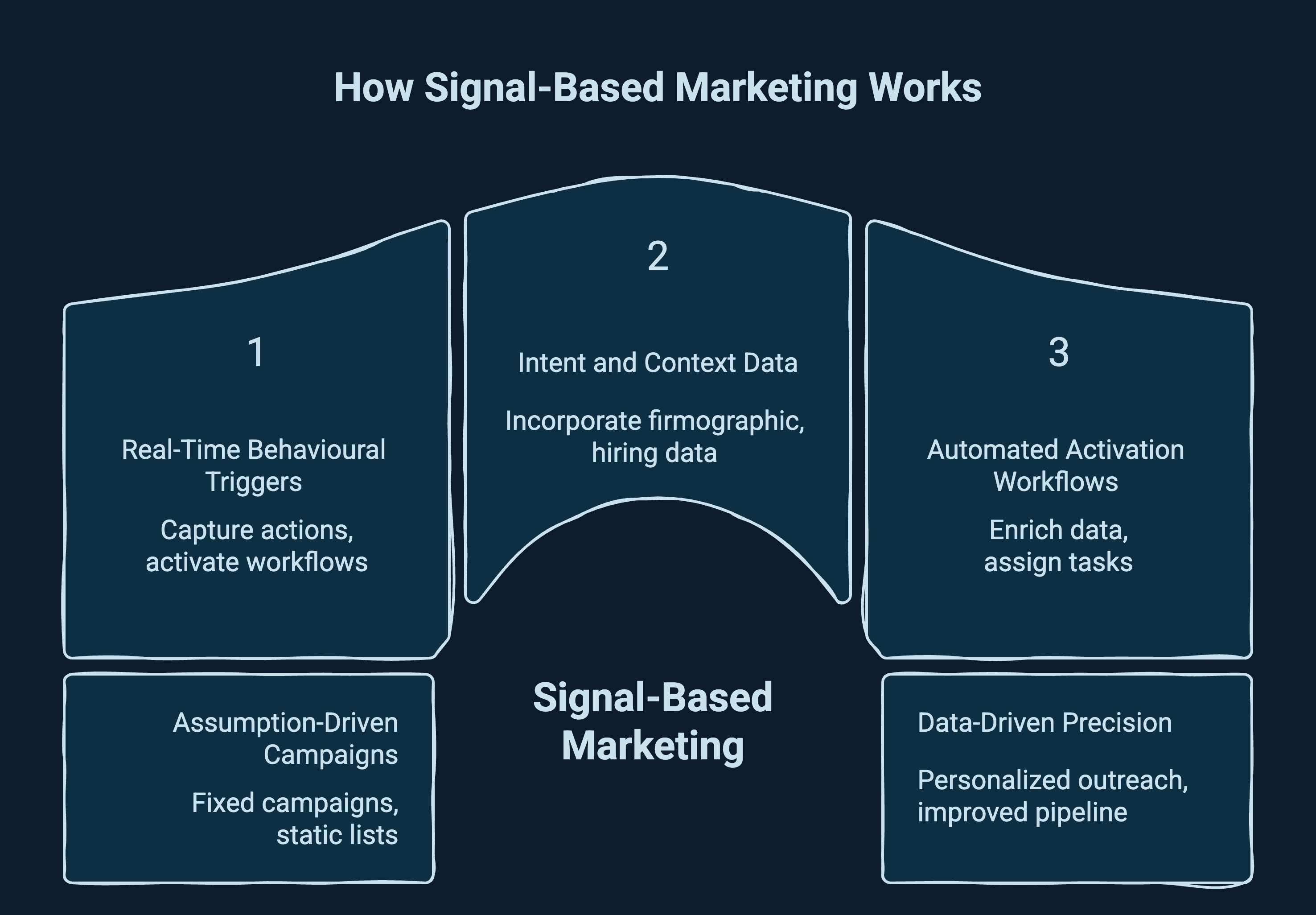
Signal-based marketing is a go-to-market strategy that triggers marketing and sales actions using real-time behavioral, intent, and contextual data. Instead of relying on fixed campaigns and static lists, it prioritizes timing, relevance, and automation to improve engagement, conversion rates, and pipeline efficiency.
To understand it properly, we must examine its foundational elements.
Signal-based marketing captures actions such as pricing page visits, repeat website sessions, demo requests, content downloads, and engagement spikes. When predefined thresholds are met, automated workflows activate personalized outreach or internal alerts, ensuring teams act when buyer interest is highest.
Beyond website activity, signal-driven systems incorporate firmographic updates, hiring activity, funding announcements, and technology changes. These contextual indicators strengthen qualification accuracy and reveal which accounts are entering active buying cycles.
Signals alone create no value unless activated. Automated workflows enrich contact data, assign sales tasks, trigger personalized email sequences, and update CRM records. Speed and consistency turn intent into measurable pipeline outcomes.
Signal-based marketing replaces assumption-driven campaigns with data-driven precision.
Is your sales process leaving revenue on the table? Explore how sales process optimization can increase profitability, improve conversion rates, and drive more consistent growth.
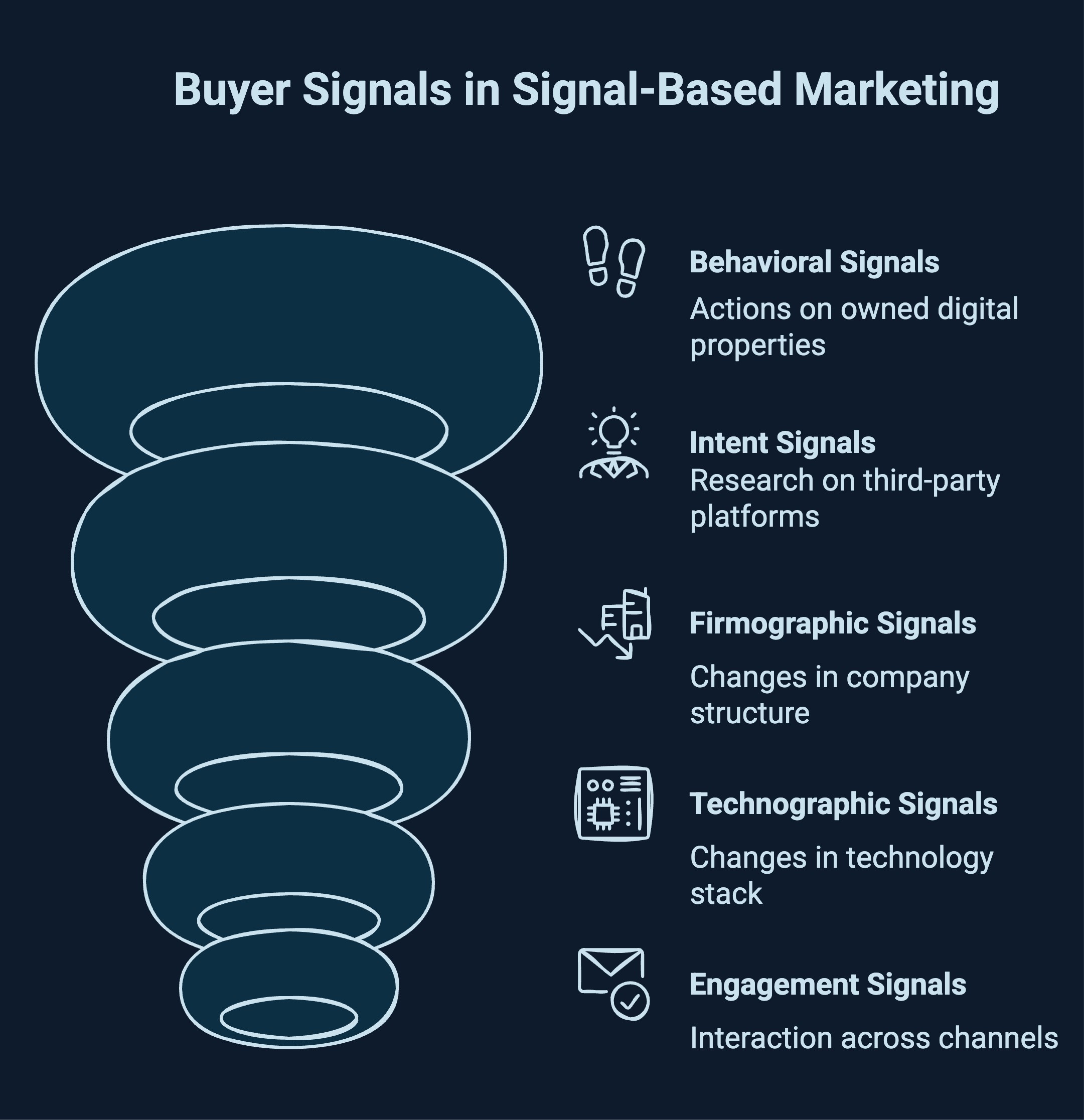
Buyer signals are measurable behavioral or contextual indicators that suggest a prospect or account may be entering an active buying cycle. In signal-based marketing, these signals trigger prioritization, enrichment, and outreach workflows designed to engage prospects at the right moment.
Understanding signal categories helps teams distinguish between passive interest and true purchase intent.
Behavioral signals are direct actions taken by a prospect on owned digital properties. These include pricing page visits, repeated website sessions, demo requests, content downloads, and high-value page engagement. Behavioral signals often indicate active evaluation and are among the strongest early indicators of buying readiness.
Intent signals capture research activity across third-party platforms, publisher networks, review sites, and content ecosystems. They reveal when companies are researching specific topics, competitors, or solution categories beyond your website. Intent signals help teams identify in-market accounts before they directly engage with your brand.
Firmographic signals relate to changes in company structure or status. Examples include funding announcements, rapid hiring, geographic expansion, mergers, or leadership changes. These events often signal budget availability, new strategic priorities, or operational shifts that may create buying opportunities.
Technographic signals track changes in a company’s technology stack. This includes adopting new software, replacing competitors, integrating complementary tools, or upgrading infrastructure. Technographic changes can indicate evaluation cycles, expansion opportunities, or replacement windows.
Engagement signals measure how consistently and deeply an account interacts with your brand across channels. Email clicks, webinar attendance, event participation, social engagement, and multi-touch content interactions signal growing interest and internal alignment within buying committees.
When unified and prioritized correctly, these buyer signals enable precision-driven marketing execution. Instead of relying on assumptions, teams activate outreach based on measurable, real-time buying behavior.
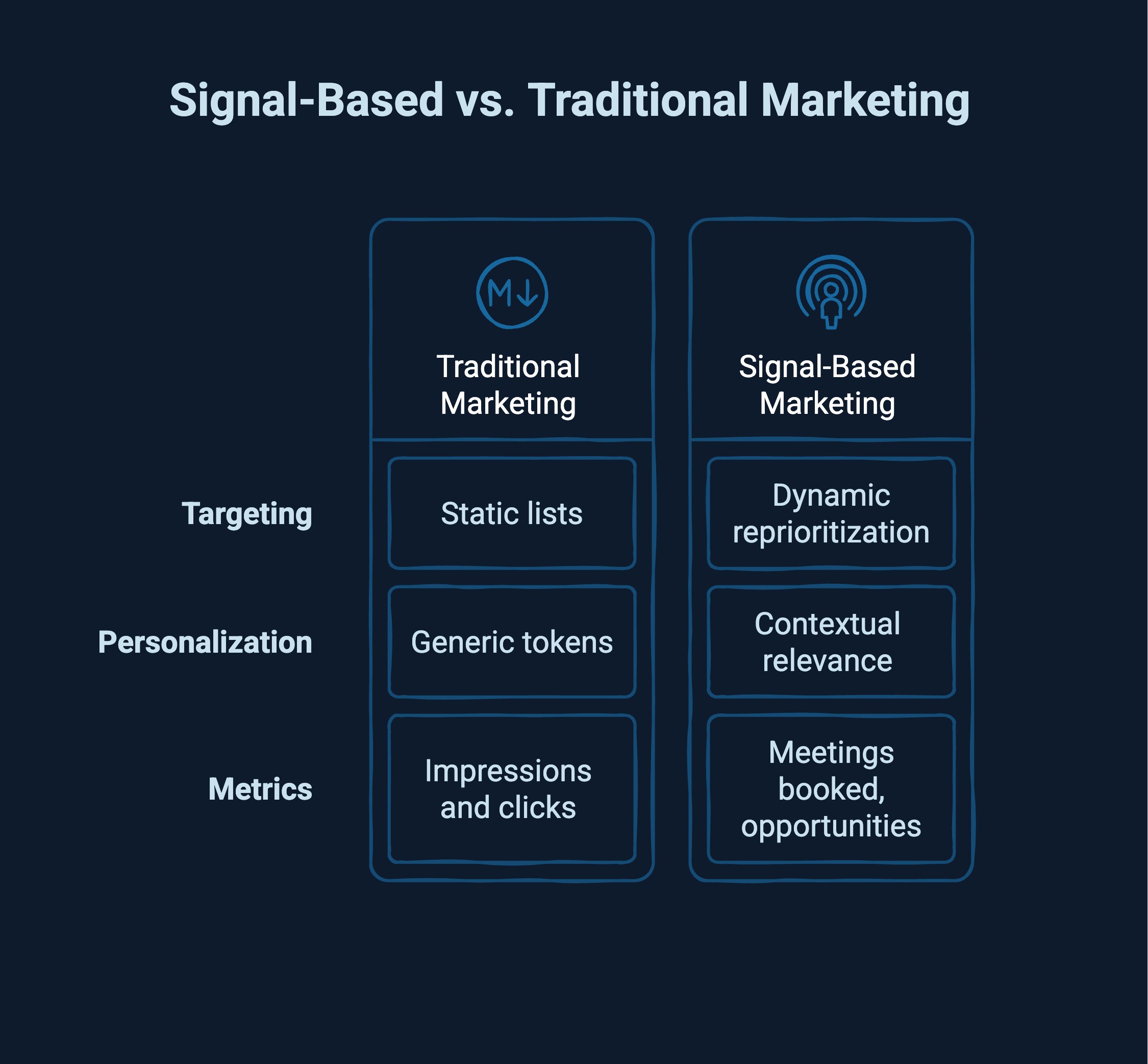
Traditional marketing depends on static segments, campaign calendars, and generalized messaging. Signal-based marketing responds dynamically to buyer behavior, activating outreach based on real engagement instead of arbitrary schedules. This shift transforms marketing from broadcasting messages to responding intelligently to buying intent.
The operational differences clarify why this model performs better.
Traditional strategies rely on predefined ICP lists that rarely change. Signal-based marketing continuously reprioritizes accounts according to live activity, ensuring sales and marketing focus only on prospects demonstrating genuine buying signals.
Instead of generic personalization tokens, messaging references specific actions such as recent feature page visits or webinar attendance. This contextual relevance increases trust and improves reply rates compared to broad campaign messaging.
Success is measured through meetings booked, qualified opportunities, and pipeline velocity rather than impressions and clicks. Because actions are triggered by intent, attribution becomes clearer and marketing performance ties directly to revenue growth.
This evolution aligns marketing output with sales outcomes.
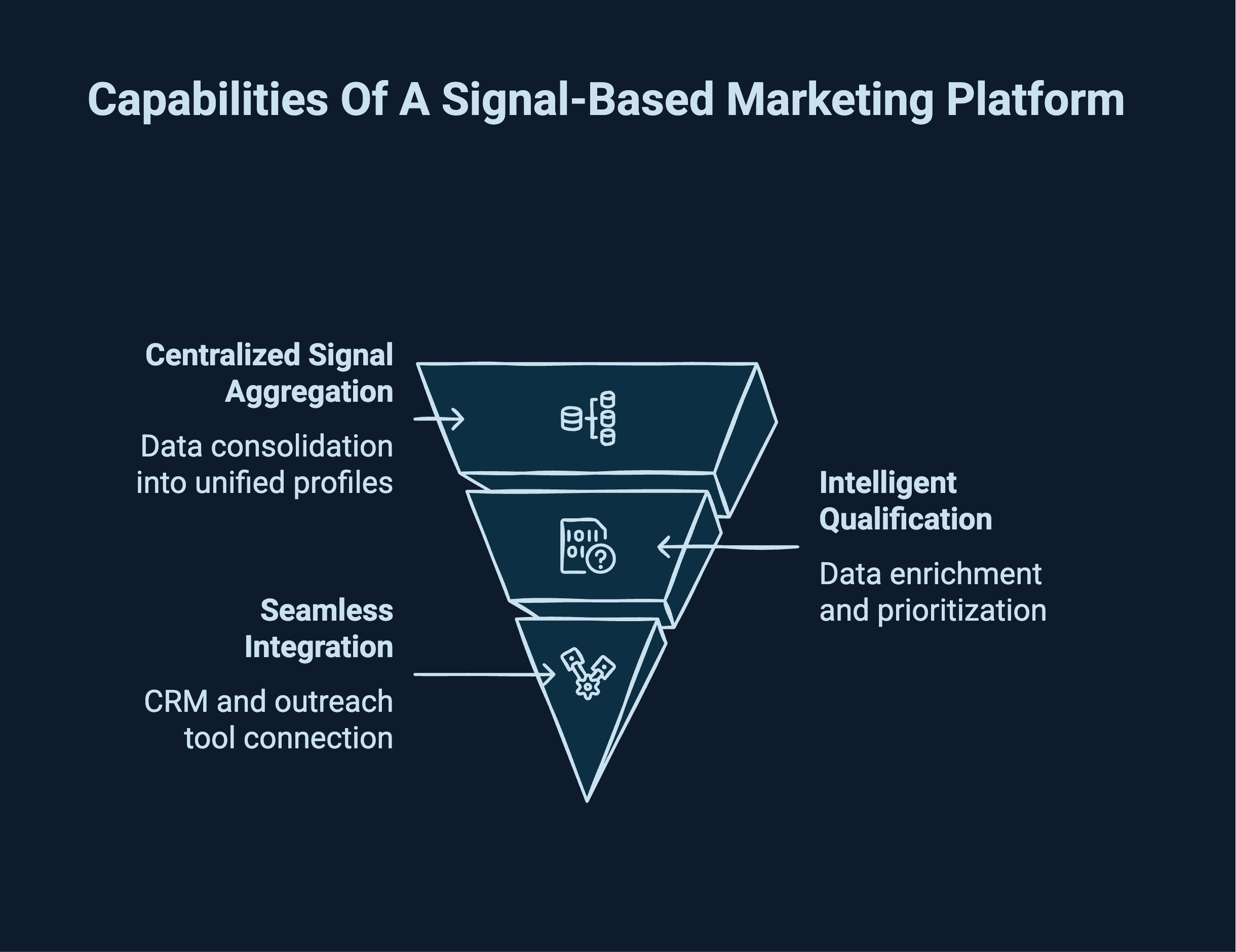
Signal-based marketing platforms are tools that collect and organize customer activity data in one place. They connect with your CRM and outreach tools to automatically trigger marketing and sales actions when someone shows real buying interest, helping teams respond faster and more effectively.
Understanding their capabilities highlights their operational impact.
Signal platforms consolidate website activity, third-party intent data, firmographic updates, and engagement metrics into unified account profiles. This centralization removes data silos, ensures consistent prioritization across teams, and creates a single source of truth for outbound decision-making.
Triggered accounts are automatically enriched with verified contact details, company intelligence, and prioritization scoring. This eliminates manual research delays and ensures sales teams receive fully actionable accounts prepared for immediate, informed engagement.
Integration with CRM and engagement systems such as HubSpot, Salesforce, and Pipedrive ensures signals update lifecycle stages, generate tasks, and trigger personalized sequences automatically, accelerating response time.
When properly integrated, these platforms become the engine powering scalable, signal-driven GTM execution.
Signal-based marketing relies on a connected technology stack that captures intent, enriches data, and activates workflows across marketing and sales systems. The following platform categories power effective signal-driven execution.
Customer relationship management systems serve as the operational backbone of signal-based marketing. Platforms like HubSpot and Salesforce centralize account data, track engagement history, manage lifecycle stages, and trigger automated workflows when intent signals are detected. When integrated properly, CRM systems ensure marketing and sales respond quickly to high-priority accounts.
Intent platforms identify accounts actively researching specific topics, categories, or solutions. Tools such as 6sense and ZoomInfo surface buying signals from third-party networks, publisher ecosystems, and behavioral data sources. These platforms help teams prioritize in-market accounts before competitors engage them.
Data orchestration platforms unify multiple signal sources, automate enrichment, and trigger outbound workflows. Clay enables teams to aggregate signals, enrich contacts, score accounts, and push structured data into CRM and outreach systems. This reduces manual research and improves activation speed.
Technology alone does not create predictable pipeline growth. GTM engineering partners like LeadGem design and implement signal-driven revenue systems that integrate CRM, intent data, enrichment workflows, and outbound automation into a unified structure. By aligning strategy with execution, LeadGem ensures signal-based marketing functions as a scalable revenue engine rather than a disconnected set of tools.
Learn how to master HubSpot sales enablement for efficiency and equip your team with the tools, content, and workflows they need to close faster
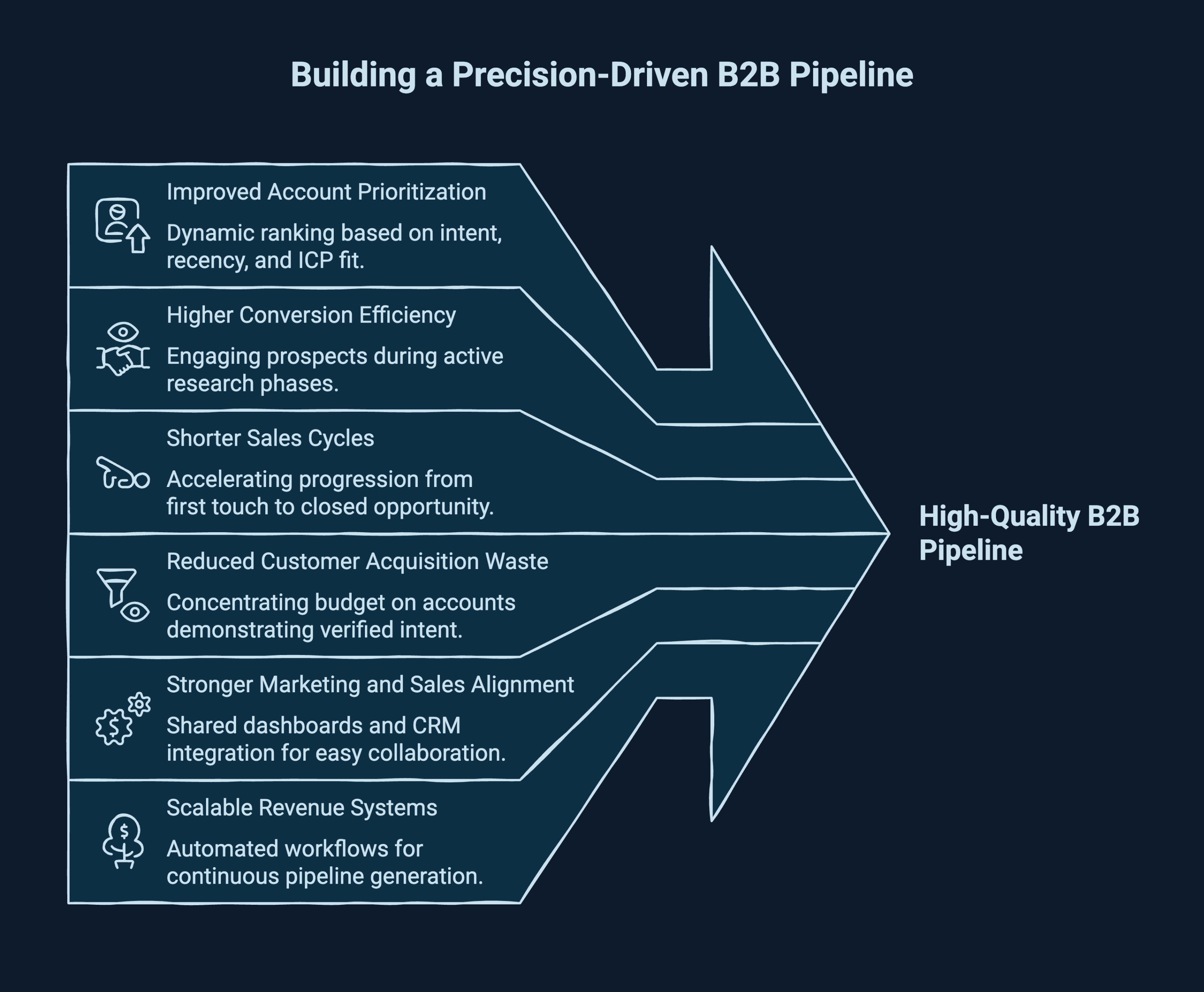
As buyer journeys grow more complex and attention spans shrink, static campaigns lose effectiveness. Signal-based marketing replaces assumption-driven targeting with real-time intent activation, enabling companies to engage prospects at the exact moment of interest. The result is stronger pipeline quality, better capital efficiency, and more predictable revenue growth.
Its impact is visible across core revenue metrics.
Signal-based marketing dynamically ranks accounts based on intent strength, recency, engagement depth, and ICP fit. Instead of treating all prospects equally, revenue teams focus on accounts actively researching solutions. This structured prioritization ensures outreach resources are directed toward the highest-probability opportunities first.
Engaging prospects during active research phases improves reply rates and meeting bookings. Because outreach reflects real behavioral signals, conversations begin with higher intent and clearer use cases. This increases the likelihood that meetings convert into qualified opportunities rather than exploratory discussions with low purchase probability.
Accounts already evaluating solutions move more quickly through early-stage conversations. Acting on real-time buyer signals allows teams to engage before competitors, influence buying criteria earlier, and accelerate progression from first touch to closed opportunity.
Signal-based marketing concentrates budget and outbound effort on accounts demonstrating verified intent. Instead of funding broad awareness campaigns with uncertain ROI, organizations allocate resources toward high-probability buyers, improving marketing efficiency and return on acquisition spend.
Shared signal dashboards, predefined activation rules, and CRM-integrated workflows align both teams around measurable buying behavior. Marketing generates signal-qualified opportunities while sales executes contextual outreach, reducing friction and improving accountability across revenue functions.
Automated signal detection, enrichment, and activation workflows create continuous pipeline generation without proportional headcount increases. When fully integrated, signal-based marketing becomes a repeatable growth infrastructure rather than a campaign-level tactic.
Signal-based marketing is not just a performance optimization strategy. It represents a structural shift toward precision-driven, revenue-aligned B2B growth.
If your organization is ready to transition from static campaigns to real-time revenue execution, building a signal-driven system with a GTM engineering partner like LeadGem is a logical next step.
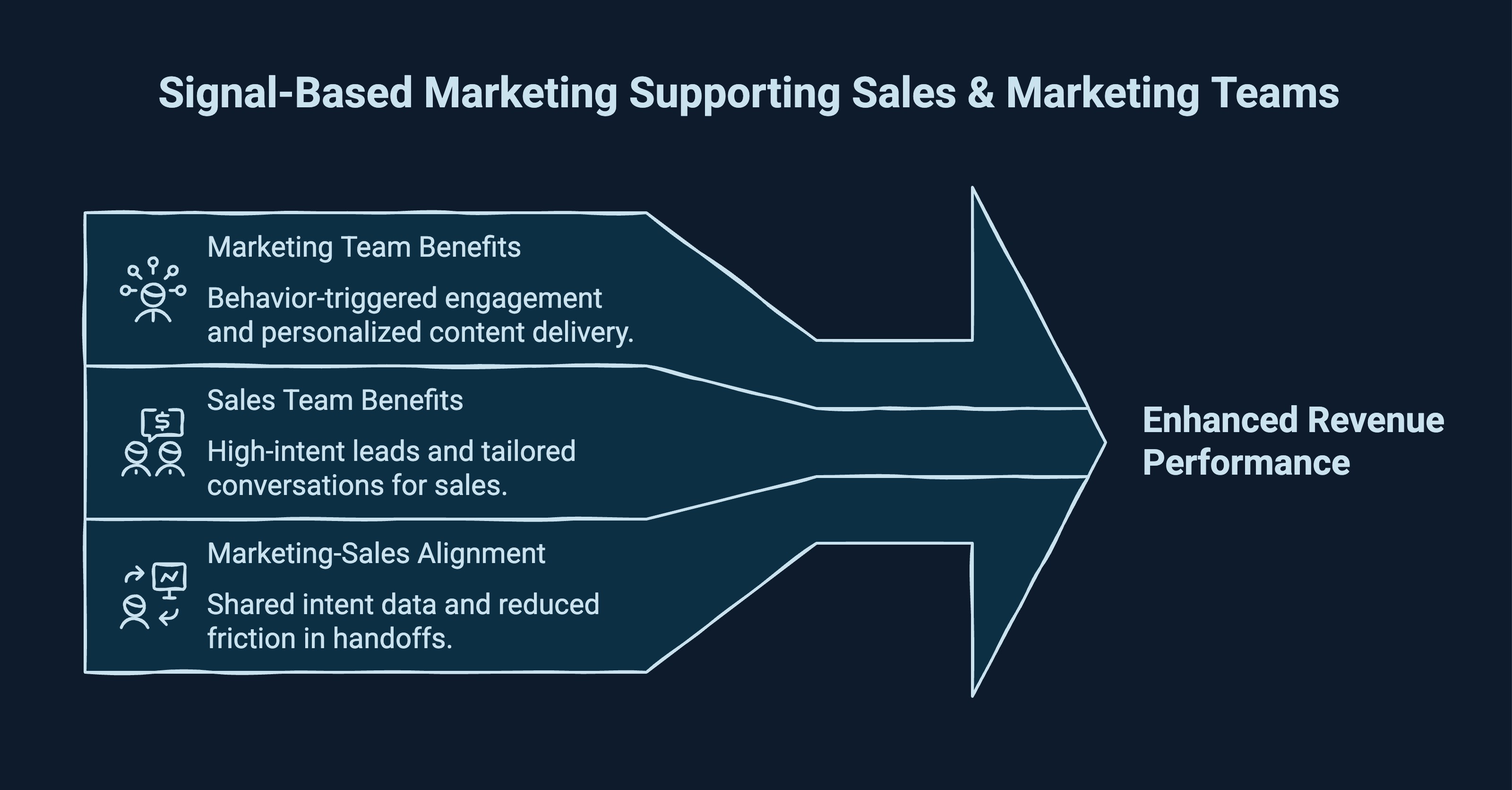
Signal-based marketing aligns both marketing and sales around real-time buyer behavior rather than static campaigns or cold outreach. By capturing intent signals and activating coordinated workflows, teams improve relevance, efficiency, and overall pipeline performance.
Below is how it supports each function specifically.
Signal-based marketing enables marketing teams to move from scheduled broadcasts to behavior-triggered engagement. Campaigns become responsive, data-driven, and aligned with real buyer activity instead of broad assumptions.
Key advantages for marketing include:
This approach ensures marketing connects with prospects at meaningful decision points.
Signal-based marketing strengthens sales performance by warming leads before outreach begins. Instead of relying on cold prospecting, sales teams engage accounts that have already demonstrated measurable interest.
Key advantages for sales include:
By focusing on in-market accounts, sales teams increase efficiency and accelerate pipeline growth.
Signal-based marketing aligns marketing and sales around shared, real-time intent data. Instead of operating in silos, both teams act on the same signals, ensuring outreach is coordinated, timely, and relevant.
Key advantages for revenue alignment include:
By enabling both teams to operate from the same data and priorities, signal-based marketing improves coordination, accelerates response time, and increases conversion efficiency.
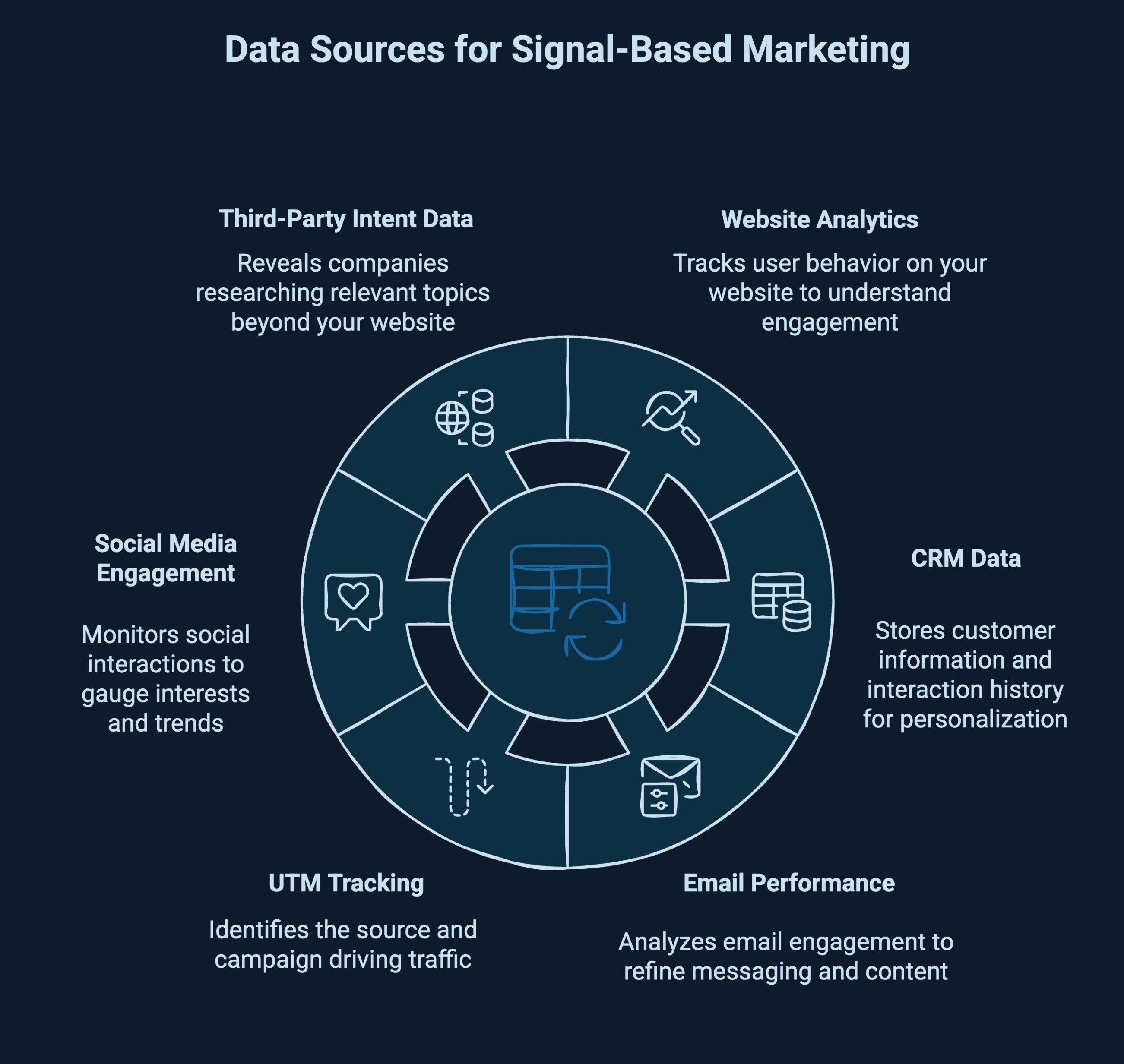
Signal-based marketing depends on diverse data streams that reveal how prospects research, engage, and make decisions. By combining behavioral analytics, campaign tracking, and customer records, organizations can detect intent signals and activate highly targeted marketing actions.
Below are 6 foundational data sources that power signal-driven strategies.
Website analytics tools capture behavioral indicators such as page views, click-through rates, bounce rates, and time spent on specific pages. These metrics reveal which topics, solutions, or offers resonate most and help identify when a visitor is moving from casual browsing to active evaluation.
Customer relationship management systems store valuable information, including demographic details, interaction history, opportunity stages, and past purchases. Analyzing this data uncovers patterns among high-value customers and enables more personalized follow-up based on prior engagement and buying behavior.
Email platforms provide insights into open rates, click-through rates, and conversion activity. Monitoring these interactions highlights which messaging themes drive engagement, while A/B testing refines subject lines, calls-to-action, and content formats for improved performance.
UTM parameters embedded in URLs track the exact source, campaign, and medium driving traffic. This attribution data helps marketers understand which channels generate meaningful engagement and which campaigns influence high-intent interactions.
Social engagement metrics such as clicks, comments, shares, and profile interactions provide additional behavioral context. While often secondary to first-party data, these signals help identify interests, preferences, and emerging engagement trends across target accounts.
Third-party intent platforms collect aggregated research behavior across publisher networks, review sites, and content ecosystems. These platforms identify companies researching relevant topics beyond your website, revealing in-market accounts earlier in their buying journey.
When integrated with CRM and automation systems, third-party intent data strengthens prioritization accuracy and enables proactive outreach before competitors engage.
Together, these data sources create a comprehensive foundation for accurate signal detection and precision-driven marketing activation.
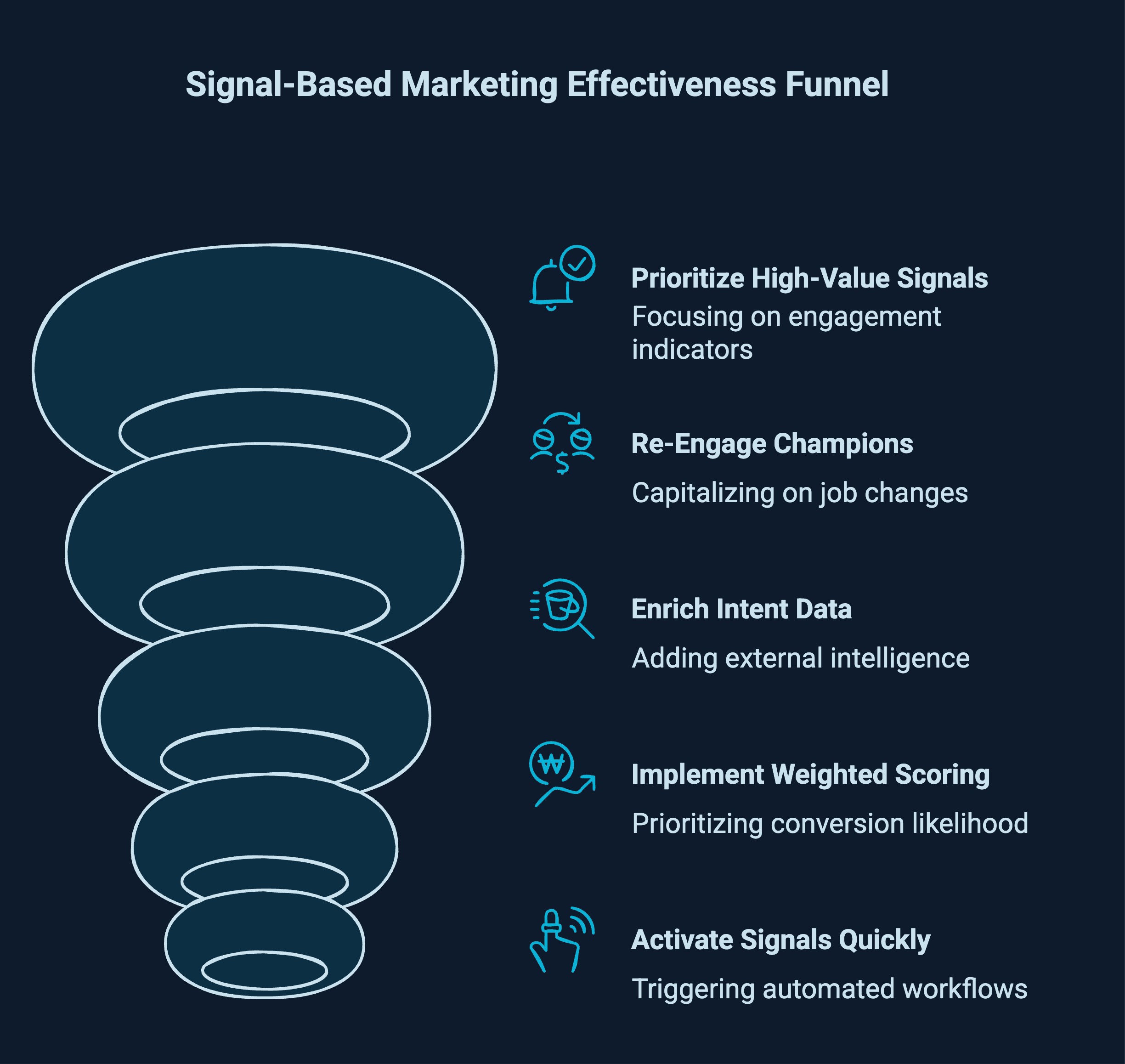
Launching a signal-based marketing strategy requires more than collecting intent data. Success depends on prioritizing meaningful signals, responding quickly, and translating insights into timely, personalized action that drives pipeline growth and higher conversion rates.
The following best practices help maximize impact.
Tracking signals alone is insufficient without understanding behavioral context. Teams must interpret whether the activity reflects casual interest or serious evaluation, then respond with messaging aligned to the prospect’s likely pain points and buying stage.
Focus on engagement indicators such as:
Responding quickly to strong engagement signals ensures outreach feels timely and relevant rather than reactive.
Former advocates who transition to new roles create high-value expansion opportunities. When a previous customer champion joins another company, they bring product familiarity and internal influence that significantly lowers entry barriers.
To capitalize on this signal:
Platforms like LinkedIn Sales Navigator help automate job-change tracking and alert teams in real time.
First-party data is powerful, but external monitoring tools add deeper context. Web crawlers gather insights from public sources, helping teams identify emerging initiatives, technology shifts, or strategic changes within target accounts.
Web crawlers can uncover:
By combining internal engagement data with external intelligence, teams act on comprehensive, real-time insights rather than assumptions.
Not all signals indicate equal buying intent. Structured scoring ensures teams focus on accounts most likely to convert instead of reacting to every engagement spike.
Effective scoring models should:
Weighted prioritization improves focus, reduces noise, and strengthens overall pipeline quality.
Intent signals rapidly lose value if response time is delayed. Clear automation rules ensure high-priority accounts move into action immediately.
Strong activation systems should:
Fast, structured activation transforms buyer intent into a measurable pipeline instead of a missed opportunity.

While signal-based marketing improves targeting precision and timing, implementation often presents operational and strategic hurdles. Teams frequently face issues related to data volume, system fragmentation, slow activation, and unclear ROI measurement.
Below are the most common challenges and how to address them effectively.
Many organizations collect large volumes of behavioral and intent data but lack clear criteria for determining which signals truly indicate buying readiness. This creates confusion, reduces focus, and leads to inconsistent outreach decisions that dilute overall marketing effectiveness.
How to overcome it:
Signals often remain trapped within separate platforms such as analytics tools, marketing automation systems, and CRM environments. Without seamless integration and shared visibility, valuable intent insights fail to reach revenue teams in time for meaningful engagement.
How to overcome it:
Intent signals rapidly lose value if outreach is delayed. When teams lack automated alerts or defined ownership, competitors may engage first, reducing the likelihood of influencing buying decisions or securing high-quality meetings.
How to overcome it:
Some teams struggle to connect signal activity directly to revenue impact, making it difficult to justify investment. Without structured tracking, signal-based marketing can appear experimental rather than a measurable driver of predictable pipeline growth.
How to overcome it:
Addressing these challenges systematically enables organizations to unlock the full potential of signal-driven marketing execution.
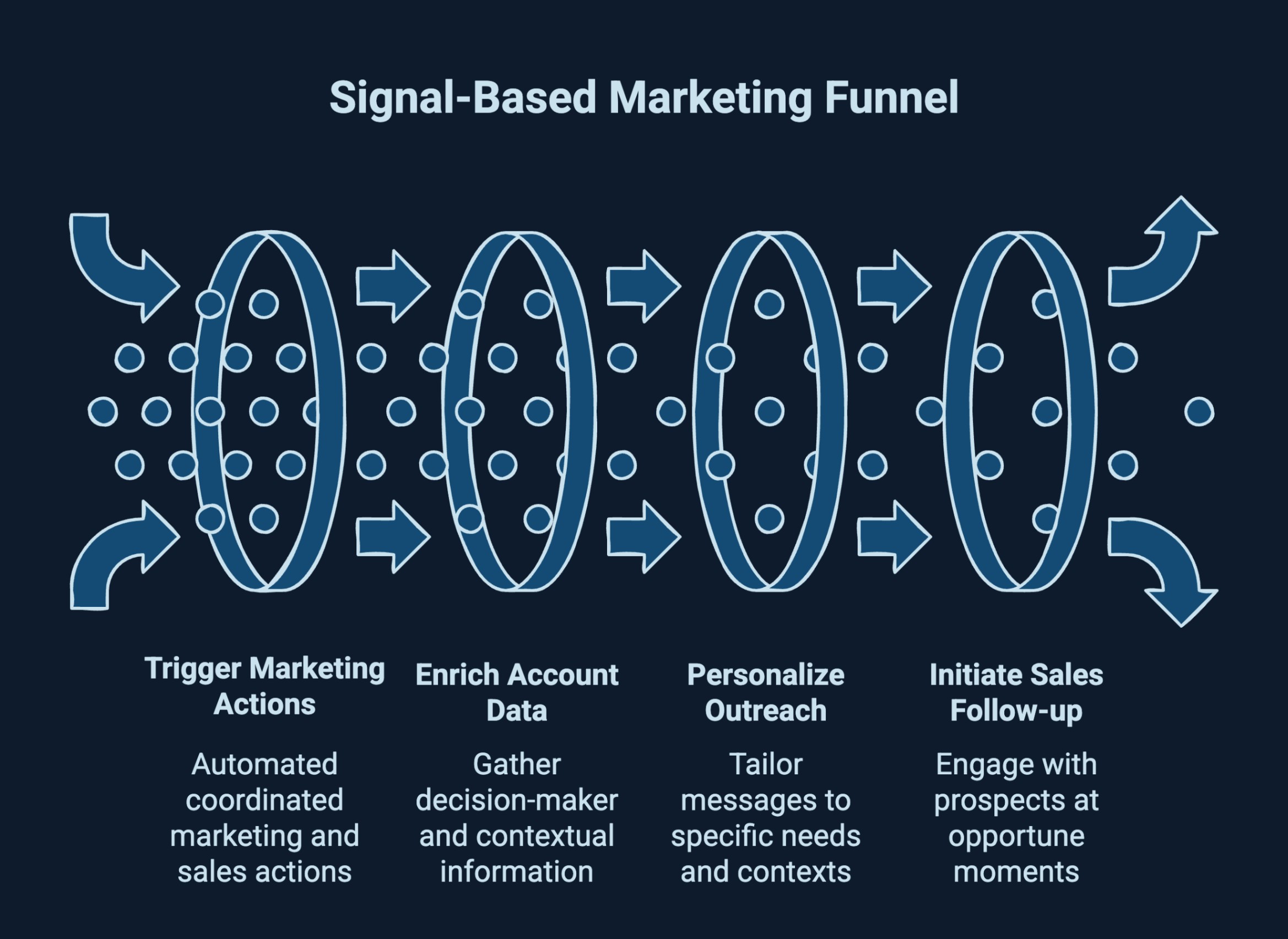
Signal-based marketing becomes powerful when real-time behavioral or contextual triggers automatically activate coordinated marketing and sales actions. Below are practical examples of how intent signals translate into pipeline movement.
When a target account repeatedly visits a pricing or comparison page, it often signals active evaluation. A structured workflow can automatically notify the assigned sales representative, enrich the account with decision-maker data, and trigger personalized outreach referencing relevant use cases. Acting quickly during this evaluation window increases meeting conversion probability.
When a former customer champion or qualified prospect moves to a new company, it creates a warm entry opportunity. Automated job-change tracking can trigger a personalized outbound campaign congratulating the contact and reintroducing the solution in the context of their new responsibilities. This leverages prior familiarity and significantly reduces cold outreach friction.
If several stakeholders from the same company engage with key product or solution pages within a short timeframe, it often indicates internal buying discussions. This signal can automatically launch an account-based marketing campaign that includes targeted ads, personalized email sequences, and sales follow-up aligned to the specific pages visited.
A newly announced funding round often signals growth initiatives, hiring expansion, or technology investment. Monitoring funding events enables marketing and sales teams to initiate expansion-focused outreach positioned around scaling, efficiency, or new strategic priorities. Early engagement during post-funding momentum increases the likelihood of entering active buying conversations.
LeadGem is a B2B growth and revenue operations agency headquartered in Amsterdam, the Netherlands, with over 5 years of experience in growth marketing and growth hacking. As a Clay-certified GTM engineering partner, LeadGem helps B2B companies replace static campaigns with structured, signal-driven marketing systems that activate real buyer intent in real time.
By integrating signal detection, data enrichment, CRM automation, and outbound activation into a unified revenue workflow, LeadGem transforms fragmented intent data into prioritized, actionable pipeline opportunities.
The team supports clients across Benelux, the Nordics, America, and Australia, building precision-driven marketing engines designed to improve conversion rates, shorten sales cycles, and create predictable pipeline growth.
If you’re ready to transition from static campaigns to real-time revenue execution, our team can help. Contact us today to design and implement a signal-driven system tailored to your growth goals.
Signal-based marketing fundamentally shifts B2B growth from assumption-driven campaigns to intent-driven execution. By combining real-time behavioral data, contextual signals, and automated activation, organizations engage buyers at the right moment with relevant messaging.
This precision improves conversion rates, shortens sales cycles, and aligns marketing with measurable revenue outcomes. Companies that operationalize signal-driven systems gain a sustainable competitive advantage, transforming advertising from broad outreach into a scalable, predictable pipeline engine built around real buyer intent.
Signal-based marketing typically relies on intent data platforms, CRM systems, enrichment tools, and automation software. Popular options include HubSpot, Salesforce, Clay, LinkedIn Sales Navigator, 6sense, and ZoomInfo. The ideal stack integrates signal detection, enrichment, scoring, and automated activation workflows seamlessly.
Yes. Signal-based marketing focuses on capturing and activating buyer intent through campaigns, automation, and content workflows. Signal-based selling applies those same insights directly to sales outreach and conversations, converting qualified signals into meetings, opportunities, and closed revenue.
The 3-3-3 rule in marketing typically structures messaging into three primary benefits, three supporting proof points, and three clear calls-to-action. This framework improves clarity, reinforces value quickly, and increases engagement by simplifying complex offers for decision-makers.
Signal-based targeting prioritizes accounts using real-time behavioral and contextual intent data rather than static segmentation. Outreach dynamically adjusts toward prospects demonstrating measurable buying signals, improving timing, personalization, campaign efficiency, and overall conversion performance.
Buying signals are behavioral or contextual indicators suggesting purchase intent. Examples include pricing page visits, demo requests, funding announcements, hiring trends, repeated website engagement, and content downloads. These signals help teams identify in-market accounts and prioritize timely outreach.
In 2026, best practices include prioritizing high-intent signals, integrating CRM and automation systems, responding in real time, enriching accounts before outreach, aligning marketing and sales workflows, and measuring signal-to-revenue conversion metrics for continuous performance optimization.