

Contact


Most modern buyers want control over their research process. In fact, 61% of B2B buyers prefer a rep-free buying experience.
Yet many outreach programs still rely on static lists and fixed cadences, ignoring real buying behavior. The result is poor timing, low reply rates, and wasted SDR effort. The issue is not a lack of data. It is failing to operationalize outreach intent signals inside CRM, enrichment, and workflow systems.
In this guide, you will learn how to use intent signals for outreach in a structured way: how to capture signals, analyze them, connect platforms for intent-based B2B lead signals outreach, and trigger timely engagement that converts intent into pipeline.
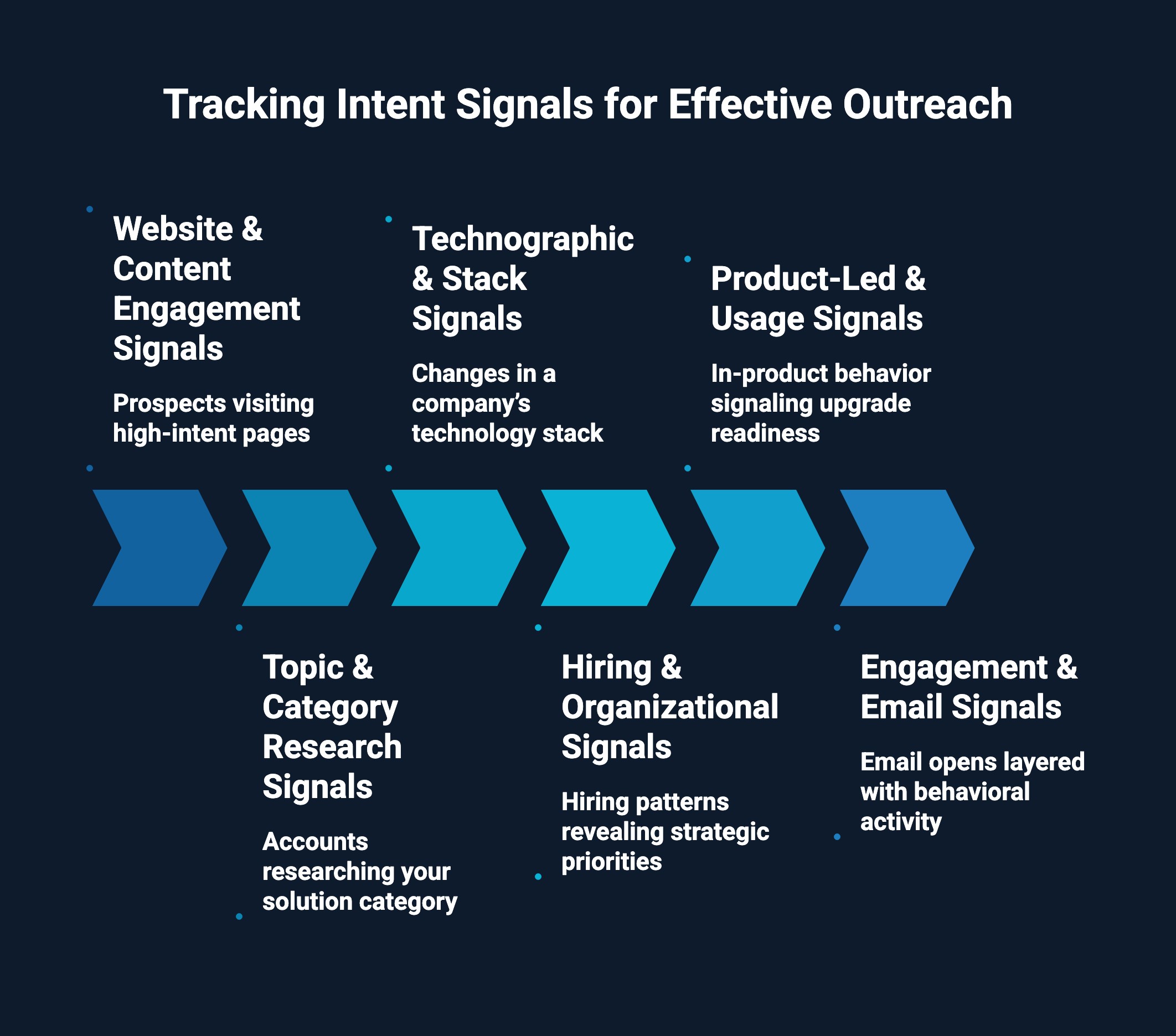
Not all signals indicate buying readiness. Strong outreach intent signals analysis focuses on identifying behaviors that correlate with real commercial intent, not just passive engagement.
Below are the key categories explained clearly and concisely.
When prospects repeatedly visit high-intent pages such as pricing, integrations, or comparison content, they are likely evaluating vendors. A single blog visit may indicate awareness, but multiple sessions within a short timeframe suggest active research.
Examples:
Recency + frequency significantly increase signal strength.
These signals show accounts researching your solution category outside your website. Spikes in keyword consumption, competitor comparisons, or review activity indicate early buying interest.
Examples:
These help identify in-market accounts before they engage directly with your brand.
Changes in a company’s technology stack often signal evaluation or transition. Adopting complementary tools or replacing competitor software may indicate readiness to explore additional solutions.
Examples:
Stack changes frequently precede vendor conversations.
Hiring patterns reveal strategic priorities. If a company recruits roles related to your solution area, it often means they’re building capability and potentially allocating budget.
Examples:
Leadership and team expansion often trigger new vendor evaluations.
For product-led teams, in-product behavior is a powerful buying indicator. Behavioral intensity often signals upgrade readiness.
Examples:
These signals are highly actionable for outreach timing.
Email opens alone are weak predictors. However, when layered with stronger behavioral activity, they reinforce intent confidence.
Examples:
These signals should support stronger behavioral indicators rather than drive outreach independently.
Looking to move from strategy to execution? Discover our complete RevOps implementation guide to build a scalable revenue engine that aligns marketing, sales, and operations.
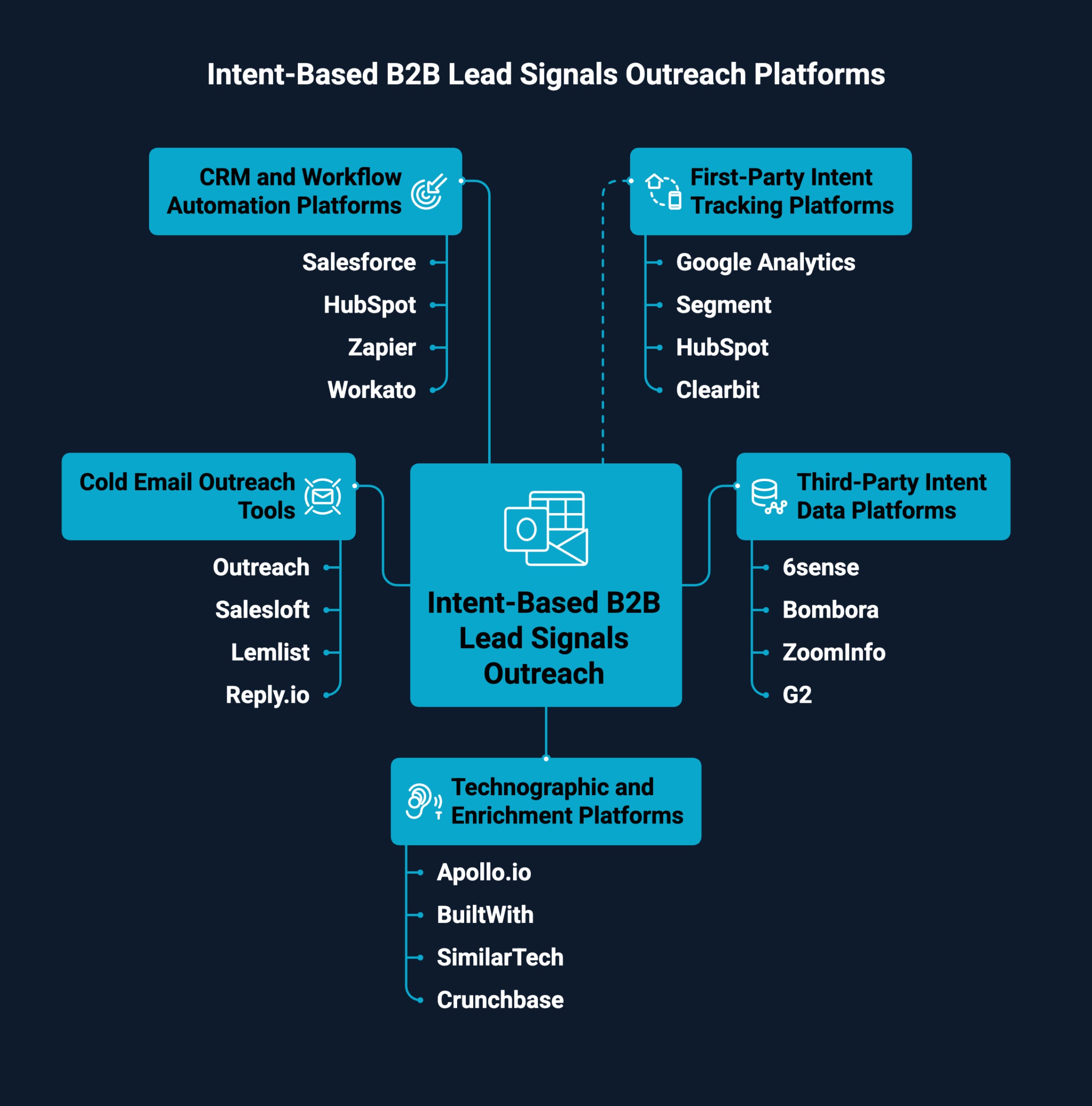
Operationalizing outreach intent signals requires a connected stack. High-performing teams do not rely on a single tool. They combine signal capture, enrichment, automation, and execution platforms to build a system that turns buying behavior into structured outreach workflows.
Below are the core platform categories and representative tools in each layer.
These tools capture behavioral signals from your owned properties, such as your website and product.
These platforms provide the strongest signals because they reflect direct brand interaction. However, they only capture accounts already engaging with you.
These platforms detect buying research happening outside your website.
These tools help identify in-market accounts earlier in the buying cycle, making them critical for proactive outreach.
Intent signals become actionable only when enriched with qualification data.
Enrichment ensures that high-intent accounts align with your ICP before triggering outreach workflows.
Execution platforms activate signals into engagement.
These tools improve the use of intent signals for outreach timing by activating sequences when signal thresholds are met rather than relying on fixed cadences.
Your CRM is the operational core of intent-driven outreach.
Without CRM integration, outreach intent signals remain fragmented across tools. When properly structured, they trigger scoring updates, routing rules, enrichment flows, and automated outreach sequences.
Want to automate your revenue engine? Check out our RevOps automation guide to streamline processes, eliminate bottlenecks, and scale predictable growth.
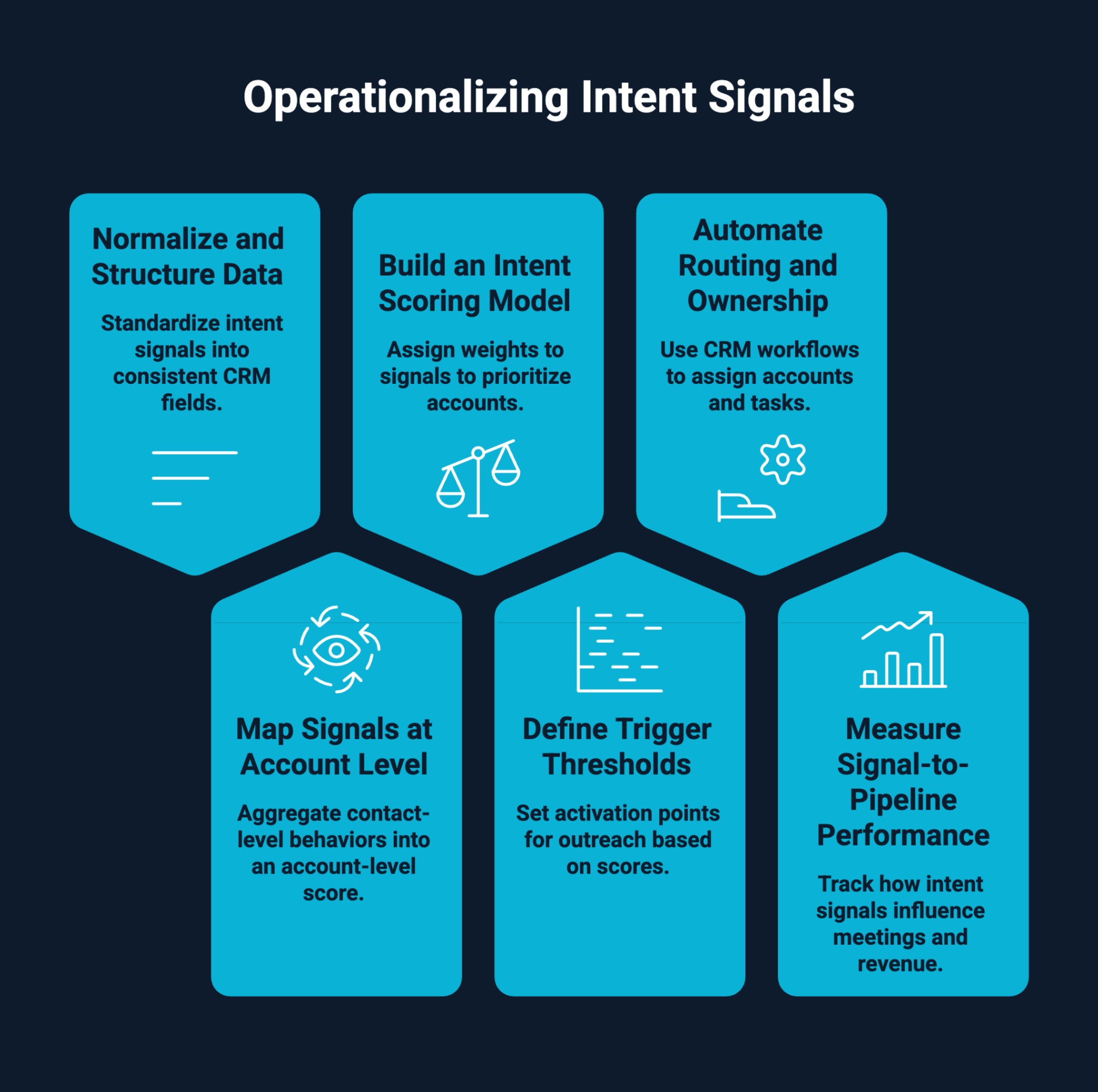
Capturing intent data is not enough. The real advantage comes from structuring, scoring, and activating it inside your CRM so it drives measurable outreach outcomes. Below is a concise breakdown of the operational steps.
Intent signals come from multiple tools and in different formats. To make them actionable, standardize them into consistent CRM fields such as signal type, source, strength, and recency. Structured data enables reliable outreach intent signals analysis and prevents fragmented reporting.
Buying decisions are typically made by groups, not individuals. Aggregate contact-level behaviors into an account-level score so multiple signals from the same company increase prioritization. This prevents duplicate outreach and improves coordination across sales teams.
Scoring helps prioritize which accounts deserve immediate attention. Assign higher weight to strong signals such as pricing visits or product usage spikes, while lower-intent actions receive minimal impact. Include recency and ICP fit to ensure relevance.
Once scoring is in place, define clear activation points. When an account crosses a specific score or signal combination threshold, automatically trigger outreach. This improves using intent signals for outreach timing instead of relying on fixed cadences.
Signals should immediately translate into action. Use CRM workflows to assign accounts to the right reps, enroll contacts into sequences, or create follow-up tasks. Automation ensures speed, which directly impacts conversion rates.
Track how intent signals influence meetings, opportunities, and revenue. Monitor conversion rates from signal to first touch and from signal to opportunity. Continuous measurement allows refinement of your scoring and activation logic over time.
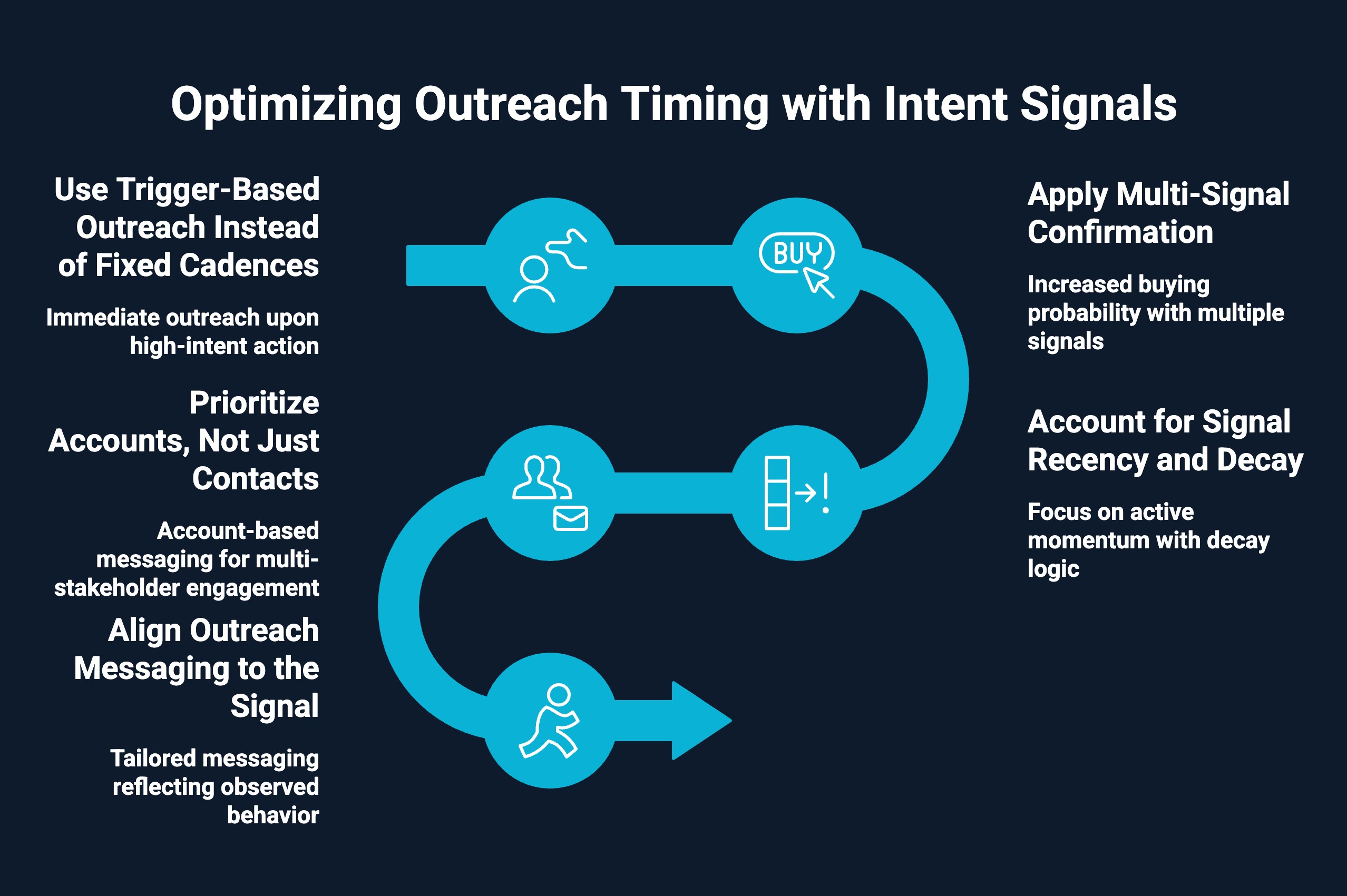
Capturing and scoring signals is only effective if outreach happens at the right moment. Timing determines whether intent converts into conversations or disappears into inactivity.
Below is how to use outreach intent signals to engage buyers when momentum is strongest:
Traditional outbound relies on preset sequences that run regardless of buyer behavior. Intent-driven outreach replaces this with trigger logic. When an account crosses a scoring threshold or shows a high-intent action such as repeated pricing visits, outreach begins immediately.
Example Outreach (Pricing Page Trigger):
Subject: Quick question about your evaluation
Hi [Name],
I noticed your team has been reviewing our pricing and integrations pages recently. Happy to walk you through how companies similar to yours structure their rollout and ROI expectations.
Would a 15-minute overview this week be helpful?
One signal rarely guarantees readiness. But when multiple signals occur close together, like a third-party topic surge + website return visit + ICP match, buying probability increases significantly.
Example Outreach (Multi-Signal Trigger):
Subject: Exploring revenue automation options?
Hi [Name],
We’ve seen increased interest from your team around revenue automation topics and competitor comparisons.
Many teams at your stage evaluate consolidation opportunities to reduce manual reporting and improve forecast accuracy.
Worth sharing what that typically looks like?
Intent is time-sensitive. A pricing visit yesterday matters more than one two months ago. Decay logic keeps SDR focus on active momentum.
Example Outreach (Recent Spike Trigger):
Subject: Timing seems right
Hi [Name],
Looks like your team has been actively researching [category] over the past few days.
If you’re currently evaluating solutions, I can share how similar companies shortened implementation time by 30%.
Open to a quick conversation?
When multiple stakeholders engage within a short window, outreach should shift to account-based messaging rather than single-threaded outreach.
Example Outreach (Multi-Stakeholder Activity):
Subject: Aligning across your team
Hi [Name],
I’ve noticed interest from a few members of your RevOps and Sales team around pipeline visibility.
Typically, when multiple stakeholders engage simultaneously, it signals active internal discussions.
Would it make sense to schedule a short working session with the group?
Messaging should reflect observed behavior. Competitor research = differentiation. Category research = education. Stack change = integration value.
Example Outreach (Competitor Comparison Signal):
Subject: Comparing options?
Hi [Name],
Many teams evaluating [Competitor] ultimately prioritize deeper forecasting visibility and cleaner CRM automation.
If you’re comparing vendors, I’m happy to outline the practical differences we see most often.
Example Outreach (Hiring Signal):
Subject: Supporting your new RevOps hire
Hi [Name],
Congrats on hiring a Revenue Operations Manager.
Many teams invest in infrastructure during this phase to support scalable reporting and automation.
Would it help to share a few proven implementation frameworks?
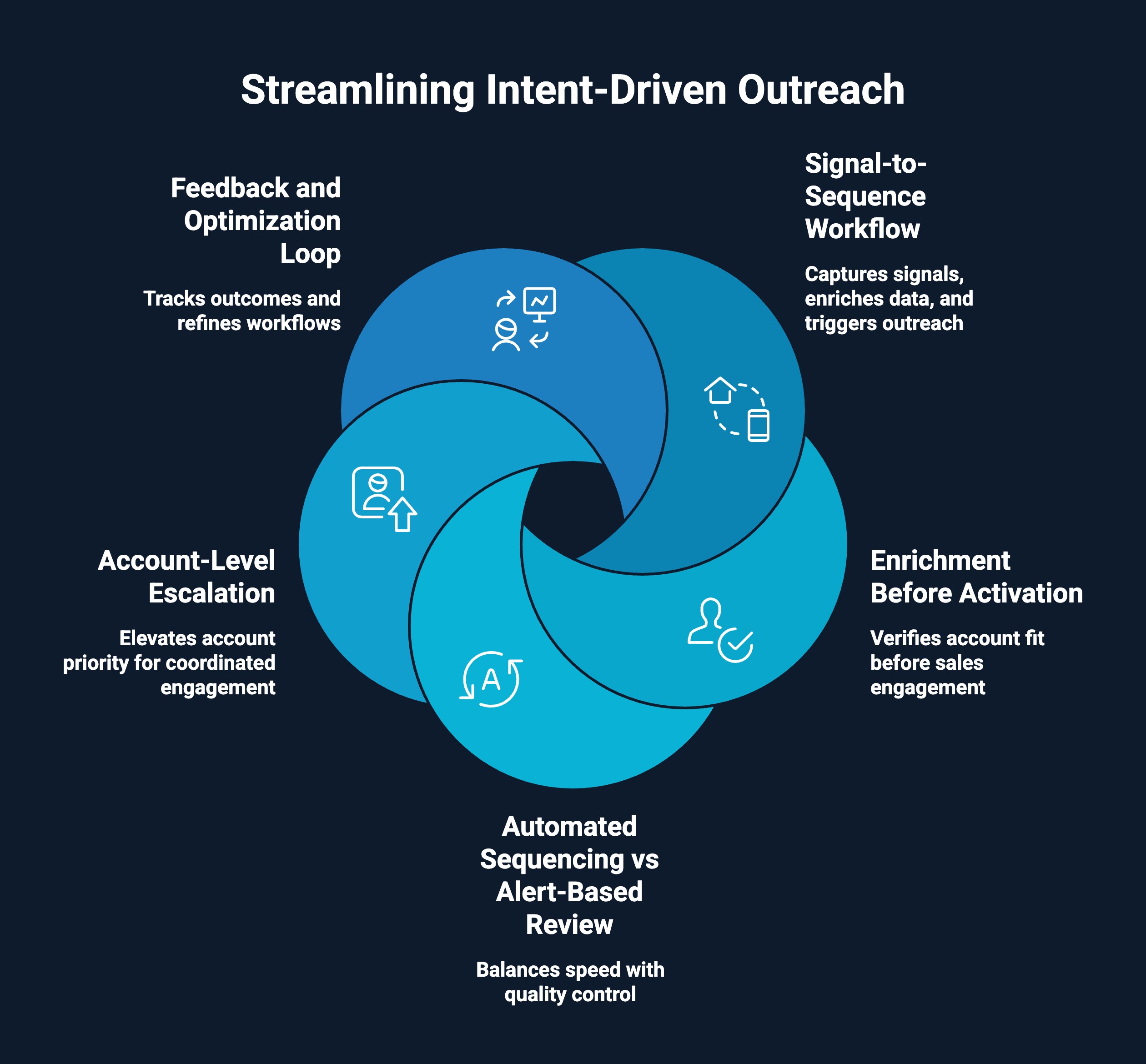
Intent data becomes powerful only when it flows automatically from signal capture to enrichment, scoring, and outreach. Manual handling slows response time and weakens conversion. Below is how to structure automated workflows that turn outreach intent signals into scalable execution.
An effective workflow starts when a signal is captured. The system enriches the account, validates ICP fit, updates the intent score, and then triggers outreach if predefined thresholds are met. This ensures signals immediately translate into engagement rather than sitting idle in dashboards.
Intent alone does not confirm qualification. Automation should first verify firmographics, technographics, or account size before assigning the record to sales. If the account does not match ICP criteria, it can be routed into a nurture track instead of direct outbound.
High-confidence signals, such as multiple high-intent page visits within a short timeframe, can trigger automatic sequence enrollment. Medium-confidence signals may generate alerts for SDR review. This hybrid model balances speed with quality control.
When multiple contacts from the same account show activity, workflows should elevate account priority and notify the assigned rep. Instead of single-threaded outreach, the system can initiate coordinated engagement across stakeholders.
Every workflow should track outcomes such as meetings booked and opportunities created. If certain signal combinations consistently convert, increase their scoring weight. If some signals rarely lead to the pipeline, reduce their influence. Continuous refinement strengthens outreach intent signals analysis over time.
Automated workflows create consistency, speed, and scalability. When properly structured, they ensure intent signals move directly from behavioral insight to measurable pipeline impact.
Looking for expert support to accelerate growth? See our guide on choosing the best go-to-market agency to amplify your revenue impact.
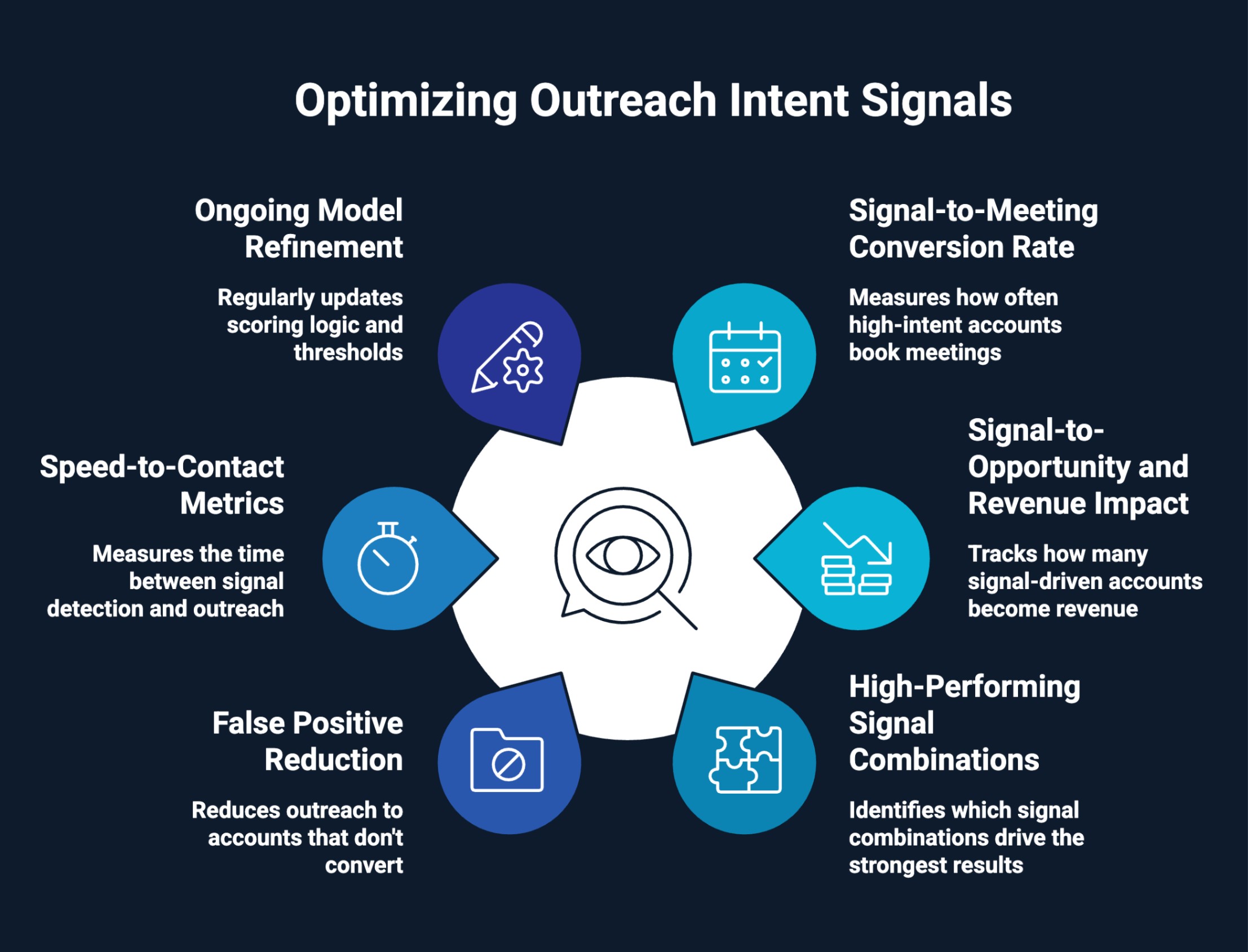
Capturing and activating signals is only part of the system. Long-term performance depends on continuous analysis of intent signals. Without measurement and refinement, even well-designed workflows lose efficiency over time.
Track how often high-intent accounts convert into booked meetings. This metric reveals whether your scoring thresholds and timing logic are accurate. If signal volume is high but meeting rates are low, your activation criteria may be too loose.
Go beyond meetings. Measure how many signal-driven accounts convert into qualified opportunities and closed revenue. This shows which signals correlate with actual buying behavior rather than surface-level engagement.
Individual signals rarely tell the full story. Analyze which combinations drive the strongest results. For example, third-party topic surge plus pricing page revisit plus ICP match may outperform single-signal triggers. Adjust your scoring model based on these findings.
If certain signals frequently trigger outreach but rarely convert, reduce their weighting or require confirmation from additional behaviors. This prevents SDR fatigue and improves overall prioritization quality.
Measure the time between signal detection and first outreach. Faster engagement often increases conversion rates. If delays are long, revisit workflow automation and routing logic.
Intent-based outreach is not static. Buying behavior evolves. Regularly audit your scoring logic, decay windows, and activation thresholds. Continuous optimization ensures your intent-driven system remains predictive and aligned with revenue outcomes.
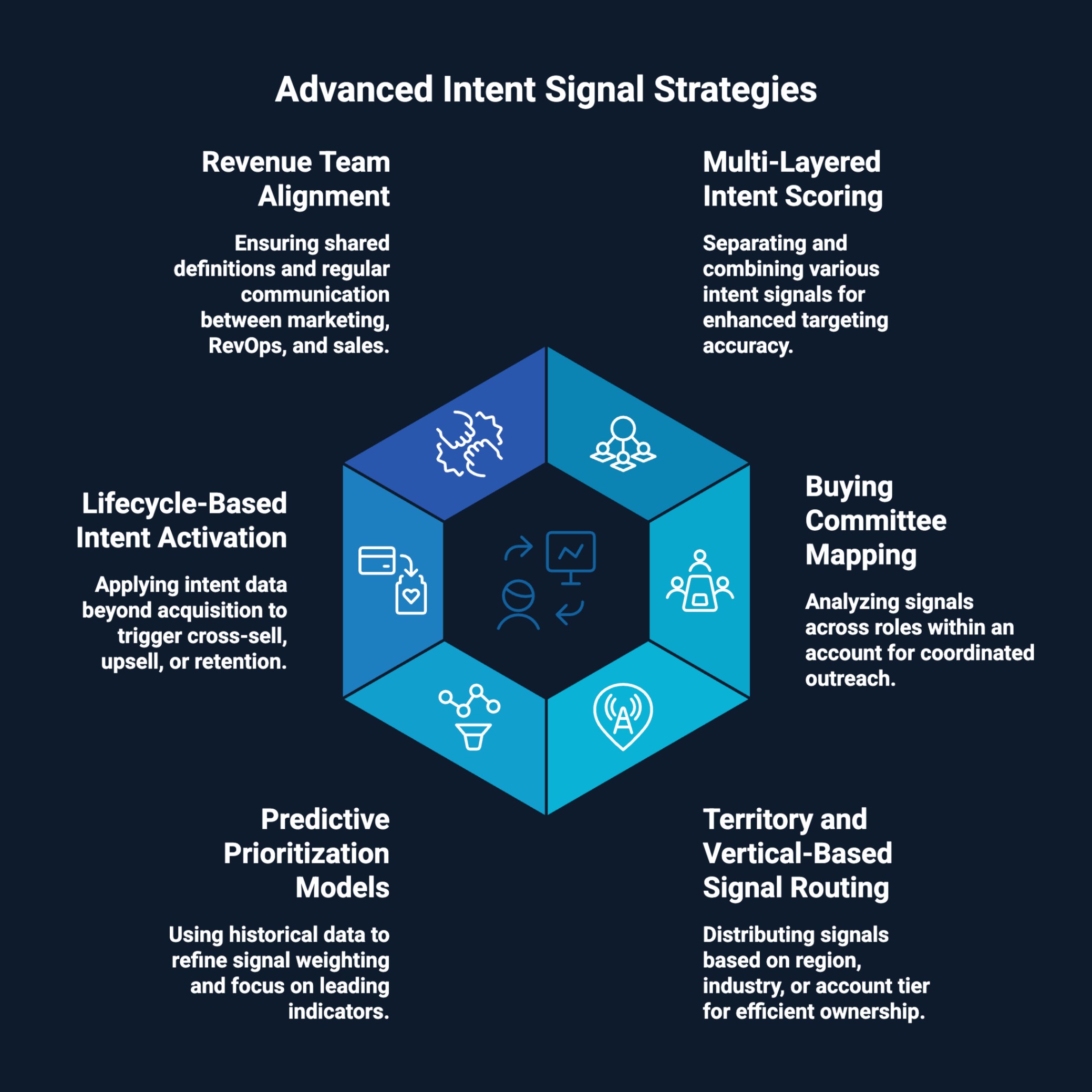
Once foundational workflows are running, mature go-to-market teams move beyond basic trigger-based outreach. The focus shifts to precision, predictive modeling, and revenue alignment across the full lifecycle.
Advanced teams separate behavioral intent, ICP fit, buying stage probability, and engagement depth into distinct scoring layers. These are combined into a composite priority score that improves targeting accuracy and reduces reliance on a single signal type.
Instead of tracking isolated contacts, mature teams analyze signals across roles within the same account. When engagement spans decision-makers, influencers, and users, outreach becomes coordinated and account-based rather than single-threaded.
Signals are automatically distributed based on region, industry, or account tier. This ensures fast ownership assignment, eliminates overlap, and maintains clear accountability across sales teams.
Historical conversion data is used to refine signal weighting. By analyzing which signal patterns led to closed revenue, teams continuously improve their prioritization logic and focus on leading indicators of the pipeline.
Intent data is applied beyond net-new acquisition. Product usage spikes, expansion behaviors, or re-engagement signals can trigger cross-sell, upsell, or retention workflows.
Mature execution requires shared definitions of signal strength, qualification thresholds, and activation rules. Regular alignment between marketing, RevOps, and sales ensures that the intent model reflects actual pipeline outcomes.
Curious how to power intelligent workflows? Check out our guide on the Clay sales tool and unlock smarter data automation for your outreach.
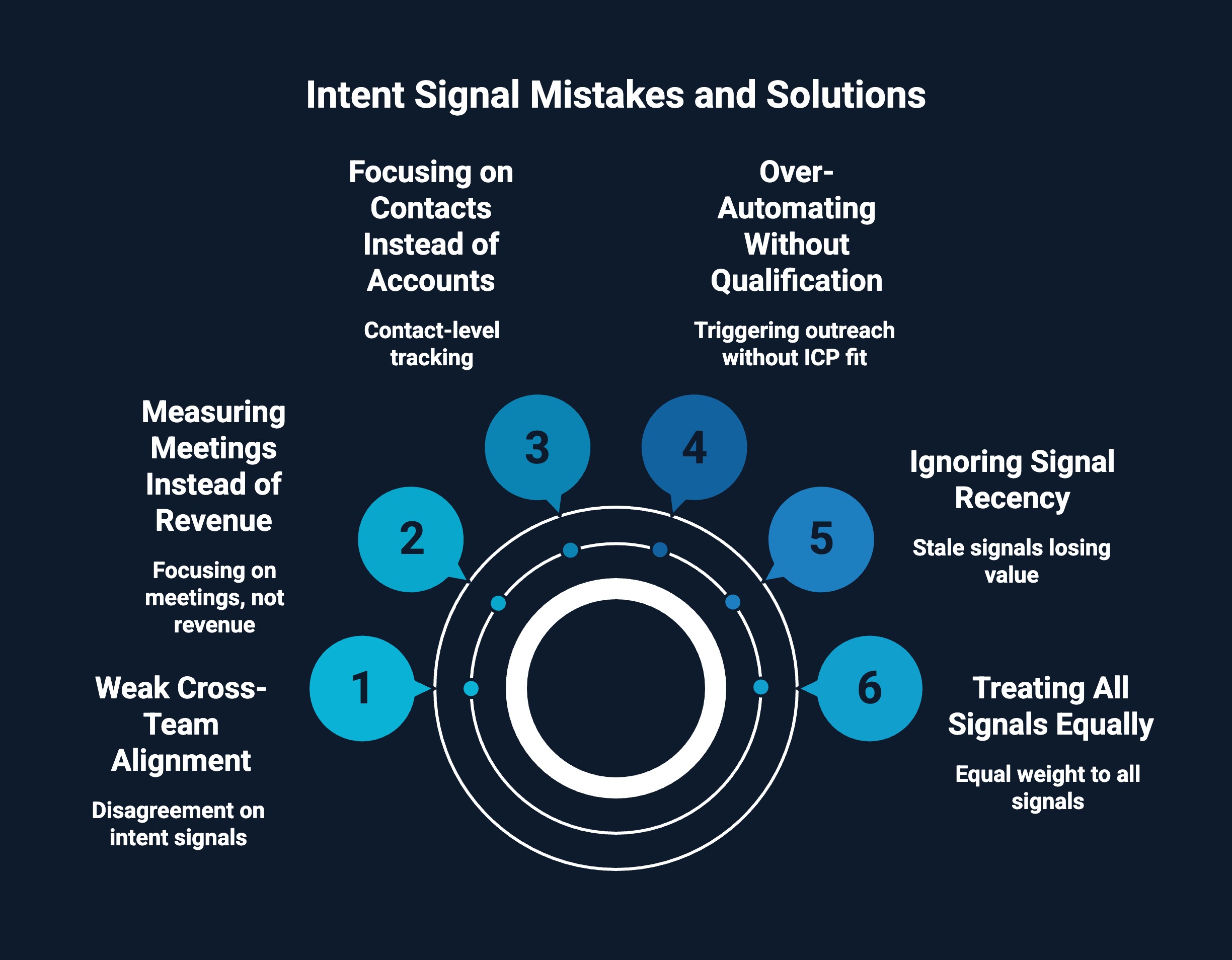
Intent data improves outreach only when structured correctly. Most failures happen because teams activate signals without prioritization, qualification, or measurement discipline. Below are the key mistakes and how to address them.
Not all engagement indicates buying intent. If blog visits and pricing page revisits carry the same weight, scores inflate, and SDR focus weakens.
Segment signals into tiers based on commercial strength. Assign a heavier weight to high-intent behaviors such as repeated pricing visits, integration views, or competitor research. Rebalance weights using opportunity and revenue data.
Intent fades quickly. Older signals lose predictive value, yet many models continue prioritizing stale activity.
Add decay logic so signal influence decreases over time. Align decay windows with your average sales cycle to keep outreach focused on active buying windows.
Triggering outreach based solely on intent spikes can waste effort if the account does not match your ICP.
Insert enrichment checks before activation. Validate company size, industry, and fit criteria. Only accounts meeting both intent and ICP thresholds should enter outbound sequences.
B2B decisions involve multiple stakeholders. Contact-level tracking alone leads to fragmented, inconsistent outreach.
Aggregate signals at the account level and escalate priority when multiple contacts engage. Shift to coordinated account-based outreach when buying committee activity increases.
Meeting volume does not equal pipeline quality. Without linking signals to opportunity creation and revenue, scoring models remain assumptions.
Track signal-to-opportunity and signal-to-revenue conversion rates. Adjust scoring weights based on which signal combinations actually drive closed deals.
If marketing and sales disagree on what qualifies as strong intent, reps will ignore triggered assignments.
Define shared signal categories, activation thresholds, and routing rules. Review performance regularly to maintain trust in the model.
Intent-driven outreach works when prioritization, timing, qualification, and revenue measurement operate together. Crisp structure ensures signals convert into a predictable pipeline rather than noise.
If you’re collecting intent data but struggling to translate it into a consistent pipeline, it’s time to move from experimentation to execution.
At LeadGem, we help B2B companies design and implement fully operational RevOps and outbound systems that connect intent signals, enrichment, CRM architecture, and automated outreach into one scalable growth engine.
With 5+ years of experience in B2B growth marketing and growth hacking, we understand that real results come from structured systems, not isolated tools. As a Clay-certified partner, we build advanced automation workflows, intelligent lead enrichment models, and trigger-based outreach frameworks that align sales engagement with real buying behavior.
Headquartered in Amsterdam, we support companies across Benelux, the Nordics, America, and Australia, helping teams replace manual prospecting and guesswork with data-driven prioritization and predictable pipeline generation.
If you’re ready to operationalize your intent signals and build a revenue system that scales, contact us today.
Intent signals are only valuable when operationalized.
Access to buying data is no longer the competitive edge. The advantage comes from how well you structure, score, route, and activate those signals inside your CRM and outreach workflows.
When aligned correctly, intent replaces guesswork with precision. SDRs focus on accounts that are actively researching. Marketing aligns with real demand. RevOps gains visibility into signal-to-revenue impact.
The question is not whether to use intent signals for outreach. It is whether your system is built to turn them into a predictable pipeline.
We combine buyer intent data, website activity, and CRM data with lead scoring aligned to our ideal customer profile. By tracking high-intent data points across the buyer’s journey, we prioritize target accounts showing real purchase intent in real time.
Buyer intent signals help marketing teams personalize marketing campaigns, trigger marketing automation tools, and deliver relevant content at the right time. They guide sales conversations, identify potential buyers, and move prospects to the next step in the buying journey.
High-intent website visits, demo request activity, free trial signups, email engagement, and tech stack changes consistently improve outreach. These buyer signals reveal specific needs and allow sales reps to reference pain points in real time.
Track high-intent website activity on a specific product, demo request behavior, free trial signups, LinkedIn post engagement, tech stack changes, and buyer intent data from data providers to prioritize target accounts showing real purchase intent.
Align buyer intent signals with your ideal customer profile and buyer’s journey. Focus on data points that consistently lead to sales conversations, such as website visits, email engagement, or demo requests tied to specific needs.
Engage first through relevant content and LinkedIn posts, reference pain points, then connect with personalized messaging. Use buyer signals and CRM data to time outreach when potential buyers show high intent activity.
Centralize buyer intent data in CRM, apply lead scoring, connect marketing automation tools, and trigger outreach in real time. Ensure marketing teams and sales reps align on high intent thresholds before activating marketing campaigns.