

Contact


Revenue growth doesn’t stall because teams aren’t working hard. It stalls because revenue execution is fragmented. As companies scale, marketing, sales, and customer teams operate with different metrics, systems, and definitions of success, creating blind spots across the revenue lifecycle.
This fragmentation makes forecasting unreliable, hides where deals actually break down, and weakens expansion and retention. Optimizing individual processes in isolation may improve efficiency, but it doesn’t restore alignment or end-to-end visibility.
The real decision isn’t Sales Ops versus RevOps. It’s how revenue is managed as a system. This guide explains when a sales-centric model is sufficient, when it breaks down, and how to choose the operating approach that delivers clearer insight, stronger alignment, and more predictable growth.
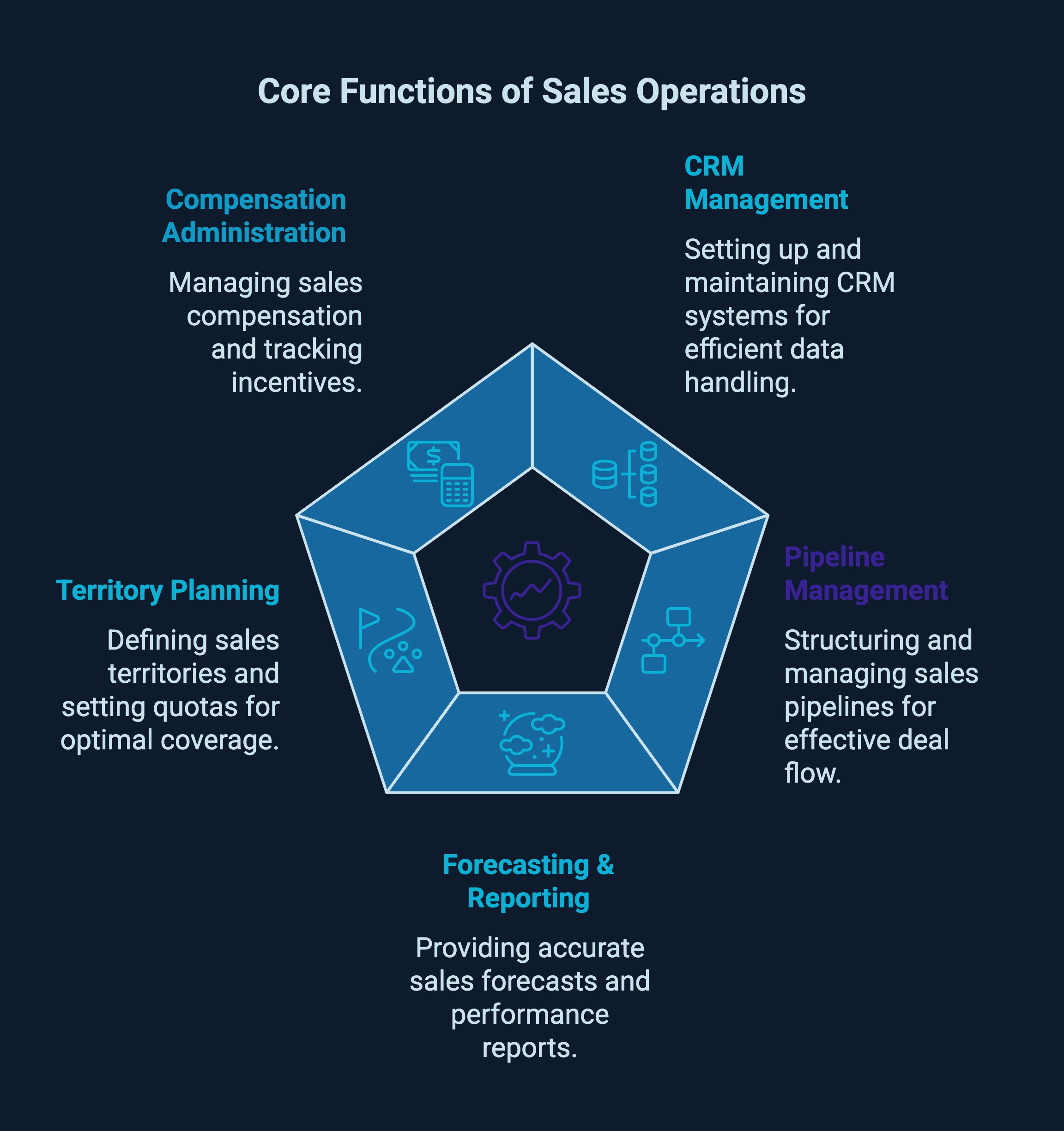
Sales Operations, often called Sales Ops, exists to make the sales team more productive and predictable. Its core purpose is to remove friction from the sales process so reps can focus on closing deals while leadership gets reliable performance visibility.
Sales Ops typically covers:
Sales Ops is execution focused and sales centric. It works best when sales is the dominant revenue driver and the go-to-market motion is relatively simple. As revenue grows more complex across marketing, customer success, and finance, Sales Ops alone often lacks the scope to address cross functional misalignment that impacts overall revenue performance.
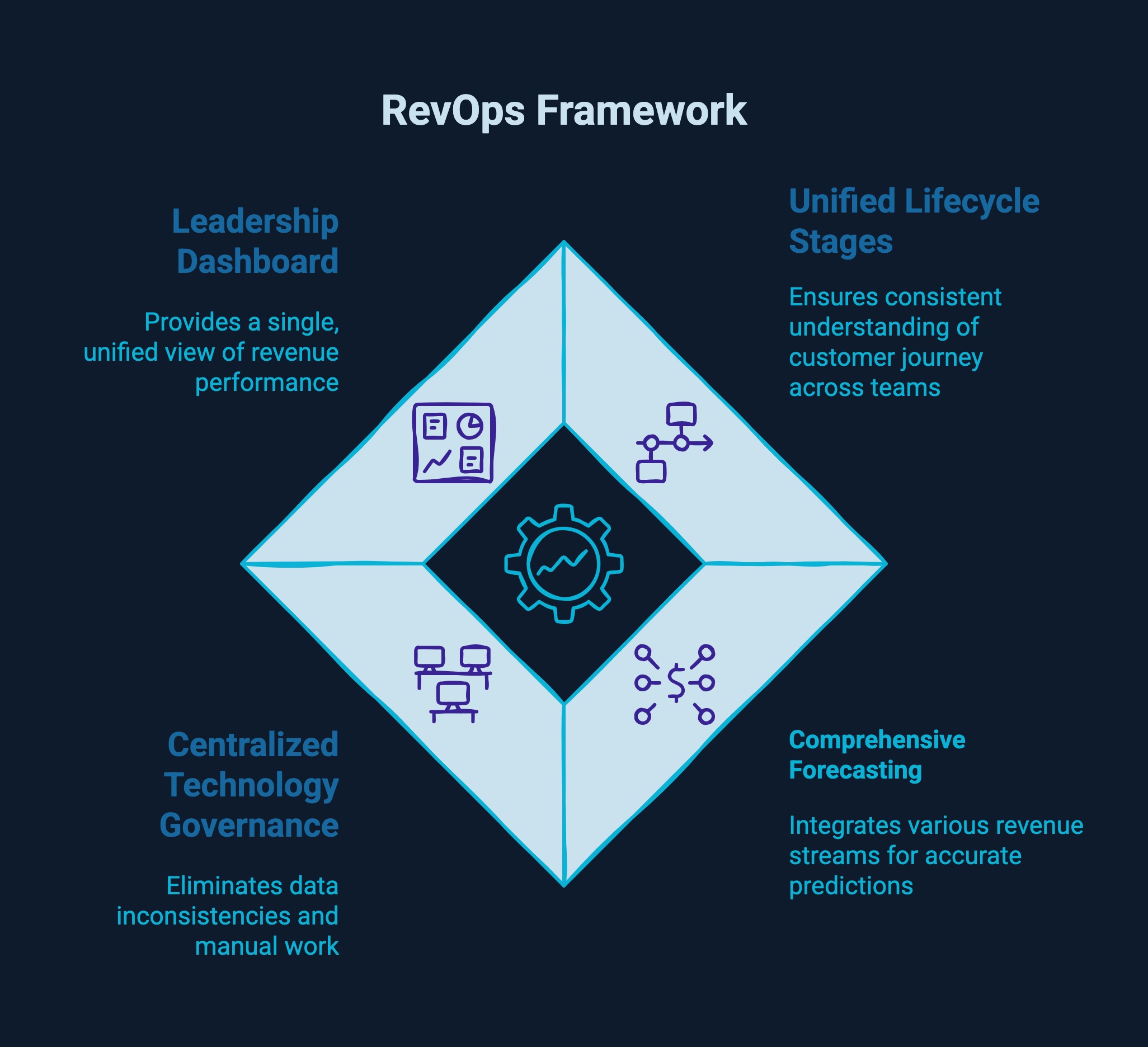
Revenue Operations, or RevOps, manages revenue as a connected system instead of a sales-only function. For example, when marketing hands off leads that sales does not trust, or customer success renews accounts without feeding data back into forecasts, revenue leaks occur. RevOps exists to close those gaps and enhance customer retention.
In practice, RevOps looks like this:
Sales Ops improves how sales executes. RevOps improves how the business grows. When revenue depends on multiple teams working in sequence, RevOps turns fragmented efforts into a coordinated revenue engine that scales predictably instead of relying on heroic sales performance.
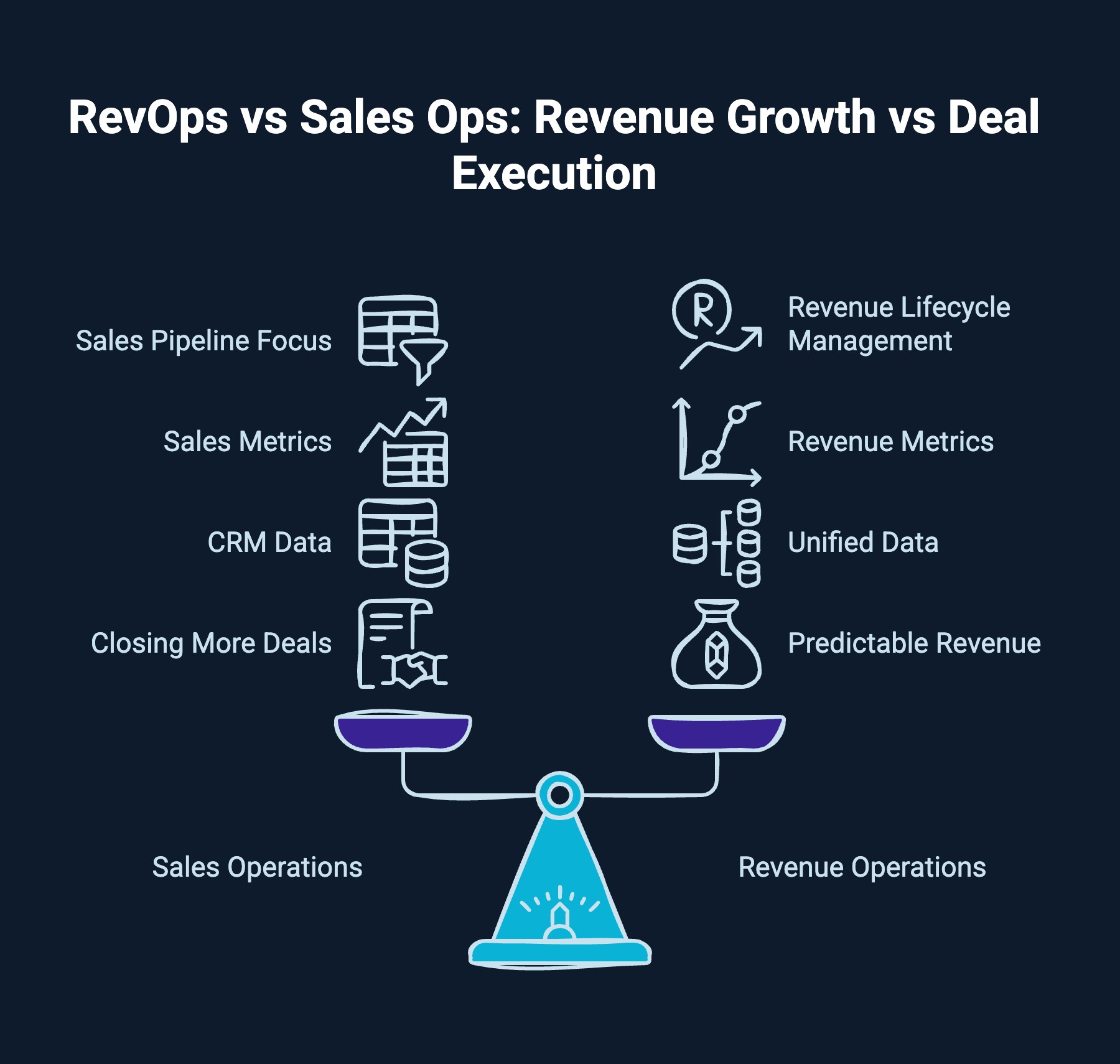
Although Sales Ops and RevOps are often grouped together, they operate at very different levels of impact.
Sales Operations is designed to improve how effectively the sales team closes deals, while Revenue Operations (RevOps) focuses on optimizing the entire revenue engine, from first touch to renewal and expansion. The distinction becomes critical as businesses scale and revenue complexity increases.
Sales Ops: Optimizing how deals get closed:
RevOps: Optimizing how revenue grows and scales:
If your growth strategy depends mainly on closing new deals, Sales Ops may be sufficient. If your business relies on cross-team alignment, customer retention, and expansion revenue, RevOps provides a clear structural advantage.
In the United States, the way companies structure their revenue operations function is changing fast. Sales Operations has long been the traditional model, especially for sales-led businesses focused on new deal acquisition and quota attainment. But subscription, SaaS, and recurring revenue models now dominate the market, exposing the limits of a sales-only focus. This shift has made revenue operations vs sales operations USA a critical consideration for growing companies.
Here is how the shift is playing out across the market:
US companies are moving toward RevOps because it creates a single source of truth for revenue data, improves accountability across teams, and delivers forecasting accuracy that reflects the full customer lifecycle. Sales Ops still plays an important role, but in many organizations it now operates within a broader RevOps framework that supports scalable, predictable revenue growth.
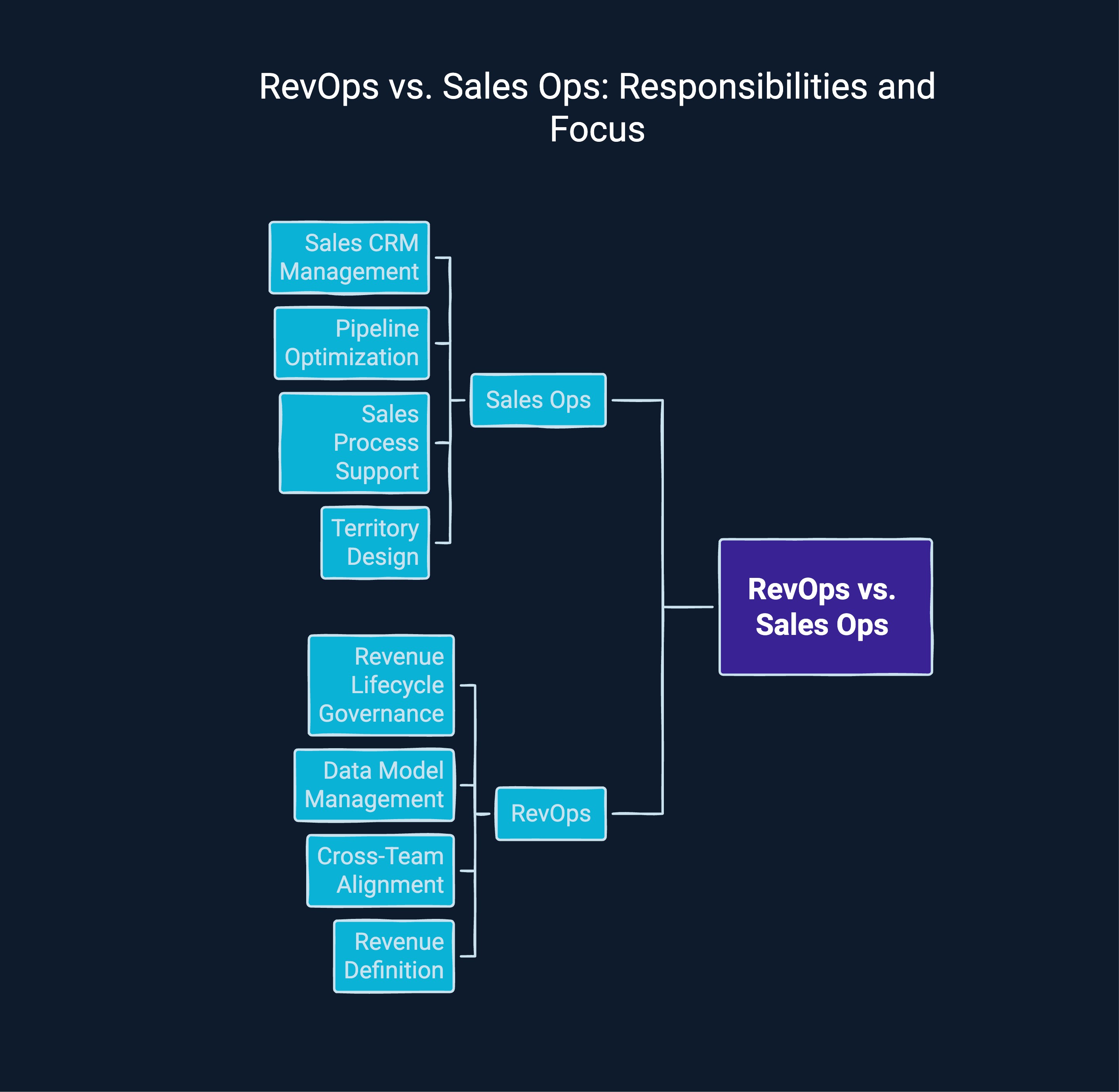
The most practical way to distinguish Sales Ops from RevOps is by examining who owns what in the daily execution of revenue. Sales Ops focuses on optimizing sales execution itself, while RevOps manages revenue as a connected, end-to-end system that spans multiple teams and stages of the customer lifecycle.
Sales Ops responsibilities:
RevOps responsibilities:
As revenue complexity increases, ownership shifts from optimizing sales execution to managing revenue as a unified system. In mature organizations, Sales Ops typically operates within a broader RevOps framework, enabling scale, alignment, and predictable growth.
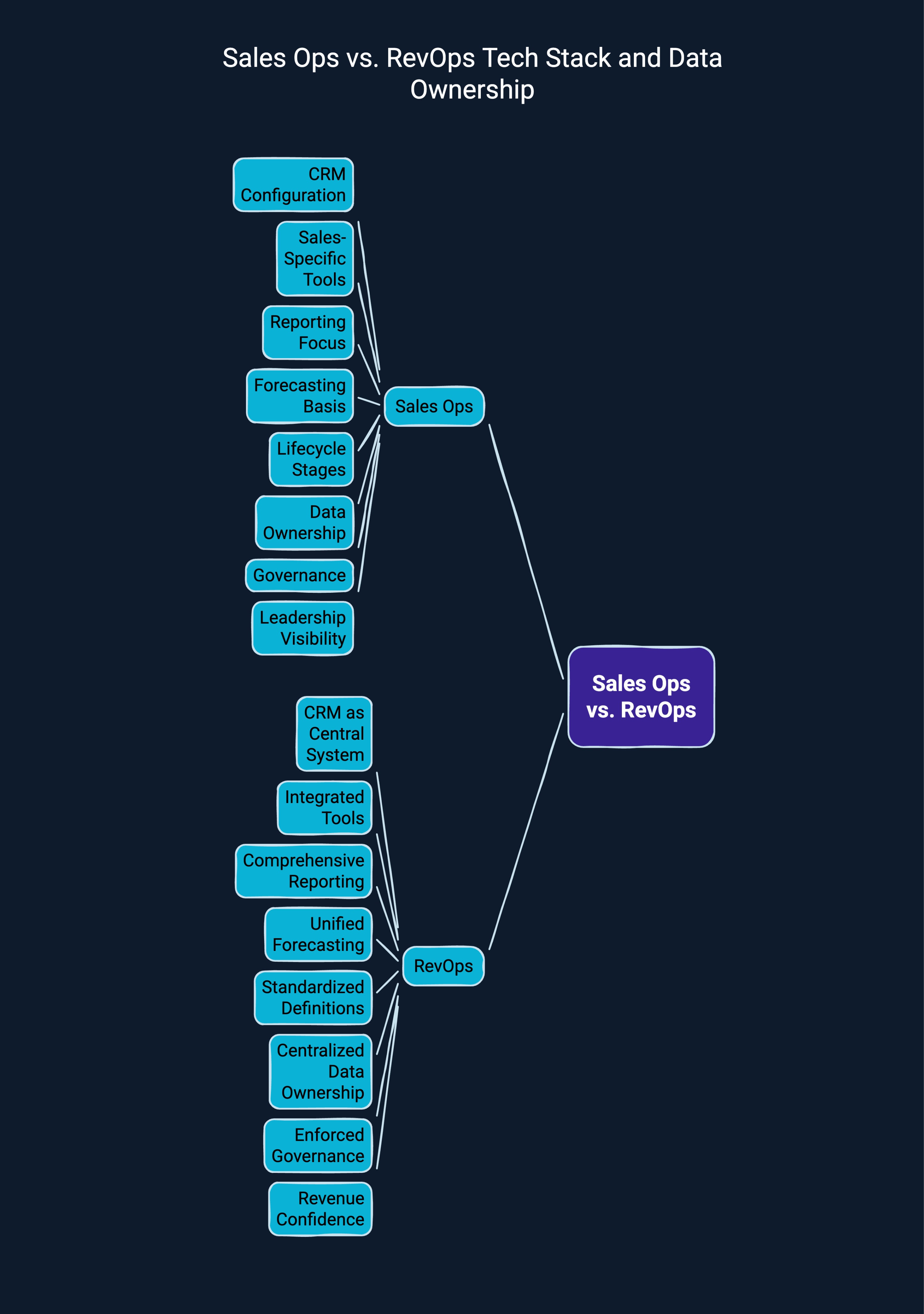
The tech stack is where the difference between Sales Ops and RevOps becomes truly structural. It determines how tools are owned, how data is governed, and whether teams operate in silos or around a shared revenue system.
Sales Ops configures technology to support sales execution, while RevOps governs the stack to drive alignment, consistency, and predictability across revenue.
Sales Ops tech stack and data ownership:
RevOps tech stack and data ownership:
When tools are owned in isolation, execution improves locally. When they are governed centrally through RevOps, revenue becomes predictable, measurable, and scalable across the business.
Predictable revenue is a result of alignment, not just stronger sales execution. The difference between Sales Ops and RevOps becomes most visible when companies try to forecast, scale, and coordinate across teams.
Where Sales Ops performs well
Sales Ops improves execution inside the sales organization and can drive short-term performance gains.
However, alignment remains limited to sales. Marketing inputs, renewal risk, and expansion revenue are often excluded, making forecasts less reliable as complexity grows.
Where RevOps delivers stronger results
RevOps improves alignment across the full revenue lifecycle, which directly impacts predictability.
The outcome is more than better reporting. Teams make faster decisions, leadership trusts the numbers, and revenue performance becomes repeatable instead of reactive.
In simple terms, Sales Ops helps sales perform better. RevOps helps revenue behave more predictably. When growth depends on multiple teams working together, RevOps consistently delivers stronger alignment and more reliable revenue outcomes.
The difference between Sales Ops and RevOps isn’t about maturity or buzzwords. It’s about how revenue is actually generated and managed inside your business. The right model depends on revenue motion, team dependencies, and how predictable growth needs to be.
Sales Ops is enough when:
In these environments, optimizing sales execution, pipeline hygiene, and rep productivity delivers most of the revenue impact.
RevOps is required when:
At this stage, growth depends less on closing more deals and more on alignment, continuity, and system-level visibility.
So, if growth comes primarily from closing more deals, Sales Ops is enough. But, if growth depends on alignment, retention, and expansion across the full customer lifecycle, RevOps becomes the necessary foundation.
The value of Sales Ops or RevOps is closely tied to how much structure a business actually needs at its current stage. Too little structure creates chaos, but too much too early slows growth. This is how the balance shifts as companies scale.
Startups win by moving fast. The priority is finding product market fit and closing early customers, not building perfect systems. At this stage, heavy cross functional processes and governance tend to slow execution more than they help.
Sales Ops fits because it adds just enough structure to keep deals, pipelines, and reporting clear without introducing unnecessary complexity, giving founders and early sales leaders visibility while preserving speed.
RevOps is usually unnecessary at this stage because marketing, sales, and customer success remain tightly coupled and are often handled by the same people.
As headcount grows, revenue no longer moves through a single team. Marketing drives demand, sales converts it, and customer teams influence renewals and expansion, which introduces natural friction.
RevOps matters because it replaces ad hoc coordination with structured alignment. It standardizes data, processes, and metrics so growth does not rely on constant firefighting.
At this stage, Sales Ops falls short because improving sales execution alone cannot fix misaligned handoffs, inconsistent revenue definitions, or forecasts that ignore retention and expansion.
Enterprises face a different challenge. Growth depends on operating at scale without losing control. Multiple products, regions, and go to market motions create complexity that cannot be managed informally.
At this stage, RevOps provides the structure to govern data and systems across distributed teams, enforce consistent revenue definitions across regions, and deliver executive level forecasting leadership can trust.
Sales Ops remains essential, but its role is execution within sales, while RevOps owns the broader system that keeps revenue predictable across the organization.
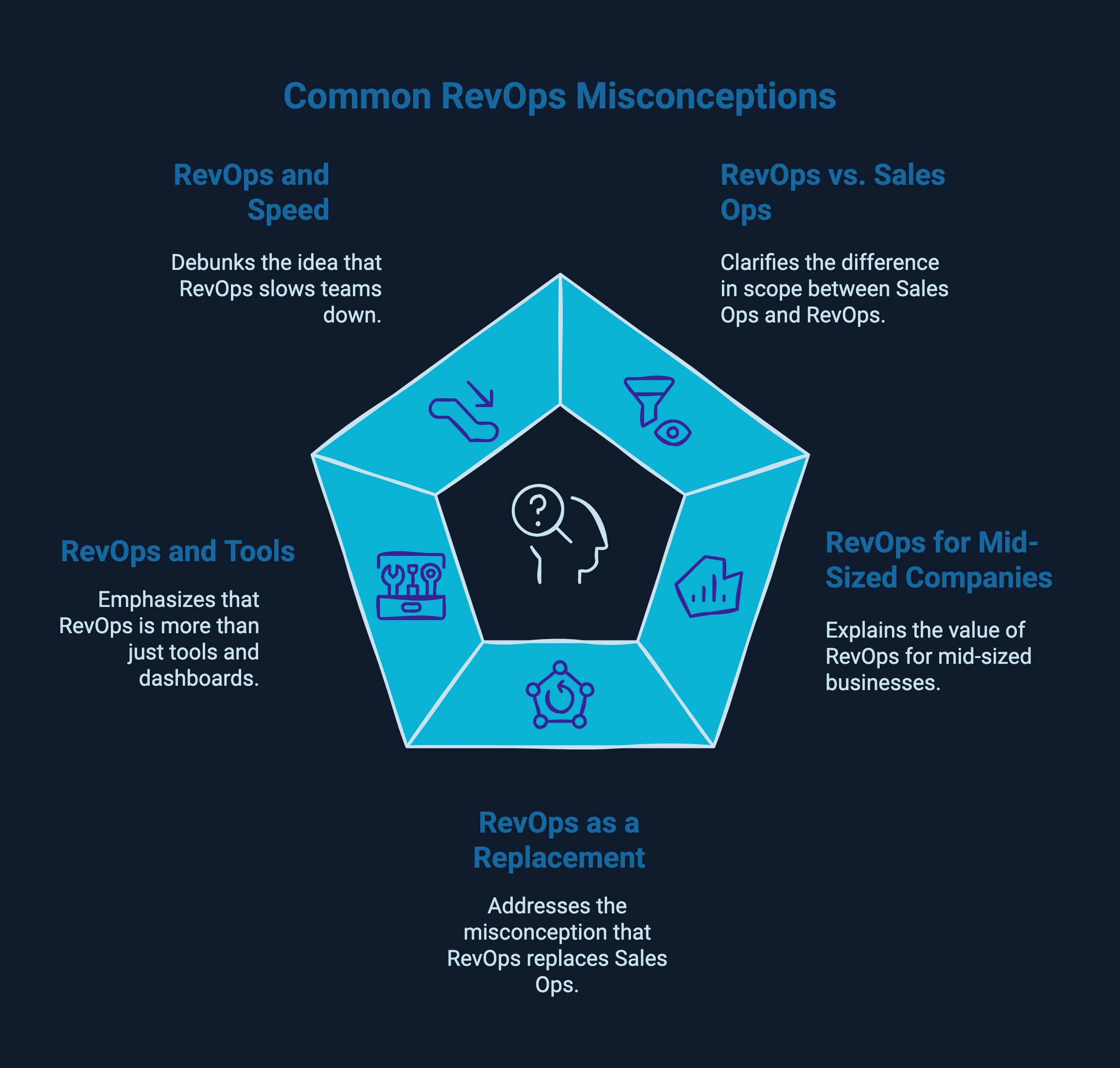
As RevOps becomes more common, confusion around its role and value has grown. These misunderstandings often cause companies to delay change or implement the wrong operating model. Below are the most common assumptions that blur the line between Sales Ops and RevOps, and why they often lead teams in the wrong direction.
This misconception exists because both functions work closely with CRM systems and revenue data. The difference is scope. Sales Ops improves how sales executes inside the funnel. RevOps designs how revenue flows across marketing, sales, and post-sale teams. As companies scale, sales execution alone no longer explains revenue performance.
This belief comes from seeing RevOps adopted by large organizations. In reality, mid-sized companies often feel the need first. They have enough complexity for misalignment to hurt, but not enough scale to absorb inefficiencies, making RevOps especially valuable at this stage.
This misconception arises from viewing RevOps as a replacement. In practice, Sales Ops continues to support sales execution, while RevOps provides the structure, shared metrics, and data governance that allow Sales Ops efforts to translate into predictable revenue.
Because RevOps often introduces better reporting, it is easy to confuse visibility with the function itself. RevOps exists to define ownership, standardize processes, and fix handoffs. Tools simply reflect the quality of those foundations.
This concern usually stems from poorly designed operations. Effective RevOps removes friction by clarifying responsibilities, simplifying workflows, and aligning teams around shared data, enabling faster execution rather than bureaucracy.
Understanding these misconceptions helps teams choose the right operating model based on how their revenue actually works, not how the function is labeled.
Most companies do not switch to RevOps overnight. The transition usually happens in stages, driven by growing revenue complexity rather than a formal reorganization.
A typical transition looks like this:
In many cases, the first RevOps leader comes from Sales Ops. The role grows as responsibility expands from supporting sales execution to governing the full revenue system.
The most successful transitions are intentional. Companies that clearly define ownership, align leadership early, and focus on process before tools avoid unnecessary disruption. RevOps works best when it is introduced as an evolution of how revenue is managed, not as a sudden structural overhaul.
The goal is not to replace Sales Ops, but to give it context. As revenue becomes more interconnected, RevOps provides the framework that turns isolated optimization into predictable, scalable growth.
Understanding when to move from Sales Ops to RevOps is one thing. Executing that shift without slowing growth is another. That is where LeadGem comes in.
We are a B2B growth and revenue operations agency with over 5 years of experience building scalable RevOps and outbound systems for growing companies. Headquartered in Amsterdam, the Netherlands, we support B2B teams across Benelux, the Nordics, the United States, and Australia. Our background in B2B growth marketing and growth hacking shapes how we approach RevOps, with a clear focus on pipeline impact and predictable revenue, not just cleaner dashboards.
What we do differently:
If you are ready to move beyond Sales Ops and build a predictable, scalable revenue engine, we help you turn RevOps from a concept into execution. Contact us today!
The real question is not whether Sales Ops or RevOps is better. It is whether your revenue model can still rely on sales execution alone. For many growing companies, that answer changes faster than expected.
Sales Ops helps teams sell more efficiently. RevOps helps businesses grow with confidence. When revenue depends on multiple teams, longer customer lifecycles, and repeatable outcomes, alignment becomes a growth lever, not an operational detail.
The shift to RevOps is not about adding process. It is about removing uncertainty. Companies that make this transition early gain clearer visibility, stronger coordination, and revenue they can actually plan around. In the long run, predictability is what turns growth into an advantage rather than a constant challenge.
Revenue operations oversees the entire revenue cycle, aligning the entire customer journey, customer data, and key metrics across different departments. The sales operations team focuses on sales reps, pipeline management, administrative tasks, and sales productivity to help close deals efficiently.
RevOps involves the sales department, marketing, customer success teams, customer success operations, and operations teams working together. Sales Ops usually supports sales reps and sales enablement, coordinating admin tasks, automation tools, and reporting within the salesops team to improve execution efficiency.
A business chooses RevOps when revenue depends on multiple teams, not sales alone. RevOps aligns marketing, sales, and post-sale functions, standardizes data, improves forecasting accuracy, and removes handoff friction that Sales Ops cannot solve as growth and complexity increase.
RevOps professionals need cross-functional thinking, data modeling, process design, systems governance, and a strong business context. Sales Ops professionals need deep CRM expertise, forecasting, reporting, territory planning, and compensation management, with a narrower focus on sales execution and efficiency metrics.
RevOps addresses cross-team misalignment, inconsistent revenue definitions, broken handoffs, siloed data, and unreliable forecasting. Sales Ops cannot resolve these because its authority and scope sit within sales, not across marketing, customer success, finance, and the full revenue lifecycle organization.
BizOps focuses on internal operations, strategy, and efficiency across the business. RevOps focuses specifically on revenue generation, retention, and expansion by aligning go-to-market teams, data, and processes to improve forecasting, accountability, and predictable growth outcomes for scaling companies.
Revenue from operations includes all core income, such as renewals and services, while sales focuses on closed deals. This explains the difference between sales operations and revenue operations, especially in subscription models where retention and expansion drive long-term revenue.
You need Sales Ops when revenue is sales-led, pipelines are simple, teams are small, and growth depends on closing new deals. Sales Ops improves efficiency, forecasting, and execution without adding cross-functional complexity or heavy governance across revenue teams.