

Contact


Revenue growth slows when go-to-market execution is not aligned. According to Forrester, organizations with strong alignment across sales, marketing, and customer teams achieve 2.4× higher revenue growth than less aligned companies. This highlights how critical operational coordination is to scaling revenue effectively.
As companies grow, disconnected tools, unclear ownership, inconsistent pipeline reporting, and misaligned outbound efforts create friction. Even strong GTM strategies fail when teams lack a structured system to execute, measure, and optimize performance together.
Modern GTM operations ensure that CRM platforms like HubSpot or Salesforce, outbound automation tools such as Outreach, enrichment platforms like Clay, and analytics infrastructure work as one coordinated revenue engine. Clean data flows, defined workflows, and shared metrics create a predictable pipeline and scalable growth.
In this guide, you will learn what GTM operations is, how it differs from RevOps and sales operations, and how a structured go-to-market operations framework can improve sales efficiency, align teams, and drive predictable revenue growth.
GTM operations are the operational framework that powers go-to-market execution. While strategy defines who you target and how you compete, go-to-market operations ensure teams execute that strategy in a coordinated and measurable way.
It connects sales, marketing, and customer teams through shared processes, systems, data, and KPIs. This includes CRM structure, lead routing, territory design, outbound workflows, reporting, and forecasting. The goal is simple: eliminate friction and create consistent revenue execution.
In short, GTM strategy and operations work together. Strategy sets direction. GTM operations builds the infrastructure that turns plans into predictable growth.

GTM strategy defines what you are going to do to win in the market. It includes your target audience, positioning, pricing, channels, messaging, and revenue model. It answers questions like: Who are we selling to? How are we differentiating? What motion are we using to generate revenue?
GTM operations define how that strategy is executed and measured. It includes CRM configuration, outbound workflows, lifecycle stages, automation logic, reporting dashboards, data governance, and performance tracking. It ensures systems, teams, and processes work together to deliver on the strategy.
In simple terms, the GTM strategy sets the direction. GTM operations builds the engine that makes it scalable, measurable, and repeatable.
These roles often overlap, but they serve different purposes within a revenue organization. Clear definitions prevent confusion and duplicated effort.
GTM Operations focuses on executing the company’s go-to-market motion. It aligns segmentation, ICP targeting, outbound strategy, campaign execution, funnel management, and cross-functional coordination. Its job is to ensure strategy turns into structured, measurable execution across sales, marketing, and customer teams.
Revenue Operations (RevOps) is the broader umbrella function. It unifies the entire revenue lifecycle by standardizing systems, data governance, reporting, forecasting, and performance tracking across acquisition, expansion, and retention.
Sales Operations supports the sales team specifically. It manages territory planning, quotas, compensation design, CRM workflows, and pipeline reporting to improve sales productivity.
In simple terms, Sales Ops optimizes the sales team, RevOps aligns the full revenue engine, and GTM Ops ensures the go-to-market strategy is executed consistently across teams.
Not sure which ops model fits your team? Check out our RevOps vs Sales Ops resource for practical insights.
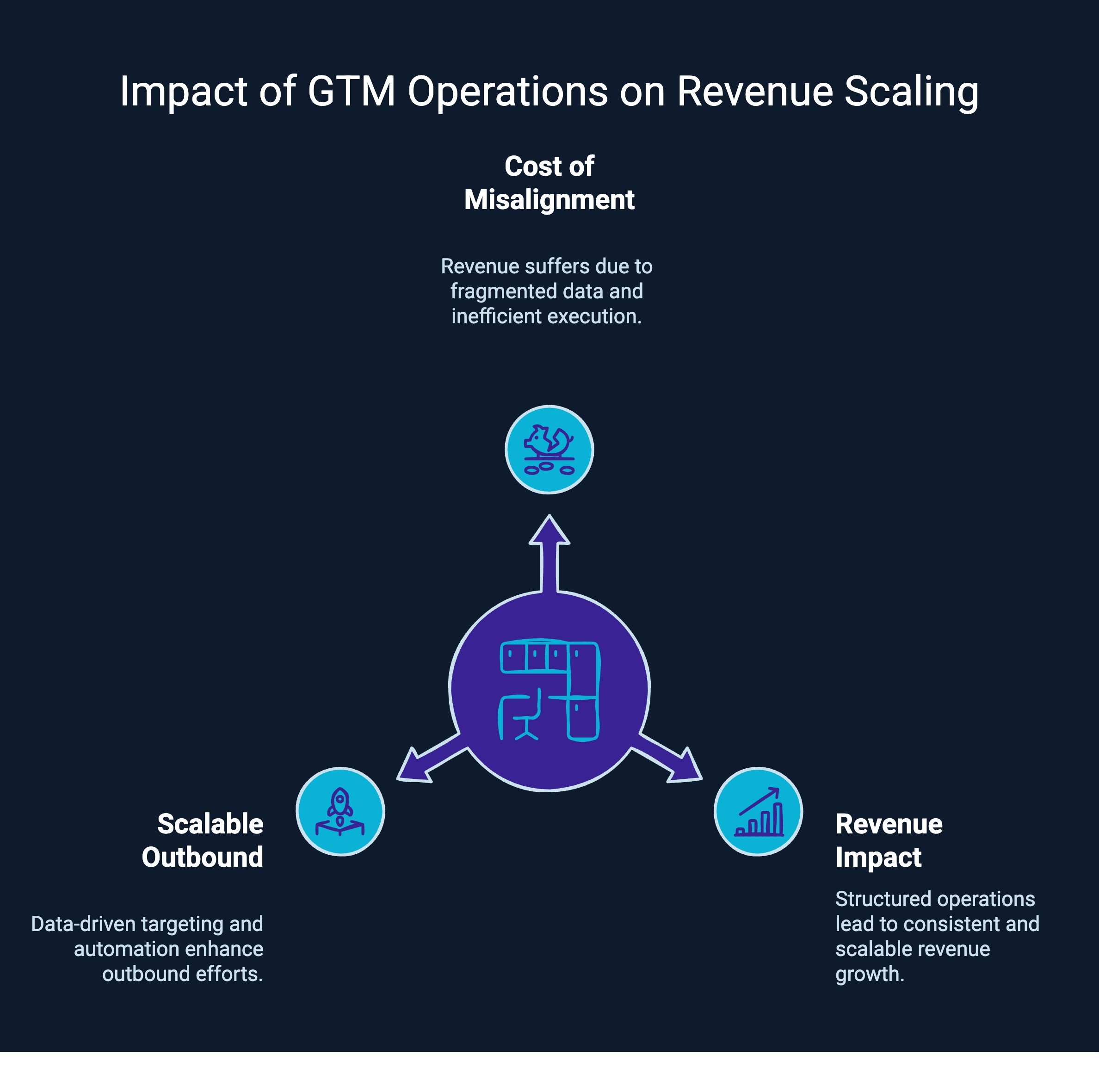
Scaling revenue increases operational complexity. More tools, more channels, and more team members create more room for misalignment. Without structured GTM operations, growth introduces friction instead of momentum.
To understand its impact, it helps to look at both sides of the equation.
When go-to-market execution lacks coordination, revenue performance suffers in predictable ways. Strategy may be sound, but execution breaks down across teams.
Common consequences include:
These gaps slow growth, increase acquisition costs, and reduce revenue predictability.
When GTM Operations is structured properly, teams operate from a shared system rather than disconnected processes. Execution becomes consistent, measurable, and scalable.
The impact is tangible:
This is where improving sales operations efficiency goes-to-market strategy consulting plays a role. Strong GTM operations turn strategy into disciplined execution, creating predictable and scalable revenue growth.
Strong GTM operations create a repeatable outbound engine rather than ad hoc prospecting. ICP definitions, enrichment workflows, CRM governance, and sequencing logic are aligned to prioritize high-fit accounts and track performance accurately.
With structured systems in place:
This operational foundation turns outbound into a scalable pipeline generation system that supports predictable and sustainable revenue growth.
Looking for expert support? Explore our curated list of top outbound prospecting agencies to boost your B2B pipeline.
GTM tech stack architecture defines how your core systems are structured to support the entire revenue lifecycle. It ensures that CRM, marketing automation, sales engagement, enrichment, and analytics platforms operate within a unified framework rather than as isolated tools. Strong architecture creates clarity, accountability, and measurable performance.
A well-designed GTM architecture includes:
Integration ensures these systems communicate seamlessly. Clean data flow enables:
Without strong architecture and integration, tools become fragmented, and reporting becomes unreliable. With both in place, your GTM stack functions as a coordinated revenue engine that supports scalable pipeline generation and predictable growth.
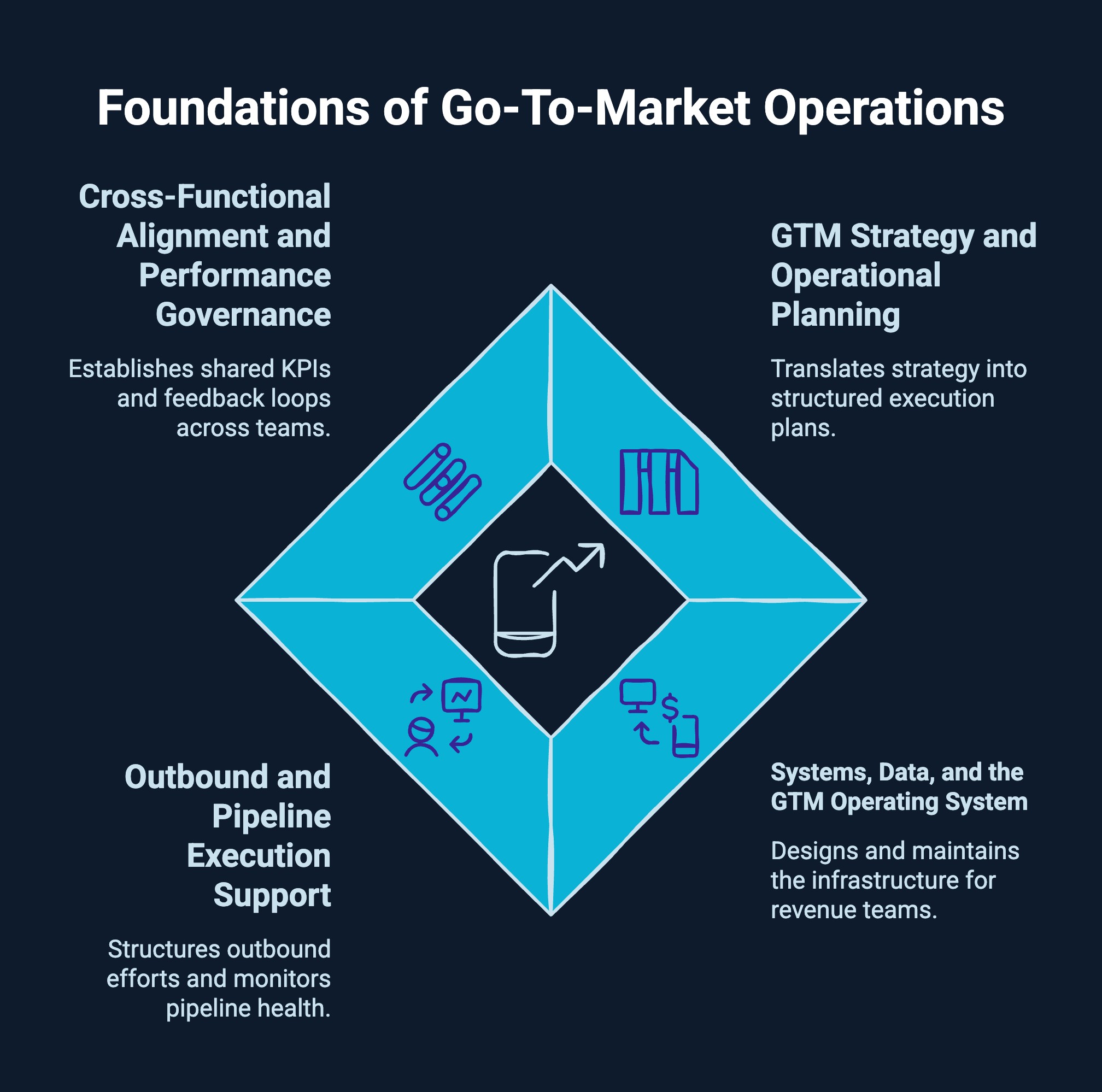
GTM operations create the execution layer behind revenue growth. It ensures that strategy is operationalized, systems are aligned, and teams work from a shared framework. The following functions form the foundation of effective GTM ops.
GTM ops turns strategy into structured execution. It translates ICP definitions, segmentation models, pricing motions, and channel priorities into clear operational plans. This includes defining ownership across funnel stages, aligning territories, and mapping how leads move from marketing to sales. Without this layer, strategy remains conceptual. With it, teams know exactly how to execute.
Strong execution depends on strong infrastructure. GTM ops designs and maintains the CRM structure, lead lifecycle stages, automation rules, and reporting logic that support revenue teams. This integrated setup forms the GTM operating system, ensuring that data is consistent, performance is measurable, and decisions are based on accurate visibility across the funnel.
Outbound efforts often fail due to misalignment rather than effort. GTM ops structures SDR workflows, account targeting, sequencing logic, and campaign tracking to ensure outbound programs support overall revenue goals. It also monitors pipeline health, conversion rates, and bottlenecks so teams can adjust execution proactively instead of reactively.
As companies scale, coordination becomes more complex. GTM ops establishes shared KPIs, reporting standards, and regular performance reviews across sales, marketing, and customer teams. It creates feedback loops between acquisition and retention, so insights inform future targeting and messaging. This governance layer keeps the go-to-market engine aligned, accountable, and adaptable over time.
Want to partner smarter? Check out this roundup of top Clay agencies and what they offer for growth teams.
A GTM operating system is the structured framework that ensures a company’s go-to-market strategy is executed consistently and measured accurately. It connects teams, tools, processes, and performance metrics into one coordinated revenue engine.
Rather than relying on disconnected tools or informal workflows, a GTM operating system creates clarity around how leads are generated, routed, converted, and analyzed.
A strong GTM operating system typically includes:
When these elements work together, go-to-market operations become structured, efficient, and scalable.

Not every company needs external support immediately. But when revenue growth becomes inconsistent, or execution feels fragmented, GTM Operations Consulting can help identify structural gaps and restore alignment.
You may need GTM operations consulting if you notice:
At this stage, the issue is rarely an effort. It is usually an operational design. GTM operations consulting evaluates your strategy, processes, systems, and data structure to uncover friction points. It clarifies ownership, standardizes workflows, and aligns teams around measurable revenue outcomes.
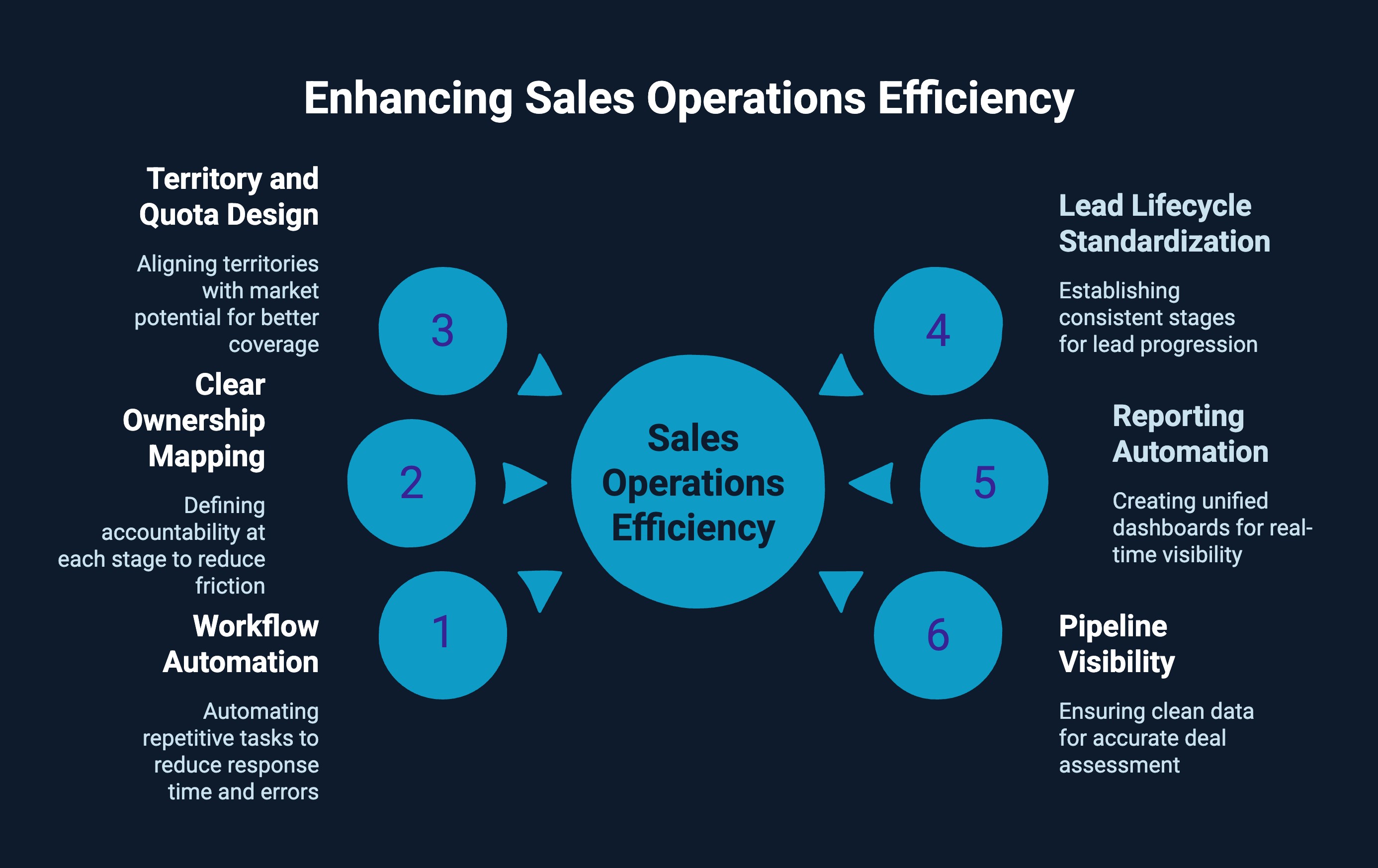
Sales inefficiency rarely comes from a lack of effort. It usually comes from unclear processes, fragmented systems, and inconsistent accountability. GTM operations addresses these structural gaps by redesigning how work flows across the revenue engine.
Below are the core levers through which GTM Operations improves sales operations efficiency.
GTM ops maps the full lead-to-revenue journey and identifies repetitive, delay-prone tasks. Automation is then applied to lead routing, follow-up triggers, stage updates, reminders, and internal notifications. This reduces response time, enforces process compliance, and prevents manual errors. The result is faster pipeline movement and more selling time for reps.
In many organizations, handoffs between marketing, SDRs, AEs, and customer teams are loosely defined. GTM ops establishes structured accountability at every funnel stage with clear entry and exit criteria. This reduces friction, shortens decision cycles, and ensures no revenue opportunity stalls due to internal ambiguity.
Instead of distributing accounts evenly or historically, GTM ops aligns territory structure and quota allocation with ICP segmentation, market potential, and capacity modeling. This prevents overlap, improves coverage balance, and increases revenue per rep by focusing effort where it has the highest probability of return.
GTM ops defines standardized lifecycle stages with consistent qualification logic and progression rules. This improves pipeline hygiene, ensures consistent conversion measurement, and eliminates inflated or inaccurate pipeline reporting. Reliable lifecycle structure directly improves forecasting confidence.
Disconnected reporting slows decision-making. GTM ops builds unified dashboards based on consistent data definitions and automated reporting flows. Leaders gain real-time visibility into funnel velocity, conversion ratios, and revenue projections without manual consolidation.
By restructuring workflows, accountability models, and performance infrastructure, GTM operations transforms sales from reactive execution into a disciplined and scalable revenue engine.
GTM operations strengthen pipeline visibility by enforcing clean stage definitions, required field governance, and standardized opportunity tracking. When CRM data is structured and consistently updated, leaders can accurately assess deal health, stage progression, and pipeline coverage.
Improved data integrity directly enhances forecasting accuracy. Instead of relying on subjective rep estimates, forecasts are based on historical conversion rates, stage velocity, and real-time performance data. This reduces revenue surprises and enables proactive resource planning.
Want to align sales, marketing & customer success? See our practical RevOps implementation framework.
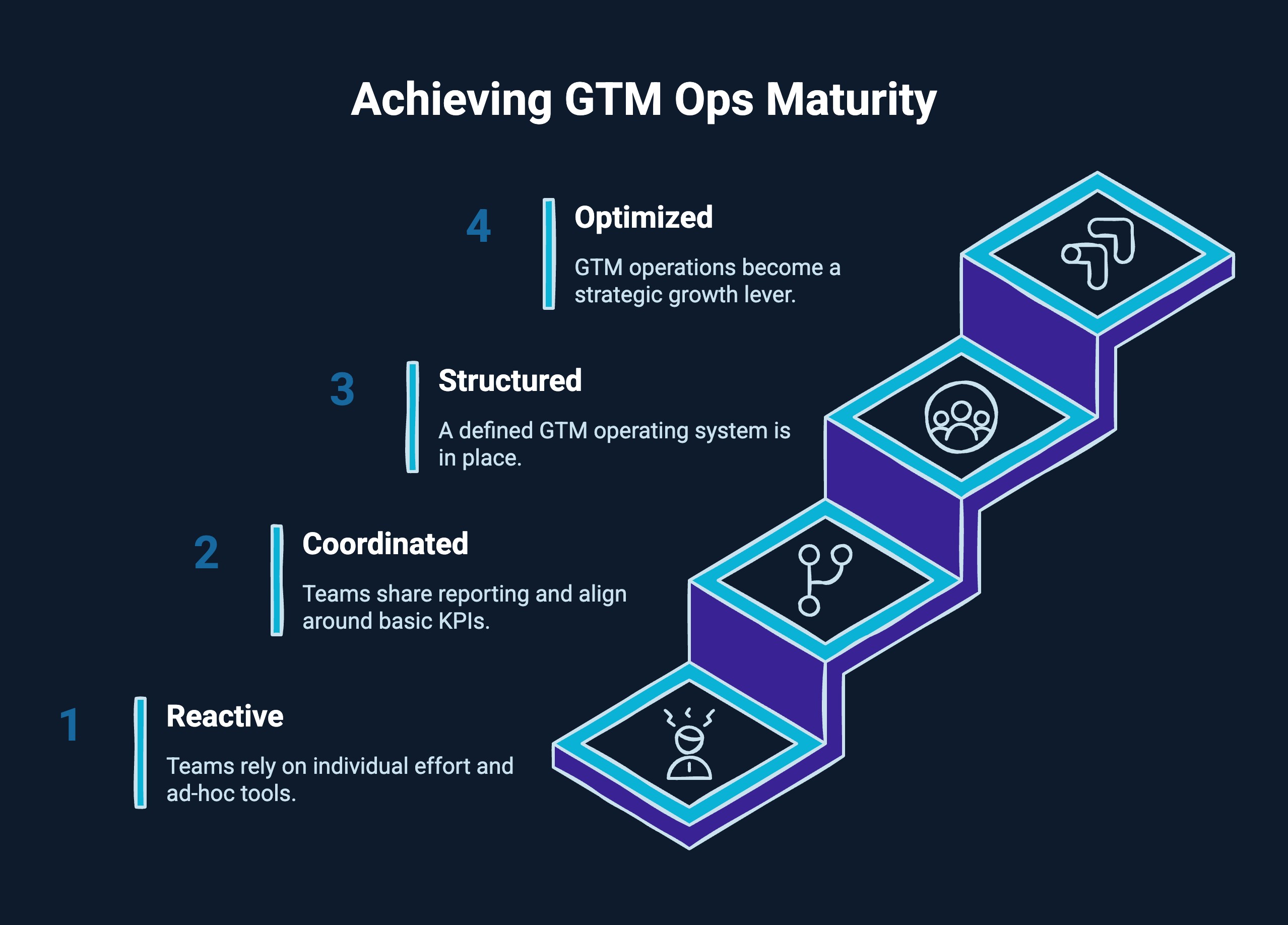
Not every company operates at the same level of go-to-market sophistication. GTM operations maturity determines how predictable, efficient, and scalable your revenue engine truly is. Understanding your current stage helps identify what needs to change.
Most organizations fall into one of four stages:
At this stage, teams rely heavily on individual effort rather than structured systems. Tools are added as problems arise, reporting is inconsistent, and processes vary by team or rep. Growth may occur, but it is unpredictable and difficult to forecast.
Typical traits:
Teams begin sharing reporting and aligning around basic KPIs. Some workflows are standardized, but execution still depends on cross-functional goodwill rather than formal governance.
Typical traits:
A defined GTM operating system is in place. Lifecycle stages, automation, reporting logic, and ownership are clearly mapped. Revenue forecasting becomes more reliable, and performance analysis drives decision-making.
Typical traits:
GTM operations become a strategic growth lever. Continuous experimentation, predictive analytics, and structured optimization cycles drive performance improvements. Execution is aligned, measurable, and scalable.
Typical traits:
Companies seeking GTM operations consulting often fall between the Coordinated and Structured stages. Moving to the next level requires redesigning operational infrastructure, not just adjusting tactics.

As go-to-market complexity increases, many companies turn to external experts for support. The top revenue operations agencies go-to-market alignment differently than traditional consultants. They do not just refine messaging or adjust tactics. They redesign the operational infrastructure behind revenue execution.
High-performing agencies typically focus on:
The difference between tactical support and true GTM alignment lies in systems thinking. Strong agencies treat go-to-market execution as an integrated engine rather than a collection of isolated activities.
When growth stalls, the issue is usually operational design, not effort. At LeadGem, we fix that at the system level.
We are a B2B growth and revenue operations agency headquartered in Amsterdam, the Netherlands. With 5+ years of experience in B2B growth marketing and growth hacking, we build and implement advanced RevOps and outbound systems.
From Benelux and the Nordics to America and Australia, we help companies scale with structured GTM alignment.
What We Deliver:
For companies seeking GTM operations consulting, we build the operational foundation that improves sales efficiency, strengthens alignment, and drives scalable revenue growth.
Strategy alone does not create predictable revenue. Execution does. When systems, ownership, and data are misaligned, growth becomes inconsistent and difficult to forecast.
GTM operations bring structure to that complexity. It aligns teams, standardizes processes, and builds the infrastructure required for scalable execution. Instead of reacting to pipeline issues, companies operate from a coordinated revenue engine.
Sustainable growth is not accidental. It is operationally designed.
AI improves GTM operations through real-time data analysis, smarter lead generation, better qualified leads, and automated marketing ops. It enhances sales performance, reduces bad data, and supports revenue generation with valuable insights across the customer journey.
Data analysis, strategic planning, KPI tracking, and sales process design are critical. Knowledge of marketing strategy, ideal customer profile development, customer journey mapping, and collaboration with sales leaders and marketing ops teams strengthens overall business objectives.
Effective GTM strategy examples include structured product launch planning, ICP-based lead generation, optimized distribution channels for new market entry, lifecycle tracking to reduce customer acquisition cost, and improving close rates to support revenue targets and customer lifetime value.
Consultants audit workflows, align the sales process and marketing strategy, standardize KPIs, reduce customer acquisition cost, and improve data analysis. They streamline lead generation, clarify ownership, and align teams with overall business objectives to strengthen revenue generation and sales performance.
Target market definition, value proposition, marketing channels, sales strategy, and customer experience. Together, they guide customer acquisition, support product launch, align marketing efforts, and drive revenue targets through a structured and effective GTM strategy.
Product launch, market entry, outbound lead generation, inbound marketing, partner distribution channels, sales-led growth, and customer success expansion. These motions align GTM teams around revenue generation, close rates, and customer lifetime value.
Define your ideal customer profile, clarify the value proposition, choose marketing channels, align the sales strategy, map the customer journey, set key performance indicators, and create a comprehensive plan tied to business objectives and revenue targets.