

Contact


Are you tired of your sales outreach falling on deaf ears? Traditional prospecting often feels like shouting into the void. Signal-based prospecting offers a smarter way forward.
At the same time, high-intent buyers are actively researching solutions and leaving clear engagement signals. The challenge is identifying those signals early and acting before competitors do.
This blog breaks down how signal-based prospecting works, how it improves meeting conversion and pipeline quality, and how to replace volume-driven outreach with precise, intent-based engagement that drives predictable revenue growth.
Signal-based prospecting is a sales approach that focuses on contacting companies showing clear signs they are ready to buy. Instead of using static contact lists, it uses real-time intent and activity signals to reach prospects at the right moment, improving relevance and conversions.
To understand how it works in practice, let’s break down its core components.
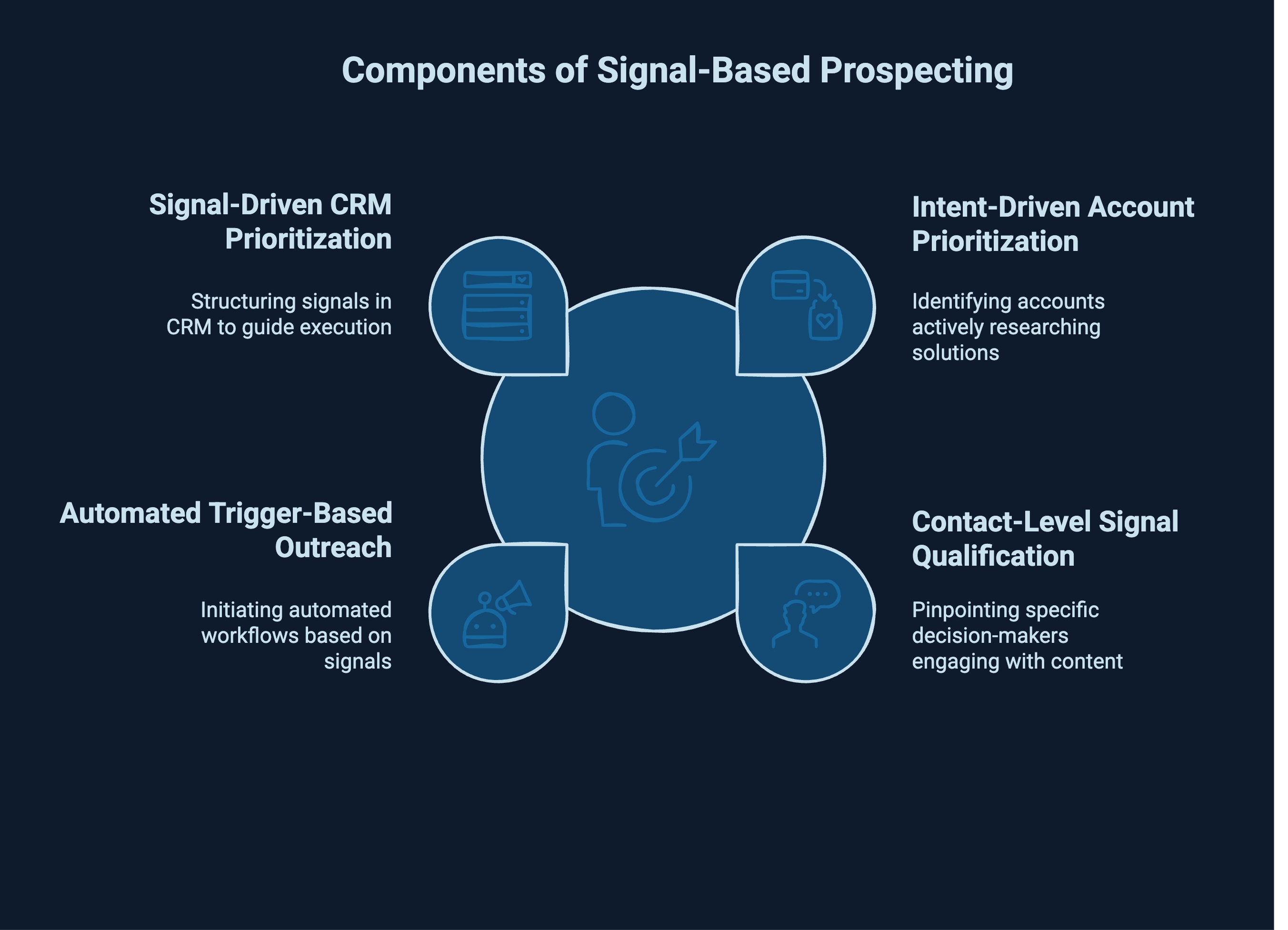
Signal-based prospecting identifies accounts actively researching solutions through intent data, technology adoption signals, hiring trends, or website engagement. Rather than contacting every ICP match, teams focus only on accounts showing meaningful buying behavior, increasing efficiency, and improving reply rates.
Beyond account activity, this method pinpoints specific decision-makers engaging with relevant content or high-value web pages. Sales outreach becomes directed toward stakeholders demonstrating interest, replacing generic database pulls with engagement-backed targeting that improves personalization and conversion likelihood.
When predefined signals appear, automated workflows initiate enrichment, task assignments, or personalized sequences. This ensures timely engagement while intent is high, helping teams secure meetings faster and engage prospects before competitors enter active conversations.
Raw signals alone do not create pipeline impact. They must be structured inside the CRM to guide execution. Signal-driven CRM prioritization uses scoring models to rank accounts based on intent strength, recency, and ICP fit, automatically pushing high-priority opportunities to the right sales reps. Intelligent routing rules assign accounts by territory, segment, or deal size, ensuring no high-intent opportunity sits idle.
LeadGem designs structured signal scoring and CRM routing systems that transform fragmented buying signals into clear sales action.
Signal-based prospecting replaces list volume with intelligent prioritization.
Learn how to leverage SaaS customer review sites for success and turn third-party feedback into increased visibility and conversions.
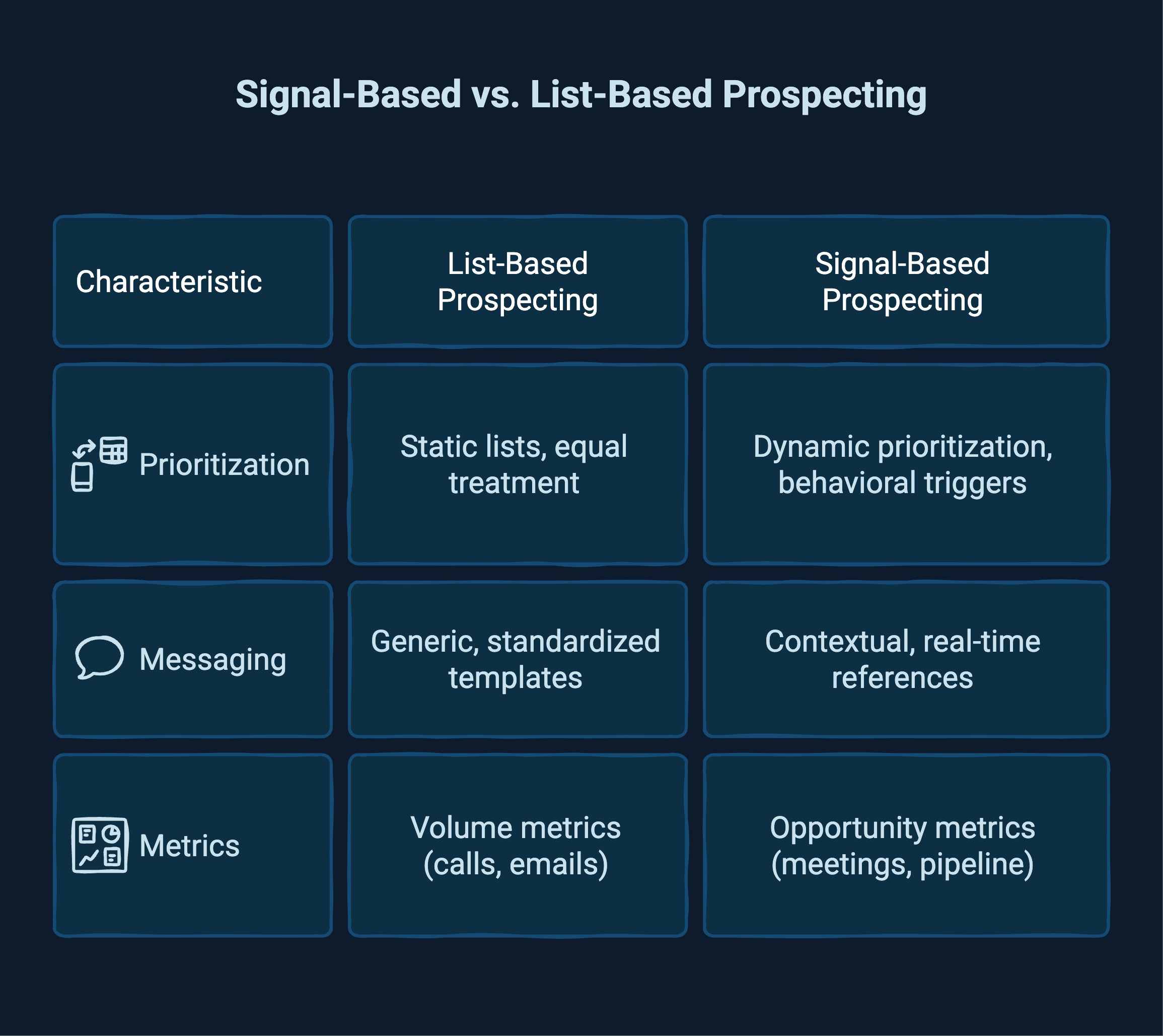
Traditional prospecting relies on static lists built around firmographics like industry, company size, and job titles. Signal-based prospecting dynamically reprioritizes outreach based on real-time behavioral indicators, ensuring sales teams focus on active buyers rather than passive contacts.
The differences become clearer when comparing operational workflows.
List-based prospecting treats all ICP accounts equally, regardless of engagement. Signal-based prospecting continuously updates targeting based on behavioral triggers, ensuring high-intent accounts automatically move to the top of outreach queues without manual reprioritization.
Cold list outreach often relies on standardized templates with limited personalization. Signal-driven outreach references specific behaviors in real time, such as pricing page visits or content engagement, increasing message relevance, strengthening credibility, and significantly improving response rates.
Traditional prospecting tracks activity metrics like calls made or emails sent. Signal-based prospecting measures meetings booked, qualified pipeline generated, and revenue impact, aligning outbound execution with measurable business outcomes rather than surface-level productivity indicators.
This shift transforms prospecting from activity-driven execution to outcome-driven strategy.
Explore “RevOps vs Sales Ops” to see which approach better aligns teams and boosts revenue performance.
As competition intensifies and inbox saturation increases, generic outbound consistently underperforms. Signal-based prospecting improves precision by aligning outreach with real buying behavior, helping teams engage prospects at the right moment with relevant context that drives stronger pipeline performance.
Its impact is both strategic and measurable across revenue metrics.
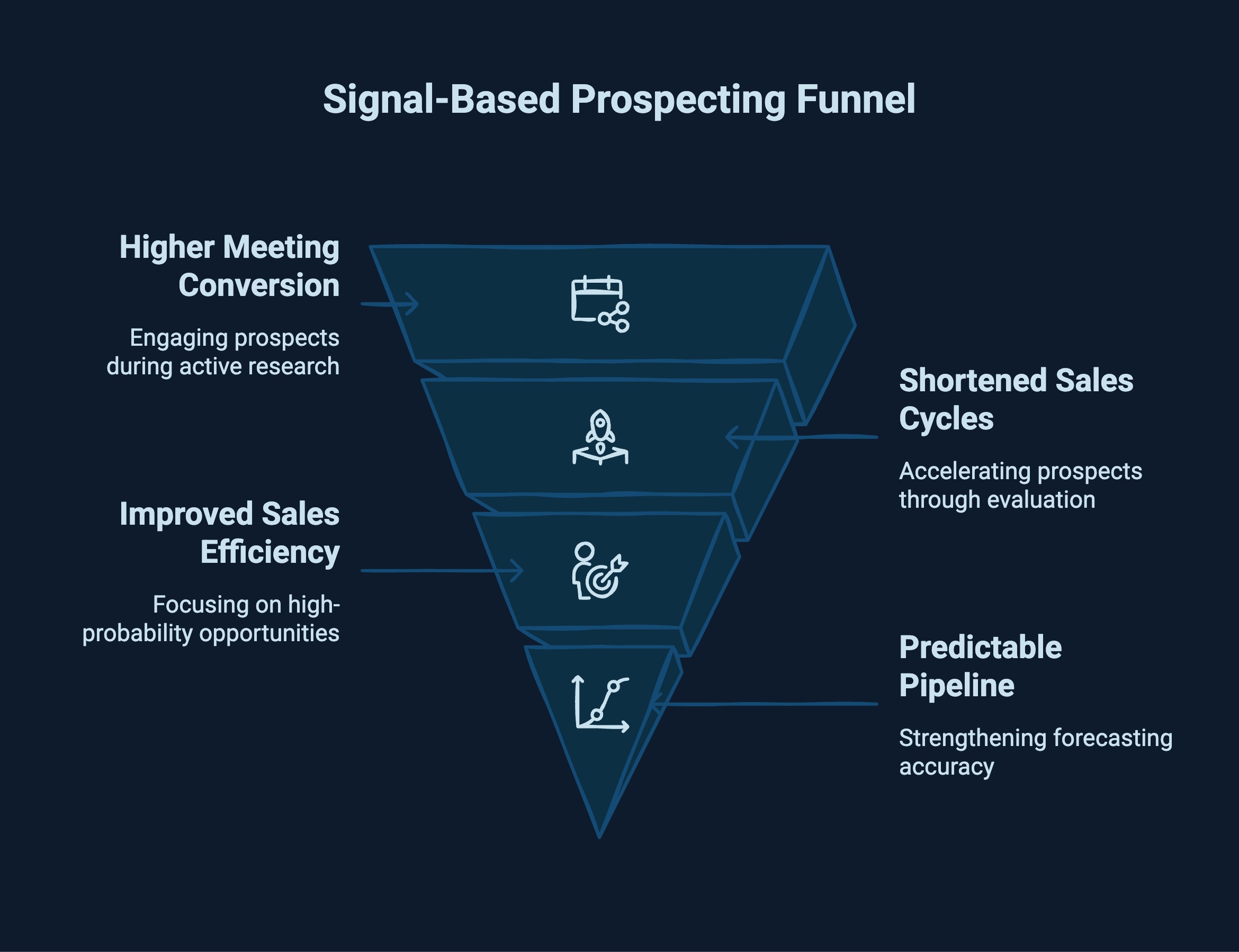
Engaging prospects during active research phases improves response rates and reduces resistance. Conversations begin with accounts already evaluating solutions, increasing the likelihood that meetings convert into sales-qualified opportunities rather than exploratory discussions with limited intent.
Targeting accounts already demonstrating buying signals eliminates prolonged warming cycles. Prospects require less foundational education, move faster through evaluation stages, and accelerate from the first conversation to a qualified opportunity.
Signal prioritization reduces time spent on low-intent accounts. Representatives focus on high-probability opportunities, increasing pipeline output without expanding headcount or inflating outbound volume.
Tracking consistent intent patterns, such as repeat engagement or high-value page visits, improves pipeline visibility. Signal-driven prospecting strengthens forecasting accuracy and creates more reliable revenue planning.
Signal-based prospecting is no longer a competitive advantage. It is becoming a structural requirement for building a predictable, high-quality B2B pipeline.
Want to improve your operational efficiency? Learn how RevOps automation drives better revenue operations and helps teams work smarter, not harder.
Not all signals indicate equal buying readiness. Effective signal-based prospecting requires identifying triggers strongly correlated with purchase intent and aligning them to a clearly defined ideal customer profile for maximum accuracy and impact.
Several signal categories consistently produce results.
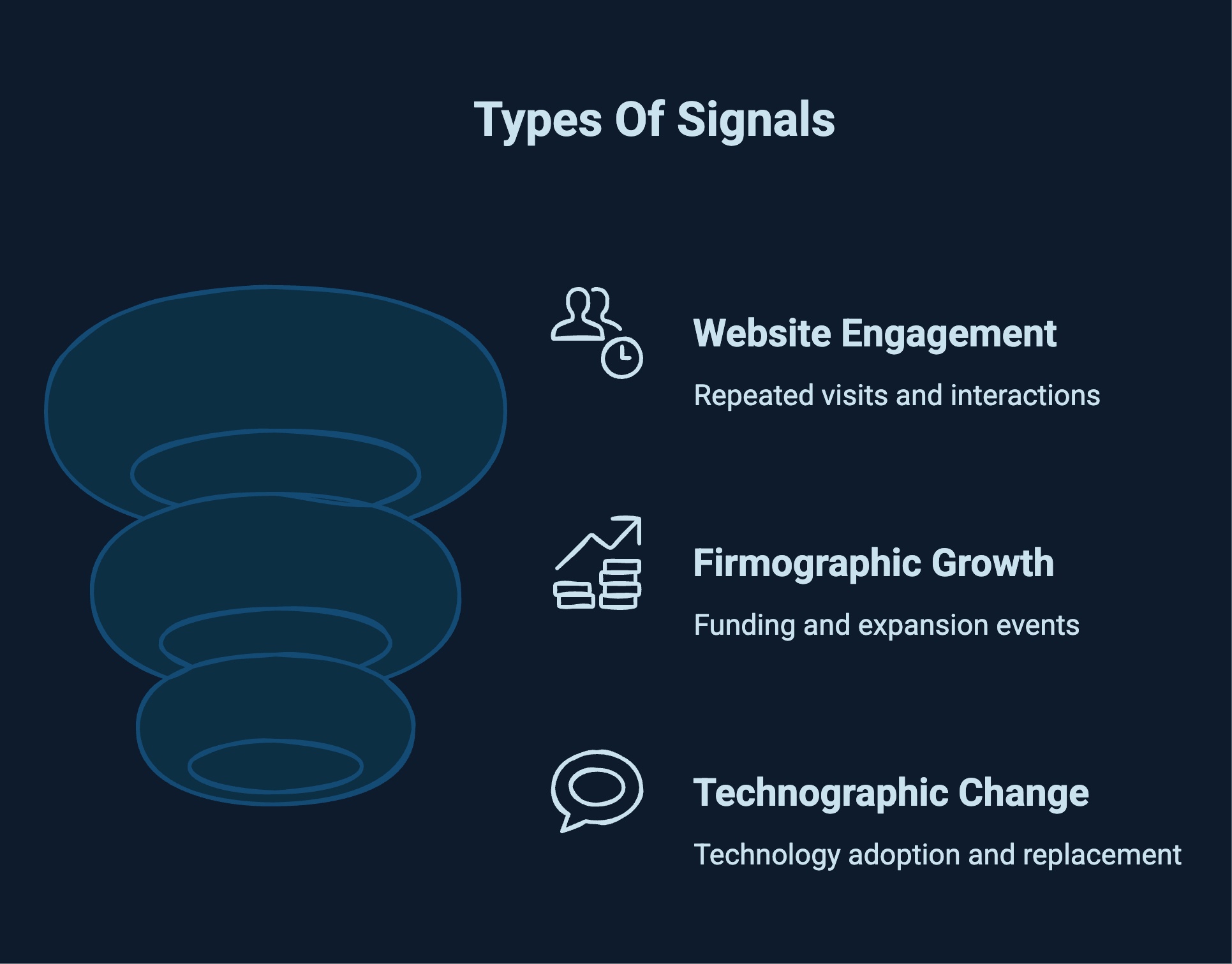
Repeated visits, pricing page views, demo interactions, and feature comparisons often indicate active solution evaluation. These behaviors typically reflect mid-to-late funnel intent and create strong opportunities for timely, context-driven outreach.
Funding events, rapid hiring for key roles, market expansion, or executive leadership changes can indicate shifting priorities and available budget. These triggers often create natural entry points for strategic conversations.
Technology adoption, tool replacement, or stack expansion often creates short timing windows. Monitoring technographic changes enables precise positioning against competitors, highlighting integration advantages or addressing capability gaps during evaluation cycles.
Selecting high-quality signals and accurately interpreting behavioral data ultimately determines prospecting effectiveness and scalability.
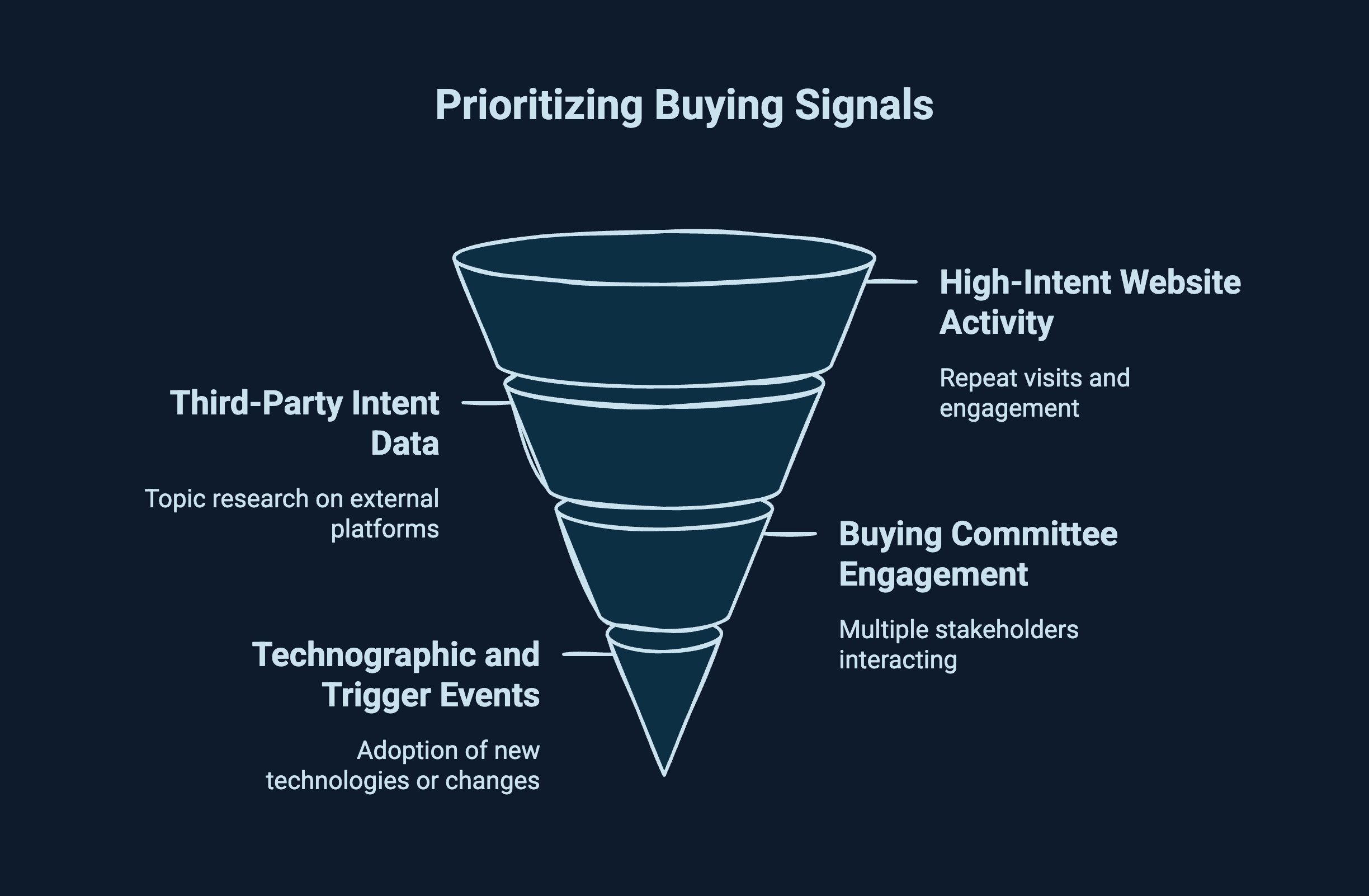
Not all signals carry equal buying weight. High-performing teams prioritize signals that indicate active evaluation rather than passive awareness.
1. High-Intent Website Activity: Repeat visits, pricing page views, demo page engagement, and product-specific content consumption signal active research.
2. Third-Party Intent Data: Topic-level research spikes across review platforms, comparison sites, or industry publishers reveal solution exploration beyond your website.
3. Buying Committee Engagement: Multiple stakeholders from the same account engaging within a short timeframe often indicates internal evaluation momentum.
4. Technographic and Trigger Events: New technology adoption, funding rounds, leadership changes, or hiring for relevant roles can signal upcoming purchase windows.
Prioritizing strong, recent, and multi-signal activity ensures sales teams engage accounts most likely to convert rather than reacting to low-impact engagement noise.
Building a RevOps tech stack? Check out this guide to discover essential tools that power scaling and cross-team alignment.
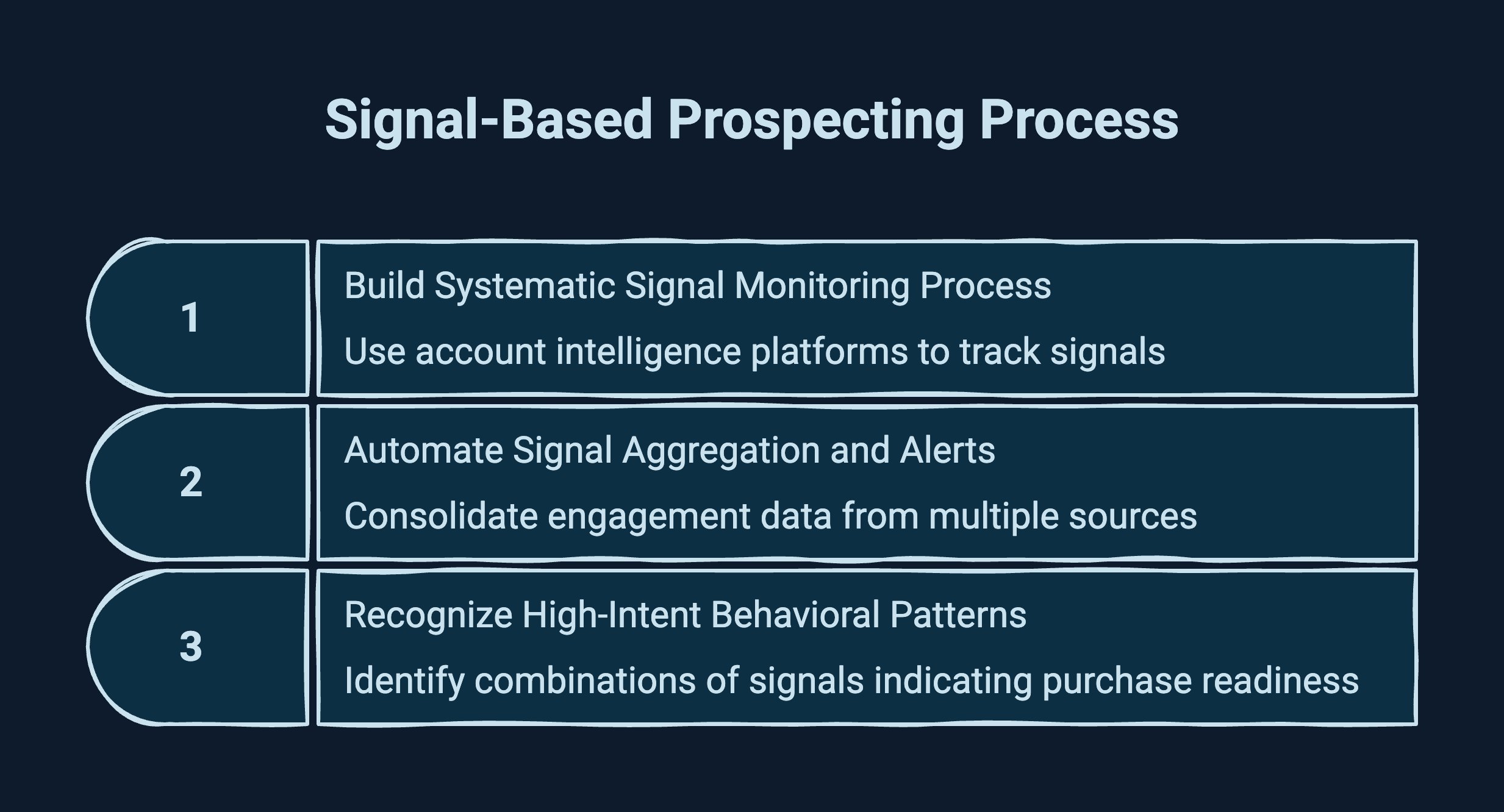
Knowing which signals matter is only part of effective prospecting. Revenue teams need structured systems to detect, prioritize, and act on intent data quickly. Moving from volume-based outreach to signal-driven execution significantly improves timing, personalization, and conversion outcomes.
Turning signals into revenue requires both process and precision.
Use account intelligence platforms to track funding announcements, leadership changes, hiring trends, and keyword mentions tied to your solution. Integrate tools to stack signals, such as combining pricing page visits with growth events, and dedicate daily review time to prioritize high-intent accounts.
Modern sales platforms consolidate engagement data from multiple sources, including CRM activity, content downloads, and social signals. For example, tools like LinkedIn Sales Navigator surface job changes and company updates, enabling faster, context-driven outreach based on verified activity.
Certain combinations of signals strongly indicate purchase readiness. Repeated pricing page visits followed by a case study download, webinar attendance paired with feature exploration, or funding news alongside relevant hiring activity often signal active evaluation and justify immediate personalized follow-up.
When these patterns emerge, timing becomes your competitive advantage.
A disciplined, signal-driven process replaces generic cold outreach with precise engagement rooted in real buyer behavior.
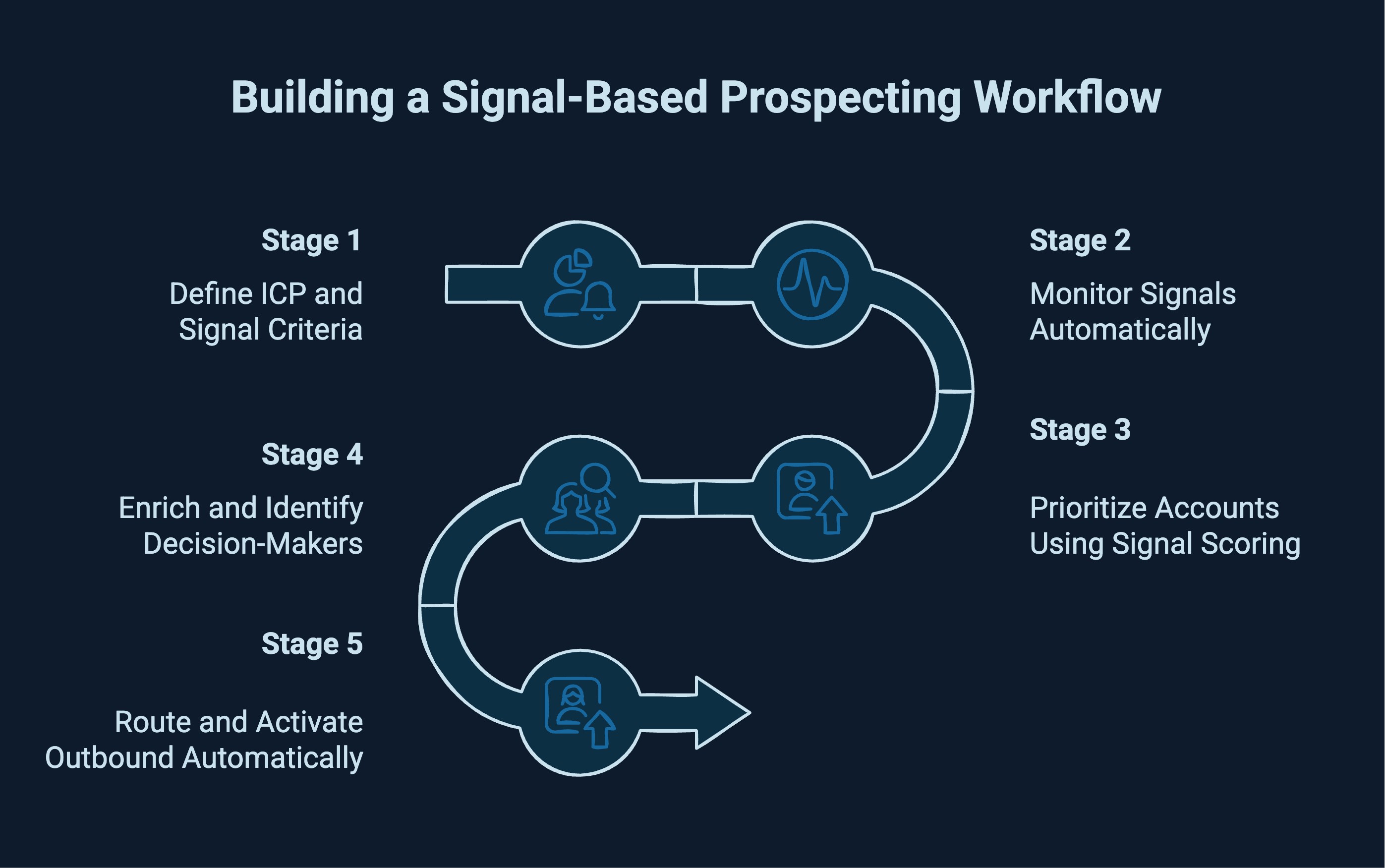
A strong signal-based system is not just about collecting intent data. It requires structured criteria, scoring logic, and automated execution inside your sales stack.
Clearly define your ideal customer profile and determine which signals indicate meaningful buying behavior. Separate high-intent signals from low-value engagement to avoid noise from the start.
Use intent data providers, website tracking, technographic monitoring, and trigger event tracking to continuously capture relevant signals in real time.
Apply scoring models that weigh recency, frequency, signal strength, and ICP fit. Automatically rank accounts so sales teams focus on the highest-probability opportunities first.
Once an account qualifies, enrich it with accurate firmographic and contact data. Identify the right stakeholders within the buying committee to ensure targeted outreach.
Push prioritized accounts into your CRM with routing rules based on territory, segment, or deal size. Trigger personalized sequences or task creation to ensure immediate engagement while intent is high.
When structured correctly, this workflow transforms fragmented signals into predictable pipeline generation rather than reactive outreach.
Read this guide to discover how to maximize profits through sales process optimization and identify gaps that may be limiting revenue performance.

Identifying buying signals is only the first step. High-performing teams use those signals to craft relevant, timely messaging that aligns with real buyer activity. Signal-based prospecting transforms generic outreach into contextual communication that captures attention and improves reply rates.
Execution determines whether signals convert into conversations.
Effective personalization starts by clearly referencing the event or behavior that prompted outreach. Mentioning funding announcements, leadership hires, webinar attendance, or product page engagement shows relevance and demonstrates research, immediately differentiating your message from generic cold emails.
Go beyond acknowledging the event and connect it to a likely business challenge. For example, a new funding round may signal scaling pressure, while a new executive hire may indicate process evaluation. Position your solution as directly supporting those emerging priorities.
Signals often indicate where a prospect sits in their evaluation journey. A pricing page visit may justify a demo invitation, while early-stage content engagement may warrant sharing a relevant case study. Matching your call-to-action to the intent level increases response probability.
Personalized, signal-driven engagement consistently outperforms volume-based messaging in competitive B2B markets.
LeadGem is a B2B growth and revenue operations agency headquartered in Amsterdam, the Netherlands, with over 5 years of experience in growth marketing and growth hacking. LeadGem builds signal-driven prospecting engines for B2B companies aiming for scalable pipeline growth.
As a Clay-certified GTM partner, LeadGem operationalizes signal detection, enrichment, and CRM activation to replace disconnected outbound efforts with structured, intent-led execution. The team serves companies across Benelux (Netherlands, Belgium), the Nordics (Sweden, Norway, Denmark), America, and Australia, helping revenue teams turn automation into predictable, high-quality pipeline growth.
Its framework blends strategic clarity with depth in automation.
LeadGem defines the signals most predictive of buying intent within each client’s industry and ideal customer profile. This prevents reliance on vanity metrics and ensures outreach is triggered by meaningful behavioral, firmographic, and technographic indicators.
When qualified signals are detected, automated workflows enrich accounts with verified decision-maker data, contextual insights, and role relevance. This prepares sales teams for timely, informed outreach without manual research delays.
Signals sync directly into CRM systems, triggering task routing, lifecycle updates, lead scoring adjustments, and personalized outbound sequences. This embeds signal-based prospecting into the broader revenue operations infrastructure rather than isolating it as a standalone tactic.
The outcome is a scalable, repeatable prospecting system built around verified buying intent.
Ready to turn buying signals into a qualified pipeline? Contact us today to build a customized signal-driven prospecting system that identifies high-intent accounts, automates outreach, and integrates seamlessly into your CRM for scalable, predictable growth.
Signal-based prospecting revolutionizes the way sales teams approach the right person at the right time. By tapping into the nuances of buyer intent through behavioral, technographic, and strategic signals, sales professionals can tailor their outreach efforts for maximum impact.
This personalized approach not only enhances engagement but also significantly increases the likelihood of conversion. As you incorporate these strategies, remember that understanding your buyers' signals is key to building meaningful connections and driving results.
Signal-based prospecting improves response rates by prioritizing high-intent accounts using verified buyer signals. It enables a sales rep to personalize outbound sales through behavioral insights, helping revenue teams focus on each target account and consistently generate better results across pipeline stages.
B2B teams often ignore best practices by reacting to isolated signals or defaulting to generic messaging and cold calls. Effective GTM teams validate multiple triggers, apply context within the sales process, and ensure outreach reflects meaningful engagement rather than surface-level activity.
In life sciences, vendors monitor clinical milestones, funding announcements, and leadership changes to identify opportunity windows. Tracking expansion updates and social media activity helps teams engage accounts during critical growth phases when budget alignment and strategic urgency converge.
AI aggregates engagement data from multiple sources, identifies predictive intent patterns, and automatically prioritizes accounts. It strengthens the feedback loop by analyzing which triggers convert, refining qualification models, and continuously optimizing outreach targeting to improve efficiency and pipeline performance.
The best platforms combine intent tracking, enrichment, CRM integration, and workflow automation into unified systems. LeadGem builds customized signal-driven infrastructures using Clay and integrated CRM workflows, ensuring signals activate structured outreach without creating fragmented data or operational silos.
Signal-driven engagement is often the only way to overcome inbox saturation and declining outbound effectiveness. Organizations that prioritize intent outperform competitors relying solely on static lists because timing, contextual relevance, and precision targeting significantly increase engagement and conversion rates.
Underrated signals include repeat feature exploration, competitor comparison research, hiring for related technical roles, and executive content engagement. These actions frequently indicate evaluation stages before direct inquiries occur, providing early positioning advantages for proactive revenue teams.
Engagement rates vary by industry and execution quality, but high signal accounts consistently outperform traditional prospecting segments. Well-structured campaigns often generate significantly higher response rates than broad outreach, reinforcing the measurable impact of intent-driven prioritization strategies.