

Contact


Revenue teams are expected to scale their pipeline with speed and precision, yet poor data quality continues to erode performance. Gartner estimates that bad data costs organizations an average of $12.9 million per year through inefficiencies, missed opportunities, and flawed decisions.
As go-to-market complexity increases, manual enrichment and static CRM workflows break down. Leads need real-time firmographic and intent data. High-value accounts must be routed accurately. Sales teams need prioritization logic, not spreadsheets.
Clay sits at the center of modern RevOps architecture as a data orchestration and decision layer. It connects your CRM, marketing automation, and outbound systems, turning fragmented signals into automated, structured revenue workflows.
This guide shows how to use Clay for scalable enrichment, intelligent routing, and AI-powered decision systems that improve qualification accuracy, accelerate handoffs, and drive predictable growth.
Clay RevOps is the strategic use of Clay as a programmable enrichment, routing, and decision layer within a revenue operations system.
Instead of functioning as a standalone data tool, Clay becomes the infrastructure that standardizes incoming data, automates qualification logic, and supports intelligent lead and account distribution.
In a RevOps motion, Clay connects multiple data providers, APIs, and signals into structured workflows. It operates upstream of the CRM, ensuring that only enriched, qualified, and correctly assigned records enter downstream systems.
It ensures that every record is enriched, validated, scored, and routed before entering core systems like the CRM. This reduces manual work, improves accuracy, and creates consistency across marketing, sales, and customer success.
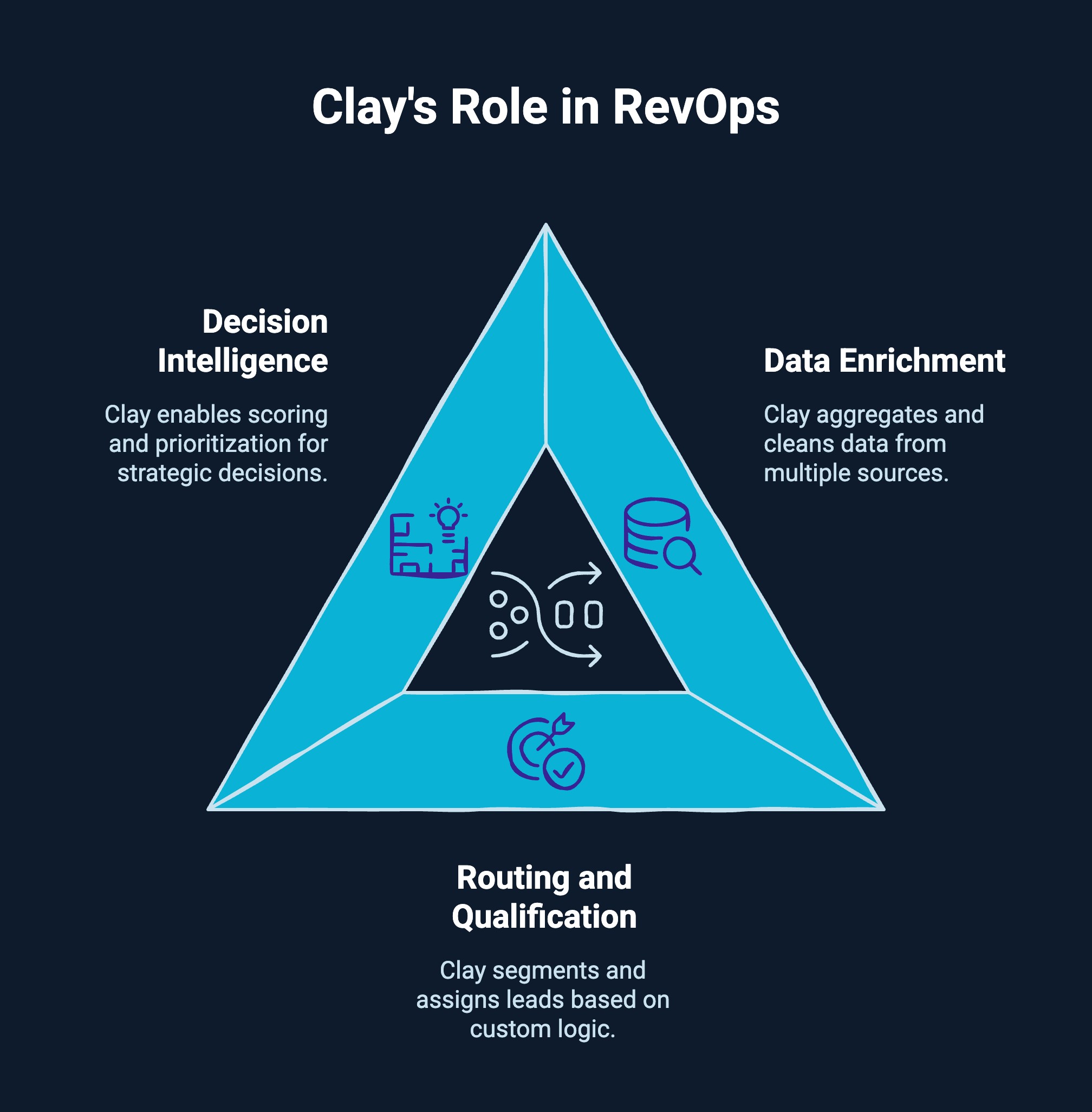
In a modern revenue operations architecture, Clay sits between data sources and your CRM as a programmable intelligence layer. It does not replace your CRM or marketing automation platform.
Instead, it strengthens them by ensuring that every lead, contact, and account is enriched, qualified, and routed before sales engagement begins.
Clay typically operates across three critical layers in the RevOps stack:
Clay aggregates firmographic, technographic, intent, and contact data from multiple providers. It validates, cleans, and standardizes records before they sync into the CRM. This prevents incomplete profiles and reduces manual research time for SDRs.
Using custom logic, Clay can segment leads by ICP fit, geography, company size, industry, or revenue potential. Based on predefined rules, records are automatically assigned to the right rep or team. This eliminates lead leakage and reduces response time.
Clay enables scoring models and signal-based prioritization. Teams can identify high-intent accounts, flag expansion opportunities, and surface risk indicators. Instead of static reports, RevOps gains a dynamic decision engine that informs who to prioritize and why.
When integrated properly, Clay becomes the operational control center that ensures data accuracy, routing precision, and smarter revenue decisions across the entire GTM motion.
Looking to scale outbound without adding headcount? Explore how the Clay Sales Tool automates prospecting, enrichment, and personalization to help your team build a pipeline faster and close smarter.
Clay and traditional RevOps tools serve different purposes in the revenue stack.
Traditional RevOps Tooling
Clay
In short, traditional tools manage revenue operations infrastructure, while Clay enhances how data is enriched, segmented, and activated before it reaches core systems.
Want cleaner data, faster routing, and zero manual enrichment? See how Clay HubSpot Integration helps you automate your CRM and turn every lead into real pipeline momentum.
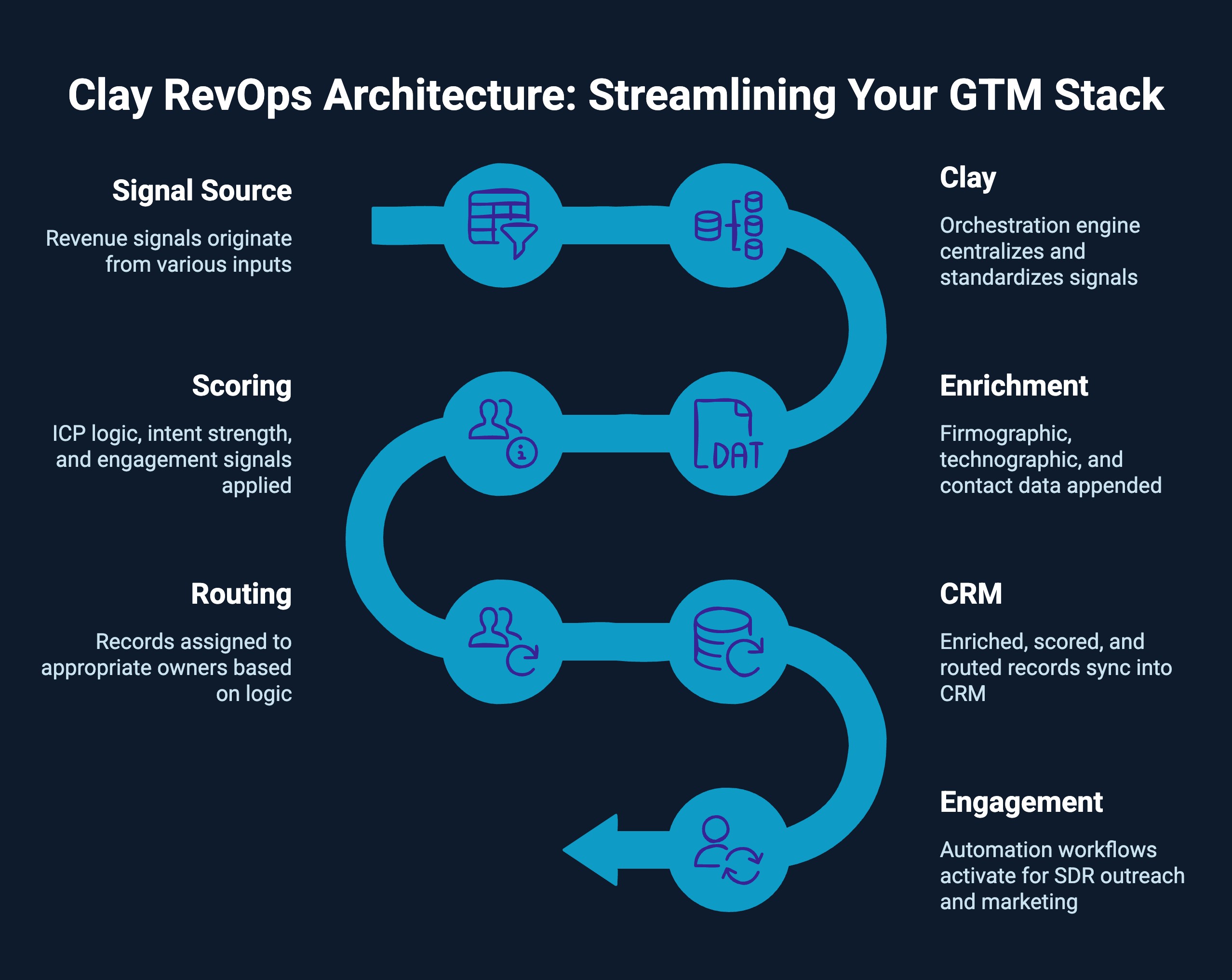
Clay operates as the control layer that structures how revenue data moves across your GTM systems. Rather than allowing raw signals to flow directly into execution platforms, Clay processes, qualifies, and assigns records before activation.
The architecture can be understood as a structured progression across key stages:
By structuring this end-to-end flow, Clay ensures that every record entering your GTM stack is qualified, prioritized, and aligned with revenue strategy before engagement begins.
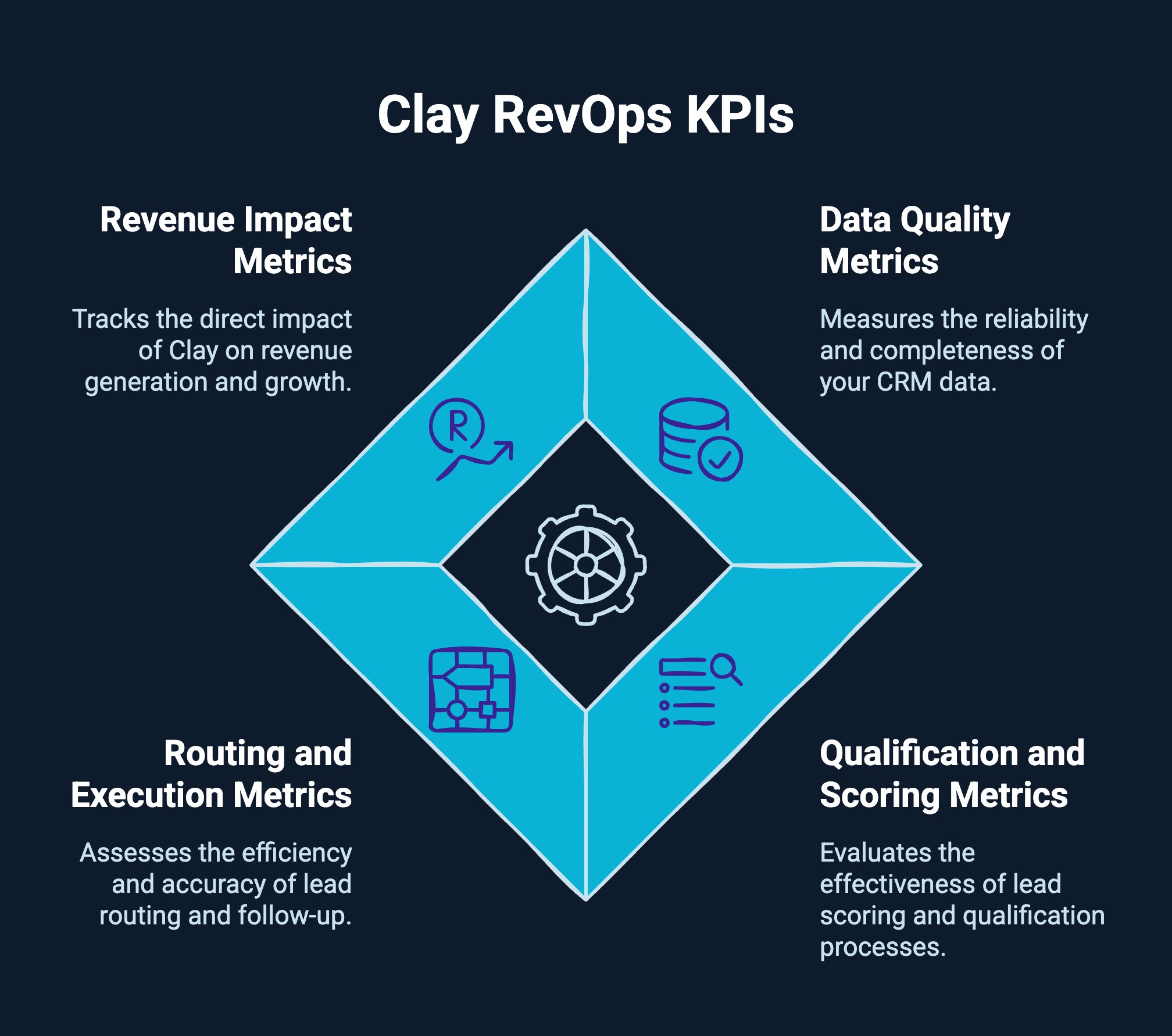
To measure the impact of Clay within your RevOps architecture, you need metrics that reflect data quality, routing efficiency, and revenue acceleration. The goal is not just enrichment volume, but operational performance.
Below are the core KPIs that indicate whether Clay is functioning as a true revenue engine:
These metrics show whether upstream data is structured and reliable.
These indicators measure decision-layer effectiveness.
These metrics reflect operational efficiency and accountability.
When these KPIs trend positively, it signals that Clay is not just enriching data but structurally improving revenue execution.
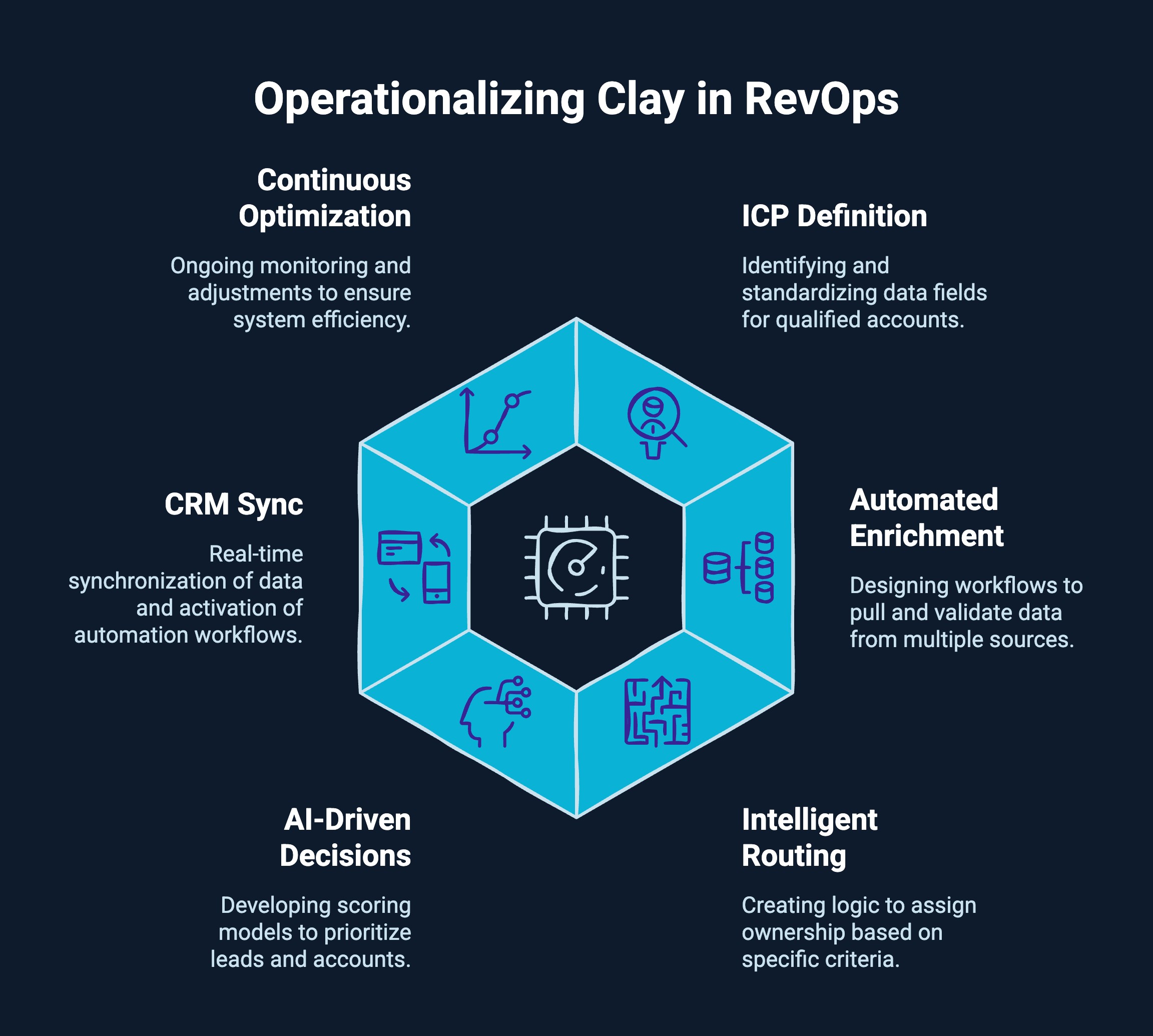
Implementing Clay within RevOps requires a structured design. Below is a practical framework to operationalize enrichment, routing, and decision-making.
Start with clarity. Identify the firmographic, technographic, and intent signals that define a qualified account. Standardize required CRM fields and determine which enrichment sources will populate them. Without a defined data model, automation creates noise instead of clarity.
Design workflows that trigger when new leads or accounts enter your system. Pull data from multiple providers, validate accuracy across sources, and normalize formatting before syncing to the CRM. Add deduplication logic to prevent record conflicts.
Create routing logic based on ICP fit, territory, industry, deal size, or product line. Assign ownership automatically and include fallback rules to prevent unassigned records. This ensures speed and accountability.
Develop scoring models that prioritize leads and accounts based on enrichment signals. Combine firmographic fit with intent data and engagement signals. Use this logic to surface high-value opportunities and guide SDR focus.
Sync enriched and routed records back into the CRM in real time. Trigger automation workflows for lifecycle stage updates, task creation, and notifications. Ensure SDR outreach sequences activate automatically once qualification thresholds are met. This closes the loop between data and action.
Monitor routing accuracy, scoring performance, and enrichment coverage on an ongoing basis. Adjust logic as ICP definitions evolve. Audit data quality regularly and optimize enrichment sources to reduce noise. Governance ensures scalability without system decay.
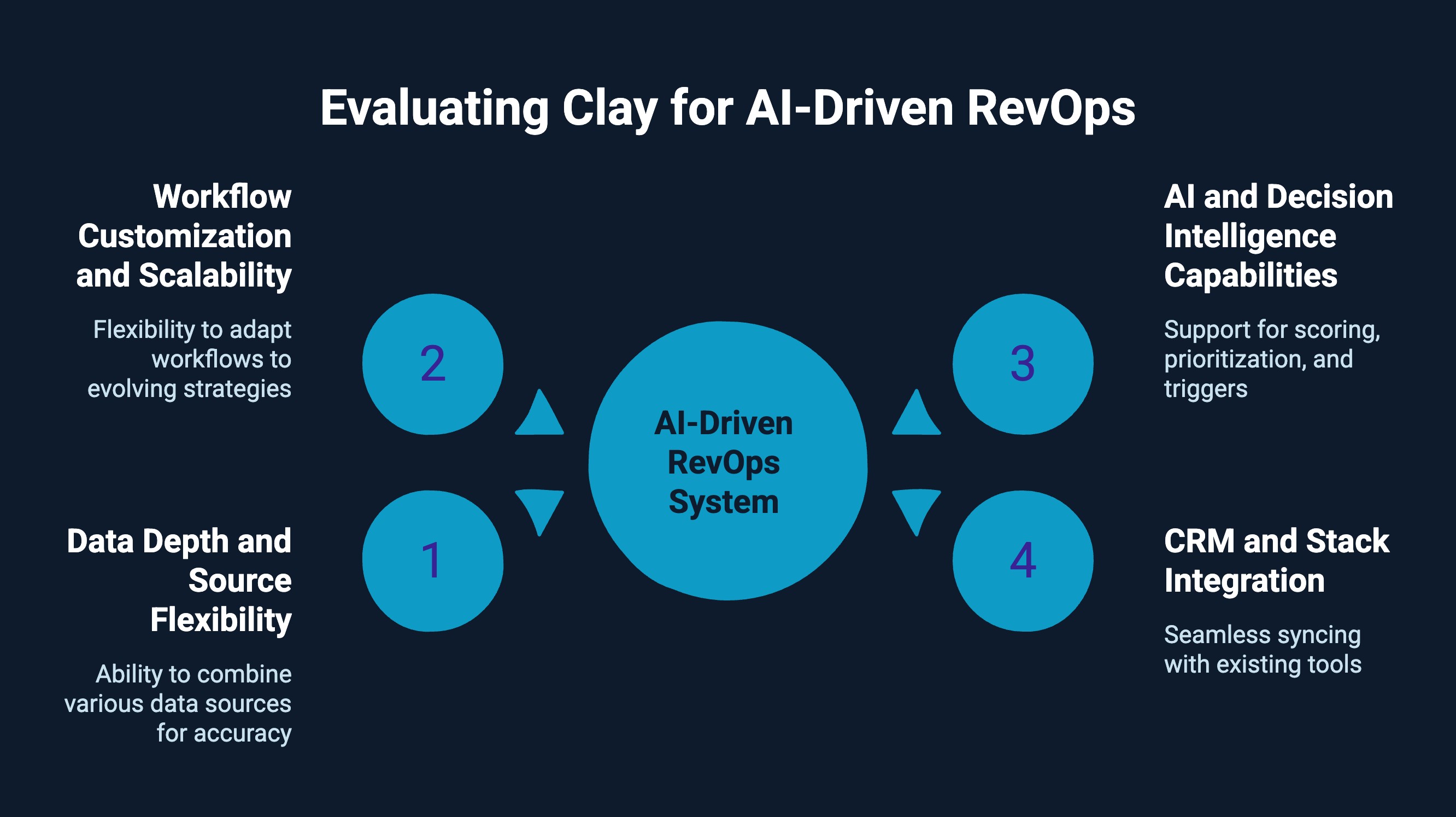
When adopting Clay RevOps, the goal is not just better data. The goal is better decisions. To properly evaluate Clay within an AI-driven RevOps motion, assess it across four critical dimensions.
Evaluate how many enrichment sources Clay can orchestrate. Can it combine firmographic, technographic, intent, and hiring signals? Can you validate data across multiple providers to improve accuracy? Strong AI RevOps depends on multi-source signal aggregation, not single-provider dependency.
Assess how flexible the workflow builder is. Can RevOps design complex qualification logic without engineering support? Can workflows scale across multiple segments, products, or territories? The right setup should support evolving GTM strategies without constant rebuilds.
Determine how Clay supports scoring, prioritization, and signal-based triggers. Can you combine enrichment data with engagement signals? Can you dynamically prioritize accounts based on ICP fit and buying intent? In AI RevOps, automation must translate into actionable prioritization.
Review how Clay syncs with your CRM and sales tools. Are updates real-time or batch-based? Is field mapping controlled and auditable? Does it maintain data hygiene and prevent duplication? Seamless integration is essential for operational reliability.
Evaluating Clay through this lens ensures you are not just buying enrichment. You are designing a scalable AI-powered RevOps system that improves routing precision, qualification accuracy, and revenue predictability.
Want richer, actionable leads without manual work? Check out how Clay Data Enrichment automatically fills in missing contact details and firmographics so your sales team spends time selling, not researching.
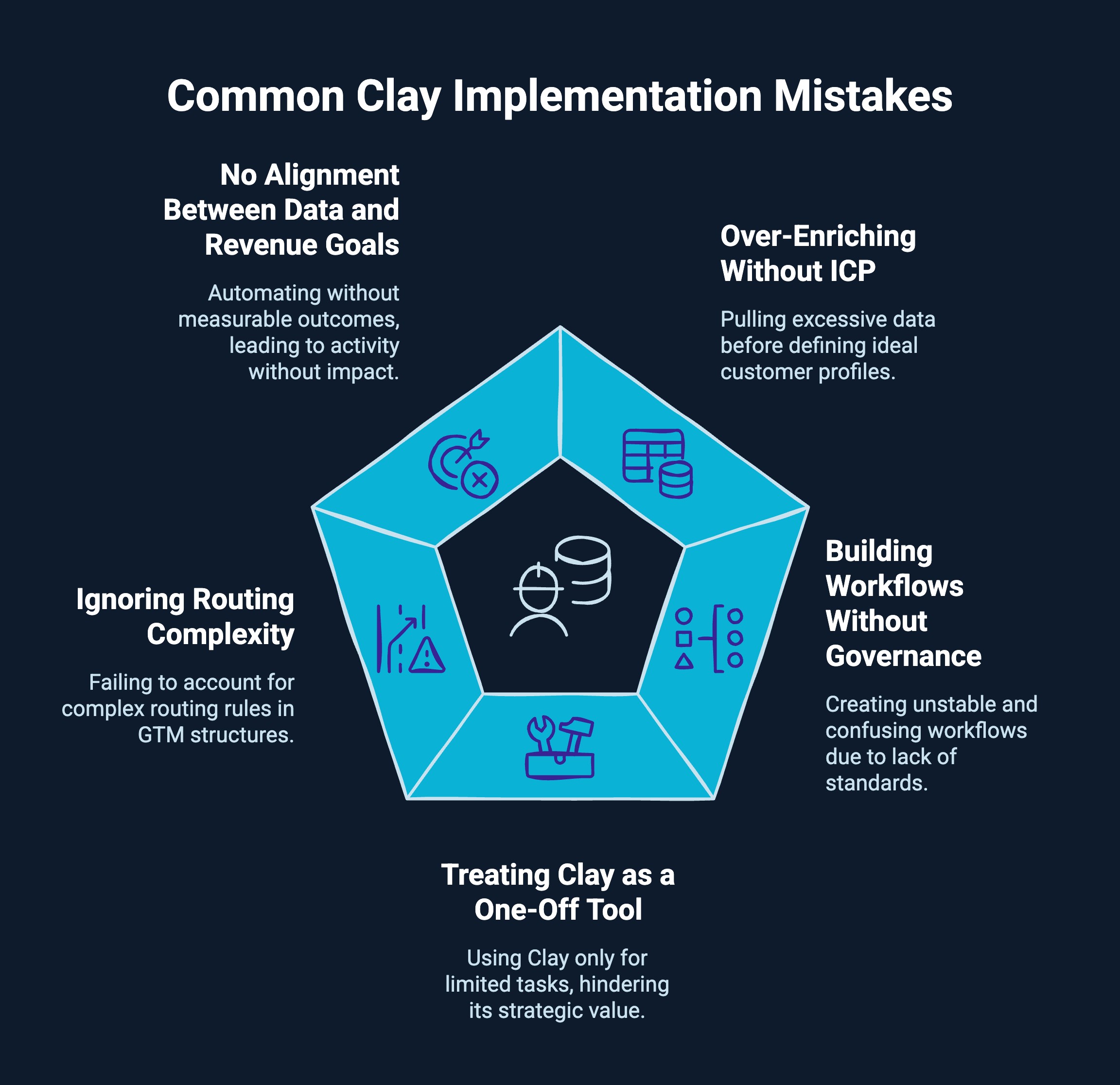
Even powerful platforms like Clay can underperform if implemented without a structured RevOps design. Below are common mistakes and how to correct them.
Many teams pull excessive data before clearly defining their ideal customer profile. This leads to cluttered records and unfocused scoring.
Fix: Start with a strict ICP framework and map enrichment fields directly to qualification and routing decisions. Every data point should support revenue outcomes.
As workflows grow, undocumented logic and frequent ad-hoc edits create instability and confusion.
Fix: Establish naming conventions, documentation standards, version control, and approval processes. Treat Clay workflows like production systems, not experiments.
Using Clay only for list building or occasional enrichment limits its strategic value.
Fix: Position Clay upstream of the CRM as a continuous enrichment and decision layer that powers qualification, routing, and prioritization across the GTM motion.
Basic round-robin logic often fails in complex GTM structures involving territories, verticals, product lines, and account ownership rules.
Fix: Design routing logic around real business structure. Incorporate segmentation rules, fallback logic, and escalation pathways to prevent lead leakage.
Automation without measurable outcomes results in activity without impact.
Fix: Tie enrichment, scoring, and routing logic directly to KPIs such as conversion rate, response time, pipeline quality, and deal velocity. Measure system performance regularly and iterate.
Addressing these gaps ensures Clay operates as a scalable RevOps engine rather than just another automation layer in your stack.
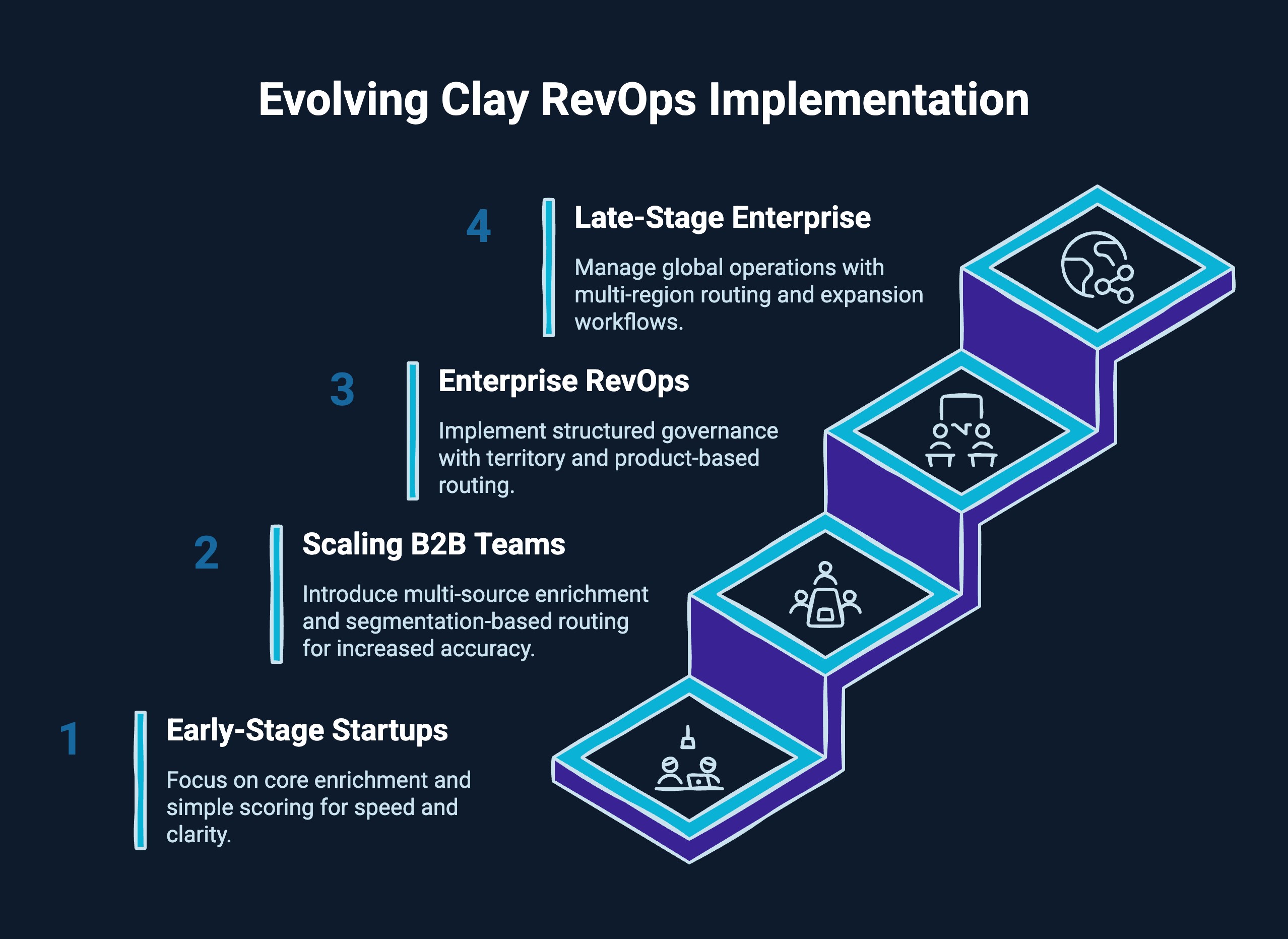
The way you implement Clay should evolve as your company grows. Enrichment depth, routing complexity, and decision logic must align with your GTM maturity.
At this stage, speed and clarity matter most.
The objective is clean data and consistent qualification without overbuilding systems.
As pipeline volume increases, operational gaps become more visible.
Here, Clay becomes a centralized enrichment and routing layer that reduces manual effort and improves prioritization.
At scale, complexity demands structured governance.
At this stage, Clay functions as a programmable intelligence layer supporting advanced RevOps governance and predictable revenue growth.
Global growth introduces operational fragmentation if not structured properly.
At this stage, Clay supports coordinated global execution by aligning enrichment, routing, and expansion logic across regions while maintaining centralized visibility and governance.
Curious how to target high-value accounts more effectively? Learn how Clay ABM helps you identify, engage, and convert your best prospects with precision and personalized outreach.
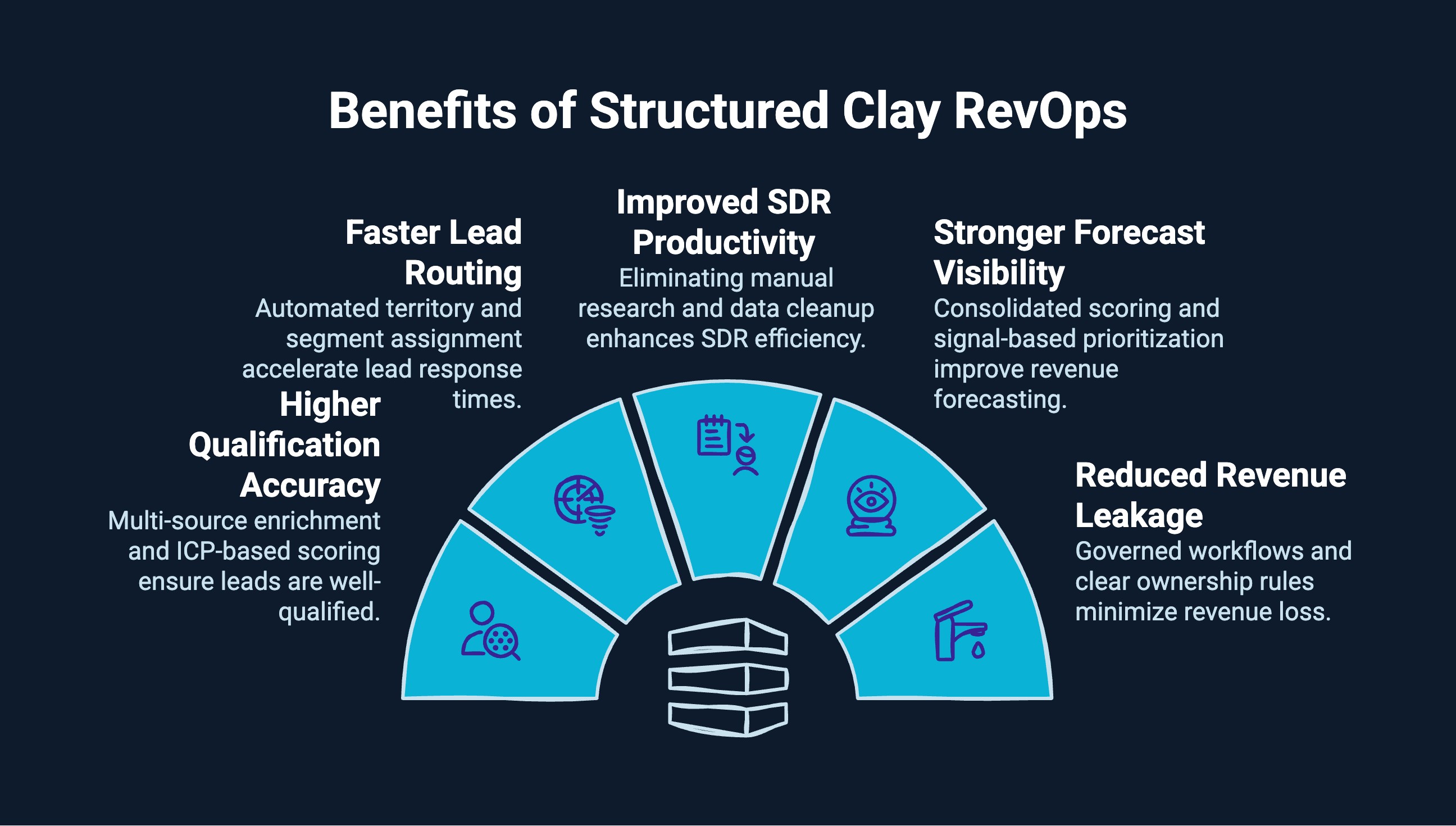
When Clay is implemented within a properly designed RevOps framework, the impact goes beyond automation. It improves qualification accuracy, accelerates execution, and strengthens revenue visibility. Instead of disconnected workflows, teams operate on clean, enriched, and prioritized data that supports faster and smarter decisions.
Research from the Harvard Business Review lead response time study found that companies that respond to leads within one hour are about seven times more likely to qualify the lead compared with those that wait longer.
A structured Clay RevOps implementation typically drives:
When enrichment, routing, and decision logic are aligned with revenue goals, Clay becomes more than an automation layer. It becomes a scalable operational engine that supports predictable growth.
Clay is not necessary for every company. The real question is whether your RevOps complexity requires a programmable enrichment and routing layer.
Clay is a strong fit when:
It may be unnecessary if:
In growing B2B organizations, complexity increases quickly. As territories expand, products diversify, and inbound volume rises, enrichment and routing errors compound. At that stage, Clay becomes less of a luxury and more of an operational necessity.
The key is not whether Clay is powerful. It is whether your RevOps architecture is ready to use it strategically. When aligned with structured system design, Clay becomes a scalable revenue engine that supports predictable growth.
While platforms like Clay can automate enrichment and routing, unlocking their full impact requires RevOps strategy, system design, and ongoing optimization. That’s where LeadGem comes in.
We are a B2B growth and RevOps agency based in Amsterdam, the Netherlands, with 5+ years of experience building scalable outbound and revenue systems. With a strong background in B2B growth marketing and growth hacking, and as a Clay-certified partner, we turn Clay into a structured revenue engine. We design enrichment architecture, routing logic, and AI-driven scoring models that directly improve pipeline quality and drive predictable growth.
We work with companies across the Benelux, Nordics, America, and Australia, helping automate sales processes, strengthen CRM governance, and scale revenue with precision.
If you want Clay to deliver measurable revenue impact, LeadGem aligns strategy and execution to make it happen.
Clay is powerful, but power without structure creates complexity.
The real value of Clay RevOps comes from intentional design. Define your ICP first. Align enrichment with qualification. Build routing around GTM structure. Tie scoring directly to revenue KPIs. When each layer supports a clear outcome, automation becomes leverage.
As your business scales, complexity increases. A structured Clay implementation helps you protect pipeline quality, speed up decisions, and reduce revenue leakage.
Clay is the engine. Strategic RevOps design turns it into predictable growth.
Master AI data enrichment, workflow automation, and CRM sync with tools like Salesforce and HubSpot. Practice building prospect lists using buyer intent data, web scraping, and specific criteria. Follow best practices aligned to specific business needs to drive ROI.
AI enrichment, multi-source contact details validation, workflow automation, CRM sync, buyer intent data integration, prospect data scoring, and outbound sales personalization. It reduces manual data entry and strengthens sales pipeline efficiency.
Automating outbound marketing prospect lists, enriching raw data from LinkedIn and Apollo, routing leads to sales reps, syncing with customer relationship management systems, and triggering personalized email outreach based on buyer intent data for better results.
Clay AI enriches and automates data workflows using AI, pulling prospect data from multiple sources, validating contact details, and feeding structured intelligence into CRM and sales pipelines for smarter routing and prioritization.
RevOps aligns marketing, sales, and customer success around unified data, processes, and tools to improve efficiency, pipeline visibility, and predictable revenue growth.
Publicly available sources do not disclose Clay’s exact revenue for 2025. As a private company focused on AI data enrichment and workflow automation, specific financial performance figures have not been shared.