

Contact


Revenue teams are overloaded with technology. The average B2B organization operates with 12–20 marketing and revenue tools, but many struggle to unify data, attribute pipeline accurately, and gain visibility across functions, even as tool counts grow.
When your go-to-market tech stack is not intentionally designed, sales, marketing, and customer success systems do not talk to each other.
Leads lack context, reporting becomes unreliable, and scaling revenue becomes increasingly complex because teams are coordinating around disconnected platforms rather than shared insights.
This guide explains what a modern GTM tech stack should include, how to build and scale it strategically, and how to select, integrate, and operationalize the right tools so your technology works as a unified system that drives predictable revenue growth.
A GTM tech stack refers to the collection of tools and systems used by sales, marketing, and customer success teams to execute a company’s go-to-market strategy. It includes platforms for CRM, marketing automation, sales engagement, product analytics, data enrichment, reporting, and integrations that together support the full revenue lifecycle.
Unlike a standalone sales or marketing stack, a true go-to-market tech stack is cross-functional. It connects demand generation, pipeline management, deal execution, onboarding, expansion, and retention into a single operational framework.
The goal is not just automation, but alignment across teams through shared data and shared metrics.
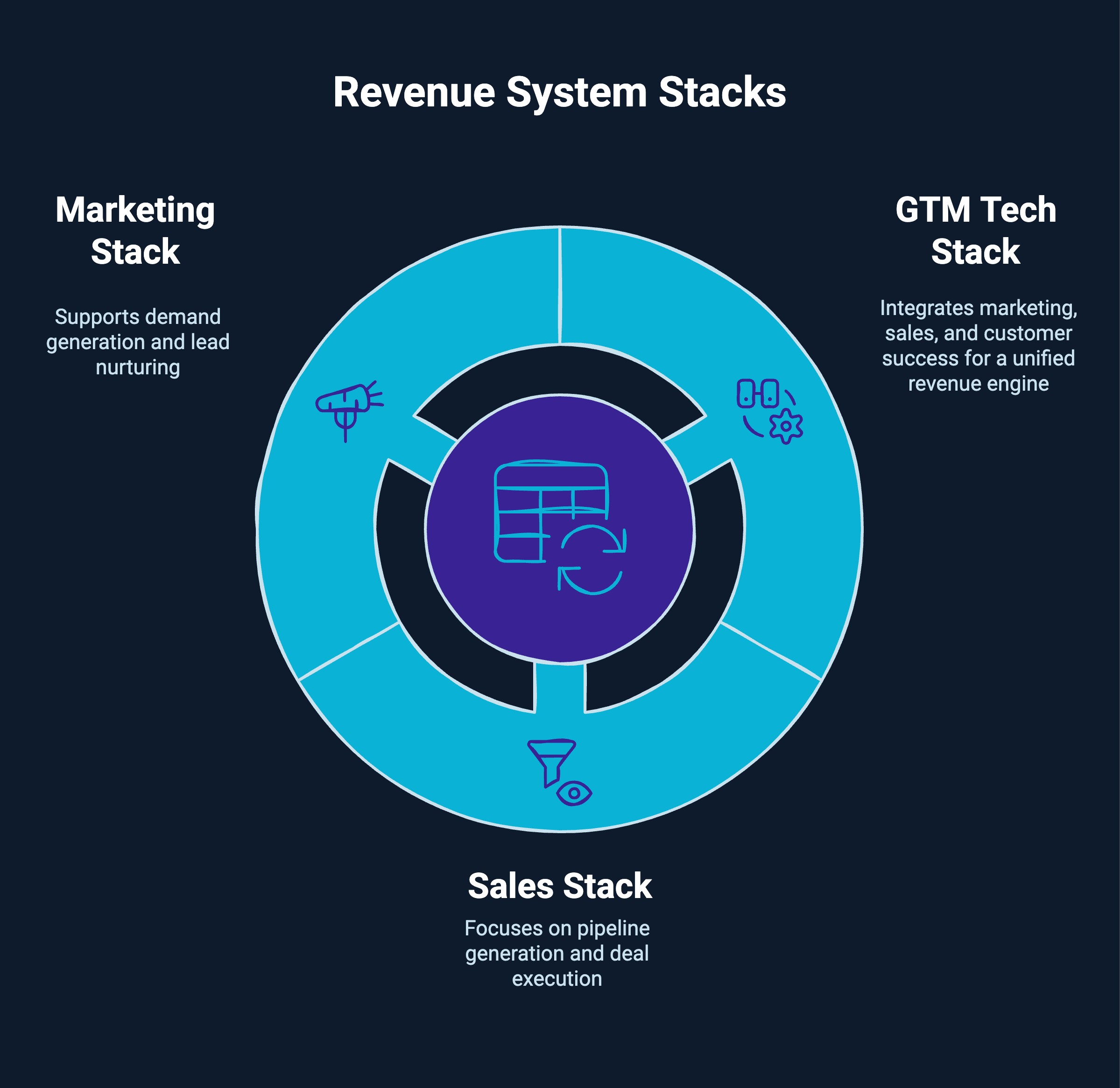
Many teams use these terms interchangeably, but they operate at different levels of your revenue system. The marketing stack and sales stack are function-specific toolsets. The GTM tech stack is broader and unifies both into one coordinated revenue engine.
Understanding the difference helps prevent siloed systems, duplicate tools, and disconnected reporting.
The GTM tech stack represents the complete infrastructure that supports revenue generation across marketing, sales, and customer success. It includes CRM, automation, data enrichment, reporting, and analytics tools working together across the entire buyer journey. Platforms like HubSpot or Salesforce typically act as the shared system of record that connects all revenue teams.
The sales stack is focused specifically on pipeline generation and deal execution. It includes prospecting tools, sales engagement platforms, call intelligence software, and forecasting systems. Examples include Outreach, Salesloft, and enrichment providers like ZoomInfo. Its purpose is to increase rep productivity, improve pipeline visibility, and drive higher close rates.
The marketing stack supports demand generation and lead nurturing. It typically includes marketing automation platforms, email tools, landing page builders, paid media tracking systems, and analytics solutions. Tools such as HubSpot Marketing Hub help attract, capture, and qualify leads before handing them off to sales.
In short, the marketing stack creates demand, the sales stack converts that demand into revenue, and the GTM tech stack integrates both into a unified, data-driven revenue system.
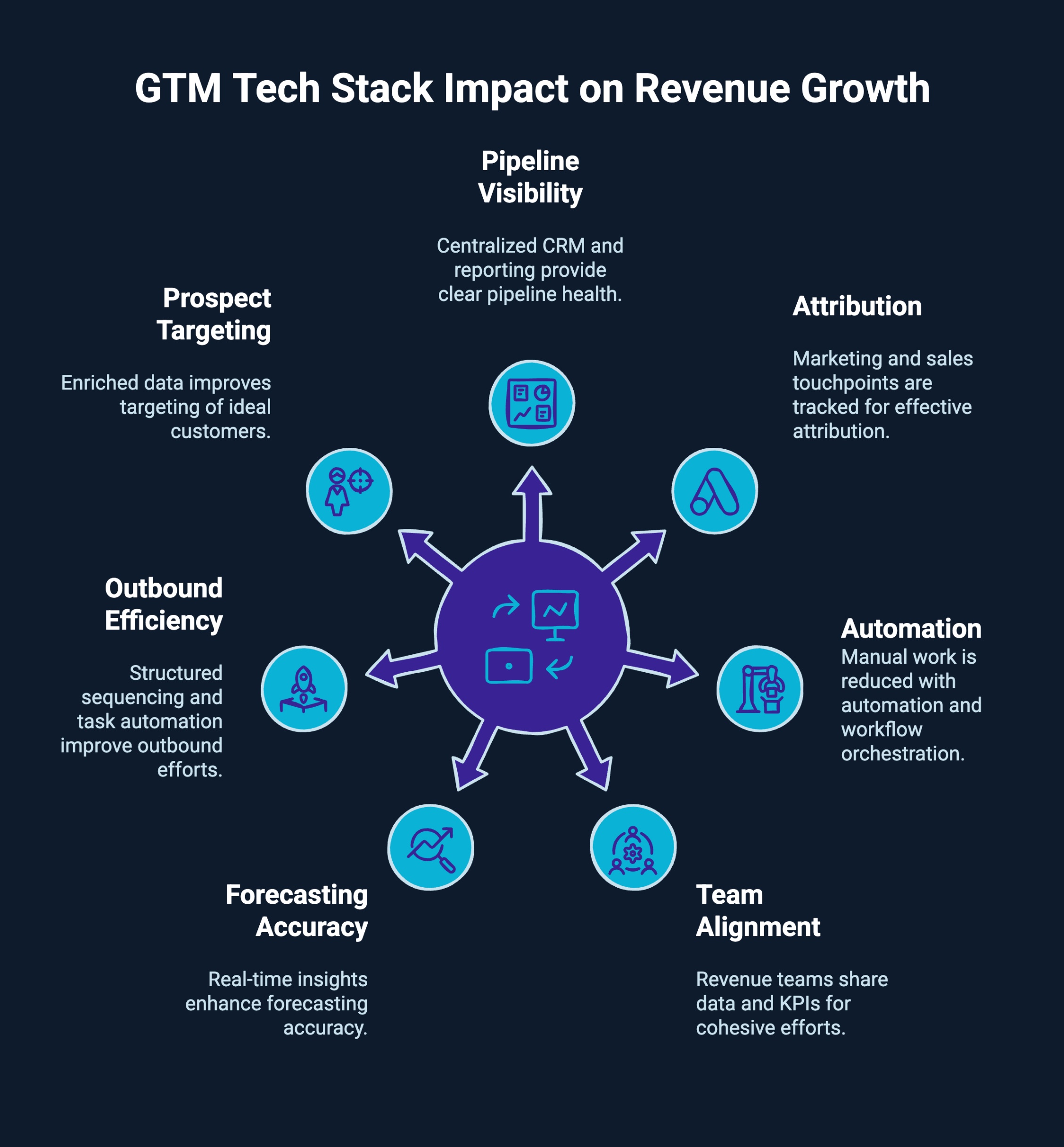
Your GTM tech stack directly impacts how efficiently revenue is generated. When systems are integrated and aligned, teams gain clear visibility into pipeline health, campaign performance, sales activity, and customer engagement. This clarity strengthens execution and improves revenue predictability.
A well-structured go-to-market tech stack drives growth by:
For outbound-focused teams, integration is critical. When CRM, enrichment tools, and sales engagement platforms work together, reps target high-fit accounts, personalize outreach at scale, and prioritize based on real engagement signals. This shifts outbound from volume-based prospecting to precision-based execution.
In contrast, disconnected tools create reporting gaps, duplicate work, poor targeting, and inconsistent data. Instead of accelerating growth, the stack slows pipeline velocity.
A strategically designed GTM tech stack turns technology into an operational advantage that supports scalable outbound execution and predictable revenue expansion, aligning with LeadGem’s structured RevOps approach.
Looking to strengthen alignment between prospecting and revenue outcomes? Check out our guide on choosing the best marketing agency for sales enablement.
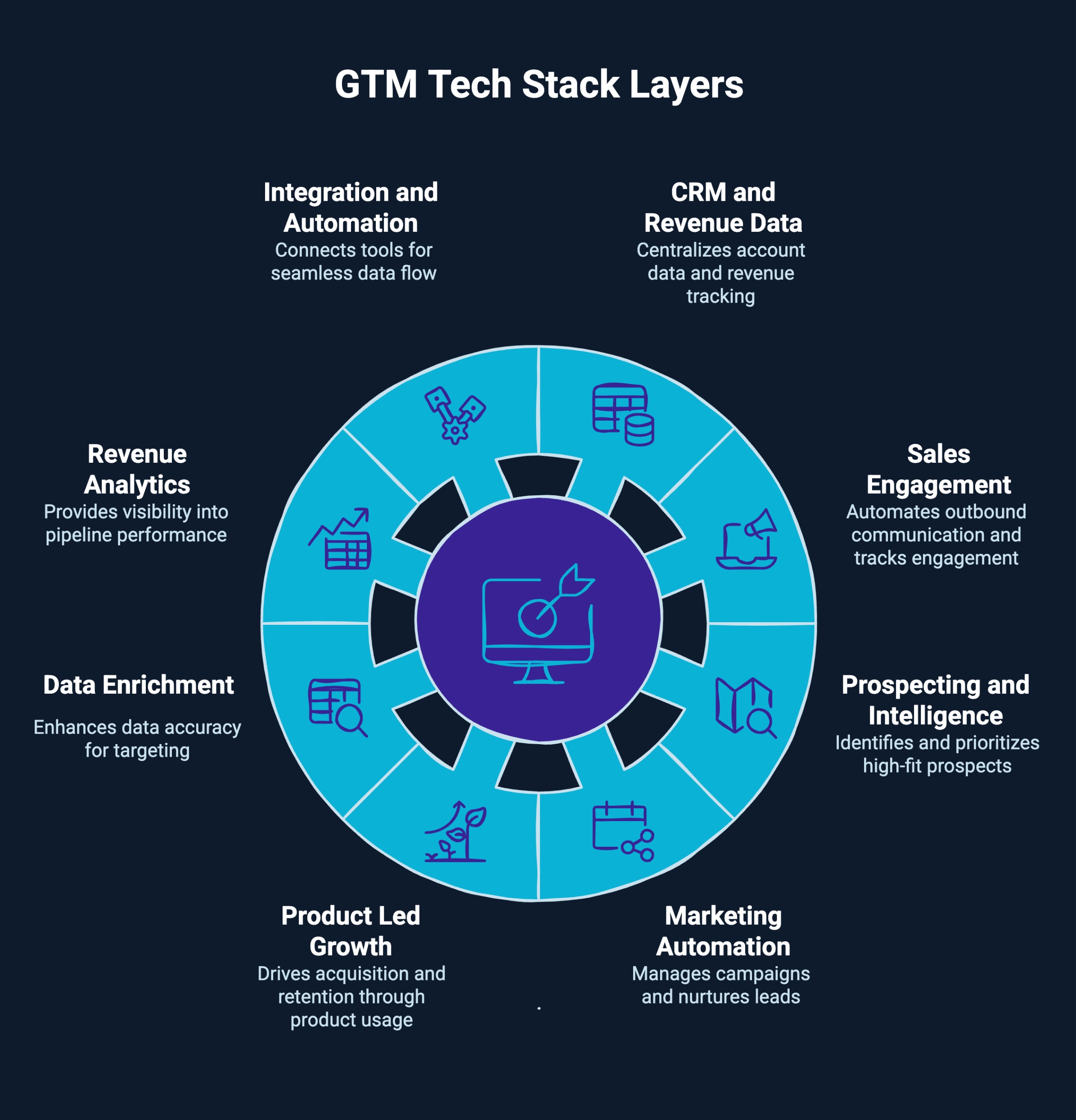
A modern GTM tech stack is built in layers. Each category plays a specific role in generating, converting, and retaining revenue. Below are the essential components and leading platforms within each.
Your CRM is the core of your go-to-market tech stack. It centralizes account data, deal stages, pipeline reporting, and lifecycle tracking.
Common CRM platforms include:
The CRM houses structured revenue data across marketing, sales, and customer success. When properly configured, it becomes the single source of truth for forecasting, attribution, lifecycle reporting, and revenue analytics. Every other GTM tool should sync back to this foundation.
Sales engagement platforms help teams execute and manage outbound communication at scale. They automate email sequences, schedule follow-ups, track engagement, and standardize outreach workflows across reps. These tools focus on execution and performance visibility.
Leading sales engagement platforms include:
They improve response rates, enforce structured sequencing, and feed activity data back into the CRM for accurate reporting and forecasting.
Prospecting tools help teams identify and prioritize the right accounts and contacts before outreach begins. They provide firmographic data, technographic insights, buying signals, and advanced search capabilities to refine targeting.
Common prospecting and intelligence platforms include:
These systems strengthen outbound efficiency by ensuring reps focus on high-fit, high-intent prospects instead of building lists manually. When integrated properly with CRM and engagement platforms, they create a more precise and scalable outbound engine.3. Marketing Automation and Demand Generation
Marketing automation platforms manage campaigns, nurture workflows, segmentation, and lead scoring.
Popular options include:
These tools capture demand, qualify leads, and pass structured data to sales, ensuring a smoother transition from MQL to SQL.
If you are learning how to build a product-led GTM tech stack, this layer is critical. PLG companies rely on product usage data to drive acquisition, expansion, and retention.
Common PLG and activation tools include:
These platforms track feature usage, activation milestones, and engagement patterns. When integrated with CRM, they allow sales and customer success to prioritize accounts based on real product behavior.
Enrichment tools enhance contact and company data, improving targeting and segmentation accuracy.
Leading intelligence platforms include:
These systems strengthen outbound precision, improve ICP targeting, and support signal-based outreach strategies.
Revenue analytics tools provide visibility into pipeline performance and forecast accuracy.
Common solutions include:
This layer ensures leadership can monitor pipeline coverage, conversion rates, and revenue predictability with confidence.
The integration layer connects all GTM tech stack tools into one operational system.
Key platforms include:
Without integration and workflow automation, even the best go-to-market tech stack becomes fragmented. This layer ensures data flows seamlessly across systems, enabling scalable and efficient revenue operations.
Curious how agency expertise can supercharge your Clay workflows? Dive into our breakdown of Clay agency support and best-fit engagement models.
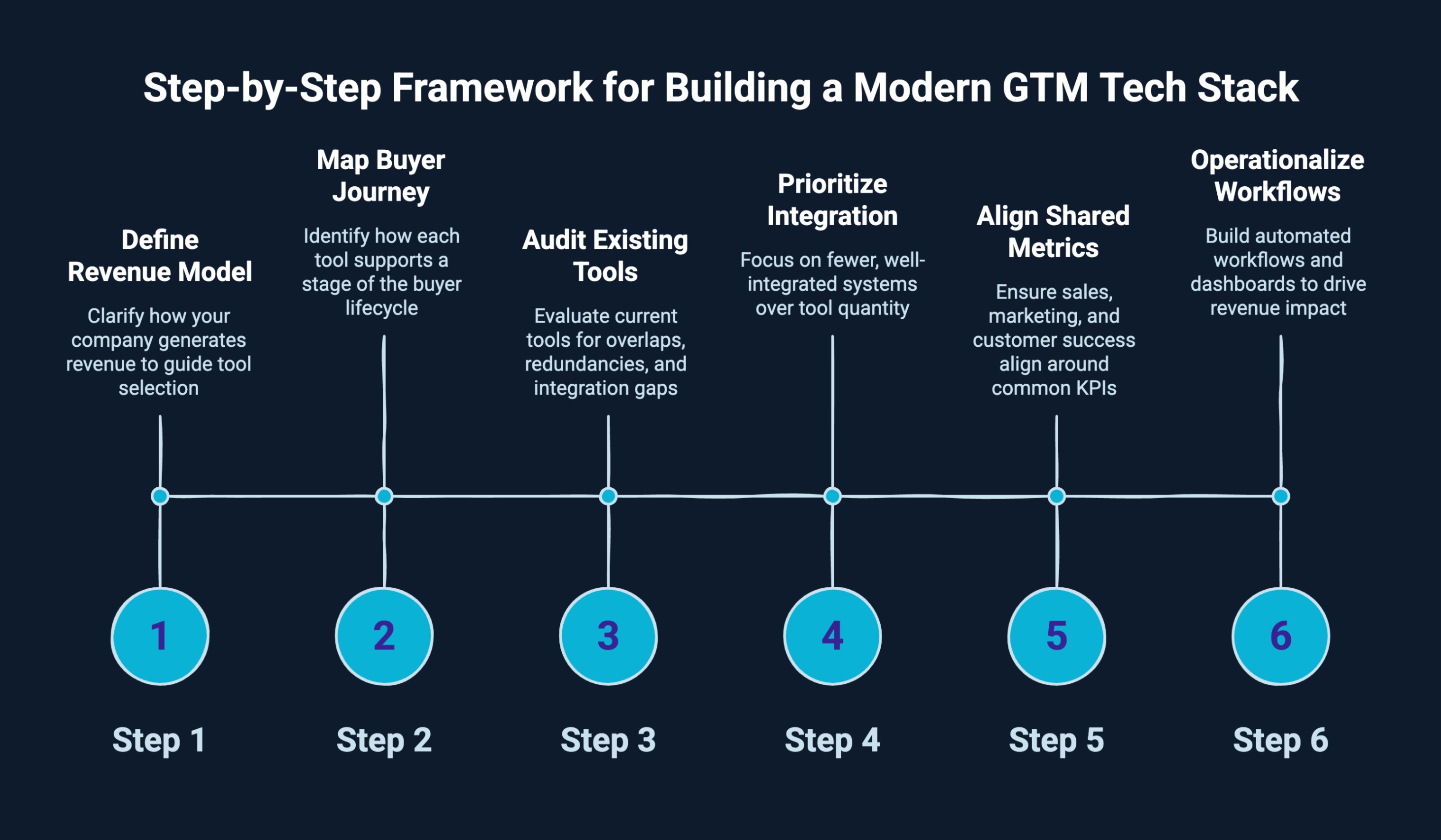
Building a high-performing GTM tech stack starts with strategy, not software. The right structure depends on your revenue model, customer journey, and operational maturity. Follow this framework to design a stack that supports scalable growth.
Your revenue model determines which tools matter most and how they should connect.
Clarity here prevents unnecessary tool purchases and ensures your stack supports how you actually generate revenue.
Every tool in your go-to-market tech stack should support a stage of the buyer lifecycle:
Mapping the journey ensures coverage without duplication and highlights integration points between systems.
Before adding new platforms, evaluate what you already use.
Many companies can optimize revenue performance simply by consolidating and properly configuring their current stack.
More tools do not equal better performance. In fact, fewer well-integrated systems often outperform bloated stacks.
Integration creates operational efficiency, reduces manual work, and strengthens data accuracy across teams.
Technology alone does not drive growth. Alignment does.
Your GTM tech stack should support shared KPIs such as:
The final and most overlooked step is operational execution. Tools create potential, but structured workflows turn that potential into revenue impact.
This is where many companies struggle. Without documented processes, ownership, and automation logic, even the best tools underperform.
LeadGem specializes in turning fragmented tools into structured RevOps systems. By designing workflows, integrating platforms, and building automation frameworks, LeadGem helps companies operationalize their GTM stack into a predictable revenue engine rather than just a collection of software.
Need help turning revenue strategy into repeatable execution? Explore our practical guide to RevOps implementation and how to build scalable systems.
Scaling your GTM tech stack requires adding capability without increasing complexity. Expansion should solve operational gaps, not create new ones.
Add tools only when there is a clear need, such as:
You may have outgrown your current stack if you notice:
As you scale, focus on strengthening automation maturity and governance. This includes:
The goal is to scale your GTM tech stack in a way that improves efficiency and alignment while preserving operational control.
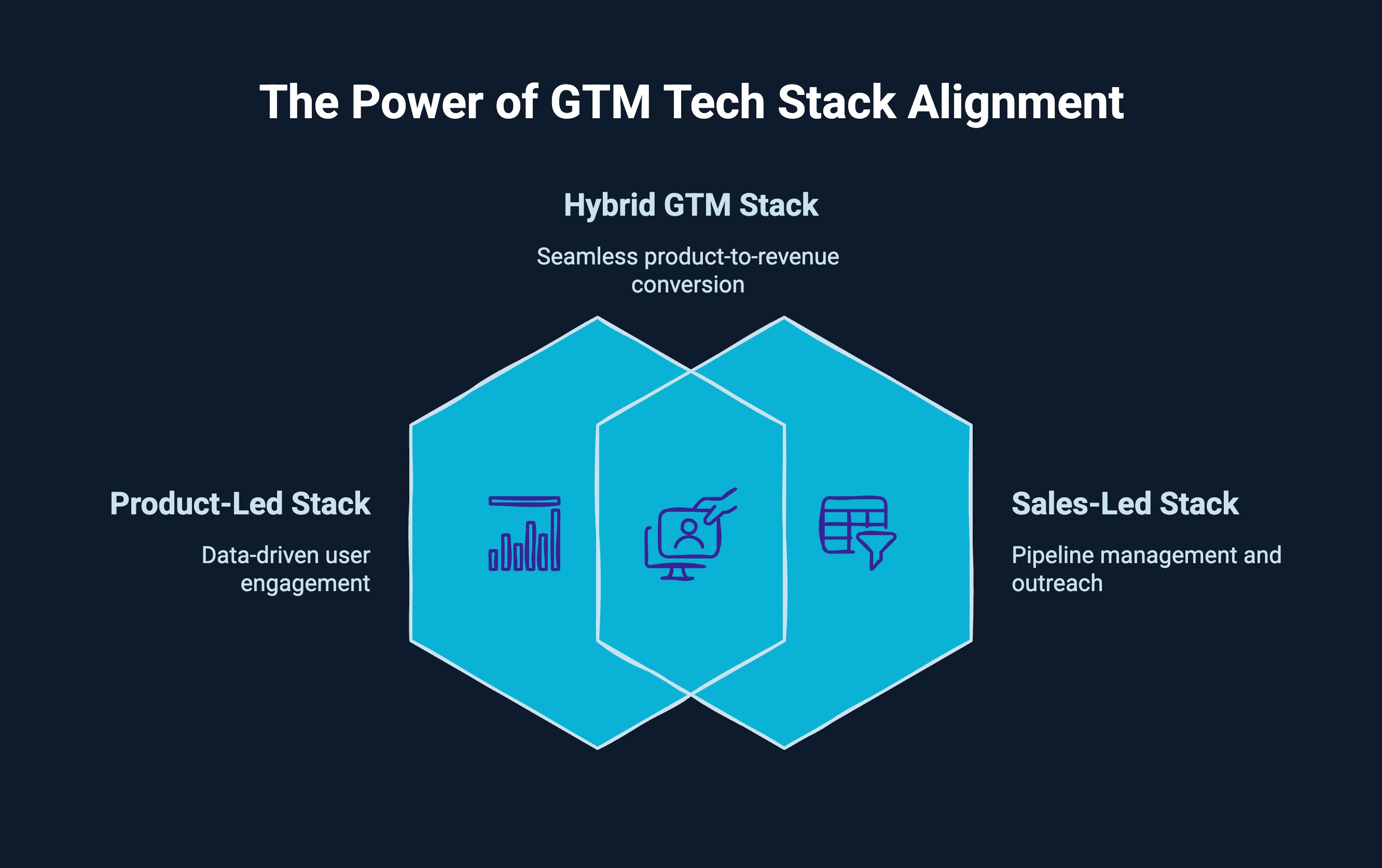
Your GTM tech stack should reflect how you generate revenue. A product-led company prioritizes usage data and in-app engagement, while a sales-led organization centers its stack around pipeline management and direct outreach. The structure, data flow, and automation priorities differ significantly.
In a product-led motion, the product becomes the primary acquisition and expansion channel. The stack typically emphasizes:
The goal is to convert free or trial users into paying customers through data-driven engagement.
Sales-led models focus on relationship building and structured pipeline management. Core priorities include:
Here, success depends on pipeline visibility, rep productivity, and deal velocity.
Hybrid models combine product signals with sales execution. This requires:
Hybrid stacks are more complex but offer stronger alignment between product adoption and revenue conversion.
Companies often shift from sales-led to hybrid or product-led as they mature or introduce self-serve options.
Transitioning requires evaluating whether your current systems can capture product behavior, automate engagement, and integrate usage insights into sales workflows.
The stack must evolve alongside the revenue strategy to support sustainable growth.
Want to understand how Revenue Operations differs from traditional Sales Operations and why it matters for scaling outbound? Check out our RevOps vs Sales Ops breakdown.
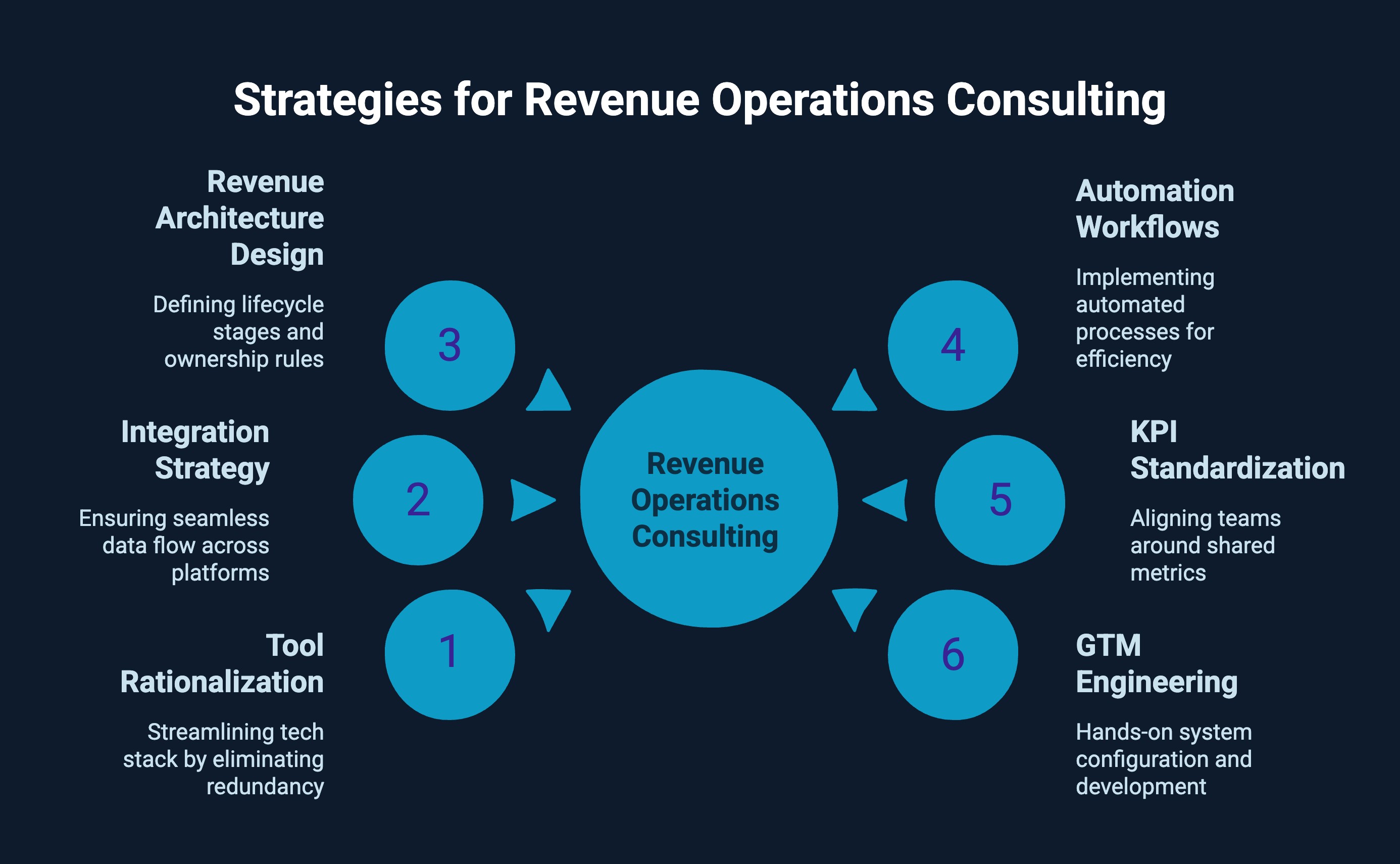
The best revenue operations consulting firms approach GTM tech stack optimization as a strategic transformation, not a software implementation project. Instead of recommending more tools, they focus on structure, alignment, and measurable revenue outcomes.
Top firms audit the entire go-to-market tech stack to eliminate redundancy and reduce tool sprawl. They identify overlapping features, underutilized licenses, and unnecessary subscriptions. The goal is to simplify the ecosystem while strengthening performance.
Rather than relying on fragmented connections, leading consultants design clean data flows across CRM, marketing automation, sales engagement, and analytics platforms. A strong integration strategy ensures accurate reporting, consistent lifecycle tracking, and reliable forecasting.
High-performing firms build a clear revenue architecture that defines lifecycle stages, lead definitions, attribution models, and ownership rules. This foundation ensures that every GTM tool supports a unified operating model.
Instead of manual handoffs, they implement structured automation for lead routing, scoring, product-triggered alerts, and customer lifecycle management. Automation improves speed, accuracy, and scalability across departments.
Finally, the best revenue operations consulting firms' GTM tech stack optimization experts align teams around shared metrics. They standardize pipeline definitions, conversion benchmarks, and revenue reporting so leadership can make decisions based on consistent, trustworthy data.
What truly differentiates firms like LeadGem is GTM engineering. Beyond strategy and recommendations, this involves hands-on system configuration, workflow logic design, automation builds, data governance frameworks, and reporting infrastructure development.
GTM engineering turns tools into a structured revenue engine by:
This operational layer ensures the GTM stack is not just integrated but fully executable. LeadGem focuses on transforming fragmented tools into a scalable RevOps system that drives predictable outbound performance and long-term revenue growth.
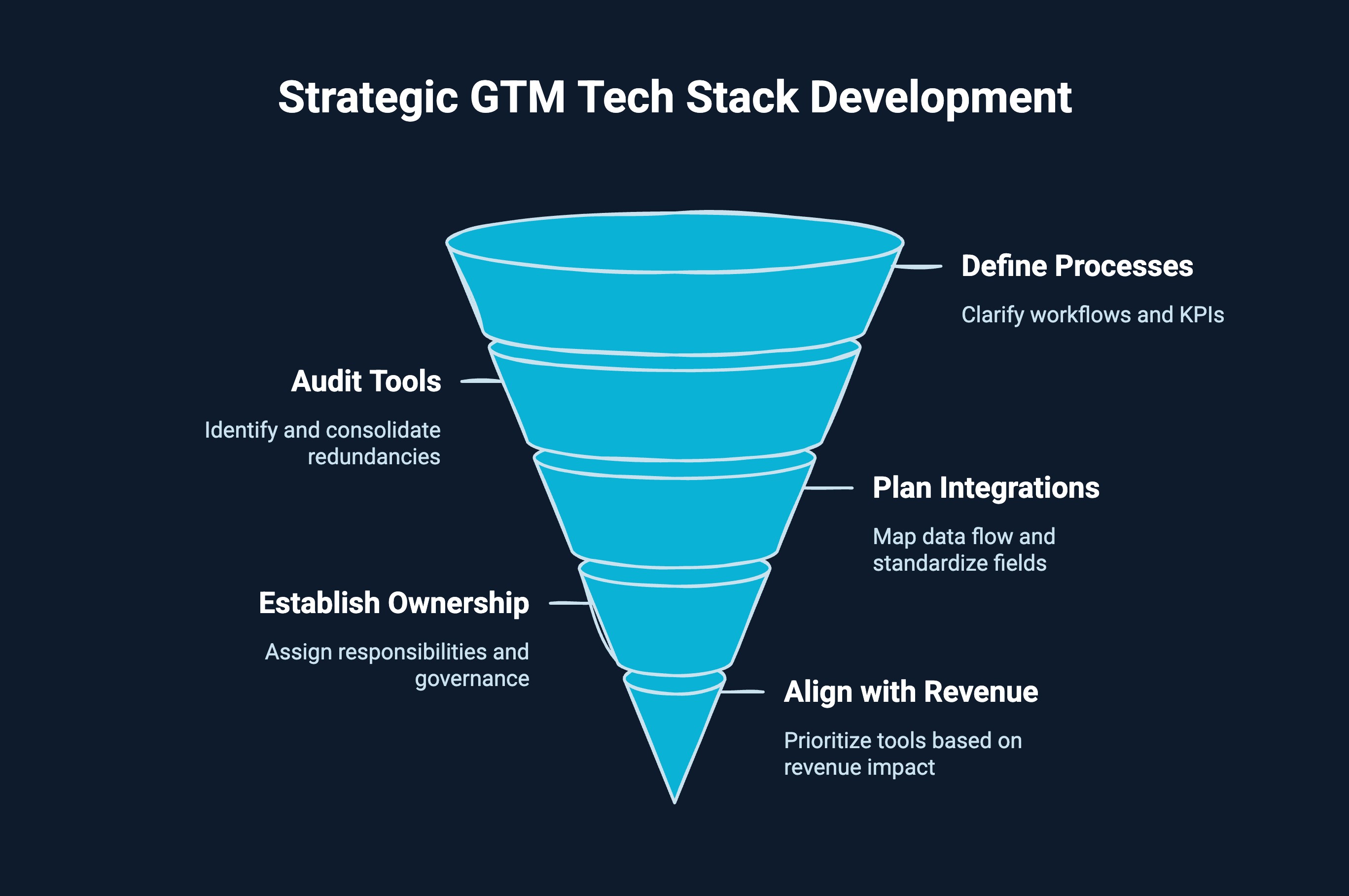
Even strong revenue teams struggle when their GTM tech stack is built reactively instead of strategically. Below are the most common mistakes and how to correct them.
Many companies invest in new platforms, hoping technology will fix performance gaps. Without clearly defined workflows, lifecycle stages, lead definitions, and ownership rules, adoption suffers, and data becomes inconsistent.
Start by documenting your revenue process. Clarify handoffs between marketing, sales, and customer success. Define KPIs and reporting requirements first, then configure tools to support that structure.
Tool sprawl often results from purchasing multiple platforms that solve similar problems, such as sequencing, enrichment, or analytics. This increases costs and creates conflicting metrics across teams.
Conduct a stack audit to identify redundancy. Consolidate overlapping tools and centralize critical functions within your core systems. A streamlined stack is easier to manage and delivers clearer reporting.
Disconnected platforms lead to manual data entry, broken attribution, and unreliable forecasting. When integration is treated as an afterthought, data quality suffers.
Design your integration architecture intentionally. Map how information should flow between CRM, marketing automation, sales engagement, product analytics, and reporting systems. Standardize key fields to maintain consistency.
Without a dedicated RevOps owner or governance framework, systems evolve without control. Fields multiply, lifecycle stages drift, and reporting standards vary across departments.
Establish clear ownership of the go-to-market tech stack. Implement naming conventions, permission controls, and routine data audits to maintain long-term system health.
Choosing tools based on feature lists instead of revenue impact often creates unnecessary complexity. Advanced capabilities mean little if they do not improve pipeline visibility or conversion efficiency.
Evaluate platforms based on strategic fit. Focus on how each tool strengthens forecasting, automation, reporting accuracy, and cross-team alignment.
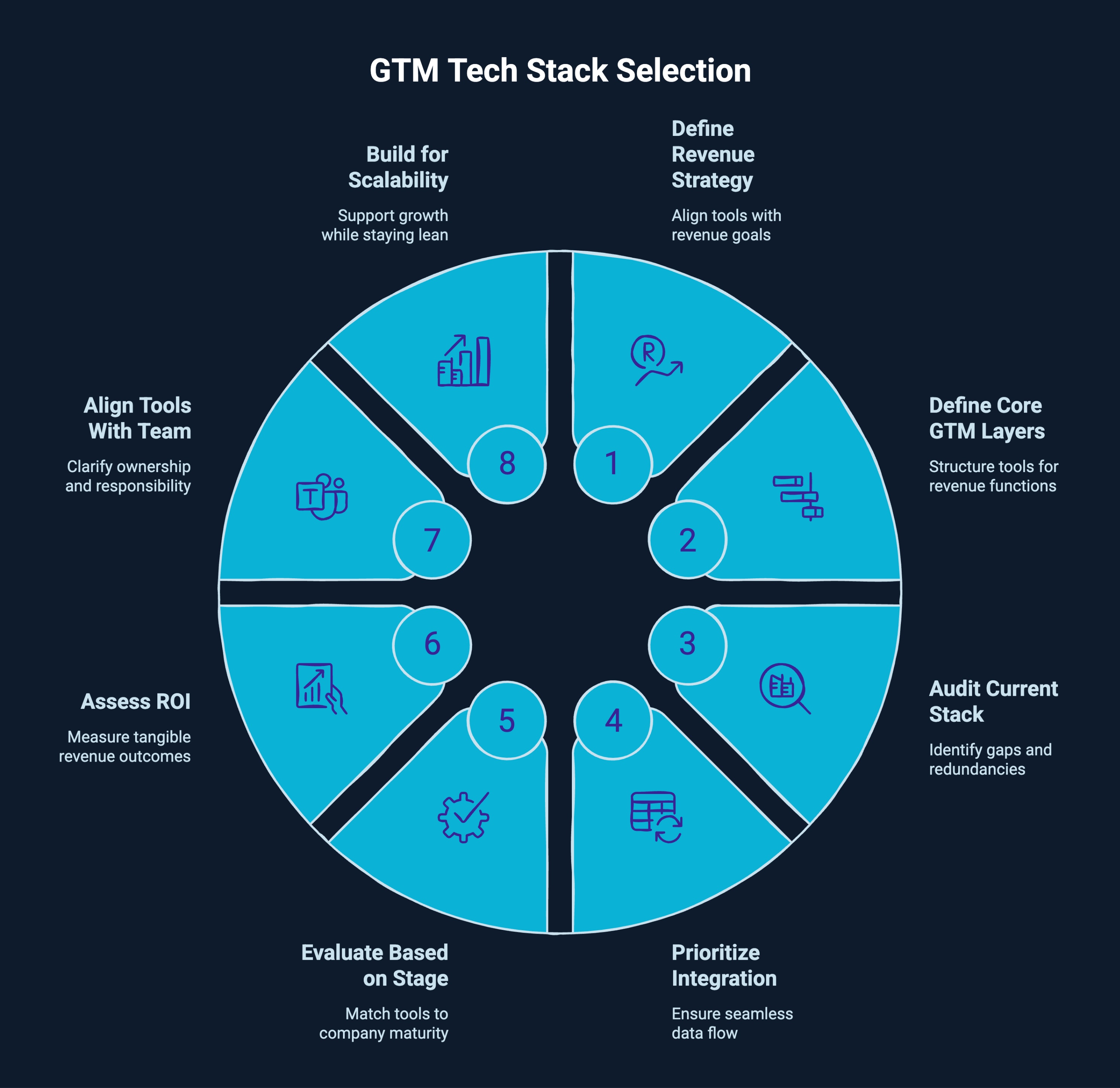
Choosing the right Go-To-Market (GTM) tech stack isn’t about chasing the latest tools; it’s about building a system that supports predictable revenue growth, clean data, and efficient execution.
Here’s a practical framework to help you select the right GTM tools:
Your GTM stack should reflect how you sell, not the other way around. Whether you operate a PLG, sales-led, or hybrid motion, your tools must support your acquisition channels, deal complexity, and sales cycle length. Define your revenue goals and bottlenecks first, then select tools that solve those specific challenges.
Every effective GTM stack is structured in layers. A CRM like HubSpot or Salesforce acts as the system of record. Marketing automation manages lead nurturing. Sales engagement tools such as Outreach or Salesloft accelerate pipeline activity. Data enrichment platforms like ZoomInfo or Clearbit improve targeting. Reporting tools support forecasting and analytics. Each layer should serve a clear revenue function without overlap.
Before investing in new tools, evaluate what you already use. Many companies suffer from tool sprawl and pay for multiple platforms with similar features. Identify gaps, redundancies, data silos, and underused licenses. Optimizing existing systems often delivers better ROI than adding more software.
GTM success depends on clean, connected data. When tools do not sync properly, reporting becomes unreliable and decision-making slows down. Evaluate integration capabilities, API flexibility, two-way sync options, and CRM compatibility. Your CRM should remain the single source of truth, with all other tools feeding into or pulling from it seamlessly.
Your stack should match your company’s maturity. Early-stage teams need simplicity and speed. Growth-stage companies require specialized tools to scale outreach and forecasting. Enterprise teams focus on efficiency, automation, and advanced analytics. Avoid building complex infrastructure before it becomes necessary.
Feature lists can be misleading. Instead, evaluate measurable impact. Consider whether the tool will reduce customer acquisition cost, improve conversion rates, shorten sales cycles, or save team hours. The right GTM tool should produce tangible revenue outcomes.
Technology only works when someone owns it. Clarify who will implement, manage, and optimize each platform. Without clear operational ownership, whether internal RevOps or an external partner, even strong tools fail to deliver value.
Your GTM stack should support automation, visibility, and future growth while remaining efficient. Add tools only when there is a proven bottleneck and clear ROI. A lean, integrated stack consistently performs better than a bloated one.
If your GTM tech stack feels complex, disconnected, or underperforming, the issue is rarely the tools themselves. It is usually a lack of clear revenue architecture, integration strategy, and operational ownership.
That is exactly where we come in.
LeadGem is a B2B growth and revenue operations agency headquartered in Amsterdam, the Netherlands. With 5+ years of experience in B2B growth marketing and growth hacking, we design and implement advanced RevOps and outbound systems that drive a predictable pipeline and revenue.
As a Clay-certified partner, we focus on:
We go beyond tool recommendations. LeadGem turns strategy into execution by engineering structured workflows inside your existing systems.
This includes:
Instead of adding more software, we connect and configure what you already use into a cohesive RevOps framework.
We work with companies across Benelux, the Nordics, America, and Australia, transforming fragmented go-to-market tech stacks into scalable, operational revenue engines that support outbound precision and predictable growth.
Ready to optimize your GTM tech stack? Contact us today!
Your GTM tech stack is more than software. It is the system that determines how efficiently you generate, convert, and retain revenue.
When tools are aligned, integrated, and governed properly, growth becomes predictable. When they are fragmented, complexity increases and performance slows.
The companies that scale successfully treat their go-to-market tech stack as a strategic asset. Simplify where needed, integrate intentionally, and design your stack to support the revenue model you want to build.
The 5 pillars of a GTM strategy are target positioning, marketing strategies, sales processes, customer success platforms, and performance measurement. These core components align marketing teams and sales reps around business goals, customer interactions, and measurable business outcomes.
There is no single best tool. Effective GTM teams combine CRM systems, marketing automation tools, and sales engagement tools within an integrated technology stack that ensures data hygiene, eliminates data silos, and delivers actionable insights.
Most companies use a CRM, marketing automation tools, sales enablement tools, customer data platforms, and predictive analytics within a modern data stack. This connected set of tools improves lead generation, supports the sales funnel, and creates a competitive advantage.
Start by defining your GTM strategy and business goals, map the sales funnel, centralize customer data in CRM systems, integrate marketing automation tools and sales engagement tools, enforce data hygiene, and align the GTM team around actionable insights and measurable business outcomes.
Common GTM motions include product-led growth, sales-led, marketing-led, channel-led, partner-led, account-based, and community-led. Each motion requires different sales processes, marketing efforts, and technology stack configurations to engage potential customers effectively.
GTM tools are a set of tools supporting lead generation, sales enablement, marketing strategies, and customer success. They include CRM systems, marketing automation tools, sales engagement tools, customer data platforms, and predictive analytics platforms within a unified technology stack.
A B2B marketing consultant defines GTM strategy, optimizes marketing efforts, supports lead generation, aligns sales processes, selects appropriate GTM tools, improves customer lifetime value, and ensures implementation of best practices that drive measurable business outcomes and competitive advantage.