

Contact


Outbound struggles because buyers conduct extensive research before engaging with vendors. Infact research shows that B2B buyers complete nearly 70% of their buying journey before contacting a seller.
The issue is not email volume but relevance and timing. Generic prospect lists, incomplete data, and weak segmentation make outbound inefficient and difficult to scale. Teams end up sending more messages while generating fewer meaningful conversations.
This guide explains how to use Clay for outbound marketing to solve that challenge. You will learn how Clay supports enrichment, precise segmentation, and automation so your outbound campaigns generate a qualified pipeline instead of noise.
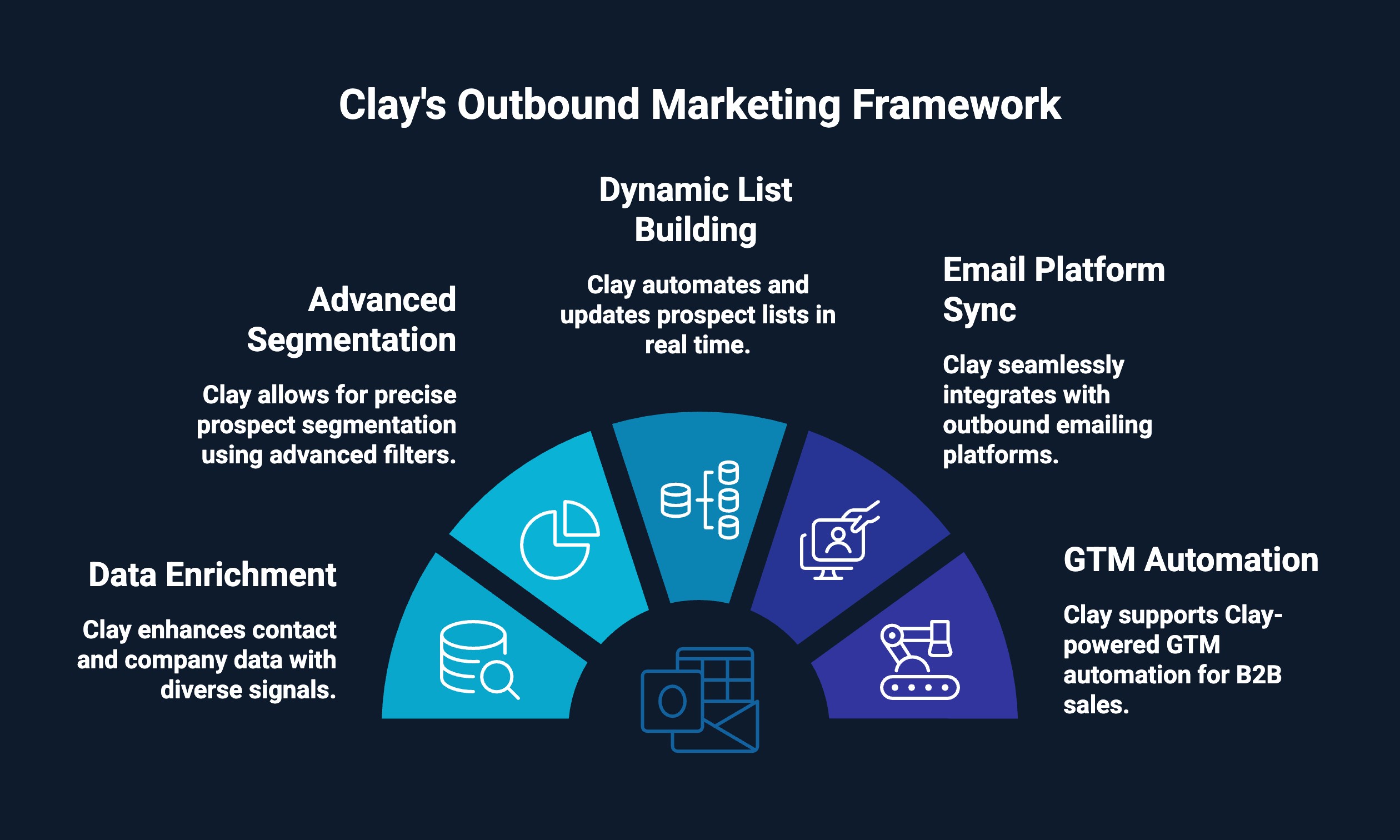
Clay is a GTM automation platform designed to power smarter outbound campaigns through data enrichment and workflow automation.
Instead of relying on static prospect lists, Clay for outbound marketing helps teams build dynamic, data-backed audiences that update in real time.
It pulls information from multiple data sources, enriches contacts and accounts, and allows teams to create segmented lists based on highly specific criteria.
Here is how Clay works in outbound marketing:
As a Clay outbound tool, it acts as the intelligence engine behind outbound campaigns, ensuring every email is informed by context and data rather than guesswork.

Strong outbound starts with strong data. Without accurate contact details, company context, and buying signals, personalization stays surface-level and inconsistent. Clay for outbound marketing improves this by turning enrichment into an automated, multi-layered process instead of a manual research task.
Here’s how Clay strengthens enrichment for outbound sales:
Clay pulls information from multiple premium data providers into a single workflow. Instead of relying on one database, teams can combine firmographic, contact, and company intelligence in one place. This increases accuracy and reduces blind spots in prospect lists.
Beyond basic filters like industry or company size, Clay allows teams to layer deeper insights such as revenue estimates, employee growth trends, and technology stack data. This makes segmentation sharper and supports more relevant positioning in outreach.
Clay can surface meaningful signals such as recent funding, leadership changes, hiring patterns, or product launches. These insights allow Clay for outbound sales campaigns to be timely and context-driven rather than generic.
Manual exports often come with inconsistencies and missing fields. Clay standardizes records, fills gaps, and structures data automatically, reducing the need for spreadsheet cleanup and improving campaign reliability.
Data decays quickly in B2B databases. Clay keeps prospect lists dynamic by refreshing and updating records within workflows, ensuring that outbound campaigns are built on current and usable information.
With enrichment handled systematically, outbound teams can focus less on research and more on strategy, personalization, and conversion.
Curious how better data fuels better outreach? Explore how Clay data enrichment powers smarter B2B growth.

Segmentation defines whether outbound feels targeted or generic.
Most teams segment by industry or company size. That creates broad lists and average messaging. Advanced segmentation focuses on shared business context, not surface attributes.
Instead of grouping companies loosely, you define segments around:
Clay enables teams to layer these signals together to form tightly defined audience clusters. The result is sharper positioning, stronger relevance, and more contextual conversations.
When segmentation is precise, outbound stops being volume-driven and becomes intent-aligned.
Scaling outbound soon? Learn how Clay lead generation builds a predictable stream of qualified B2B leads.
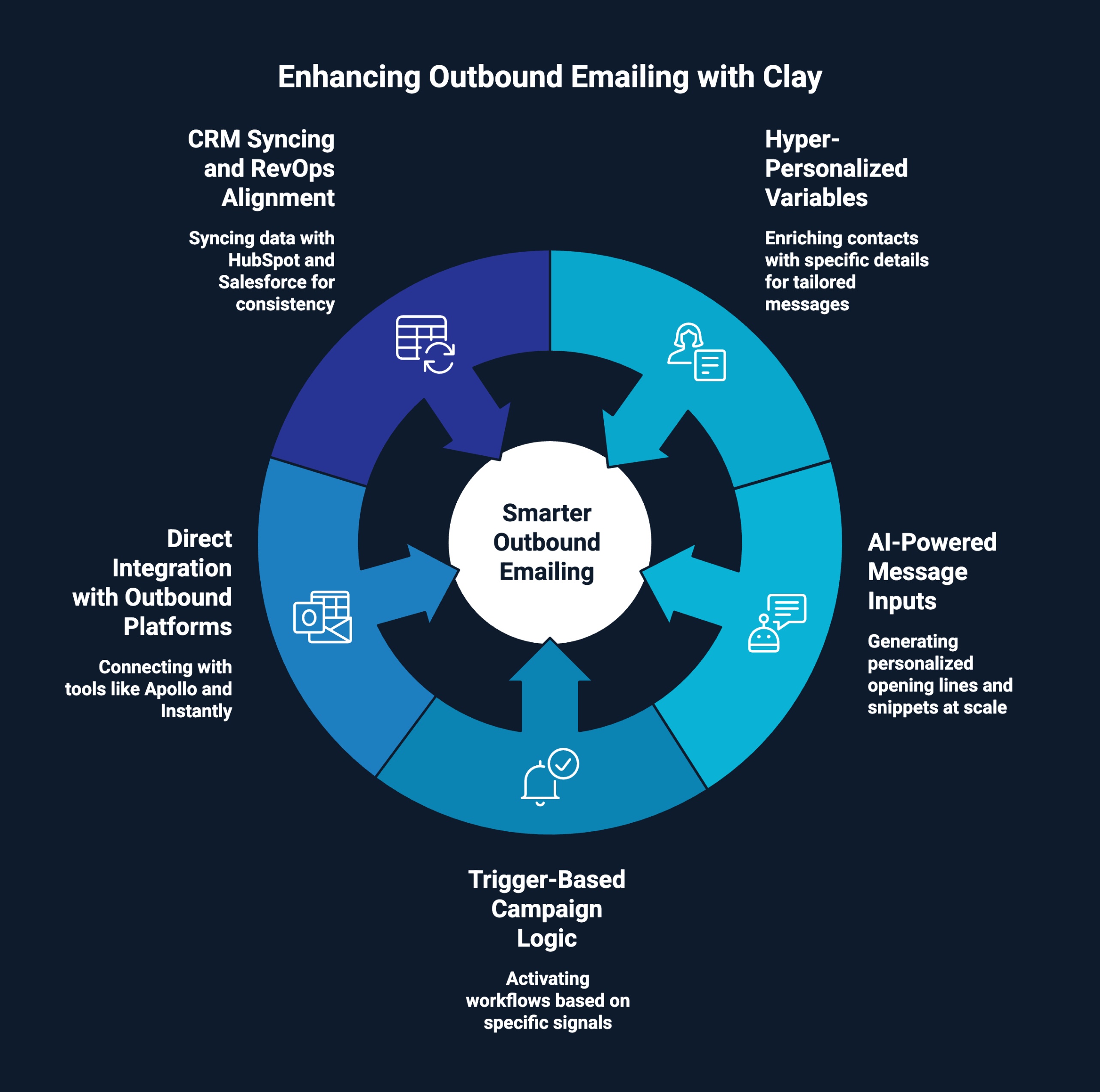
Outbound emailing only works when personalization and execution are tightly connected. Many teams enrich data in one tool, build sequences in another, and manage reporting somewhere else. This disconnect creates errors, delays, and inconsistent messaging.
Clay GTM automation software outbound emailing solves this by acting as the intelligence layer that feeds accurate, enriched data directly into your outbound tools and CRM.
Here is how Clay strengthens outbound emailing and integrations:
By combining enrichment, automation, and seamless integration, Clay ensures outbound emailing is not just personalized but operationally efficient and fully aligned with your GTM infrastructure.
Ready to streamline workflows? Learn how Clay-HubSpot integration enhances lead routing and sales follow-up.
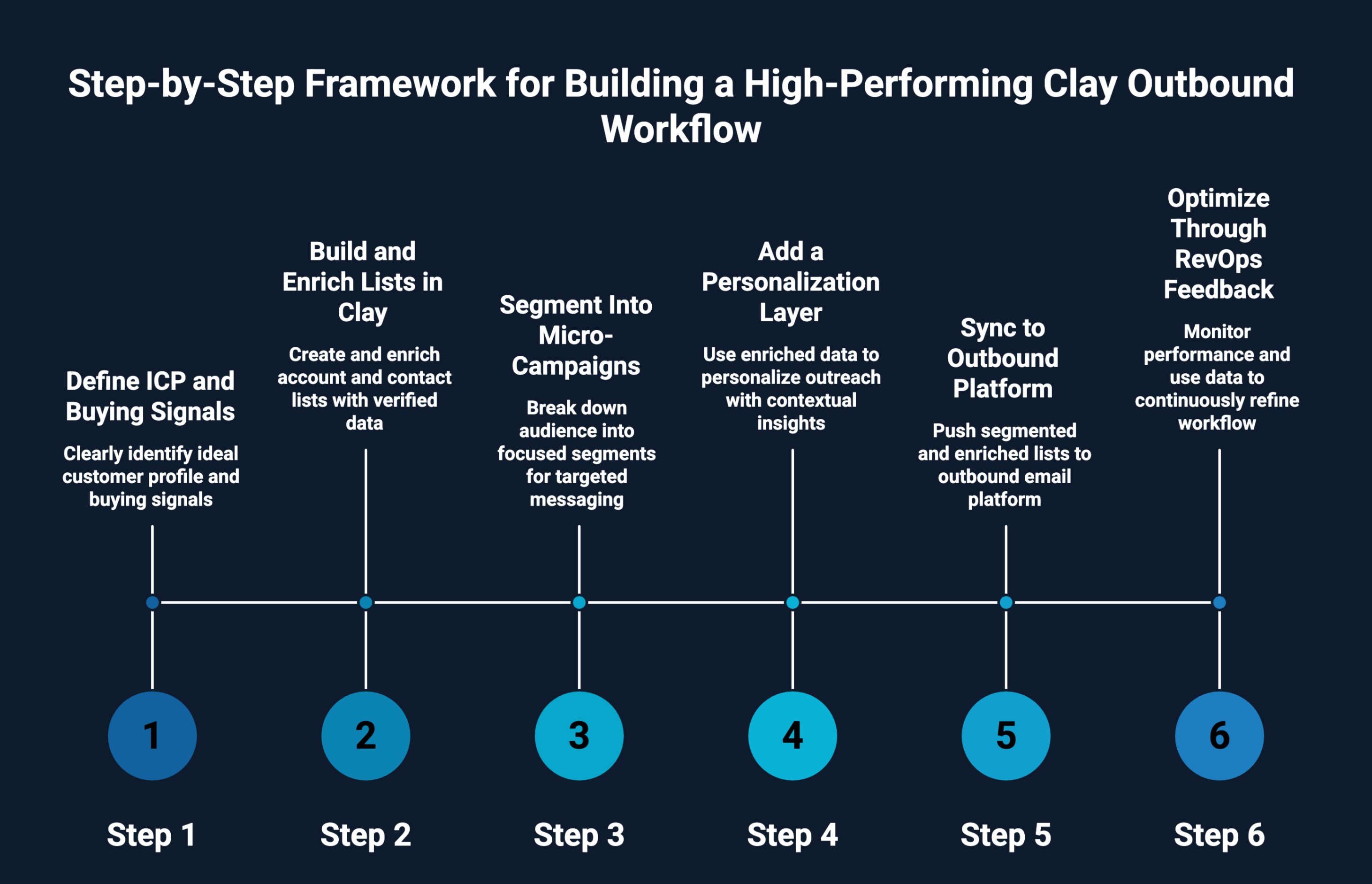
A strong Clay outbound workflow follows a structured sequence. Each step builds on the previous one, turning enrichment and automation into predictable pipeline generation.
Clay strengthens the outbound strategy by:
Everything starts with clarity. Define your ideal customer profile using firmographics such as revenue, employee size, geography, and industry. Then identify buying signals that indicate timing, such as funding rounds, rapid hiring, leadership changes, or adoption of specific technologies. These filters ensure you are targeting accounts that both fit and show intent.
Once criteria are defined, build your account and contact lists inside Clay. Apply multi-source enrichment to append verified emails, direct dials, company insights, technographic data, and contextual signals. Clean and standardize records so every contact entering outreach is accurate and complete.
Avoid sending one broad message to your entire list. Break your enriched audience into focused segments based on persona, vertical, company stage, or trigger event. Micro-segmentation allows you to craft messaging that speaks directly to a specific problem or opportunity.
Use enriched data to create meaningful personalization. Reference relevant hiring trends, funding news, technology usage, or industry challenges. Personalization should feel contextual and insight-driven rather than relying on basic first-name variables.
Push segmented and enriched lists directly into your outbound email platform. Ensure dynamic fields are mapped correctly so personalization variables populate automatically. Sync data back to your CRM to maintain visibility across sales and marketing teams.
Monitor performance metrics such as reply rates, meeting bookings, and pipeline contribution. Use this data to refine ICP filters, adjust signal triggers, and improve segmentation logic. Continuous optimization turns Clay into a scalable, repeatable outbound system.
When executed correctly, this workflow transforms Clay from a list-building tool into a structured pipeline engine driven by intelligence and automation.
Not sure which Clay agency fits your goals? Compare leading Clay agency providers and find the right outbound growth partner.
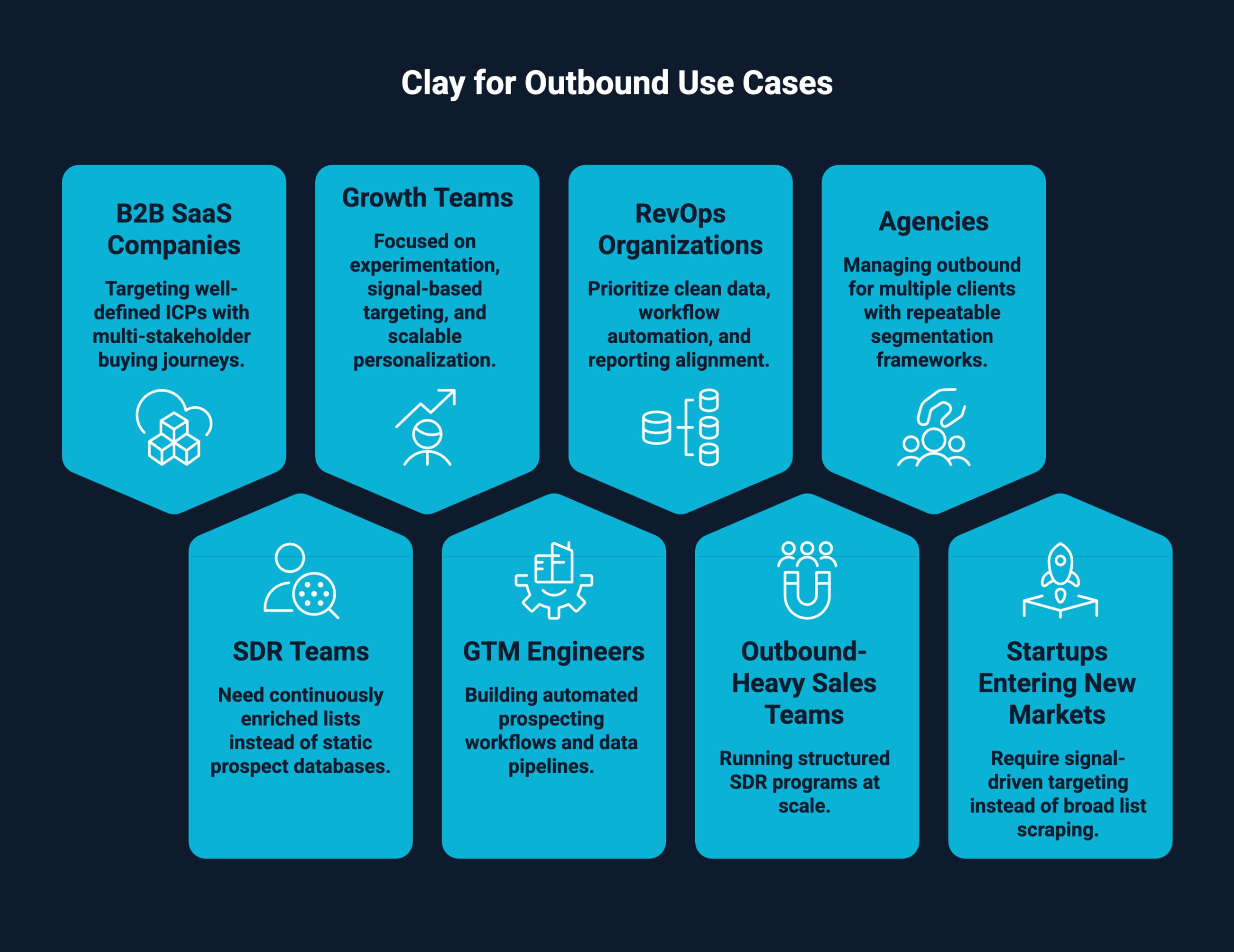
Clay is best suited for B2B teams that want to move beyond generic outreach and build a structured, data-driven outbound engine. If your growth depends on targeted account acquisition rather than inbound volume alone, Clay for outbound sales can significantly improve precision and scalability.
Clay is especially valuable for:
If your team struggles with low reply rates, messy data, or manual list building, Clay provides the enrichment and automation layer needed to turn outbound into a predictable growth channel.
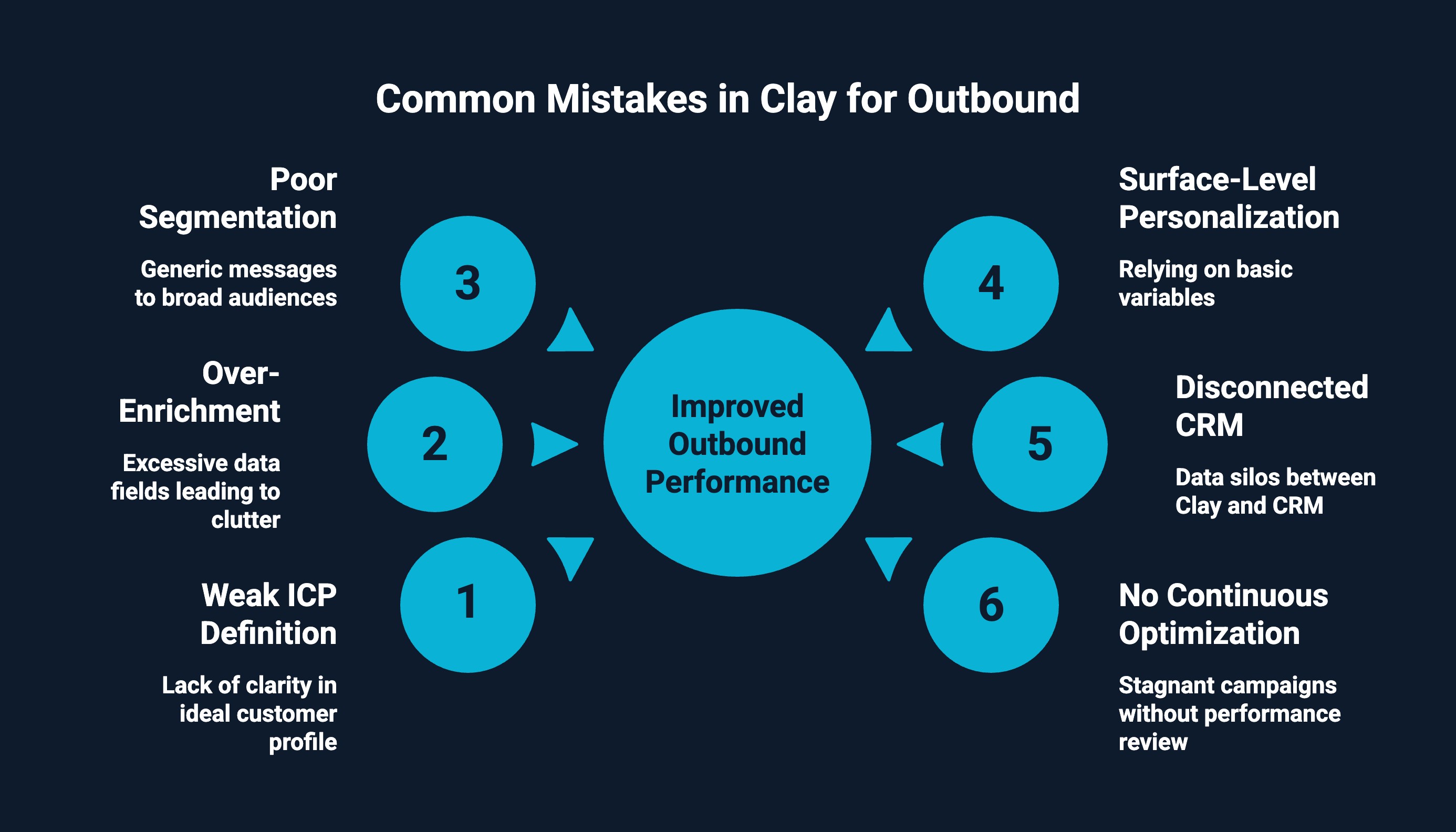
Clay can transform outbound performance, but results depend on structure and strategy. Many teams adopt Clay for outbound marketing without aligning ICP clarity, segmentation depth, and RevOps execution. Below are the most common pitfalls and how to correct them.
Jumping into enrichment without a clearly defined ideal customer profile leads to broad targeting and diluted messaging. When revenue bands, company size, growth stage, and buying triggers are unclear, segmentation becomes guesswork.
Start by tightly defining your ICP before building workflows. Use firmographic filters and signal-based criteria inside Clay to reinforce precision rather than compensate for unclear targeting.
Pulling in excessive data fields simply because they are available creates clutter and slows execution. More data does not automatically mean better targeting.
Enrich only for attributes that support segmentation, personalization, or qualification. Every field should directly improve targeting accuracy or message relevance.
Even with strong data, sending one broad message to an entire enriched list reduces performance. Generic campaigns limit the value of advanced filtering.
Break audiences into micro-segments based on persona, vertical, growth stage, or trigger event. Smaller, focused segments allow messaging to speak directly to specific business challenges.
Relying only on first-name variables or company names weakens outreach impact. Buyers expect context, not placeholders.
Use enriched insights such as funding activity, hiring patterns, or technology adoption to craft meaningful hooks. Personalization should reflect real business situations.
Running Clay workflows without syncing data back to the CRM limits reporting and attribution visibility. This disconnect prevents clear measurement of outbound impact.
Ensure enriched data flows into HubSpot or Salesforce so pipeline reporting, attribution, and sales follow-up remain aligned across teams.
Launching campaigns without reviewing performance data stalls improvement. Reply rates and meeting conversions should inform refinement.
Regularly analyze results and adjust ICP filters, signal triggers, and segmentation logic. Continuous iteration turns Clay into a scalable, predictable outbound engine rather than a one-time campaign tool.
Looking to supercharge sales operations? Discover a handpicked list of Clay sales tools that help teams grow faster.
At LeadGem, we are a B2B growth and Revenue Operations agency headquartered in Amsterdam, the Netherlands, with 5+ years of experience in B2B growth marketing and growth hacking. As a Clay-certified partner, we focus on designing the outbound architecture behind the tools, not just configuring workflows.
Our approach starts with strategy and system design before execution.
We help companies:
Clay provides the technical foundation. LeadGem builds the strategic framework that ensures it drives measurable revenue impact.
If you want Clay implemented with clear architecture, governance, and revenue accountability, we design and operate the full outbound system end to end.
Outbound is no longer a numbers game. It is a precision game. The teams that win are the ones who combine the right data, the right signals, and the right workflows into one coordinated system.
Clay for outbound marketing gives you that foundation. It transforms scattered prospecting efforts into a structured, intelligence-driven engine that targets better, personalizes smarter, and scales faster.
If your goal is a predictable pipeline instead of unpredictable campaigns, the opportunity is clear. Build outbound as a system, not a tactic.
Clay goes beyond basic lead lists and cold email tech by combining enrichment tools, intent data, and outbound automation into a single tech stack. It helps sales reps reach the right people with accurate data, reducing manual work and improving qualified opportunities.
Alternatives include LinkedIn Sales Navigator, Apollo, ZoomInfo, and other sales automation platforms. These tools support lead generation, contact data, and cold emailing, but often require multiple tools for enrichment, email verification, and buyer intent tracking.
Yes. Clay offers no-code workflows and clay templates that allow sales teams and individual SDRs to build enrichment, segmentation, and outbound automation without engineering support, reducing the learning curve and accelerating lead generation.
Yes, Clay is a legitimate B2B growth platform used by sales and marketing teams worldwide. It helps with lead sourcing, data enrichment, and outbound automation. Many growth teams rely on it to build targeted prospect lists and improve pipeline performance.
Yes, Clay functions as a sales tool focused on prospecting and outbound growth. It helps teams discover, enrich, and organize high-quality leads. While it is not a traditional CRM, it supports sales workflows and improves targeting accuracy.
Clay AI refers to Clay’s automation and intelligence features that collect, clean, and enrich prospect data. It uses integrations and AI workflows to enhance lead information, personalize outreach inputs, and reduce manual research for go-to-market teams.
Clay supports go-to-market teams by automating lead generation, enriching contact data, and connecting workflows with sales tools. It helps teams identify ideal customers, improve segmentation, and build targeted outbound campaigns that drive faster pipeline growth.
Clay is not designed to replace a CRM. It focuses on prospect discovery, enrichment, and workflow automation. However, it integrates with CRM platforms like HubSpot and Salesforce, allowing enriched leads and data to sync directly into existing systems.
Clay is not primarily an email sending platform. Instead, it prepares and enriches prospect data for outreach. Users typically connect Clay with email sequencing tools or sales engagement platforms to send campaigns and manage communication with leads.
Top Clay outbound experts include Clay-certified GTM engineers, RevOps-led agencies like LeadGem, and specialized B2B growth consultancies focused on signal-driven prospecting, segmentation architecture, workflow automation, and attribution modeling. The best partners combine strategy, data engineering, and revenue accountability.